
Warsh Confirmed as Fed Chair; Clarity Act Advances; THORChain Hit for $10M

0
0
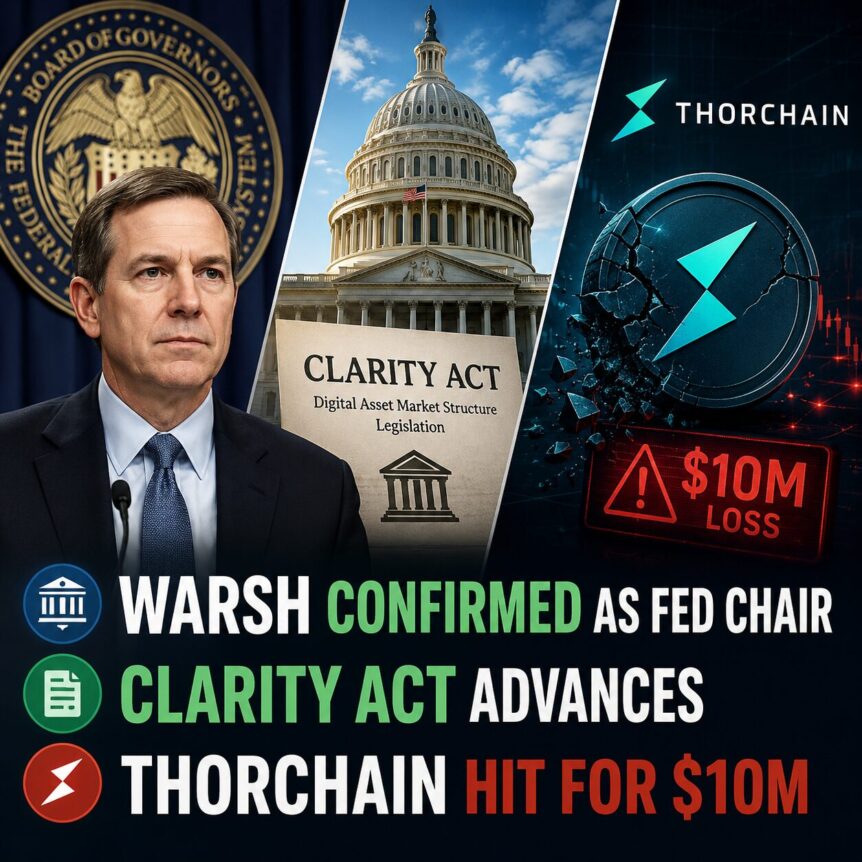
Warsh takes the helm as market and policy questions mount
Kevin Warsh was confirmed this week as the 11th chair of the Federal Reserve in a 54-45 Senate vote, ending a contentious transition and setting the stage for a potentially different policy posture at the central bank. The confirmation was unusually partisan, and comes after a delay that followed an inquiry into his predecessor. Jerome Powell will remain on the Board of Governors, marking the first time in roughly 75 years that a former chair has continued as a voting governor.
What it means for crypto: Warsh has previously described bitcoin as a form of digital gold for younger investors and has signaled skepticism toward central bank digital currencies while voicing support for private stablecoin frameworks. Those views offer a degree of structural validation for the industry. At the same time, several committee members have signaled that rate hikes remain on the table, and Warsh inherits an environment where cuts are not yet priced in by markets. Less accommodative monetary policy tends to compress liquidity across risk assets, and bitcoin, which has recently traded like a risk asset, may be vulnerable to those dynamics in the near term.
Markets will be watching Warsh’s first Federal Open Market Committee meeting, scheduled for June 16-17, for early clues about the new chair’s approach to inflation, employment, and market liquidity.
Senate committee advances Clarity Act, but path to passage remains uncertain
The Senate Banking Committee voted 15-9 to advance the Digital Asset Market Clarity Act, a comprehensive market-structure bill that would reshape how US authorities regulate crypto trading venues and stablecoins. The measure proposes several notable changes: it seeks a jurisdictional split between the Securities and Exchange Commission and the Commodity Futures Trading Commission, mandates 1:1 stablecoin backing in high-quality, short-duration Treasury instruments, and creates a registration pathway for digital commodity exchanges.
Legislative hurdles: The bill still must be reconciled with a parallel text in the Senate Agriculture Committee, and significant points of contention remain—most prominently an ethics provision that would restrict public officials from profiting from crypto holdings. The White House has signaled it favors broad ethics rules but objects to provisions that single out the president. Final passage would also require overcoming the Senate’s 60-vote threshold, meaning bipartisan support will be essential.
If enacted, the Clarity Act would reduce regulatory uncertainty around market infrastructure and stablecoins, potentially easing compliance pathways for exchanges and issuers. However, the bill faces opposition from institutions worried about stablecoin yield provisions and from law enforcement and labor groups concerned about illicit finance and financial stability risks. Those debates will shape the bill’s final form.
THORChain suspends operations after suspected $10M exploit
THORChain halted trading on Friday after detecting a suspected exploit that the protocol estimates at about $10 million, affecting assets across Bitcoin, Ethereum, BNB Smart Chain and Base. Two addresses linked to the theft were identified and the native token RUNE declined roughly 15% on the news.
This is the latest incident in a history of security and solvency challenges for the cross-chain protocol: THORChain suspended its ThorFi lending operations earlier this year amid significant defaulted obligations, and last fall the protocol’s founder reported funds drained from a personal wallet. On-chain analysis cited by the protocol indicates unusually high weekly volume—approximately $394 million in daily throughput—driven in part by activity tied to laundering from a prior breach.
Broader implications: Cross-chain bridges and swap mechanisms remain prime attack surfaces in decentralized finance. The very mechanisms that enable seamless asset flows between chains also expand the avenues for exploitation and money movement following thefts. THORChain’s recurring incidents highlight the trade-offs between permissionless interoperability and operational resilience, and they are likely to attract heightened scrutiny from users, counterparties and regulators until technical details are disclosed and remediation steps are completed.
AI-assisted research cracks Apple M5 protections, underscoring rising software risk
Security researchers at startup Calif reported using a preview of Anthropic’s Claude Mythos to accelerate development of a kernel exploit that bypassed Apple’s Memory Integrity Enforcement on M5 silicon, escalating from an unprivileged user to root on macOS 26 in under a week. The team delivered a 55-page technical report to Apple in person. According to the researchers, Mythos identified candidate kernel vulnerabilities quickly, while human engineers designed the bypass and exploit chain.
Project Glasswing, Anthropic’s program for enterprise partners, has placed Mythos with select organizations including Apple, major cloud providers and security firms. In controlled testing cited by Anthropic, Mythos identified hundreds of vulnerabilities in large software targets and completed simulated multi-stage cyberattacks.
Why crypto stakeholders should care: The incident illustrates how advanced generative AI tools can compress vulnerability discovery timelines. For crypto, that raises pressure on software wallet providers, custodial services and smart-contract audit practices. While hardware-level protections and transaction-signing isolation can limit exposure, the security community increasingly argues that defenses will need to shift toward hardware-backed and multi-layered approaches if AI continues to accelerate exploit development.
Takeaway: This week combined major policy developments with fresh reminders of operational risk. Warsh’s confirmation and the Clarity Act’s committee progress could reduce regulatory uncertainty over time, but monetary policy and the bill’s final form will materially affect market liquidity and institutional participation. At the same time, repeated DeFi exploits and the advent of AI-accelerated vulnerability research increase the imperative for robust security standards and for market infrastructure that can withstand faster, more automated threat actors. Investors and infrastructure providers should monitor the June FOMC meeting, the Senate’s legislative calendar, and ongoing technical disclosures from THORChain and the security research community for signals on risk and resilience.
This article was originally published as Warsh Confirmed as Fed Chair; Clarity Act Advances; THORChain Hit for $10M on Crypto Breaking News – your trusted source for crypto news, Bitcoin news, and blockchain updates.
0
0

 Administra todas tus criptomonedas, NFT y DeFi desde un solo lugar
Para comenzar, conecta de forma segura el portafolio que estés utilizando.


0
0