
Dash Weighs Philippines Expansion for Crypto Payments as Rules Ease

0
0
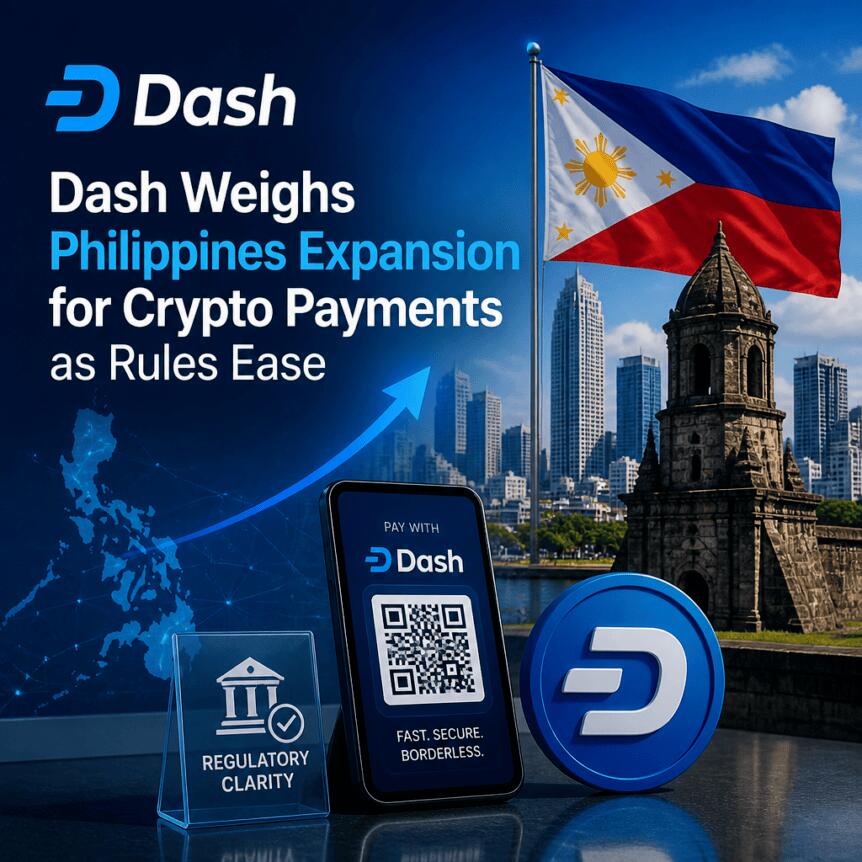
Dash is evaluating the Philippines as a potential market for crypto payments, with the project pointing to persistent pressure on consumers to use lower-cost transaction options. During Philippine Blockchain Week 2026, Dash Blockchain’s global adoption lead, Daria Chernozub, said the team is focused on regions where high fees and friction can make everyday payments difficult and where users may be more willing to adopt new digital tools.
Chernozub told Cointelegraph that Dash’s approach is geared toward “people who are suffering from high commissions” and need payment solutions that are simple to use. She also said Dash is conducting an assessment of local demand and market readiness, while prioritizing legal compliance before any launch.
Key takeaways
- Dash is exploring the Philippines for crypto payments, emphasizing lower transaction costs and easier user experience in markets with high fees.
- Dash says it is still assessing the local market and is prioritizing regulatory compliance, including preparation of a legal opinion letter for discussions with relevant bodies.
- The Philippine SEC says foreign companies can register a corporation online in about 20–30 minutes, but operating a crypto business may still require additional approvals.
- Industry participants argue that crypto-specific regulation is considerably more demanding than standard corporate registration, citing multi-year compliance work for exchange partnerships.
Dash’s Philippines push: payments built for fee-sensitive users
Dash’s stated rationale for looking at the Philippines centers on everyday payment costs and usability. In an interview at Philippine Blockchain Week 2026, Chernozub framed the project’s target demographic as users facing expensive commissions and looking for a straightforward alternative. She said the Philippines is a fit because consumers are generally open to learning about new technologies.
Even with that fit, Chernozub emphasized that Dash is not yet in a launch phase. She said the team is working through its market assessment and is placing compliance at the top of its priorities. According to her remarks, Dash has started engaging with major market participants and prepared a legal opinion letter intended to support talks with regulatory and financial industry stakeholders.
Why the compliance gap matters: registration can be fast, crypto operations may not be
A major point raised at the same event was the difference between setting up a corporate presence and meeting crypto-related regulatory obligations. Philippine Securities and Exchange Commission (SEC) Commissioner Rogelio Quevedo told Cointelegraph that foreign investors can register a corporation online from anywhere in the world in roughly 20 to 30 minutes. He described the SEC’s online registration process as part of a broader digitization and innovation push.
Quevedo’s comments suggest that the administrative step of forming a local entity has become much easier for foreign firms. However, the ability to register quickly does not automatically translate into permission to operate a crypto business. Crypto companies may still need additional licensing and must satisfy compliance requirements tied specifically to digital assets and payments.
This tension—between streamlined corporate setup and more complex crypto oversight—was echoed by other speakers at the event. Marie Antonette Quiogue, BlockShoals’ head of legal and CEO of Arden Consult, said the Philippines offers a regulated pathway for foreign crypto exchanges, but that path carries significant obligations. She pointed to the roughly two years BlockShoals spent developing its arrangement with Binance, underscoring how long compliance processes can take even when a framework exists.
Regulatory framework exists, but effort is still front-loaded
Quiogue’s account highlights a practical reality for investors and operators: the “ease” of registering a company is only the beginning of the work. According to her, while the SEC has created a framework for foreign crypto exchanges seeking entry into a regulated environment, meeting the requirements can demand substantial time and coordination.
For market participants, this matters because early compliance decisions can affect timelines, budgeting, and product scope. A project evaluating the Philippines—such as Dash—may need to plan not just for consumer-facing deployment, but also for legal assessments, documentation, and stakeholder engagement well before any rollout of payment services.
In that context, Chernozub’s mention of preparing a legal opinion letter for discussions with regulatory and financial industry bodies signals a similar approach: aligning technical plans with compliance expectations early, rather than treating it as a late-stage hurdle.
Market attractiveness: demand signals and a tech-forward consumer base
Beyond regulations, speakers also pointed to structural factors that could make the Philippines appealing for crypto-related services. Quiogue said the country’s young population, high mobile usage, and widespread English proficiency could help attract overseas crypto firms. Chernozub, meanwhile, connected Dash’s interest to the behavior of local consumers—especially their openness to learning about new technologies—alongside the economic reality that fee-sensitive users often seek more cost-effective options.
Taken together, the discussions suggest that the Philippines may be attractive not because compliance is minimal, but because the demand for accessible financial tools and the ability to reach users via mobile platforms could support adoption—provided firms can successfully navigate the regulatory requirements for crypto activity.
For readers watching this story, the key question is what “compliance-first” assessment ultimately enables. Dash’s current status is exploratory, with legal positioning and market engagement underway. The next signals to monitor are whether Dash moves from evaluation into concrete regulatory discussions and whether it identifies a practical pathway for payment deployment within the local framework.
This article was originally published as Dash Weighs Philippines Expansion for Crypto Payments as Rules Ease on Crypto Breaking News – your trusted source for crypto news, Bitcoin news, and blockchain updates.
0
0

 Manage all your crypto, NFT and DeFi from one place
Securely connect the portfolio you’re using to start.

0
0

0
0

0
0

0
0