
Solana DeFi Outflow Widens as Kamino USDC Pools Hit 100% Utilization

0
0

Solana DeFi outflow is widening after the KelpDAO rsETH hack, with pressure now showing in major USDC lending markets on Kamino. Data from Kamino-linked pools points to fast capital movement, rising utilization, and tighter liquidity across parts of the Solana DeFi sector.
Kamino market data shows users have been pulling or repositioning funds at a rapid pace. That shift has pushed deposit APY and utilization rates higher across several USDC pools. In lending markets, this pattern often signals that liquidity is drying up.
The clearest sign has appeared in Kamino’s Prime Market USDC Reserve. The reserve holds about $178 million and has reached 100% utilization. That means no liquidity remains available in that pool for new borrowing.
Solana DeFi Outflow Spreads Across Kamino Vaults
Other Kamino-linked vaults are also showing pressure. The Staekhouse USDC Vault and the RockawayX RWA USDC vault both recorded utilization above 95%. When several pools move to those levels at once, it usually suggests the stress is broad.
The recent market reaction shows that the KelpDAO rsETH hack is no longer limited to EVM-based ecosystems. Its effects are now visible in Solana based lending conditions. That shift highlights how quickly risk sentiment can move across chains.
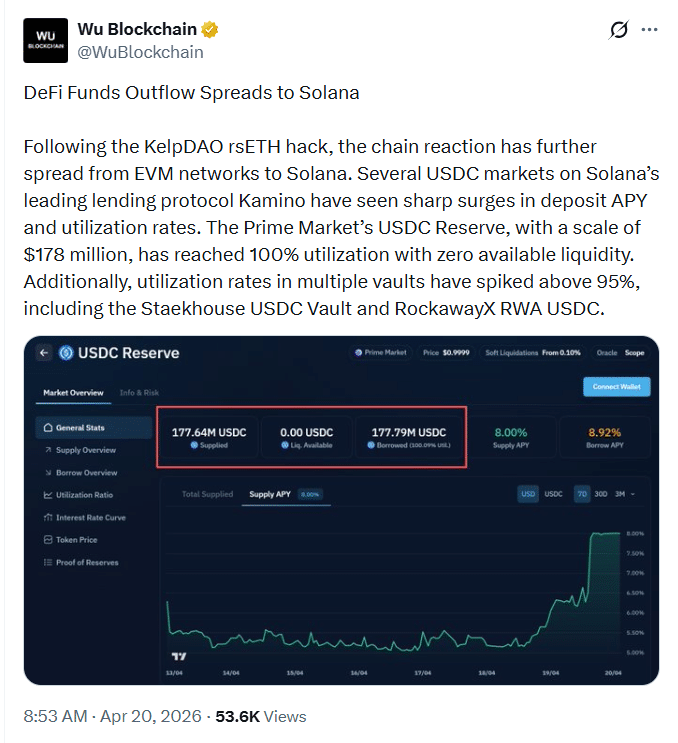
For Solana, this matters because it shows how connected Solana DeFi liquidity has become. Even when the original event happens elsewhere, users may still react by pulling funds or rotating capital. That behavior can tighten conditions on other networks in a short time.
Kamino Reserve Shows Direct Strain
Kamino’s Prime Market USDC Reserve is the strongest sign of current market tension. A pool at full utilization usually creates an uneasy setting for users. Lenders may be drawn to higher yields, but borrowers often face higher costs and limited access to funds.
This kind of imbalance can develop quickly when users begin to react to risk. Once liquidity falls, utilization rises faster. That can create a feedback loop that keeps pressure elevated.
APY Rise Reflects Lower Available Liquidity
Deposit APY has climbed sharply across several Kamino-linked USDC pools. In DeFi lending, that often happens when liquidity becomes scarce. Protocols tend to offer stronger yields to attract fresh deposits back into reserves.
For market participants, higher APY can look attractive on the surface. Still, it often reflects deeper strain. In this case, rising yields appear tied to a fast change in liquidity conditions rather than healthy growth.
Multiple Vaults Suggest Broader Pressure
The pressure is not isolated to one market. Staekhouse and RockawayX RWA USDC vaults have both moved above 95% utilization. That kind of clustering usually signals a wider liquidity squeeze.
When multiple vaults tighten at the same time, users often grow more cautious. They may delay borrowing, reduce leverage, or move stablecoins to safer settings. That defensive behavior can deepen the stress already visible in the market.
Cross-Chain Fear Reaches Solana
The spread of this reaction shows how fast fear can jump between ecosystems. What began as a security event tied to KelpDAO rsETH has now affected sentiment on Solana DeFi outflow. Capital in DeFi tends to move quickly when users start to worry about liquidity risk.
This shift also underlines the role of confidence in cross-chain markets. DeFi users do not always wait for direct exposure before acting. In many cases, they respond to broader risk signals first.
Prediction Markets Show Weak Conviction
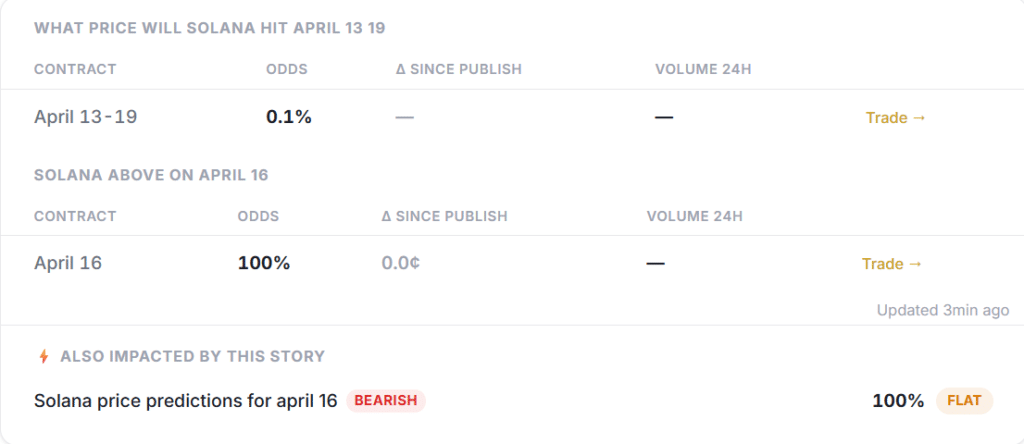
The pressure has also been linked to weak conviction in Solana DeFi related prediction markets. One market tracking Solana DeFi reaching $150 in April showed 0% YES, with no actual USDC volume traded. That lack of volume limits confidence in the signal.
Another market for April 13-19 showed 0.4% YES odds for Solana reaching $150. Yet no actual USDC trading was reported there either. Thin or absent volume makes those readings fragile.
Solana Pricing Signals Remain Fragile
For April 16, one market priced Solana above $100 at 100% YES. Still, the broader setting showed a liquidity crunch and no actual USDC volume in related prediction activity. That gap suggests that headline odds may not reflect strong conviction.
A YES share priced at 0.4 cents would pay $1 if Solana reached $150 by April 13-19. That implies deep skepticism around that outcome. It also shows how cautious the market remains under current liquidity conditions.
What Traders May Watch Next
Market participants are likely watching for any sign that liquidity could improve. Announcements from the Solana Foundation or major exchanges could shift sentiment. Any move that helps restore liquidity may affect both pricing and lending conditions.
High utilization levels mean even a small improvement could matter. If capital returns to major USDC pools, the market may stabilize. If not, caution may continue to dominate short-term behavior.
Conclusion
The latest data shows that the KelpDAO shock has moved beyond its original setting and is now shaping behavior inside Solana’s DeFi markets. Kamino’s 100% utilization in a major USDC reserve, along with pressure across other vaults, points to a market under strain.
For now, liquidity remains the key issue to watch. Rising APY, limited borrowing room, and weak conviction in related market signals all show the same pattern. Solana DeFi sector is facing a period of caution as users respond to cross-chain risk.
Appendix Glossary of Key Terms
KelpDAO rsETH hack: Security breach tied to the rsETH-related exploit.
Kamino: A Solana DeFi platform focused on lending and liquidity markets.
USDC reserve: A stablecoin pool used for lending, borrowing, and liquidity access.
Utilization rate: The share of pool funds that has already been borrowed.
Deposit APY: The annual yield earned by users who supply assets to a pool.
Liquidity pressure: Market stress caused by low available funds in a lending pool.
Cross-chain sentiment: Investor reaction spreading from one blockchain network to another.
Borrowing costs: The expense users pay to borrow assets from DeFi lending markets.
Frequently Asked Questions (FAQ)
1- What triggered the recent outflow?
The movement followed the KelpDAO rsETH hack, which caused risk-driven reactions across DeFi markets.
2- Why is full utilization important?
It shows that all available liquidity is in use, leaving no room for additional borrowing.
3- How does this affect users?
Borrowers face higher costs and limited access. Lenders may see higher returns with added risk.
4- Is the impact limited to one platform?
No, the effects are visible across multiple Kamino-linked pools and vaults.
References
Read More: Solana DeFi Outflow Widens as Kamino USDC Pools Hit 100% Utilization">Solana DeFi Outflow Widens as Kamino USDC Pools Hit 100% Utilization
0
0


 Manage all your crypto, NFT and DeFi from one place
Securely connect the portfolio you’re using to start.

0
0


0
0

0
0