
CATFI Solana Rug Pull Case Marks South Korea’s First DeFi Criminal Prosecution

0
0
This article was first published on The Bit Journal.
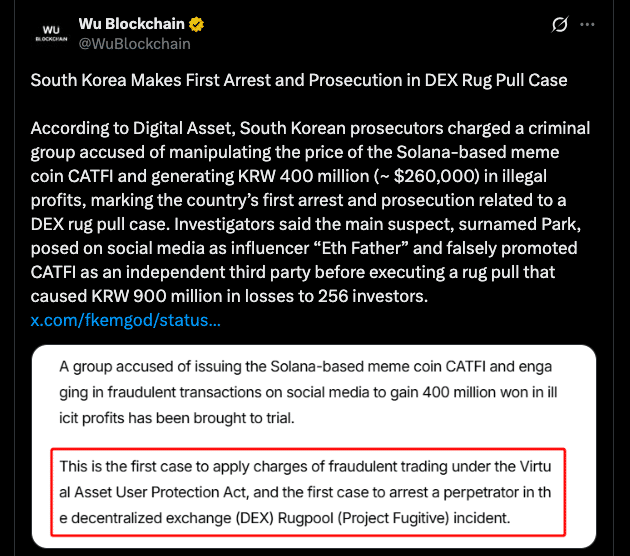
South Korea has opened its first criminal prosecution against a decentralized exchange rug pull. According to reports, prosecutors in Seoul have charged five suspects connected with the Solana-based meme coin CATFI with orchestrating a coordinated market rip-off that allegedly wiped out nearly 900 million Won from 256 investors, roughly $600,000.
This is the first time South Korea’s Virtual Asset User Protection Act has been applied to a decentralized finance operation. Until now, the law had mostly been used to target manipulation cases involving centralized exchanges.
Authorities believe the CATFI operators exploited the speed and anonymity of Solana meme coin launches for their own gain, taking out the liquidity and permanently abandoning their investors.
Prosecutors Say CATFI Was Engineered as a Solana Rug Pull
According to the Seoul Southern District Prosecutors’ Office, the main suspect behind the scam, who is only identified by the surname Park, was working online under the fake influencer identity “Eth Father.” Prosecutors allege that Park and four associates quietly accumulated massive insider positions before launching a campaign to promote the token publicly.
Investigators say the group used circular trading and coordinated wash trades to artificially inflate trading activity and momentum. Within just 26 hours, CATFI surged 1,001-fold, attracting thousands of retail traders into the project.
Once the investors were in and the trading was hot, the operators allegedly removed liquidity from the pool, causing the token to collapse almost instantly.
Prosecutors claim the group made off with around 400 million Won in ill-gotten gains, about $260,000, leaving their victims with worthless tokens.
Two suspects were arrested and indicted for market manipulation. One additional suspect was charged without detention, while two others were accused of helping Park evade authorities. Prosecutors said one accomplice allegedly spent nearly three months disguised while attempting to avoid arrest.
Why This Case Matters for DeFi Regulation
Decentralized exchanges have been operating in the regulatory grey area for a while now because they operate without centralized listing approval systems, issuer disclosures, or direct intermediaries.
But in this case, prosecutors have bypassed those challenges by focusing on the fraud and manipulation provisions inside the Virtual Asset User Protection Act instead of relying on exchange registration violations.
Authorities are effectively arguing that illegal conduct itself is enough for prosecution, even if the activity happens entirely on-chain.
The Seoul Southern District Prosecutors’ Office stated it would “resolutely deal with acts that disrupt the digital asset market and undermine public trust.”
Earlier this year, regulators introduced automated kill switches and five-minute reconciliation requirements for crypto platforms. Authorities have also proposed stronger stablecoin reserve rules and reopened discussions around spot Bitcoin ETFs.
Blockchain Forensics Helped Crack the Case
Investigators reportedly pieced together the CATFI Solana rug pull case using wallet clustering analysis, trading-pattern monitoring, and tracing how funds flowed out of KYC-regulated exchanges.
Authorities mapped out the activity inside wallets owned by insiders to identify concentrated token ownership and coordinated trading behavior.
They also tracked how funds eventually moved from pseudonymous wallets into regulated exchanges where identity verification requirements exposed potential links to suspects.
That became one of the biggest breakthroughs of the whole investigation.
Initially, online investigators flagged suspicious wallet activity and filed complaints, but the case was temporarily closed after the accused operators claimed the project had been hacked.
The investigation only restarted after South Korea’s Financial Services Commission re-referred the matter for deeper forensic analysis involving financial and tax authorities.
The renewed probe eventually allowed prosecutors to reconstruct the entire trading sequence behind the alleged Solana rug pull.

What the CATFI Rug Pull Case Means for Solana Meme Coins
Platforms like Pump.fun and other Solana-based launchpads have taken off because tokens get issued quickly and there’s hardly any oversight. But at the same time, that speed also creates grounds for con artists, fake influencer campaigns and scams designed to suck the liquidity out of these projects.
By successfully bringing the criminal charges tied to the Solana rug pull, South Korean prosecutors are making it known that anonymity and decentralized infrastructure no longer guarantee protection from enforcement.
For all the meme coin traders out there, the case is another reminder that any price spike that comes from social hype can very quickly turn out to be a liquidity trap.
Conclusion
The CATFI Solana rug pull case in South Korea has become one of those very clear signs that regulators are moving beyond centralized exchanges and coming into DeFi too.
This Solana rug pull case combines influencer manipulation, wash trading, forensic blockchain analysis and on-chain enforcement, all of which is likely to have a big impact on regulators globally.
As crypto oversight gets stronger, decentralized platforms might not be the safe haven they once were.
Glossary
DEX: a decentralized exchange where people can trade cryptocurrency without any central middleman.
Rug Pull: a type of crypto scam where the developers behind a project remove liquidity or abandon a project after attracting investor funds.
Wash Trading: artificial trading activity designed to inflate market volume or price movement.
Wallet Clustering: A blockchain analysis technique used to connect related wallet addresses.
Frequently Asked Questions About CATFI Solana Rug Pu Case
What is the CATFI Solana rug pull case?
The CATFI involves a Solana-based meme coin that was allegedly used to run a coordinated rug pull on unsuspecting investors.
How much did investors lose?
Apparently 256 investors lost almost 900 million won which is about $600,000.
Why is this case so important?
It is South Korea’s first criminal prosecution involving a decentralized exchange rug pull under the Virtual Asset User Protection Act.
How did they manage to catch the suspects?
They used forensic blockchain analysis, wallet clustering, trading patterns analysis, and KYC exchange data.
References
Read More: CATFI Solana Rug Pull Case Marks South Korea’s First DeFi Criminal Prosecution">CATFI Solana Rug Pull Case Marks South Korea’s First DeFi Criminal Prosecution
0
0

 Manage all your crypto, NFT and DeFi from one place
Securely connect the portfolio you’re using to start.


0
0

0
0

0
0