
Binance Pay Enables USDT Payments at PayPay Merchants in Japan

0
0
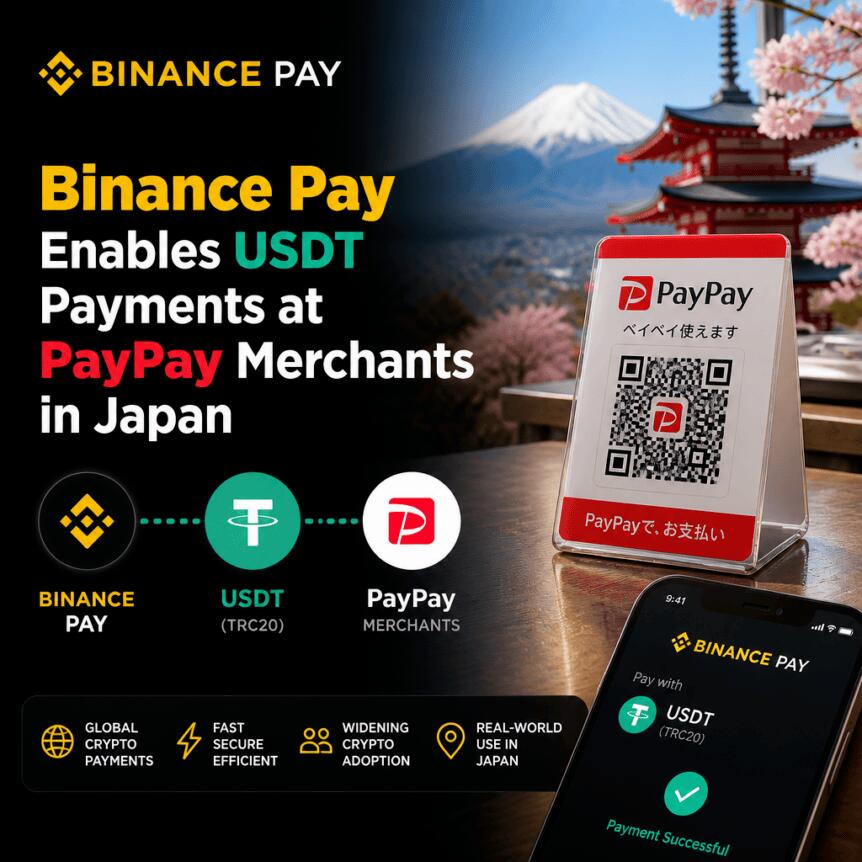
Binance Pay is set to expand its crypto spending options in Japan by enabling eligible overseas visitors to pay with Tether USDt (USDT) at most merchants that accept PayPay. The rollout begins on Wednesday, with settlement handled in yen rather than crypto.
The integration is delivered through HIVEX, a payment interoperability framework designed to connect overseas QR payment applications with local PayPay-supported merchant infrastructure. Binance says it is the first crypto payment service to reach PayPay merchants via HIVEX, and that participating merchants will not need separate opt-ins for the new payment method.
Key takeaways
- Binance Pay will allow eligible overseas users in Japan to spend USDT at the majority of merchants that support PayPay.
- The payments will be routed through HIVEX interoperability, linking overseas QR services to PayPay merchant acceptance.
- Merchants will continue receiving settlement in yen, keeping local accounting and pricing aligned with Japan’s currency.
- Binance positions the move as the first crypto payment service to access PayPay-supported merchants through HIVEX.
How Binance Pay reaches PayPay merchants in Japan
At the center of the update is HIVEX, which acts as a bridge between different QR-based payment ecosystems. Instead of requiring Japanese merchants to implement a new crypto rail directly, the framework connects compatible overseas payment providers to the local PayPay merchant network.
Binance told Cointelegraph that this makes the service accessible across PayPay’s existing merchant footprint. According to Binance, merchants do not need to take additional steps to enable the new option, which could reduce friction for adoption and speed up availability across Japan.
USDT payments, with yen settlement for merchants
The most operational detail for local businesses is that settlement remains in yen. That distinction matters because it preserves the familiar flow for merchant operations—most notably for accounting, pricing, and reconciliation—while still giving eligible visitors the flexibility to pay using a stablecoin.
For users, paying with USDT is aimed at simplifying transactions when a visitor’s funds are held in crypto rather than local fiat. For merchants, the change is designed to avoid introducing a requirement to hold, manage, or directly interface with crypto assets—an approach that can be easier to integrate within existing retail payment workflows.
What PayPay acceptance looks like on the ground
PayPay is widely used across Japan, with acceptance at millions of locations. It covers large retail chains as well as smaller retailers, vending machines, taxis, and public transportation services. A PayPay help page also indicates the platform supports multiple overseas payment services via HIVEX, with those providers “mainly from China, Hong Kong and Taiwan.”
Against that backdrop, adding Binance Pay extends the list of internationally oriented payment options that can reach PayPay’s core merchant channels. While the number of merchants that will accept USDT via this route is described as “the vast majority,” the interoperability framing suggests coverage could scale beyond a limited pilot rather than being restricted to a handful of trial locations.
Japan’s travel demand adds urgency to payment expansion
Japan’s move comes as the country continues to manage a high level of inbound travel. The Japan Tourism Agency reported that Japan welcomed a record 42.7 million international visitors in 2025. In a global ranking based on 2024 data, Japan ranked ninth worldwide and first in Asia.
Recent travel figures underline ongoing momentum, even with some year-over-year variation. The Japan National Tourism Organization reported 3.1 million visitor arrivals in August, a 9.6% decline compared with the same month a year earlier. Over the first eight months of 2026, arrivals totaled 27.6 million, down 2.7% year over year.
For payments providers, these conditions make interoperability particularly relevant: the more geographically broad and administratively straightforward the acceptance becomes, the more useful it is for travelers who may not want to convert funds repeatedly into local currency.
Why Binance’s “first crypto via HIVEX” claim matters
Binance’s statement that it is the first crypto payment service to access PayPay-supported merchants through HIVEX is significant because it positions this launch as more than a standalone partnership. In practical terms, it indicates that crypto payments can be folded into mainstream QR merchant networks using interoperability rather than requiring entirely separate merchant deployments.
Still, readers should watch how coverage expands in the months after launch—particularly whether “vast majority” acceptance translates into consistent availability across merchant categories and regions. They should also monitor how Binance defines “eligible” overseas users, since eligibility rules often determine how quickly a rollout moves from announcement to full usable scope for travelers.
For now, the key next question is whether the integration scales smoothly across PayPay’s merchant base without operational exceptions, and how quickly other crypto payment providers might follow similar interoperability routes if the demand from international users proves strong.
This article was originally published as Binance Pay Enables USDT Payments at PayPay Merchants in Japan on Crypto Breaking News – your trusted source for crypto news, Bitcoin news, and blockchain updates.
0
0

 Manage all your crypto, NFT and DeFi from one place
Securely connect the portfolio you’re using to start.


