
100 Euros Into Bitcoin Without Fees: What Actually Arrives at Five Providers

0
0
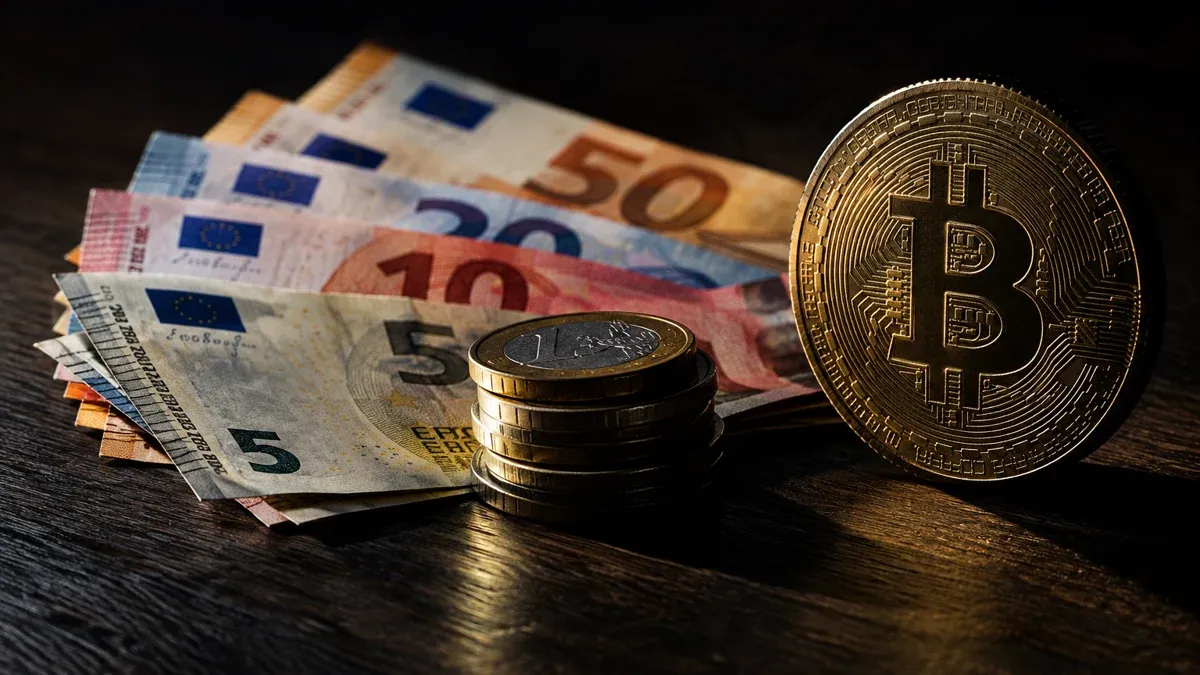
Anyone putting €100 into bitcoin gets bitcoin for €100 at no German provider. After the disclosed fee, between €98.50 and €100 is left, and after that a second item applies that most providers do not quantify: the spread.
The marketing phrase "without fees" is therefore not a price promise but a statement about a single line of the statement. This analysis was carried out by cryptoticker.io itself on 30 September 2026. It is based on the public fee and terms pages of five providers serving German retail customers: justTRADE, finanzen.net ZERO, BISON, Kraken and N26. What was counted is which price components the provider names itself and which it leaves open.
The result up front: at exactly one of the five providers can you work out in full, from its own disclosures, what arrives in bitcoin from €100. At the other four, a number is missing for the second half of the calculation.
Spread and order commission: the two price components when you buy bitcoin
A purchase costs you money in two places, and the two have nothing to do with each other.
The order commission is the amount the provider charges for execution and discloses as a fee on the statement. This item is usually a percentage of the order volume and is fixed before the purchase.
The spread is the difference between the price at which you can buy and the price at which you could sell at the same moment. It is not a fee in the legal sense, because it is not charged but built into the quoted price. For your holdings the difference is irrelevant: both reduce the amount of bitcoin you receive for your money.
That is exactly the gap the phrase "without fees" exploits. A provider can set the order commission to zero and put the margin into the price. The statement then shows a zero, and the customer has paid all the same. How much is stated nowhere.
Why the comparison does not end at the percentage
Two providers with identical commissions can be differently expensive if their prices sit at different distances from the market price. A provider that quantifies its spread is therefore not automatically the cheaper one, but the only one where you can do the maths in advance.
justTRADE: 0.125 percent order commission and a €25 minimum order size
justTRADE names the lowest disclosed commission in the field: 0.125 percent of the order volume. On €100 that is 12.5 cents, leaving €99.88 for the purchase.
The provider sets this rate expressly "plus trading venue spread". The trading venue spread is the margin the venue itself builds into its price, not the broker. justTRADE does not name a figure for it, and it varies with the venue and the time of day.
Two conditions narrow the rate further: a minimum order size of €25 applies, and according to the provider no network fees are charged. Tradable are 73 crypto assets and 94 crypto ETPs, 43 of them eligible for savings plans, plus fractional trading and custody in Germany.
For a savings plan of €25 a month that means a commission of around three cents. At that order size the spread is by far the larger item, and it is the one you do not know.
finanzen.net ZERO: zero euro order fees and a small-order surcharge
finanzen.net ZERO advertises "from 0 euro order fees" and states itself what that costs: "plus spreads and, on very small orders, a 1 euro small-order surcharge". The order fees are covered by the trading partners, according to the provider.
Tradable are 59 coins plus more than 50 crypto ETPs, held in custody and regulated in Germany, with no minimum order size. In the Stiftung Warentest cost comparison of December 2025 the provider was, by its own account, the cost winner across all pricing models.
The small-order surcharge is a flat amount that applies on top for small orders and eats up the percentage advantage on small sums. From which order volume it no longer applies is not stated on the terms page. That is the decisive point for your calculation: if the threshold is above €100, you pay €1 on a hundred euros and therefore more than with any percentage rate in the field. If it is below, you pay nothing. One euro of difference on €100 is thus an open question at this provider, not a number.
BISON: no trading fee, but a 1.25 percent spread on bitcoin
BISON is the only provider in this count that names both components. Trading is free of charge according to the provider; transactions, deposits and withdrawals, custody and account maintenance cost nothing.
And then comes the number that is otherwise missing: the proportional spread on buying and selling bitcoin and ethereum averages 1.25 percent in each case. On all other cryptocurrencies it averages 1.75 percent. The provider adds that the figure fluctuates because it depends on market conditions and on the size of the trade.
That makes the calculation possible. Of €100, around €98.75 arrives in bitcoin at an average spread of 1.25 percent. That is the lower figure in this comparison, but it is the only one that contains the whole price. At the other four providers, a blank sits next to the commission.
Fee-free trading can be the more expensive kind
Setting the 1.25 percent against justTRADE's 0.125 percent compares two different things: a complete disclosure against half of one. If the trading venue spread at justTRADE comes out above 1.125 percent, the provider with the tenfold commission is cheaper in the end. That can only be checked against the actual price at the moment of the order.
Kraken: 1 percent on instant buy, 0.80 percent in the order book
Kraken separates two routes, and the price difference between them is larger than the difference between some providers.
On instant buy, the one-click option in the app and on the web, the exchange charges, by its own account, 1 percent on instant and recurring purchases and 1.5 percent on so-called custom orders. It states expressly that the displayed price includes a spread. For members of its paid plan the trading fee is waived up to a volume of $10,000 a month.
In the order book, by contrast, the volume-tiered schedule applies. At the lowest tier, from zero dollars of turnover in 30 days, that is 0.40 percent as maker and 0.80 percent as taker. A maker is someone who puts an order into the book and waits for it to be filled, a taker someone who immediately fills an order already sitting there. So anyone with the patience for a limit order pays 0.40 instead of 1 percent.
On €100 that means: €99 through instant buy, €99.20 as a taker in the order book, €99.60 as a maker. The spread comes on top in all three cases and is not quantified. One detail on the margin that affects small holdings: for consolidating dust balances below the minimum order size, the exchange names a flat rate of 3 percent.
The jump from 1 percent to 0.40 percent costs you nothing but a different route through the interface. That is the biggest lever in this whole comparison, and it lies not in the choice of provider but in the choice of order screen. An overview of which trading venues in Germany offer which order types is in our comparison of the best crypto exchanges.
N26: 1.5 percent on bitcoin, 2.5 percent on other coins
N26 names the highest rate in the field. As standard, 1.5 percent applies to bitcoin transactions and 2.5 percent to transactions in other coins. That leaves €98.50 out of €100.
On the Metal plan the rate falls to 1 percent for bitcoin and 2 percent for other coins, but only for trading amounts up to €5,000 per calendar month, purchase fees included. Above that limit the standard rates apply again. The bank also rounds the fee up to the next full cent.
The most revealing sentence on that page, however, concerns not the level but the responsibility: the fees and the prices shown in the app, which may include spreads, are not set by N26 but by Bitpanda Asset Management GmbH, according to the bank. So anyone buying at their bank is trading through a service provider in the background whose pricing the bank itself does not answer for.
That has a practical consequence for you. The most convenient route, straight from the current account, is the most expensive disclosed one in this comparison, and the margin in the price is set by a third party. How banks and neobrokers otherwise differ in their crypto offering is therefore not decided by the bank you hold your account with alone.
The calculation on €100: between €98.50 and €100 before the spread
The five providers, sorted by the disclosed fee, each for a purchase of €100 on 30 September 2026:
- finanzen.net ZERO: €0 order fee, leaving €100. On very small orders a €1 surcharge is added; the threshold is not stated. Spread not quantified.
- justTRADE: 0.125 percent, leaving €99.88. Trading venue spread not quantified.
- BISON: no trading fee, leaving €100. After the stated average spread of 1.25 percent, around €98.75 arrives in bitcoin.
- Kraken: 0.40 percent as maker, 0.80 percent as taker, 1 percent on instant buy. That leaves €99.60, €99.20 or €99. Spread included in the price, not quantified.
- N26: 1.5 percent on bitcoin, leaving €98.50. Possible spreads are set by a third party, not quantified.
The range of the disclosed fee thus runs from zero to €1.50 per €100 invested. That sounds like little, and on a single purchase it is. On a savings plan of €100 a month, the same range separates around €180 over ten years, in the commission alone and before the spread is added.
Why the spread stays unquantified at four out of five providers
The count produces a clear pattern: only BISON names a concrete percentage for the spread. The other four name it but do not disclose it as a figure.
There is a substantive reason for that. The spread genuinely fluctuates, with liquidity, the time of day and the order size, and a fixed number would be an assertion. BISON solves it with the word "average" and a note on the variation.
The consequence for you stays the same regardless of the reason: a price comparison based on percentages is incomplete at four out of five providers, and the gap cannot be closed by research, only by your own measurement. It goes like this: immediately before the order, note the market price of bitcoin at an independent price source, then the price your provider shows you. The difference in percent is your spread at that moment. Done at two providers in parallel it takes two minutes and replaces any fee table.
How individual exchanges construct their mark-ups in detail we have broken down using one provider as an example: what a purchase at Coinbase really costs.
Network fee, custody and savings plan: the costs after the purchase
The purchase price is not the whole price. Three items only arise later, and on small amounts they matter more than the commission.
The network fee you pay to the blockchain, not to the provider, as soon as you move your coins to your own wallet. justTRADE states that it charges none, and BISON calls deposits and withdrawals free of charge as well. Anyone underestimating this item may pay more on withdrawing a small holding than on buying it.
The custody is free of charge at justTRADE, BISON and finanzen.net ZERO by their own accounts, and takes place in Germany. That is no side detail: domestic custody under German supervision is a different legal framework from custody at an exchange abroad.
On a savings plan, the maths shifts in favour of the percentage models as soon as a flat amount is involved. A commission of 0.125 percent stays at three cents on a €25 instalment. A small-order surcharge of €1 would be a cost rate of 4 percent on the same instalment. That is exactly why a look at the threshold above which a flat amount is dropped is worth more than a look at the percentage in the advertising.
What the holding period has to do with your fees
One point often lost in the arithmetic: every sale and every swap triggers its own tax assessment for you, and frequent reshuffling multiplies not only the fee but also the documentation effort. Anyone who buys rarely and holds long pays the commission once. Anyone reshuffling monthly pays it twelve times a year and has to be able to evidence every transaction.
Buying bitcoin without fees: what to take away
The phrase "without fees" describes a line of the statement, not the price. Three steps turn the advertising promise into a number you can work with:
- Separate commission and spread before you compare providers. Take the commission from the terms page and treat every provider without a quantified spread as an incomplete disclosure. Which trading venues and brokers are authorised in Germany and which order types they offer is set out in the comparison of the best crypto brokers.
- Measure the spread yourself once, directly before your order. Note the market price, note the provider's price, work out the difference in percent. Two minutes of work replace any table, and the result applies to your order size rather than to an average. The routes by which a purchase is possible in Germany at all are summarised in our overview of buying bitcoin.
- Do the sums over your holding period, not over one purchase. One percentage point of difference is one euro on €100 and a three-figure amount on a savings plan over ten years. Anyone documenting every order cleanly has the basis for the tax return done at the same time: an overview of crypto tax tools and portfolio trackers.
The full disclosures of the two providers that reveal the most in this count can be found at BISON on fees and costs and in the Kraken fee schedule.
(As of September 30, 2026. This article is not investment advice. Prices and fee structures change; check the terms with the provider before you buy.)
0
0

 Manage all your crypto, NFT and DeFi from one place
Securely connect the portfolio you’re using to start.


