
TRON DAO AI Fund Hits $1B: What It Means for the Agentic Economy

0
0
This article was first published on The Bit Journal.
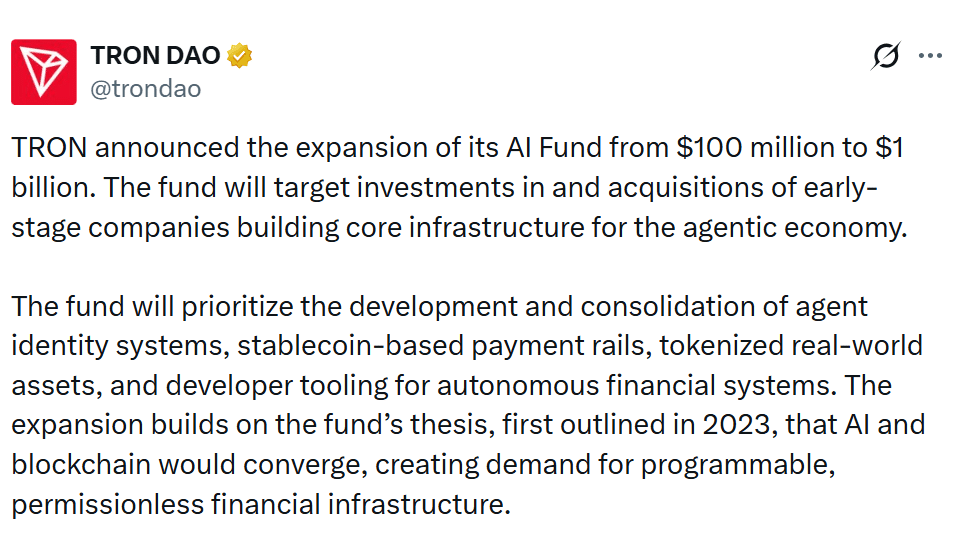
TRON DAO has expanded its artificial intelligence fund from $100 million to $1 billion, marking a major increase in its push toward the emerging agentic economy. The enlarged fund will target early-stage startups and acquisitions building infrastructure for AI-driven finance.
TRON DAO said the new fund will back projects in four main areas. These include agent identity systems, stablecoin payment rails, tokenized real-world assets, and developer tools for autonomous finance.
The expanded fund was announced on Monday. It builds on investment ideas the organization has outlined since 2023. Those ideas center on the view that stablecoins may become the most practical form of money for AI agents and AI-augmented users.
The strategy also highlights tokenized equity and real-world assets. TRON DAO said such assets can make ownership programmable, divisible, and transferable at any time. That structure could make them useful in automated financial environments.
TRON DAO Focuses on Stablecoin Payment Rails for AI Agents
A major part of the plan focuses on stablecoin payment rails. TRON DAO said stablecoins are currently the most practical form of money for AI agents. That is because AI agents cannot access traditional banking systems, but they can use digital wallets.
This point is central to the fund’s investment thesis. If AI agents begin making small and frequent payments, they will need systems that are available at all times. They will also need transaction rails that are low cost and easy to use.
Agent Identity Gets Fresh Attention
The new fund will also target agent identity systems. This area is important because autonomous agents may need trusted ways to prove who or what they are on-chain. Identity systems could also help define permissions, roles, and transaction limits.
That could become more important as AI agents handle more financial tasks. It may also matter as more firms look for ways to deploy agents in real business settings. In that environment, identity tools may help reduce friction and improve accountability.
Developer Tools Remain a Core Focus
TRON DAO is also directing capital toward developer tooling. These tools are expected to help teams build, test, and deploy autonomous financial systems. Strong tooling can also reduce the time needed to bring new products to market.
Justin Sun said infrastructure is already beginning to develop around this ecosystem. He pointed to AINFT, an AI agent framework launched on TRON, which is designed to help developers build and deploy autonomous agents.
Tokenized Assets Fit the Broader Thesis
Tokenized real-world assets and tokenized equity are another part of the plan. TRON DAO said these assets are critical to the agentic economy. They can support ownership that is digital, programmable, and transferable without strict market-hour limits.
This gives the strategy a wider scope than payments alone. It suggests that AI agents may not only move money but also interact with financial products tied to real assets. That could open the door to broader use across digital markets.
TRON’s Position in the AI Race
The move comes as more crypto and fintech players enter the agentic AI space. Solana and Base have both taken steps in this area. Visa, Stripe, and World have also moved toward AI-linked payment infrastructure.
In September, the Ethereum Foundation launched its “dAI Team” to position Ethereum as a settlement layer for AI agents. TRON DAO, in contrast, focuses on faster, lower-cost payment rails.
Network Scale Supports the Case
TRON DAO said the network has more than 370 million user accounts. It also reported over $21 billion in daily transactions and more than $85 billion in circulating USDT supply. These figures were presented as evidence of existing scale.
Sun has also said many AI agent use cases involve small and frequent payments. He noted that such activity needs networks that are fast and inexpensive to use.
He added that average confirmation times on TRON are about three seconds, compared with roughly 12 seconds on Ethereum, citing an Arkham report.
Market Outlook and Risks
The fund expansion could influence sentiment around TRX, the network’s native token. Similar ecosystem developments have, at times, led to higher trading activity and short-term price swings. It may also strengthen interest in AI-linked crypto themes.
Still, the integration of AI and blockchain is in an early stage. Long-term potential remains, but the sector may stay volatile while adoption develops. Market participants may continue to watch for signs of real usage, developer traction, and follow-through from funded projects.
Conclusion
The new $1 billion fund marks a major step in TRON DAO’s AI strategy. It shows a clear effort to back the infrastructure needed for autonomous finance and machine-to-machine commerce.
By focusing on payments, identity, tokenized assets, and tooling, the organization is trying to position itself at the center of this emerging sector.
Appendix Glossary of Keyterms
Agentic Economy: A system where AI agents autonomously perform tasks and financial transactions.
Stablecoins: Digital currencies pegged to stable assets, used for payments and settlements.
AI Agents: Autonomous programs that can make decisions and execute actions independently.
Tokenized Real-World Assets (RWA): Physical or traditional assets converted into blockchain-based tokens.
Digital Wallets: Tools that store, send, and receive digital assets on blockchain networks.
Payment Rails: Systems that enable the transfer of funds between users or entities.
AINFT: A framework on TRON designed to build and deploy autonomous AI agents.
Frequently Asked Questions About TRON DAO
1- What is the size of the new AI fund?
TRON DAO has increased its AI fund from $100 million to $1 billion.
2- Which sectors will the fund target?
It will focus on agent identity systems, stablecoin payment rails, tokenized real-world assets, and developer tooling.
3- Why are stablecoins important in this strategy?
The organization said stablecoins are practical for AI agents because they can use digital wallets but not traditional banks.
4- How is this different from Ethereum’s approach?
Ethereum is focusing on coordination and settlement, while TRON DAO is emphasizing payment rails, speed, and low-cost transactions.
References
Read More: TRON DAO AI Fund Hits $1B: What It Means for the Agentic Economy">TRON DAO AI Fund Hits $1B: What It Means for the Agentic Economy
0
0


 Manage all your crypto, NFT and DeFi from one place
Securely connect the portfolio you’re using to start.

0
0

0
0

0
0

0
0