
Bitcoin Price Outlook Remains Fragile as Iran Tensions Threaten Crypto Recovery

0
0

Bitcoin price outlook remains under intense scrutiny as global markets respond to a surprise interim agreement between the United States and Iran. Stocks surged, oil prices tumbled, and industrial metals rallied. Yet Bitcoin barely moved. That unusual reaction suggests crypto investors see a bigger story unfolding beneath the headlines.
According to the source, the U.S. and Iran have agreed to halt hostilities temporarily and reopen the Strait of Hormuz, a critical shipping route responsible for roughly one-fifth of the world’s oil supply. The announcement removed a major source of uncertainty from financial markets. However, Bitcoin’s muted response shows that traders are looking beyond the immediate headlines and focusing on whether the agreement can actually survive.
Traders Have Learned a Painful Lesson
The current Bitcoin price outlook reflects more than simple caution. It reflects experience.
Bitcoin is behaving like a market that has learned a painful lesson. Two failed peace agreements erased earlier gains, teaching traders to wait for confirmation before pricing in a third deal. A ceasefire announced in April eventually collapsed, while another truce broke down after U.S. strikes on June 9. On both occasions, Bitcoin surrendered its entire relief rally.
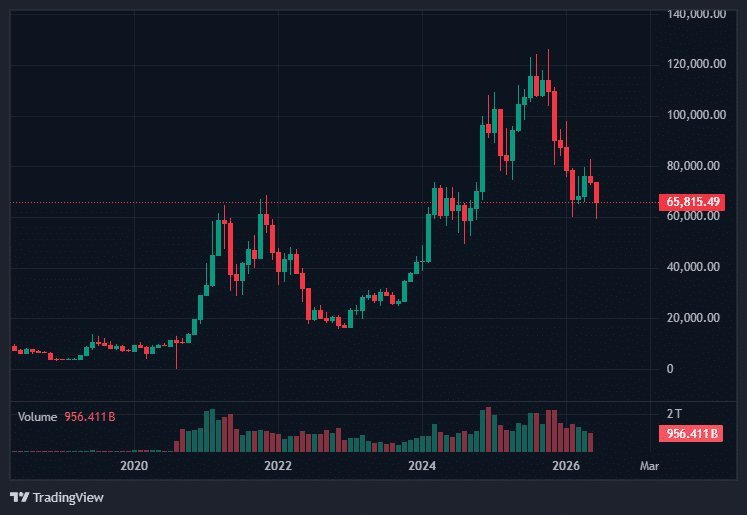
As a result, investors appear unwilling to commit significant capital before the June 19 signing in Switzerland. Bitcoin continues to trade near $65,000 and remains trapped within its recent $63,000 to $65,000 range. The crypto market is effectively demanding proof before rewarding optimism.
The Rally That Lifted Everything Except Bitcoin
Traditional markets responded far more enthusiastically. Brent crude oil fell more than 4% toward $83 per barrel, marking its lowest level in three months. Lower oil prices immediately eased concerns about supply disruptions and inflation.
At the same time, Asian shares climbed more than 3%, while Japan’s Nikkei index advanced toward a record close. Investors viewed the reopening of the Strait of Hormuz as a positive development for global trade and economic stability.
Yet the crypto market remained restrained. This contrast is important because it highlights why the current Bitcoin price outlook differs from that of stocks and commodities. Traders still worry that the agreement could unravel before becoming permanent.
Copper, Aluminum, and Bitcoin Are Telling Different Stories
One of the clearest signals comes from industrial metals. Copper climbed as much as 1.4% following the announcement and has gained roughly 4% since the conflict began in late February. Aluminum has performed even better, rising about 13% during the same period as supply routes through the Persian Gulf faced disruptions.
The reason behind this divergence is simple. Copper trades on growth expectations and supply routes. Aluminum reacts strongly to supply-chain recovery and transportation conditions. Bitcoin follows a different path.
Unlike copper and aluminum, Bitcoin is no longer reacting to the deal itself. Traders appear to be waiting for evidence that the agreement can survive beyond June 19 before assigning any lasting value to it.
The crypto market increasingly trades on liquidity expectations rather than trade flows. That distinction helps explain why metals rallied aggressively while the Bitcoin price outlook remained cautious. Investors are not questioning the immediate benefits for commodities. They are questioning whether the agreement will hold long enough to improve financial conditions.
The Inflation Channel Could Decide Bitcoin’s Next Move
The most important part of the story may not involve geopolitics at all. Analysts increasingly argue that the Bitcoin price outlook depends on inflation and central bank policy rather than ceasefire headlines.
Lower oil prices reduce inflation pressure. Lower inflation gives the Federal Reserve less reason to maintain a restrictive stance. The Bank of Japan is also scheduled to announce its policy decision tomorrow, making the next 24 hours especially important for global markets.
A softer inflation environment could reduce the hawkish pressure on Japanese policymakers and lower the risk of a yen carry-trade unwind. That risk has weighed heavily on the crypto market throughout recent weeks.
The sequence is straightforward. Oil prices fall. Inflation cools. Central banks become less aggressive. Carry-trade risks decline. Liquidity improves. The crypto market benefits. This chain reaction is why many analysts believe the Bitcoin price outlook remains closely tied to macroeconomic conditions.
Conclusion
Despite the recent emergence of positive signals of diplomatic breakthroughs, Bitcoin price outlook remains uncertain. This temporary agreement may suffer the same failed outcome as previous ceasefire deals, while unresolved sanctions, nuclear negotiations, and warnings from Trump continue to unfold.
Currently, low oil prices, a strengthening stock market, and rising industrial metal prices signal an improving economic environment. However, the crypto market will not easily enter a bull market; liquidity will only pick up after core conditions are formally implemented. Caution remains necessary, as the Bitcoin price outlook is still influenced by lessons learned from recent market volatility.
Glossary of Key Terms
Bitcoin Price Outlook: Expectations regarding Bitcoin’s future market direction.
Strait of Hormuz: A major oil shipping route that carries about 20% of global oil supplies.
Carry Trade: A strategy that involves borrowing in low-interest currencies and investing in higher-yielding assets.
Inflation: The rate at which prices rise across an economy.
Liquidity: The amount of capital available for investment in financial markets.
FAQs About Bitcoin Price Outlook
Why is Bitcoin reacting cautiously to the Iran deal?
Traders remember two failed ceasefires that erased earlier gains and prefer to wait for confirmation.
Why did copper rise more than Bitcoin?
Copper responds to growth expectations and supply routes, while Bitcoin reacts more to liquidity conditions.
Why is the Bank of Japan important for crypto?
Its policy decisions can affect global liquidity and influence risk appetite across markets.
What is the biggest risk for Bitcoin right now?
The interim agreement could fail, leading to renewed geopolitical tensions and market volatility.
Sources/References
Read More: Bitcoin Price Outlook Remains Fragile as Iran Tensions Threaten Crypto Recovery">Bitcoin Price Outlook Remains Fragile as Iran Tensions Threaten Crypto Recovery
0
0


 Manage all your crypto, NFT and DeFi from one place
Securely connect the portfolio you’re using to start.

0
0

0
0

0
0
