
Ethereum price $2,702: next target is $2,775, but 812,887 ETH are queued for the exit

0
0

The Ethereum price stands at $2,702 on Sunday evening, or 2,399.90 euros, up 0.7 percent over 24 hours. The next target to the upside is no estimate. It is a level taken from Ether's own chart: $2,775, the high of 22 September, and therefore only 2.7 percent away. The question this weekend is not whether ETH clears those $73. What decides matters is who will be able to sell at all over the next three weeks, and who will not.
Because 812,887 ETH are sitting in the staking exit queue, a good $2.2 billion. Anyone joining that queue today gets their money back in roughly 22 days. This is a hard liquidity question for every European investor who holds ETH in staking and wants to remain able to act before the Glamsterdam upgrade on 4 November.
Ethereum price at $2,702: 2.7 percent below the September high, 21.6 percent above the 200-day line
Let us place the price first, so the levels later do not come out of thin air. The following values are taken from CoinGecko's daily price series over the past 365 days, as of 4 October.
- Current price: $2,702, or 2,399.90 euros
- 200-day line: $2,117.74, with the price 27.6 percent above it
- 50-day line: $2,500.34, with the price 8.1 percent above it
- High of the past 30 days: $2,775.17 on 22 September
- Low of the past 30 days: $2,397.50 on 16 September
- January 2026 high: $3,351.82 on 15 January, still 24.0 percent away
- Low for the year: $1,566.01 on 26 June
Two of those numbers carry the picture. First, ETH has closed above its 200-day line for 47 trading days in a row. That line is the average price of the past 200 days and serves as a rough divide between an upward and a downward phase. Second, the price has spent two weeks in a narrow band between $2,397 and $2,775, a corridor of some 16 percent. Together they describe a market that is neither breaking out nor breaking down.
812,887 ETH in the exit queue: $2.2 billion waiting for the way out
Staking your ETH means depositing it with a validator and helping to secure the network. There is a yield for that, but the coins are not freely available. The way back runs through a waiting queue, because the protocol releases only a limited number of validators per unit of time. That queue has become the number of the weekend.
According to validatorqueue.com, which sources its data from beaconcha.in, 812,887 ETH are queued to exit. At a price of $2,702 that is $2.2 billion, or roughly 1.95 billion euros. Measured against the 43.5 million ETH staked in total, it amounts to 1.87 percent. The estimated waiting time until exit is 14 days and 3 hours.
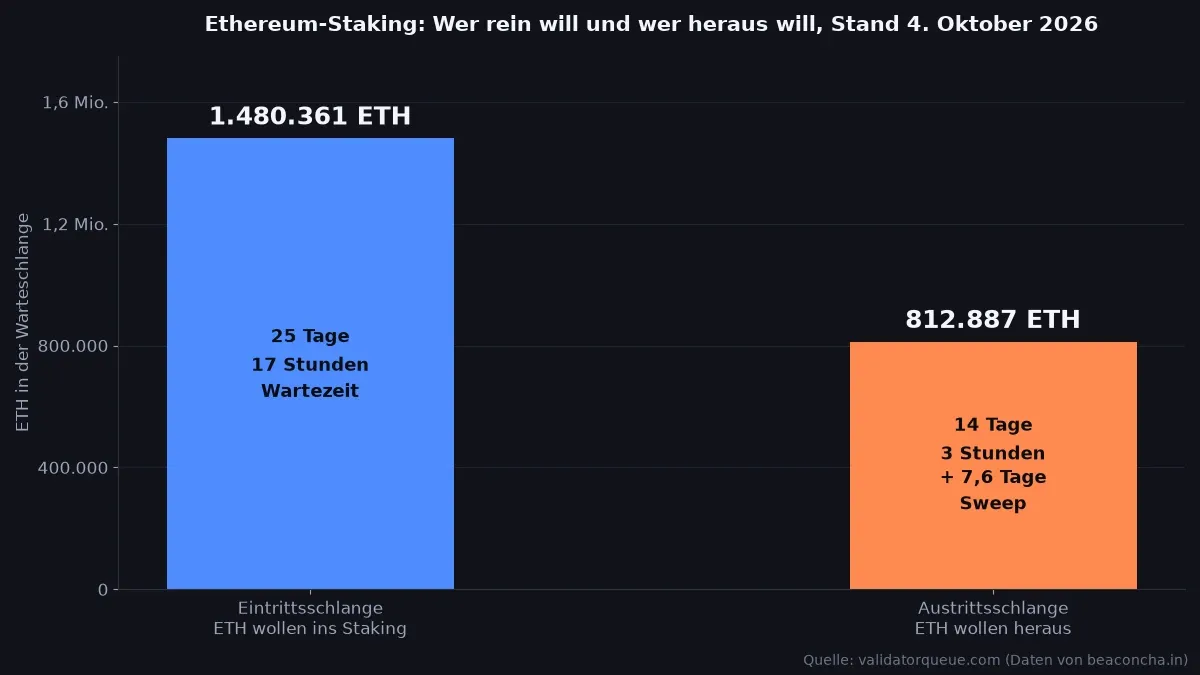
A sweep delay of 7.6 days: 14 days of waiting become about 22
Here lies the point most overviews leave out. Those 14 days and 3 hours are only the first half of the journey. After leaving the validator set, the balance still has to be transferred to the registered withdrawal address, and this so-called sweep works through the addresses in order. That currently adds 7.6 days.
In total, then, 21.7 days pass between the decision and the available balance. Start your exit on 4 October and your ETH lands on the withdrawal address on 25 October. Three weeks is a long time in a market that has moved 16 percent in two weeks. If you want to steer your position size through a possible dip in the price, staked ETH simply does not let you do it at short notice. That is the real cost of the 2.63 percent yield, rather than the yield itself.
In practice: split your holdings between the part that is to stay staked and the part that has to remain tradable. You will find an overview of the providers and their respective exit routes in our comparison of staking platforms, because the protocol deadline is only the floor. Centralised providers add processing times of their own, while decentralised liquid staking tokens can be sold on the market, though often at a discount to the ETH price itself.
The entry queue is larger: 1,480,361 ETH want to go the other way
An exit queue worth $2.2 billion sounds like flight. The counter-figure appears in the same overview and turns out to be considerably bigger: 1,480,361 ETH are waiting to be admitted into staking, with a waiting time of 25 days and 17 hours. That is 1.8 times the exit queue and corresponds to around $4.0 billion.
On balance, 667,474 ETH more want in than out. For the price question that is the more important figure. Every ETH that enters the entry queue is unavailable to the market as sellable supply for at least 25 days. In total, 35.61 percent of all ETH is staked, spread across 870,025 active validators. Read only the exit number and derive selling pressure from it, and you have read half the table.
Glamsterdam on 4 November: the Hoodi fork of 5 October is the last testnet stage
The date on which the queues and the price meet is in the developers' calendar. Glamsterdam is Ethereum's next major upgrade after Fusaka, and according to the overview at EIPs Insight the target date for mainnet is 4 November 2026. One stage comes before it: on 5 October, that is Monday, the Hoodi testnet forks. The Sepolia testnet went through the fork on 21 September.
In substance, Glamsterdam brings two changes worth knowing about, even if you do not run a validator yourself. EIP-7732 writes the separation of block proposal and block building firmly into the protocol, known as enshrined proposer-builder separation. EIP-7928 introduces access lists at block level, allowing a client to know in advance which data a block touches. Both aim to make it possible to raise the gas limit without overwhelming the requirements placed on a single node.
What a testnet fork actually means for you
A testnet fork is a dress rehearsal on a copy of the network without real value. For you as a holder, nothing changes on Monday: your ETH stays where it is, there is no swap, no new address and no action you would have to take. The date only becomes relevant if you run a validator yourself or sit with a provider that fails to update its clients in time. Either way, that is a question for your service provider.

The calendar arithmetic: start on 14 October and you are liquid by the upgrade
A date can be derived from those two numbers, and that date is the real value of this exercise. The upgrade targets 4 November. The way out of staking currently takes 21.7 days. So if you want free use of your ETH on upgrade day, you have to trigger the exit by 14 October at the latest. After that the time runs out.
One caveat belongs here in all honesty: the waiting times are not fixed values. How they develop depends on how many validators want out at the same time, and they can double or halve within days. The 14th of October is therefore not a guaranteed cut-off but the arithmetic based on today's queue. If you want to be safe, build in a buffer of a week and check the figure again before you start.
And there is the counter-question: do you actually need liquidity on 4 November? An upgrade is not an event that forces a sale. Fusaka went over mainnet without incident in December 2025. If you hold for the long term and want to collect the yield, you have no reason to leave staking because of a date. The arithmetic above applies to anyone with a concrete intention to sell.
The levels above: $2,775 from September, then $3,351 from January
Back to the price. The first level to the upside is the September high at $2,775.17. It is the point where the market turned two weeks ago, and it sits 2.7 percent above the current reading. As long as ETH stays below it, the price moves inside the band that has held since mid-September.
Only above it does the view open on the round $3,000 mark, which last held in early February of this year. The next demonstrable target after that is the January high at $3,351.82 from 15 January, currently 24.0 percent away. This is explicitly not a forecast; these are places where trading actually took place in the past.
The levels below: $2,500 as the 50-day line, $2,397 as the September low
To the downside, the first catch line is $2,500.34, the average of the past 50 days, 7.5 percent below the current price. Below that follows the September low at $2,397.50, some 11.3 percent lower. The 200-day line at $2,117.74 is far away at a distance of 21.6 percent and would be the level at which the run of 47 days above that line would end.
For practical purposes: if you work with a stop level, the round number 2,500 has the drawback that almost everyone else can see it too. The average happens to sit just beside it at 2,500.34. Choose a distance of a few percent below and you avoid the densest zone. And if you work with leverage, hold the 16 percent range of the past two weeks against your liquidation distance: at five times leverage, liquidation sits roughly 20 percent away, which is already within what the market has covered in 14 days.
2.63 percent staking yield: what 870,025 validators pay out over a year
The yield for which one accepts those 22 days of waiting currently stands at 2.63 percent a year. On a single ETH that works out at around $71 a year, and on a stake of 10,000 euros at roughly 263 euros, in each case before tax and before the provider's fee. The rate falls as more ETH is staked, because the protocol's payout is spread across more validators. The entry queue of 1.48 million ETH therefore tends to push this value down further.
The fee decides the net yield. Centralised providers usually keep between 10 and 25 percent of the proceeds, which turns 2.63 percent gross into somewhere between 1.97 and 2.37 percent net depending on the provider. A difference of 0.4 percentage points on 10,000 euros comes to 40 euros a year, and that is more than most people expect when they compare.
Holding period and the tax office: what the German BMF letter of 6 March 2025 sets out for staked ETH
For German private investors, the disposal period under section 23 paragraph 1 sentence 1 number 2 of the Income Tax Act applies to the sale of crypto assets. Once a year has passed since acquisition, a gain on the sale is tax free; before that it counts as a private disposal transaction and is taxed at the personal rate.
The clarification that matters for stakers is in the BMF letter of 6 March 2025: staking and lending do not extend that period. The 2021 draft had provided for an extension to ten years where crypto assets are used as a source of income. That rule never came into force. Hold your ETH for longer than a year and you do not lose the tax exemption on the gain simply because you staked it in the meantime.
The staking rewards themselves are to be looked at separately. These rewards count as other income in the year they accrue, and a holding period of their own begins for them on the day they arrive. Receive rewards in October and sell them in December and you have a taxable event there, even if the ETH originally staked is long outside the period. For documenting these two pots, our overview of tax tools and portfolio trackers is worth a look, because otherwise the inflow dates have to be pulled out of the statements by hand. This account does not replace tax advice; for your individual case, the word of your tax office or your adviser applies.
Holding and buying ETH under MiCA: what to check before your next step
Since the European crypto regulation MiCA has applied in full, providers in Europe need authorisation to offer custody and trading. For you as a buyer, three points are verifiable before you pay money into an exchange or hand ETH over to staking.
- The authorisation: does the provider appear in a public register with a MiCA licence or a licence under banking law, and which country does it cover? That information belongs in the legal notice, not just in the advertising.
- The custody arrangement: is your ETH held separately from the provider's own assets, and do you get proof of it? With a liquid staking token you do not hold ETH itself but a claim on it, and that claim can trade below the ETH price on the market.
- The costs across the whole route: purchase, custody, staking fee and withdrawal. The spread on the purchase is the item fewest people recalculate, because it is not shown as a fee. A side-by-side look at the terms belongs before the purchase rather than after it.
Ethereum price: the key points for your decision
- Measure your staked share against your liquidity needs. An exit currently takes 21.7 days. If you want free use of your ETH on 4 November, 14 October is the last possible starting date by that arithmetic. The deadlines of the individual providers are in the staking comparison.
- Set your levels on the measured points, not on round numbers. Upwards that means $2,775.17, downwards $2,500.34 and $2,397.50. If you are buying or adding, the terms are in the exchange comparison.
- Separate holdings and rewards in your tax file. The one-year period applies to the holding and is not extended by staking; every reward runs a period of its own from the moment it arrives. Tools for this are in the overview of tax software.
(As of October 4, 2026. This article is not investment advice. Prices and fee structures change; check the terms with the provider before you buy.)
0
0

 Manage all your crypto, NFT and DeFi from one place
Securely connect the portfolio you’re using to start.


