
Solana price 108.46 euros: a 2.4 percent gain in euros, a 2.5 percent loss in dollars: what to check now

0
0
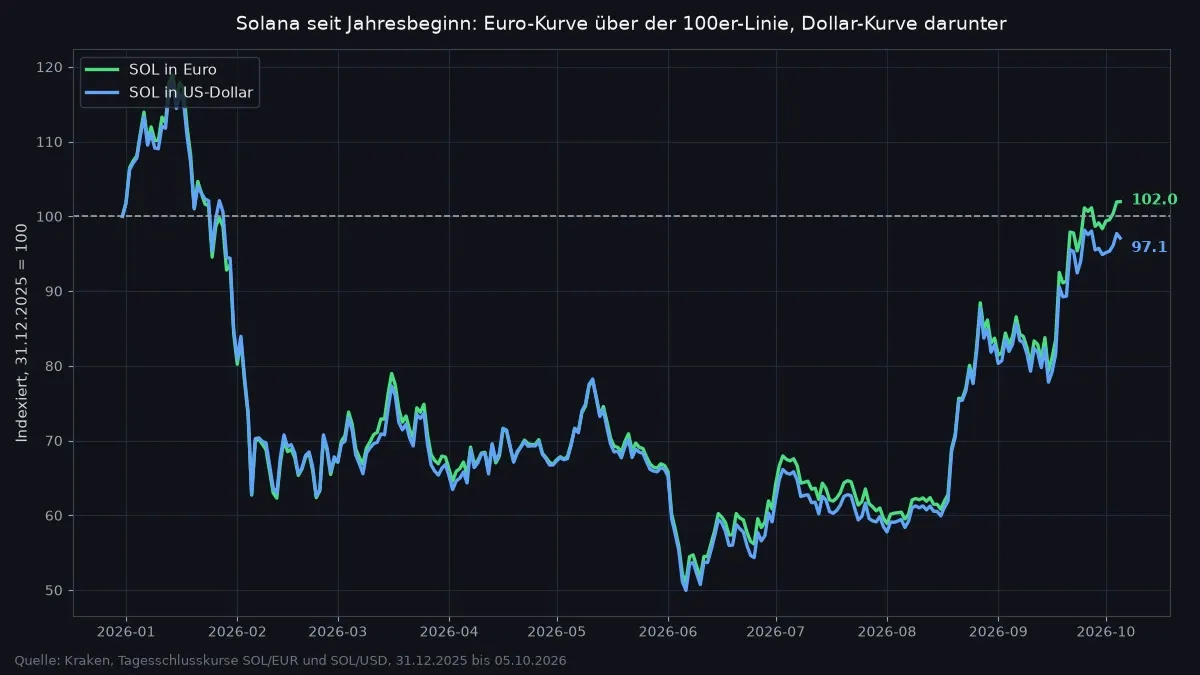
Put the Solana price on two screens side by side on Monday morning and you see two different years. The dollar chart has SOL at $121.30, which is 2.5 percent below its 2025 close. The euro chart has the same coin at 108.46 euros, which is 2.4 percent above it. Both numbers are correct. The gap of almost five percentage points does not come from the blockchain. It comes from the currency the sum is done in.
For an investor in Germany that is not a technicality. The tax office works in euros. The one-year rule under Section 23 of the Income Tax Act, the 1,000 euro threshold and every loss offset hang on the euro figure, not on the dollar reading most exchange apps show by default. Anyone who takes their 2026 result from the dollar chart is currently almost five percentage points out on Solana, and out in the wrong direction: they believe they are down, while on a euro basis a taxable gain may already have arisen.
Solana price on Monday morning: 108.46 euros and $121.30
The starting position in numbers, taken from trading data at the Kraken exchange for the SOL/EUR and SOL/USD pairs on Monday, October 5, 2026, shortly before nine o'clock German time:
- SOL/EUR: 108.46 euros, with a 24-hour range of 107.21 to 108.60 euros.
- SOL/USD: $121.30, with a range of $120.00 to $122.25.
- Implied exchange rate: $1.1184 to the euro.
Solana has moved in both currencies since the 2025 close, but not by the same distance. On December 31, 2025, SOL closed at 105.95 euros and $124.43. That works out at a euro gain of 2.37 percent for 2026 and a dollar loss of 2.52 percent. The difference is 4.88 percentage points.
The same pattern runs through every time frame. Over 30 days SOL added 21.97 percent in euros and 17.57 percent in dollars. Over seven days it is 3.76 against 2.08 percent. From the low of the year on June 6, 2026, which stood at 52.27 in euros and 60.12 in dollars, the price has recovered 107.50 percent in euros and 101.76 percent in dollars. The euro calculation is ahead in every single one of those windows.
Why the euro and dollar readings on Solana drift apart
Solana trades mainly against the US dollar and against dollar stablecoins on the large venues. The SOL/EUR pair is derived from that: the euro price is essentially the dollar price divided by the current euro-dollar rate. If the euro falls against the dollar, the euro price of a coin rises even when nothing at all happens to the dollar price.
That is exactly what has happened in 2026. The euro has given ground against the dollar over the year, and that move feeds straight through into every euro quotation. For a holder in Germany it works like a quiet extra return while the euro stays weak, and like a quiet discount as soon as it recovers. This is not a Solana phenomenon. The same spread hits every dollar-traded asset, from bitcoin to a US share. It merely stands out on Solana this year because the dollar price is hovering around the flat line for 2026, so the sign flips.
Currency risk, in short: it describes the swing in a result that arises purely because an asset is quoted in a currency other than the one in which the sum is done and the tax is paid. It works in both directions, and on a dollar asset it cannot be argued away, only carried deliberately or hedged.
EUR/USD at 1.1225: the ECB reference rate is at its lowest since May 2025
The official yardstick is not the rate at any single exchange but the daily euro reference exchange rate of the European Central Bank. It is set on every banking day at around 4pm and is accepted as the basis for conversion by tax offices, tax software and accounting departments.
That reference rate stood at $1.1225 to the euro on October 2, 2026, the last banking day before this Monday. It is the lowest reading of the whole of 2026. For comparison: on January 28, 2026, it stood at 1.1974, and on December 31, 2025, at 1.1750. Over the year so far the euro has therefore lost 4.47 percent against the dollar. The last time the reference rate was this low or lower was May 16, 2025, almost seventeen months ago.
Those 4.47 percent are the complete explanation for the 4.88 percentage points of difference in Solana's annual result. The small remainder comes from the gap between the official reference rate and the live exchange rate, which on Monday morning was a little below it at 1.1184.
Holding period under Section 23 of the Income Tax Act: the year runs to the day
In Germany crypto assets held privately count as other assets. A sale within one year of purchase is a private disposal under Section 23 of the Income Tax Act and is taxed at the holder's personal income tax rate. Once a year has passed, the gain is tax free, however large it is.
The deadline runs to the day, not by calendar years. Anyone who bought Solana at the low on June 6, 2026, does not reach tax-free status at the turn of the year but only at the end of June 6, 2027. A sale on June 7, 2027, or later is tax free; a sale on June 5, 2027, is fully taxable. At the current level those two days are around 56 euros of gain per coin apart, and on that amount the full marginal rate applies in case of doubt.
What counts is the euro amount at the moment of purchase and at the moment of sale. Anyone who traded in dollars or against a dollar stablecoin has to convert both sides, each with the rate of the day in question, not with an annual average. More on the basics is in our overview of crypto tax in Germany.

The 1,000 euro threshold: it breaks at 17.8 Solana on a purchase at the low of the year
Within the one-year window the gain stays tax free as long as the sum of all private disposals in a calendar year stays below 1,000 euros. Those 1,000 euros are a threshold, not an allowance. The difference is expensive: on a gain of 999 euros no tax falls due; on 1,001 euros the entire amount becomes taxable, not just the euro above the line.
Worked through at the current level it looks like this. Anyone who bought Solana at 52.27 euros on June 6, 2026, is sitting on 56.19 euros of gain per coin at 108.46 euros. The 1,000 euro threshold is therefore broken from 17.8 coins, which is a stake of a good 930 euros at the price back then. Anyone who also sold other coins at a profit within the window in the same calendar year crosses the line correspondingly earlier, because the threshold applies to all private disposals together.
This is where the dollar habit is most costly. Measured in dollars, the same gain comes to $61.18 per coin and looks like 101.8 percent. In euros it is 107.5 percent. Anyone who cross-checks the threshold with dollar amounts and then divides by the current exchange rate ends up with too low a figure and believes they are below the line when in fact they are above it. How to keep such calculations clean is shown in our overview of crypto tax tools and portfolio trackers.
FIFO per wallet: what the German finance ministry letter of March 6, 2025, changes for Solana holdings
Anyone who has bought more than once needs an order of use. The letter of the German Federal Ministry of Finance of March 6, 2025, on individual questions of the income tax treatment of crypto assets prescribes the first-in-first-out method for this: the coin bought first counts as the coin sold first.
FIFO, in one sentence: on a partial sale the oldest holdings are disposed of first, which gives them the best chance of having already met the one-year deadline.
The decisive detail is the one many people miss: the order is formed per wallet, meaning separately for each wallet and each exchange account, not as a single list across every venue. Anyone holding Solana on an exchange, in a software wallet and on a Ledger runs three separate calculations. A sale on the exchange draws on the oldest holding at that exchange, not on the older holding in the hardware wallet. We have broken down what that means in practice using the example of several wallets.
For Solana the point matters more than elsewhere, because staking and moving coins between wallets are everyday events on this chain thanks to the low fees. Every transfer between your own wallets is not a disposal and triggers no tax, but it does shift the holdings, and with them the order in which a later sale is settled.

Staking rewards on Solana: received in euros, not in dollars
Solana is a proof-of-stake chain, and staking is the normal case. For tax purposes the rewards are not private disposals but income from other services under Section 22 number 3 of the Income Tax Act. They are recognised at the moment they are received, at the euro equivalent on precisely that day.
On a chain with frequent payouts that turns the currency question into a clerical chore. Anyone receiving a reward while the euro is weak records a higher euro amount than with a strong euro, even though the number of SOL received is identical. Income from other services has its own threshold of 256 euros in a calendar year; above that the full amount is taxable.
For scale: as of October 2, 2026, the Grayscale Solana Staking ETF reported a gross yield of 4.87 percent and 4.52 percent after costs. Anyone delegating themselves lands in a similar range depending on the validator and its commission. A selection of providers and their terms can be found in our overview of staking platforms.
One point matters for the timing: the coins received start their own one-year clock when they arrive. A staking reward credited in October 2026 can only be sold tax free after October 2027, regardless of how long the underlying holding has been held.
Levels in euros: 127.57 as the high of the year, 74.55 as the 200-day line
Anyone thinking in euros should also know the levels in euros, because they sit in different places than on the dollar chart.
- High of 2026: 127.57 euros on January 13, 2026. The current price is 14.98 percent below it. On the dollar chart the same distance to the high of the year of $148.66 is 18.40 percent.
- Low of 2026: 52.27 euros on June 6, 2026. That is the anchor for almost every gain built up in holdings this year.
- 200-day line: around 74.55 euros. The price sits 45.5 percent above it. In dollars the line is at around $86.11 and the distance is 40.9 percent.
- 50-day line: around 91.79 euros, with a distance of 18.2 percent. In dollars it is $105.63 and 14.8 percent.
The distances to the moving averages are consistently wider in euros than in dollars, and for the same reason as the annual result: over the period the averages are drawn from, the euro was on average stronger than it is today. Anyone reading technical levels off a dollar chart and then applying them to a euro portfolio is quietly shifting their own entry and exit thresholds.
Buying in Germany: the currency your provider settles in
Since the EU regulation on markets in crypto assets applies in full, any provider selling, holding or exchanging crypto assets for retail clients in Germany needs authorisation as a crypto asset service provider, granted in Germany by BaFin. That changes nothing about the currency question, but it does tell you who belongs in the selection at all.
On the settlement currency there are three cases, and they lead to different records:
- Direct euro pair: you buy SOL against euros. The purchase price in euros appears in the statement without conversion and is exactly the figure the tax office wants to see.
- Dollar pair with a euro deposit: your euros are first exchanged into dollars or a dollar stablecoin, then into SOL. Two transactions arise here, and the conversion usually carries a spread that is not contained in the trading price shown.
- Stablecoin pair without touching euros: you swap USDC or USDT for SOL. That swap is itself a disposal of the stablecoin and has to be valued in euros on both sides.
Which route is cheaper depends on the fee model and on the spread on the exchange rate, not on the advertised trading fee. A comparison of the terms at German and European venues is in our overview of crypto exchanges.
The case against the euro calculation
The euro perspective has limits, and they belong in the picture. The first objection comes from market structure: supply, demand and liquidity for Solana arise in dollars. Anyone who wants to understand why the price is moving is right to look at the dollar chart. The euro chart explains no market move; it only describes the outcome for a holder in the euro area.
The second objection is direction. Euro weakness has flattered the 2026 result, and it can weigh on 2027 just as easily. A euro returning to the January level of almost 1.20 costs a euro holder around six percent without Solana's dollar price moving at all. Anyone booking this year's euro return as a performance of the network is mistaken about its source.
The third point concerns the tax itself. The duty to convert is not an option but a requirement, and it applies regardless of whether the exchange rate happens to work for or against the investor. The euro view is therefore not a perspective you can choose but the measure the law prescribes.
Solana in euros: the key points for your decision
Three things stand at the end of this calculation.
- Restate the annual result. Run your Solana position through once with the ECB reference rates of the purchase day and of today, not with the dollar chart. On a purchase at the low of the year that is 56.19 euros of gain per coin, and the 1,000 euro threshold breaks from 17.8 coins. Tools that pull the reference rate automatically are listed in the overview of crypto tax tools.
- Note the deadlines per wallet. Write down separately for each wallet and each exchange account when the oldest holding there meets its one-year deadline. On a purchase on June 6, 2026, that is June 7, 2027. Only that calendar makes the FIFO rule from the finance ministry letter applicable at all.
- Settle the currency with your provider. Check your last statement to see whether your venue settled against euros or against a dollar stablecoin, and what spread sat on the exchange rate. Anyone with a choice saves one transaction and one record with a direct euro pair. The terms at the trading venues are in the exchange overview.
(As of October 5, 2026. This article is not investment advice. Prices and fee structures change; check the terms with the provider before you buy.)
0
0

 Manage all your crypto, NFT and DeFi from one place
Securely connect the portfolio you’re using to start.


