
Bitcoin Rips Back Above $80,000 and These 5 Altcoins Went Vertical

0
0

Why Did Bitcoin Suddenly Jump Back Above $80,000?
Nobody was positioned for this one. The week handed the market three headlines that should have crushed it: a Fed rate hike, a Bank of Japan rate hike, and a failed crypto bill. The Clarity Act stalled in the Senate and pushed Bitcoin as low as $75,000. Then the market did the opposite of what the script said.
$Bitcoin reclaimed $80,000 on Friday morning, jumping more than 5%. The trigger was regulatory, not monetary. After the Clarity Act failed to advance, the SEC stepped in on Thursday with a conditional exemption allowing certain tokenized stocks to trade on blockchains for the next five years, and the CFTC filed its own crypto asset rulemaking to the White House for review. Agencies kept building the framework that Congress could not pass.
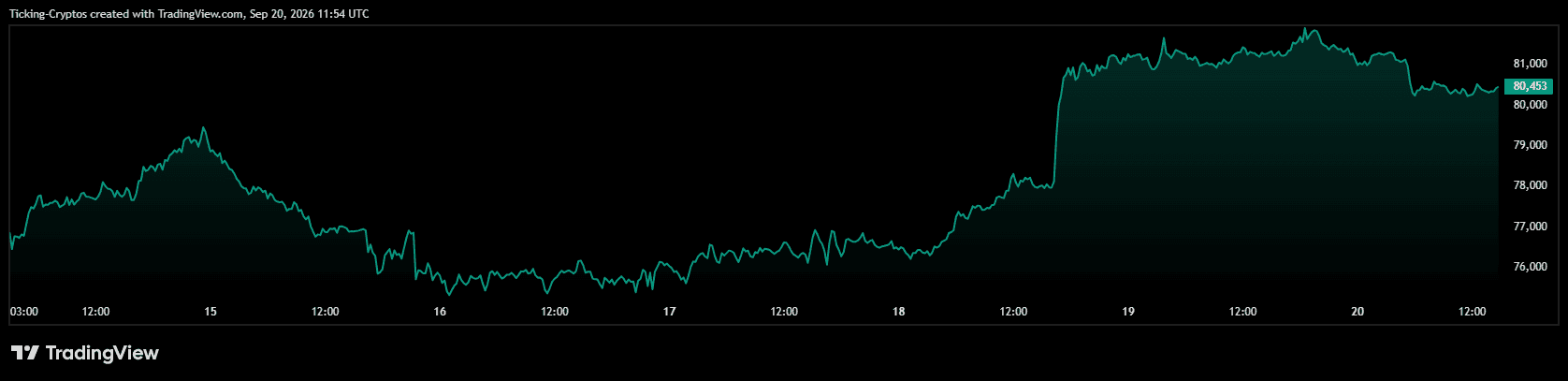
The rest was mechanics. Spot Bitcoin ETFs saw net inflows of $159.5 million on Thursday, and 111,660 traders were liquidated for $547.80 million over 24 hours, with short positions accounting for $431 million of that. Translation: everyone leaning short got run over. The Crypto Fear and Greed Index jumped to 71, firmly in "Greed," up from 56 the day before.
And when Bitcoin stops bleeding, altcoins do not just follow. They sprint.
Which Altcoins Performed Best This Week?
Here is the seven-day leaderboard from the screener, with prices at time of capture:
| # | Coin | Price | 7d % | YTD % | Market Cap |
|---|---|---|---|---|---|
| 1 | NEAR Protocol ($NEAR) | $3.56 | +55.24% | +136.02% | $4.66B |
| 2 | Arbitrum ($ARB) | $0.2129 | +54.13% | +14.15% | $1.44B |
| 3 | Pieverse ($PIEVERSE) | $1.75 | +48.58% | +233.93% | $517.05M |
| 4 | Ethena ($ENA) | $0.2036 | +45.42% | +2.01% | $2.05B |
| 5 | Uniswap ($UNI) | $9.00 | +40.86% | +55.34% | $5.59B |
Notice what these five have in common: not one of them is a memecoin. Every single mover this week had a real product update, a fee mechanic, or a regulatory tailwind behind it. That is unusual, and it is worth paying attention to.
NEAR Protocol: Why Is NEAR Up 55% in One Week?
NEAR led the pack, and it earned it. The token climbed from $2.34 on September 15 to $3.45 on September 18, a gain of over 45% in three days, briefly touching $3.50 on Friday after a 30.8% single-day move.
Three things stacked on top of each other. First, NEAR launched confidential perpetual trading through a Hyperliquid integration, hiding position details from public view. Second, confidential TVL crossed $70 million, which automatically triggered the first snapshot and reward distribution under the NEAR@3.33 incentive program. That program is cleverly built: it locked 333,333 milestone tokens redeemable only when NEAR's 3-day VWAP hits $3.33, so holders had a direct incentive to defend the price rather than dump the airdrop.
Third, and the part most people are ignoring, there is actual revenue. NEAR Intents generated $5.01 million in total fees over the past 30 days and retained $1.58 million in net revenue. On September 9, dormant wallets bought $33.37 million in ETH via CowSwap, then routed 2,500 ETH into 6,601 ZEC through NEAR Intents, which is exactly the kind of whale flow that privacy rails were built for.
The catch: NEAR is up 120.1% over 30 days. Moves that size do not retrace politely.
Arbitrum: What Is Actually Driving the ARB Price?
ARB is the comeback story of the month, and the engine has a familiar name. Robinhood Chain, built on Arbitrum's technology, set records on August 30 and 31 with $989 million in DEX volume and $2.66 million in daily app revenue. As part of the Arbitrum Expansion Program, it shares 10% of its net protocol revenue with the ecosystem: 8% to the DAO treasury and 2% to developers.
That is the bull case in one sentence. Somebody else's chain does the volume, and Arbitrum's treasury gets paid. The ArbOS 61 "Elara" upgrade activated on August 20, boosting Stylus contract capacity and adding optional protocol-level compliance filtering, which is aimed squarely at institutional developers.
Now the uncomfortable part, because we are not here to sell you anything. A scheduled unlock on September 23, 2026 releases 139.15 million ARB, with 53.8% going to team and insiders and 35% to private investors. That lands in three days. On top of that, some analysts have flagged that earlier ARB rallies this month showed thin organic activity and a very high share of wash trading, suggesting coordinated volume rather than genuine demand. Treat the ARB chart with more suspicion than the others on this list.
Pieverse: What Is PIEVERSE and Why Is It Pumping?
The one name most readers will not recognize. Pieverse is a Web3 payment infrastructure protocol designed to make blockchain transactions auditable and compliant for businesses and AI agents by generating on-chain, timestamped financial records. Its core product, Purr-Fect Claw, deploys AI agents with TEE wallets inside messaging apps like Line, Kakao and WhatsApp, and a ".pie" identity system replaces wallet addresses with readable handles like john.pie.
In plain language: invoices and receipts that a tax authority would accept, plus AI agents that can pay each other without you signing anything. It sits at the intersection of two of the loudest narratives in crypto right now, AI agents and compliant stablecoin payments.
Be honest about the risk profile here. Total supply is 1 billion PIEVERSE with roughly 27.5% circulating, and the full emission schedule runs four years, so there is a lot of supply still to come. Analysts covering the token's earlier September moves found no confirmed corporate announcements or news catalysts, attributing the advance to pure technical momentum and altcoin rotation. A half-billion-dollar market cap riding a narrative is a very different asset than Uniswap.
Ethena: Can ENA Hold a 45% Weekly Gain?
Ethena is the highest-beta name on this list, and its chart tells you why. ENA trades at $0.1927 on September 20, roughly 71.4% below its twelve-month high of $0.6729 and about 170.4% above its twelve-month low of $0.0713 from July 2. That is a token that falls harder and bounces harder than almost anything at its size.
The product itself is genuinely interesting. Ethena's core innovation is USDe, a synthetic dollar that is not fiat-backed but uses a delta-neutral hedging strategy, holding staked ETH while opening an equivalent short position on ETH futures. USDe peaked at $14.5 billion before correcting, and yield-bearing stablecoins as a category grew from under $1 billion to over $19 billion by September 2025.
But the week's move looks like beta, not fundamentals. Analysts covering an earlier ENA surge this month noted that the strength had little to do with the protocol itself, with limited capital flowing in and minimal fees generated. Allocations for early investors and the core team unlock continuously, creating persistent sell pressure that new demand has to absorb. ENA rips when risk appetite returns and gives it all back when it leaves.
Uniswap: Why Is UNI Back at $9?
Uniswap is the one where the fundamentals are hardest to argue with. UNI rose to $9.05 on September 18, up 18.67% in 24 hours and 48.8% over the week, driven by two unrelated things landing on the same day.
The first is structural and has been building for months. The UNIfication proposal, passed in December 2025 with 99.9% support, activated protocol fees across Uniswap v2, v3 and v4, directing trading fees toward automated UNI buybacks and burns. The mechanism burns an estimated $90 million in UNI annually, roughly 2.8% of circulating supply. Every swap now quietly removes tokens from the float. When Robinhood Chain posted a record $1.3 billion single-day DEX volume in early September, Uniswap captured the bulk of it, and the fee switch turned that volume into burns.
The second is the SEC news that lifted the whole market, except it hits Uniswap most directly. The September 17 Innovation Exemption lets eligible venues trade tokenized US stocks through permissioned automated market makers and liquidity pools for five years, which aligns closely with Uniswap v4's Permissioned Pools infrastructure launched in July 2026 with partners including Superstate, Securitize and Dowgo. The SEC did not name Uniswap. It did not really have to.
What Should Altcoin Traders Watch Next?
The honest read on this week: a relief rally that nobody was positioned for, amplified by forced short covering, landing on a handful of tokens that happened to have real catalysts ready. That is a better setup than a pure liquidity pump, but it is not a guarantee of follow-through.
Three things decide what happens next. Bitcoin needs to hold the level it just reclaimed, because a strong break above $82,000 is what analysts see as opening the door toward the $100,000 region, and $76,000 is the key support if momentum fades. The ARB unlock on September 23 is the first real supply test. And NEAR needs its confidential products to keep generating fees once the incentive program stops paying people to use them.
Altcoins that move 50% in a week can move 30% back in two days. Size accordingly.
0
0


 Manage all your crypto, NFT and DeFi from one place
Securely connect the portfolio you’re using to start.


