
Arbitrum Stablecoin Supply Falls From $7.7B To $4.4B Since May

0
0

Arbitrum’s stablecoin supply has fallen sharply since May, dropping from about $7.7 billion to roughly $4.4 billion on the latest Artemis dashboard.
The Artemis chain data shows a decline of about $3.3 billion from the May level. The drop reverses the expansion that previously pushed Arbitrum above $7.8 billion in stablecoins while 30-day transfer volume topped $74 billion.
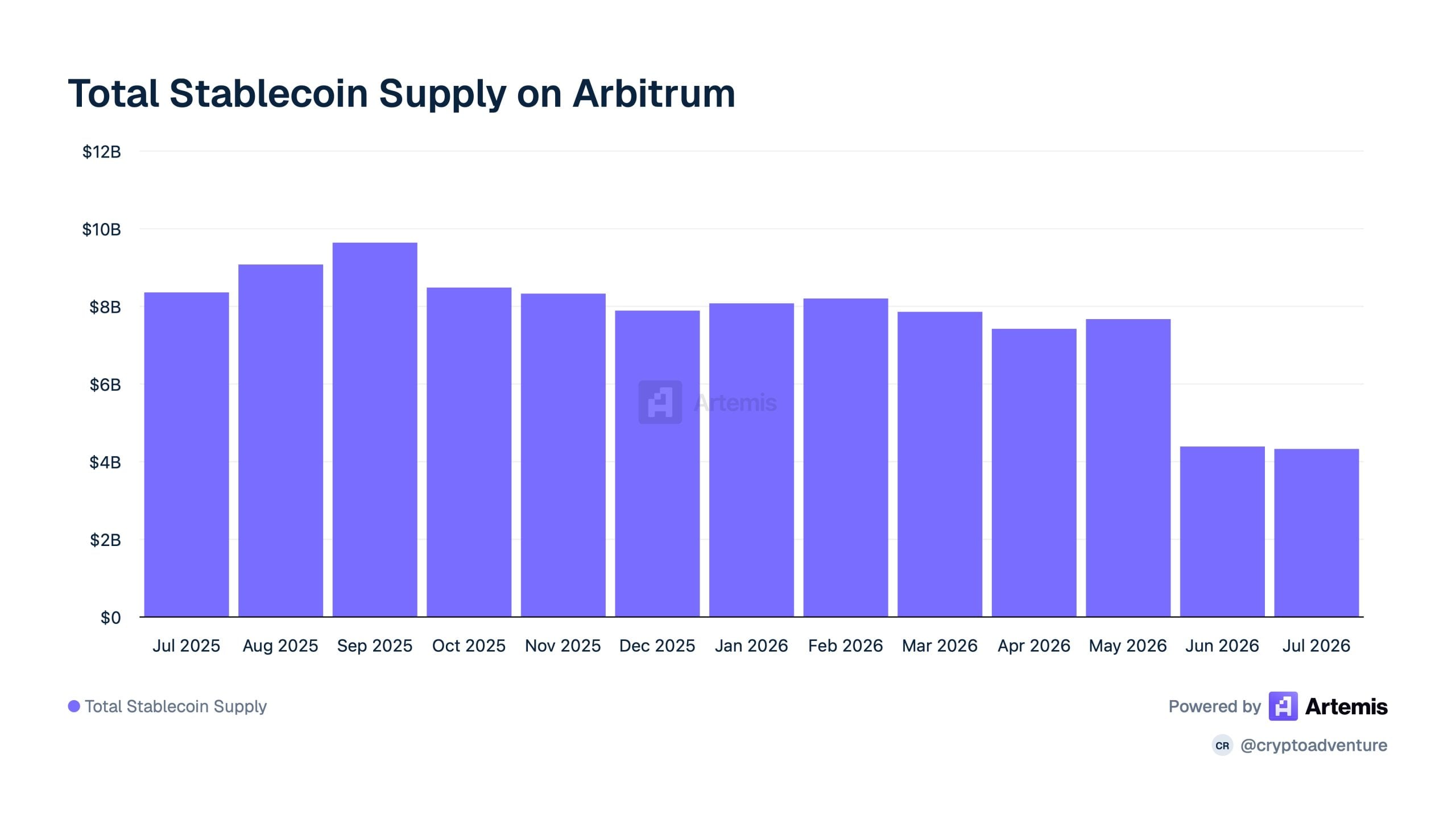
The new reading does not mean Arbitrum has stopped being an important Ethereum Layer 2 liquidity venue. It does show that part of the stablecoin base that built up earlier in the year has moved elsewhere, been bridged out, redeemed or repositioned into other networks and trading environments.
Stablecoin supply measures balances sitting on the chain. It does not show user intent by itself, so the decline should be read as a liquidity movement rather than proof that one single app, issuer or market maker caused the full outflow.
Hyperliquid Rotation Explains Part Of The Move
The clearest reason is the shift around Hyperliquid liquidity.
Arbitrum had been one of the main routes for USDC moving into Hyperliquid. Users and market makers used Arbitrum as a stablecoin bridge path for trading collateral, while Hyperliquid built one of the largest USDC bases in onchain derivatives.
That role has changed as HyperEVM and Hyperliquid-native flows matured. CEX.IO’s Q2 stablecoin report tied Arbitrum’s outflow to the fading of its earlier role as the main Hyperliquid on-ramp, while HyperEVM stablecoin supply grew in the same period.
The same transition was already visible when USDC on Hyperliquid crossed $4 billion. At that stage, the split included native USDC on HyperEVM and Arbitrum-bridged spot USDC on HyperCore, showing that liquidity was moving from a bridge-heavy model toward more direct Hyperliquid-side settlement.
Broader Stablecoin Market Also Rotated
Arbitrum’s decline also fits a wider stablecoin rotation rather than an isolated chain event.
Stablecoin supply has been moving between networks as users chase cheaper settlement, exchange liquidity, yield products, perpetual futures venues and issuer-specific integrations. That means a chain can lose supply even while stablecoin usage across crypto remains large.
For Arbitrum, the issue is not only total balances. The next test is whether lower supply still supports strong transfer volume, DeFi depth, lending markets, perps liquidity and tokenized-asset settlement. A smaller balance can still matter if the remaining stablecoins are actively used.
The drop does reduce Arbitrum’s liquidity cushion. Less stablecoin supply can make it harder for large trades, lending positions and app-level flows to stay on the network unless new deposits or higher turnover offset the balance decline.
Arbitrum’s Next Test Is Usage After Outflows
The May milestone showed Arbitrum as a major Layer 2 stablecoin hub. The current Artemis data shows a more defensive picture, with supply now near $4.4 billion.
A recovery would require fresh stablecoin inflows, stronger app demand or renewed use of Arbitrum as a settlement path for trading and DeFi. A deeper decline would suggest liquidity continues rotating toward Hyperliquid, Ethereum mainnet, Solana, Base, BNB Chain or other networks.
As of July 5, Arbitrum stablecoin supply stood near $4.4 billion on Artemis, down about $3.3 billion from the May level near $7.7 billion.
The post Arbitrum Stablecoin Supply Falls From $7.7B To $4.4B Since May appeared first on Crypto Adventure.
0
0

 Manage all your crypto, NFT and DeFi from one place
Securely connect the portfolio you’re using to start.

0
0

0
0

0
0

0
0