
Hyperliquid and Paradigm Urge Treasury to Revise GENIUS Act Stablecoin Rules

0
0

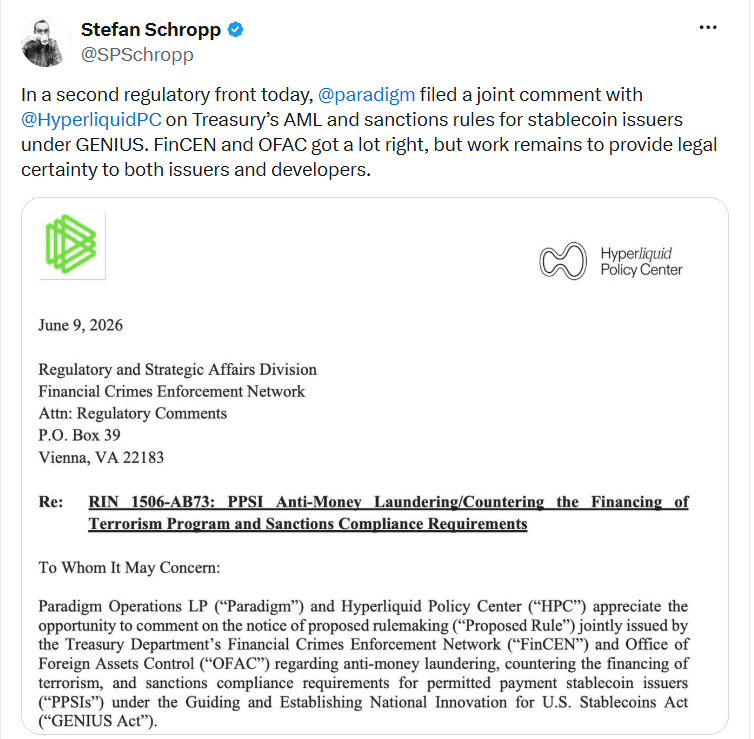
GENIUS Act stablecoin rules are at the center of a new policy debate after the Hyperliquid Policy Center (HPC) and Paradigm called on the U.S. Treasury to revise parts of a proposed anti-money laundering and sanctions framework for stablecoin issuers. In a joint comment submitted on Tuesday, the two organizations argued that some compliance obligations tied to secondary market activity should be narrowed or clarified to prevent unintended consequences for decentralized finance and permissionless blockchain networks.
The request arrives as federal agencies continue implementing the GENIUS Act, the stablecoin legislation signed into law by U.S. President Donald Trump last year. The law established a regulatory structure for stablecoins and their issuers, with implementation expected no later than January 2027. As regulators work through the rulemaking process, industry participants are increasingly focused on how compliance requirements will apply in decentralized environments where issuers often have limited visibility into user activity.
How Could GENIUS Act Stablecoin Rules Affect Stablecoin Issuers?
The GENIUS Act stablecoin rules are designed to establish anti-money laundering and sanctions compliance requirements for payment stablecoin issuers. In April, the Treasury Department, through the Financial Crimes Enforcement Network (FinCEN) and the Office of Foreign Assets Control (OFAC), proposed a rule to implement key provisions of the law.

HPC and Paradigm said they endorse FinCEN’s approach of focusing most compliance obligations on the primary market, where issuers maintain direct customer relationships and have access to customer information needed for regulatory compliance.
They argued that the same principle should guide the implementation of anti-money laundering and sanctions requirements for stablecoins operating on permissionless blockchain networks. In such environments, issuers generally see only wallet addresses and transaction activity rather than verified customer identities.
Why Are Hyperliquid and Paradigm Seeking Changes?
The organizations contend that parts of the Treasury proposal expand compliance obligations beyond areas that issuers can reasonably oversee. The proposed rule requires stablecoin issuers to have the capability to block, freeze, or reject transactions that violate U.S. law or sanctions on both primary and secondary markets.
HPC and Paradigm argued that this approach brings secondary market activity into an issuer’s compliance perimeter even when the issuer has no direct relationship with the users involved. In their letter, the groups said smart contract interactions are being treated as activities that may carry sanctions liability regardless of whether issuers have visibility into the transacting parties. They warned that issuers could be exposed to obligations for transactions they cannot meaningfully police.
What Concerns Were Raised About Decentralized Finance?
HPC and Paradigm said the proposed framework could discourage stablecoin issuers from deploying assets on permissionless blockchain infrastructure. They argued that an issuer facing compliance obligations it cannot realistically meet may choose to operate only within permissioned environments. Such a shift, they said, could reduce the presence of U.S.-regulated stablecoins in decentralized finance markets.
The organizations further warned that this could create space for unregulated offshore and non-dollar alternatives to gain a larger role in the market. Their position is that compliance requirements should reflect the practical limits of issuer oversight in decentralized ecosystems while preserving regulatory objectives.
What Does the Treasury Proposal Aim to Achieve?
The proposal is intended to give regulators stronger tools to enforce anti-money laundering and sanctions requirements in the stablecoin market. Under the draft rule, issuers would need the ability to block, freeze, or reject transactions that breach U.S. laws or sanctions restrictions.
The proposal forms part of the broader implementation process for the GENIUS Act stablecoin rules ahead of the law’s effective date. While HPC and Paradigm support compliance measures focused on direct customer relationships, they maintain that extending liability into secondary market transactions could create legal uncertainty for issuers and developers operating in decentralized environments.
What Happens Next in the Regulatory Process?
Federal agencies are reviewing industry feedback as they continue developing the final framework under the GENIUS Act stablecoin rules. At the same time, lawmakers are debating the CLARITY Act, a separate cryptocurrency bill that could introduce additional provisions for stablecoin issuers and potentially remove money laundering and sanctions liability for developers of crypto platforms.
Senators continue to negotiate key provisions of the legislation with some seeking a chamber-wide vote ahead of November. The measure could ultimately shape how regulatory responsibilities are assigned among crypto firms, issuers, and other market participants.
Could Future Legislation Change the Compliance Landscape?
The regulatory discussion extends beyond the Treasury proposal. Other industry participants have also advocated for clearer protections for developers and infrastructure providers as lawmakers consider broader crypto legislation.

The disagreement reflects a wider challenge facing policymakers. As stablecoin regulation takes shape regulators are trying to address financial crime risks while industry participants warn against rules that could be difficult to implement on open blockchain systems.
Conclusion
GENIUS Act stablecoin rules continue to shape discussions between regulators and the digital asset sector as implementation efforts move forward. The letter highlights ongoing concerns over how anti-money laundering and sanctions requirements should be applied to stablecoin transactions that take place beyond an issuer’s direct oversight particularly within decentralized finance.
With federal agencies reviewing feedback and lawmakers considering additional legislation the coming months are expected to play a significant role in determining how regulated stablecoins operate within the U.S. market. The outcome will likely influence not only issuers but also developers, blockchain infrastructure participants and the future role of decentralized finance under the GENIUS Act stablecoin rules.
Glossary
Hyperliquid Policy Center: Hyperliquid’s public policy and advocacy arm.
Paradigm: Venture firm investing in crypto and blockchain projects.
FinCEN: U.S. agency that fights financial crime.
OFAC: U.S. office that manages sanctions programs.
Anti-Money Laundering: Measures used to prevent money laundering.
Frequently Asked Questions About GENIUS Act Stablecoin Rules
Why did Hyperliquid and Paradigm oppose the proposal?
They said some compliance requirements could be difficult for issuers to manage in decentralized networks.
What changes are Hyperliquid and Paradigm requesting?
They want some secondary market obligations to be narrowed or clarified.
How could the rules affect stablecoin issuers?
The rules could require issuers to block, freeze, or reject certain transactions.
Why are DeFi projects concerned about the proposal?
They believe the rules could make it harder for stablecoins to operate in decentralized finance.
When will the GENIUS Act be fully implemented?
The GENIUS Act is expected to be implemented by January 2027.
Sources-
Read More: Hyperliquid and Paradigm Urge Treasury to Revise GENIUS Act Stablecoin Rules">Hyperliquid and Paradigm Urge Treasury to Revise GENIUS Act Stablecoin Rules
0
0


 Manage all your crypto, NFT and DeFi from one place
Securely connect the portfolio you’re using to start.

0
0

0
0


0
0