
Arbitrum Mainnet Upgrade Is Live Now: Elara Adds Priority Fee Support

0
0
Arbitrum News Today: What New ArbOS 61 Elara Upgrade Mean for Users?
Arbitrum's ArbOS 61 "Elara" upgrade went live on August 20, 2026, following approval through ArbitrumDAO governance. The update introduces optional protocol-level compliance filtering, priority-fee support, and an alternative data-availability interface, but only for dedicated chains, not Arbitrum One or Nova.
On Arbitrum One itself, Elara brings a new base-fee management system and quadruples Stylus smart contract capacity from 24 KB to 96 KB. Here's a breakdown of what changed, how the new compliance tools work, and what comes next.
Arbitrum Price Today hits $0.09576 with a surge of 8% and Market capitalization of $639.56 million, as well as 24-hour trading volume of $98.4 million.
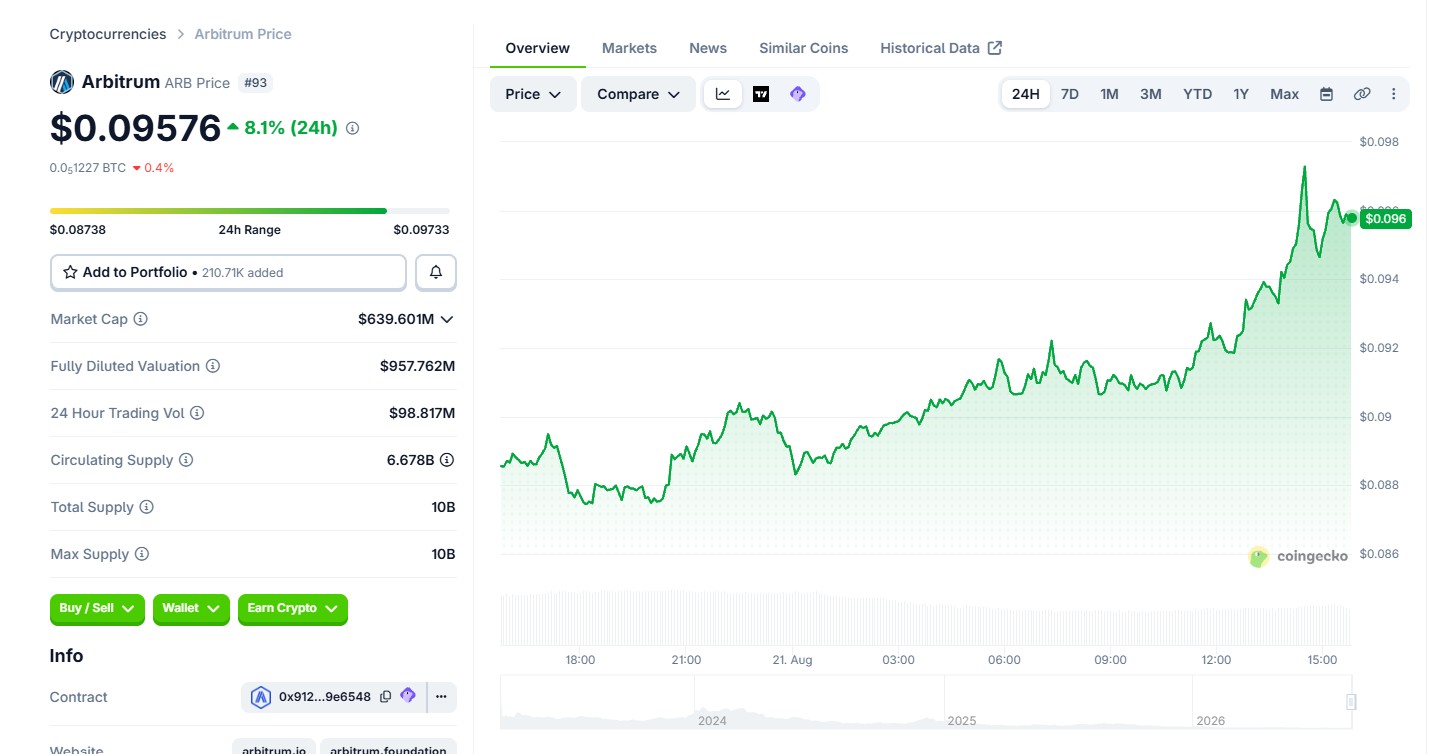
CoinGecko Data
Arbitrum ArbOS 61 Elara Upgrade Is Now Live: What Changed?
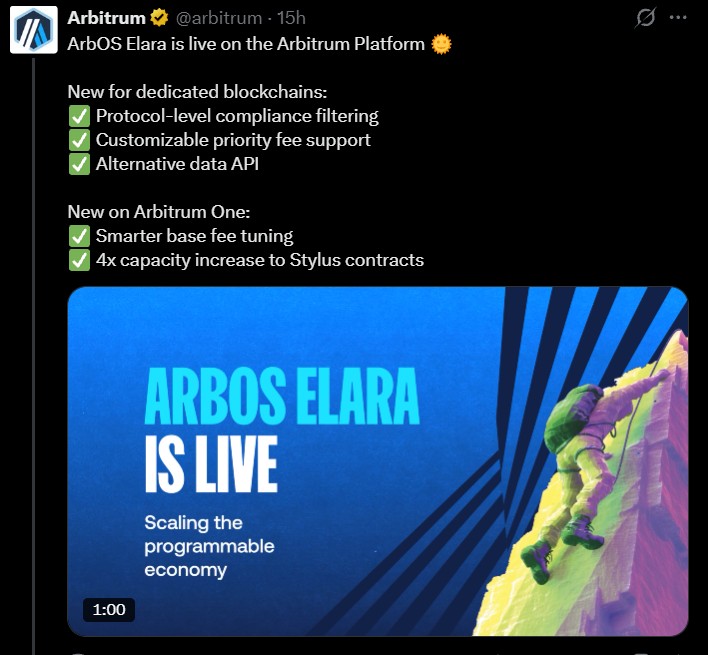
The ArbOS Elara upgrade went live on August 20, 2026, after clearing ArbitrumDAO governance. ArbOS 61, nicknamed Elara, brings optional protocol-level transaction screening, priority-fee support, and a new data-availability interface to dedicated chains, while also adjusting how base fees are managed and expanding smart contract capacity on One.
Importantly, the headline compliance and fee features are not switched on for One or Nova. Those tools exist as configurable options that only operators of dedicated (private) Arbitrum chains can turn on. The One users see two changes from this release: a new system for tuning the network's base fee, and a fourfold jump in the size limit for Stylus smart contracts.
What Is Arbitrum Elara and Why Does the Upgrade Matter?
Elara is built for businesses that want to run their own Arbitrum-based blockchain while meeting regulatory obligations. Rather than forcing every chain to follow identical rules, the upgrade gives chain owners a toolkit they can configure to match their own compliance and market-structure needs.
That flexibility is aimed squarely at institutions exploring regulated, onchain financial products, since it lets them build screening and fee-ordering logic directly into the base protocol instead of bolting it on at the application layer.
Arbitrum Adds Optional Compliance Filtering for Dedicated Chains
The most discussed piece of Elara is protocol-level compliance filtering. It ships off by default, and a dedicated chain's owner must actively set it up before anything is screened.
An owner can pick a third-party screening provider; the source material names TRM Labs and Chainalysis as examples to generate a list of restricted addresses, then write rules governing how those addresses can transact, call contracts, or move funds.
How Arbitrum's Compliance Filter Works
Enforcement happens in two stages.
First, the sequencer test-runs incoming transactions and blocks anything that breaks the configured rules before it can land in a block.
Second, for transactions sent through the parent chain's Delayed Inbox, a route that normally lets users bypass the sequencer, a monitoring component can flag the transaction hash to an onchain guardian, which forces the state transition function to reject it anyway. This closes off the usual workaround for forced inclusion.
Restricted addresses are kept as salted hashes rather than stored in plain text, and Arbitrum's documentation suggests chains hold off adopting the feature for at least 30 days following the Arbitrum One release, presumably to let the tooling prove itself in production first.
Arbitrum Elara Adds Priority Fees, But Arbitrum One Still Needs a DAO Vote
Elara also introduces the underlying machinery for priority fees, or tips, on dedicated chains but again, it arrives switched off. Only a chain owner, using the access-controlled ArbOwner precompile, can activate fee collection, and even then the chain must separately update its sequencer to actually reorder transactions based on those tips.
For Arbitrum One specifically, this update only installs the groundwork. Turning on priority-fee collection network-wide would require its own constitutional vote from ArbitrumDAO, as Step has flagged as a potential move toward priority gas auction-style transaction ordering down the line.
What Elara Changes on Arbitrum One: Base Fees and Stylus Capacity
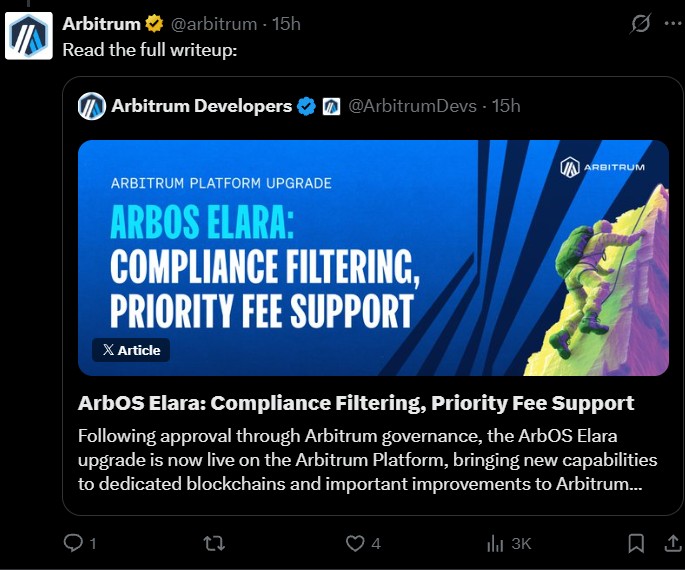
The One does get two concrete upgrades. A new BaseFeeManager contract lets Offchain Labs adjust the network's minimum layer-2 base fee within a DAO-approved band of 0.01 to 0.10 gwei.
That authority is time-limited, expiring two years after activation, requires public notice on the forum before any change, and can be revoked by the DAO at any point. The upgrade itself does not raise fees it simply creates a faster, pre-approved mechanism for adjusting them later if conditions call for it.
Separately, Stylus contract capacity used for Rust-based smart contracts jumps from 24 KB to 96 KB, a fourfold increase that should reduce how often developers need to split large applications across multiple contracts. Solidity contract-size limits are unaffected.
Alternative Data Availability API: What It Means for Dedicated Arbitrum Chains
Elara's new Alternative Data Availability (AltDA) API lets dedicated chain operators plug in outside data-availability providers instead of maintaining a customized fork of Arbitrum's Nitro software stack. That should cut long-term engineering overhead for teams running their own chains. The One won't use this feature, since its transaction data already settles on Ethereum.
Arbitrum Elara Upgrade Timeline
-
Governance approval: ArbitrumDAO approves ArbOS 61 "Elara."
-
August 20, 2026: ArbOS 61 Elara activates across the Arbitrum Platform.
-
After activation: Dedicated-chain owners can begin configuring compliance filtering and priority fees.
-
Post-launch: Chains are advised to wait at least 30 days after the One release before enabling compliance filtering.
-
Next step: One's own priority-fee activation still needs a separate DAO vote.
-
Ongoing: Stylus developers should review WASM compatibility notes, since support for the multi-value extension has been removed.
What Users, Developers and Chain Operators Should Watch Next
For now, everyday One users won't notice a difference no new screening, no new fees, just a smoother base-fee process and more room for Stylus developers to build.
The bigger story is what dedicated-chain operators do with these new tools over the coming months, and whether ArbitrumDAO eventually votes to bring priority fees to One itself. Stylus developers relying on multi-value WASM should check compatibility before attempting to activate or reactivate affected contracts.
Conclusion
Elara marks a shift toward configurable, institution-friendly infrastructure rather than one-size-fits-all rules. Dedicated chain owners now have real tools for compliance and fee-market design, while One gains only incremental changes: smoother base-fee tuning and expanded Stylus capacity.
Bigger questions remain open, including whether ArbitrumDAO will eventually approve priority fees for One and how quickly dedicated chains adopt compliance filtering. For now, everyday users see no immediate impact, but the groundwork for a more regulated ecosystem is in place.
YMYL Disclaimer: This article is for informational purposes only and does not constitute financial, investment, or legal advice. Cryptocurrency markets are volatile and carry risk; always do your own research before making investment decisions.
0
0

 Manage all your crypto, NFT and DeFi from one place
Securely connect the portfolio you’re using to start.


