
Crypto News Today: Binance Exits the EU, Circle Craters, and Bitcoin Slides Below $59K

0
0

The MiCA enforcement deadline has finally landed, pushing the world's biggest exchange out of the EU. A 140-company alliance just detonated a bomb under the leading regulated stablecoin issuer. And Bitcoin is grinding near its lowest levels in over a year as institutional demand stays soft. Here's what's actually moving the market today.
Why is Bitcoin falling today?
Sentiment is firmly risk-off. The global crypto market cap sits around $2.11 trillion, down roughly 1.8% over 24 hours, with total trading volume near $76.9 billion. $BTC is trading around $58,500, off about 2.2% on the day, while $ETH is near $1,573, down roughly 1.4%.
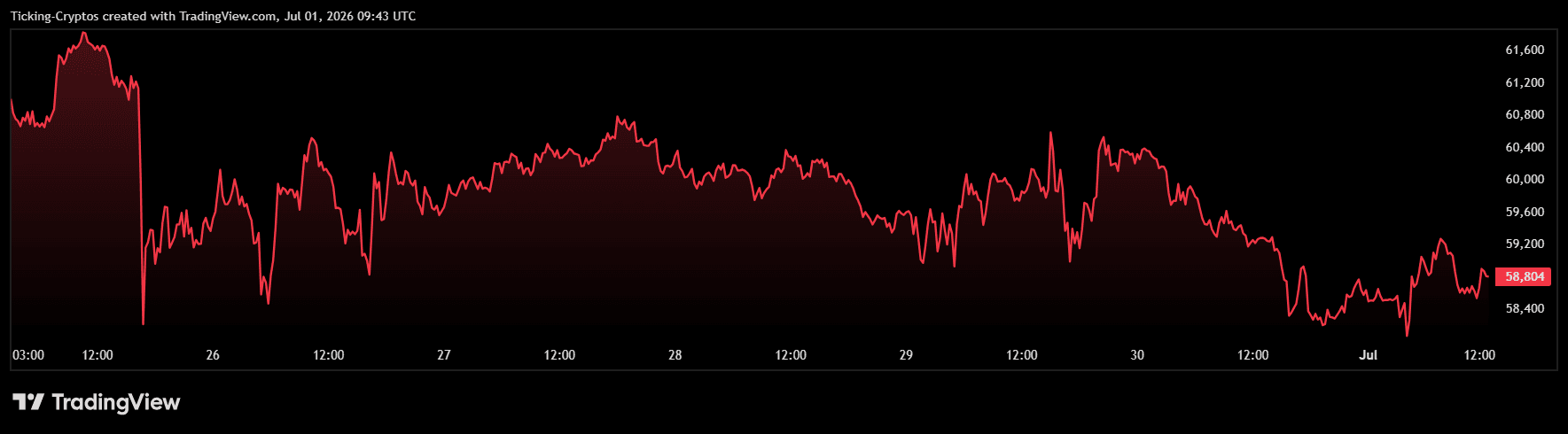
The mood gauge tells the story. The Fear & Greed Index has dropped to 11 — deeper into "extreme fear" — down from 15 a day earlier, as total market cap slipped from $2.16T to $2.11T. The backdrop is a persistent bear phase: ETF outflows, worries over a delayed CLARITY Act, and money rotating out of crypto and into AI stocks have all extended the downturn that dragged $BTC to its lowest levels since 2024 last week. Not everything is red, though — Polkadot and the XRP Ledger ecosystem were among the day's biggest gainers, and Stellar's $XLM climbed close to 12%.
What does the Binance EU exit mean for the market?
Today is the day MiCA gets real. As of 1 July 2026, any crypto firm serving EU residents must hold a MiCA licence — and Binance doesn't. It withdrew its Greek licence application on 24 June, leaving it without authorisation in any EU country, and from today it halts new sign-ups, spot trading, deposits and Earn products for EU users, though withdrawals stay open.
The scale of the regulatory cull is the real headline. Of more than 3,000 firms that were operating across Europe, only around 210 have secured full CASP authorisation — a pass rate near 7%. Rivals like Coinbase, Kraken and OKX cleared the bar; the world's largest exchange did not. For traders, that means hundreds of thousands of users across Spain, France, Italy and Poland are now weighing where to move their funds — a live migration that favours already-licensed venues. (We've published a full step-by-step guide on switching from Binance to a regulated EU exchange, if that's on your radar.)
Why did Circle stock crash?
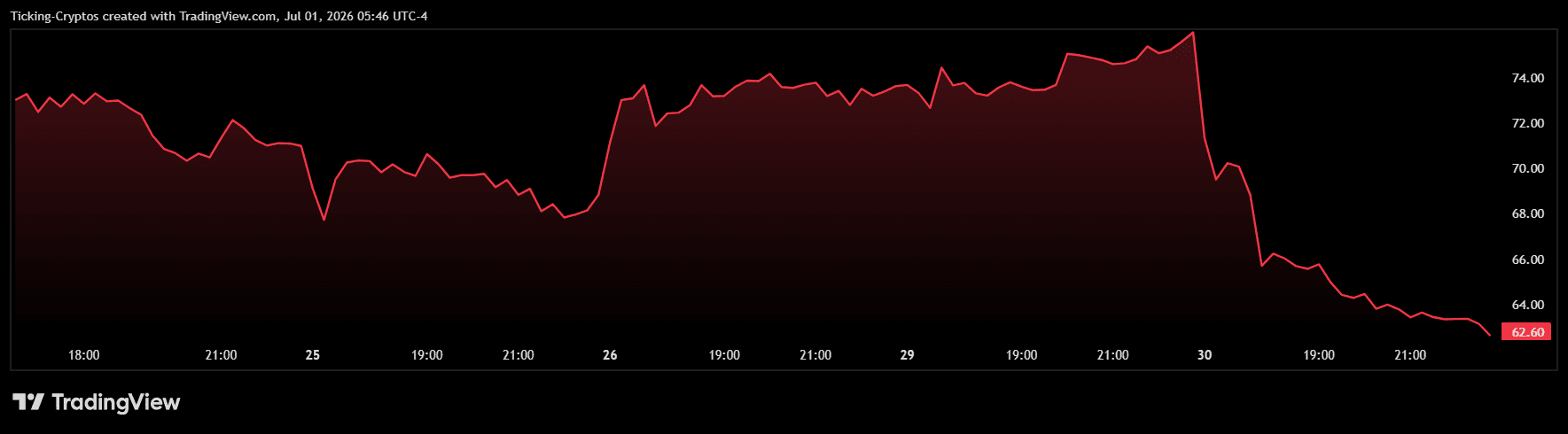
This is arguably the biggest structural story of the week. Circle ($CRCL) shares fell about 16.5% on 30 June after a consortium of more than 140 companies unveiled Open USD (OUSD), a stablecoin built to compete head-on with USDC. The stock traded as low as $63.10 after opening near $72.46, one of its sharpest single-day drops since listing, and is now down more than 40% over the past month.
What makes OUSD dangerous to incumbents is its economics. Launch partners include Stripe, Coinbase, Mastercard, Visa and BlackRock, and the new stablecoin lets partners keep the reserve earnings — striking directly at one of the core economics of today's issuers. Where issuers like Circle earn revenue by investing reserves in short-term Treasuries and keeping most of the interest, OUSD instead distributes that yield to participating businesses, with free, uncapped minting and shared governance. The Coinbase angle stings most: Circle paid Coinbase roughly $908 million in a single recent year in USDC distribution fees — and that partner is now backing a rival. OUSD is expected to go live later this year, initially on chains including Base and Solana.
Other regulatory news to watch
Several fronts are heating up at once. Jefferies has warned of crypto market volatility as the CLARITY Act faces a key Senate test, noting passage would boost institutional adoption while delays would prolong regulatory uncertainty. Meanwhile, the stablecoin rulebook is diverging across borders: the UK's Financial Conduct Authority has proposed lowering stablecoin capital buffers, undercutting the EU's stricter MiCA requirements. And in Asia, Taiwan has passed a sweeping crypto law introducing licensing, reserve mandates and tough penalties, now awaiting final presidential approval.
0
0

 Manage all your crypto, NFT and DeFi from one place
Securely connect the portfolio you’re using to start.

0
0

0
0


0
0