
Chainlink’s Address Spike May Not Be Organic — Bot Activity or Real Users?

0
0


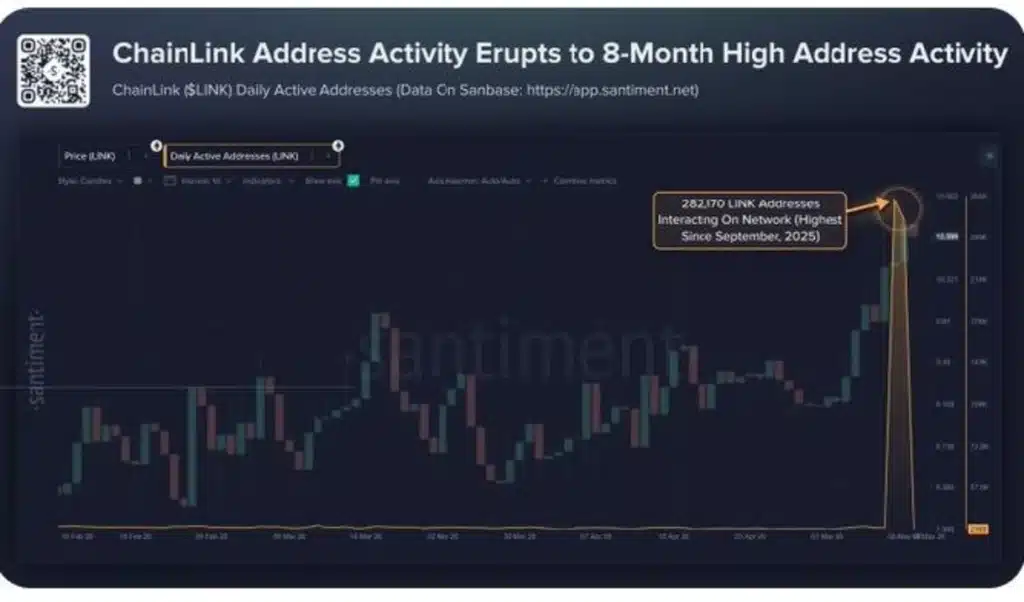
Chainlink’s address activity just erupted to an 8-month high — and the first question any serious analyst asks is whether that number is real.
According to Santiment, 282,170 LINK addresses were interacting on the network on May 10 — the highest level since September 2025.
The price responded, climbing toward $10.44. But address spikes without context are one of the most misread signals in crypto. So what is actually driving this one?
The Case for Real Users
On May 8, Solv Protocol and Re migrated nearly $1 billion in assets to Chainlink’s CCIP after a rival bridge exploit.
This is a high-value flight to quality that directly translated security concerns into adoption of Chainlink’s core infrastructure.
CCIP processed over $18 billion in cross-chain volume in Q1 2026 — 78% quarterly growth.
Wallets holding between 100,000 and 10 million LINK added 32.93 million tokens, pushing combined holdings toward 461 million LINK.
Deloitte issued a SOC 2 Type 2 audit on May 2 — making Chainlink the only oracle platform meeting top-tier institutional compliance standards.
That kind of certification does not attract bots. It attracts institutions.
Should the Address Spike Be Taken at Face Value?
Address activity is one of the most easily gamed metrics in crypto.
A single protocol migration or automated contract interaction can generate thousands of address touches — none representing a human decision.
LINK spent three months in a tight range between $7.80 and $10.00, down more than 37% year-on-year.
A 282,170-address spike on a single day warrants scrutiny. Address data alone cannot separate bots from real users. What it can confirm is that something is happening on-chain. The question is what.
Chainlink’s Technical Overview
LINKUSD (Weekly): As of May 12, 2026 timestamped 06:56 UTC, LINK trades at $10.440, up +1.41% on the week.
The MACD histogram has flipped green at +0.446 — a small but directionally significant shift from deeply negative territory.
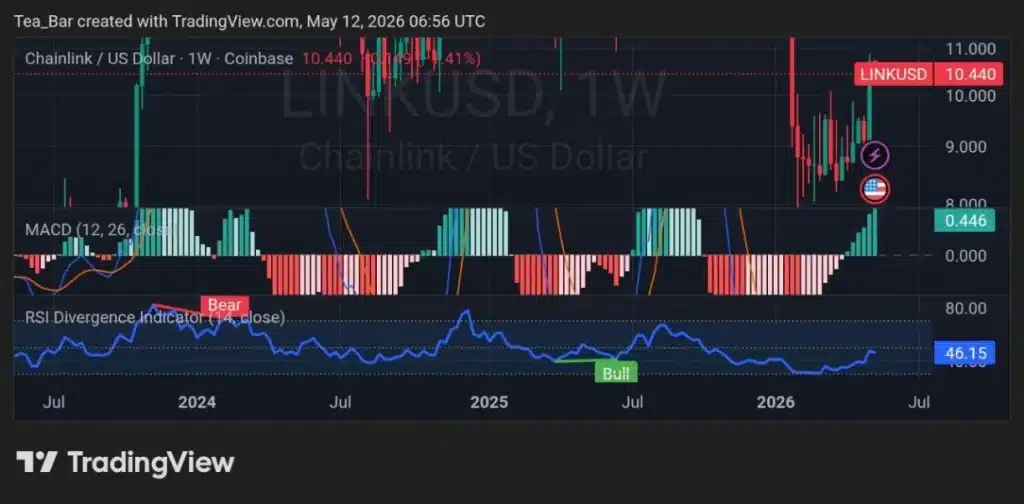
The MACD and signal lines are crossing upward. The RSI Divergence Indicator at 46.15 is climbing from the “Bull” divergence signal that appeared in mid-2025 — the same signal that preceded LINK’s last significant recovery.
A “Bear” divergence in early 2024 accurately predicted the subsequent downtrend.
The current bull signal points the opposite way. The $10.00 level is the immediate gate. A weekly close above it is the first confirmation this move has legs.
LINKBTC (Weekly): Against Bitcoin, LINK sits at 0.0001289 — far from its cycle high of 0.0004573.
The Keltner Channel mid-band at 0.0001313 sits just above price. The lower band at 0.0001126 has acted as a floor.
The MACD lines at +0.0000013 and -0.0000075 are compressing — a tightening that has preceded prior directional expansions on this pair.
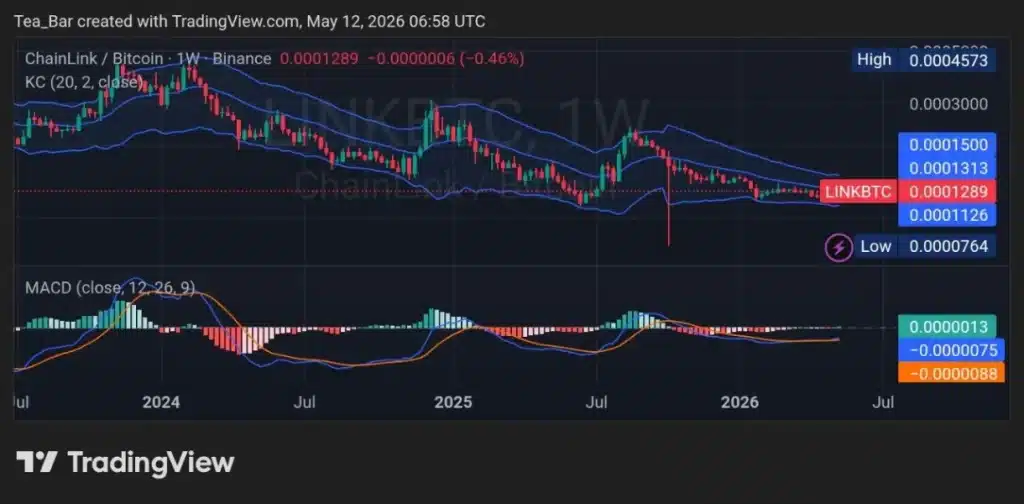
Price is sitting between the lower and mid Keltner bands. That zone has historically resolved upward when accompanied by a MACD crossover.
The crossover has not happened yet. But the lines are moving.
Real Demand or Just Noise?
Exchange reserves have dropped to approximately 129.3 million LINK. Netflows have turned negative — roughly 345,000 LINK moving off exchanges — a pattern commonly associated with accumulation.
That data does not come from address counts. It comes from wallet behaviour — and wallet behaviour is much harder to fake.
The exchange outflows, the $1 billion CCIP migration, the whale accumulation, and the Deloitte certification are all pointing in the same direction.
When this many independent signals align simultaneously, is it still reasonable to call it noise?
Disclaimer:
This article is for informational purposes only and does not constitute financial, investment, or trading advice. The views expressed are based on publicly available data, market observations, and the author’s interpretation at the time of writing. Cryptocurrency markets are highly volatile and unpredictable, and past performance or current technical setups do not guarantee future results. Readers should conduct their own research and consult with a qualified financial advisor before making any investment decisions. TechGaged does not accept liability for any losses incurred based on the information presented.
The post Chainlink’s Address Spike May Not Be Organic — Bot Activity or Real Users? appeared first on TechGaged.com.
0
0

 Manage all your crypto, NFT and DeFi from one place
Securely connect the portfolio you’re using to start.

0
0


0
0
