
Amundi Solana UCITS Fund Signals Growing Institutional Confidence in SOL

0
0

The Amundi Solana UCITS Fund marks a major shift in institutional crypto finance. Europe’s largest asset manager has moved deeper into blockchain infrastructure, adding fresh momentum to Solana’s expanding role in global financial markets.
Amundi, which oversees roughly €2.4 trillion in assets under management, announced a partnership with Spiko Finance to launch a regulated investment structure connected to the Solana ecosystem. The development arrives as institutional demand for blockchain-based financial products continues to accelerate across Europe, North America, and Asia.
The announcement matters because institutional capital rarely moves early. Large asset managers typically enter markets after infrastructure, compliance systems, and liquidity conditions mature. Solana now appears to be reaching that phase.
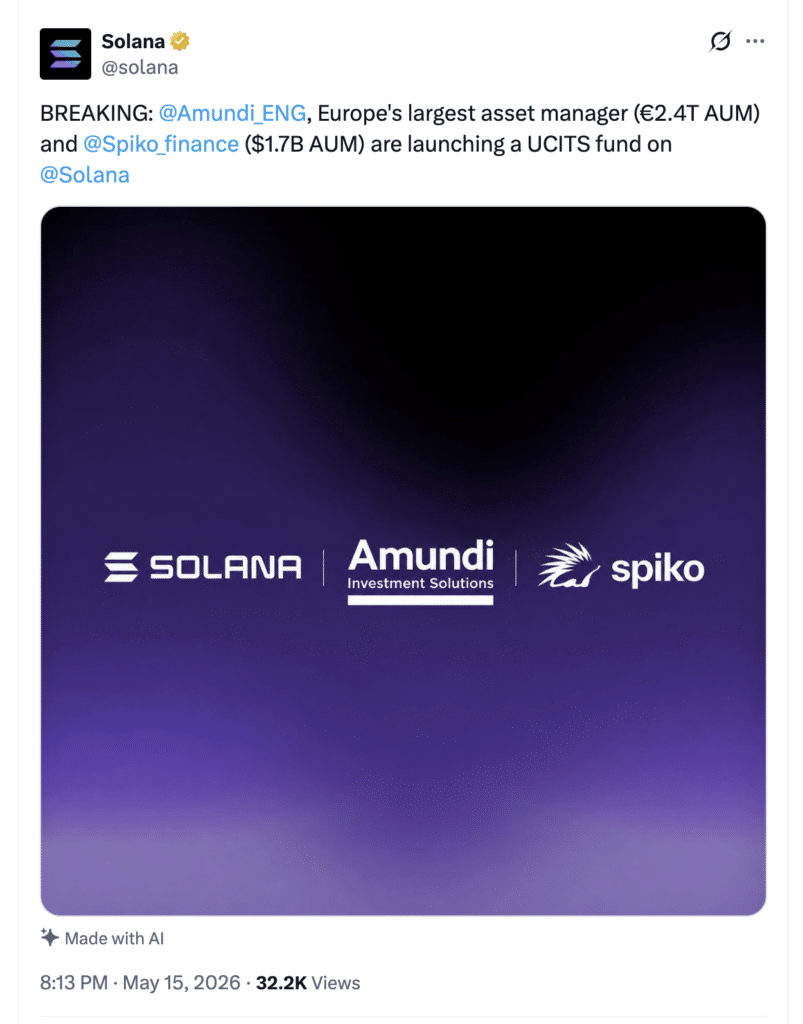
Amundi Solana UCITS Fund Shows Institutional Confidence in SOL
The Amundi Solana UCITS Fund immediately changes how financial institutions may evaluate Solana exposure. Institutional allocators often avoid blockchain products without strong regulatory frameworks. That barrier continues shrinking.
Solana has already built momentum through partnerships involving major payment infrastructure companies and growing institutional market participation. Spot exchange-traded fund activity tied to SOL products has expanded significantly in recent months.
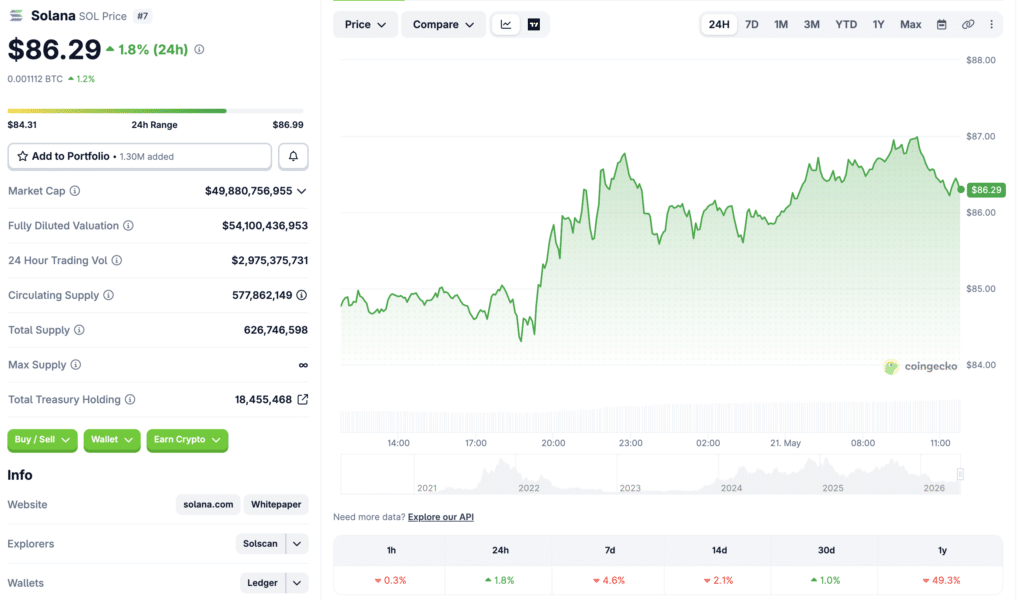
Current market conditions also support broader optimism. Solana trades near $86.35 at publication time, showing a 24-hour gain of approximately 1.77%. Daily trading volume stands around $3.64 billion, while market capitalization remains near $49.9 billion. Circulating supply currently sits above 577 million SOL.
The Amundi Solana UCITS Fund strengthens the narrative surrounding long-term Solana institutional adoption and positions SOL closer to Bitcoin and Ethereum in institutional portfolio discussions.
Why Goldman Sachs and Amundi Reflect Different Institutional Strategies
Institutional behavior rarely moves in one direction. That remains true with Solana.
Recent reports showing reduced SOL exposure from Goldman Sachs created industry debate around changing institutional preferences. Some market participants interpreted the move as bearish sentiment. Others viewed it differently.
The Amundi Solana UCITS Fund introduces a second institutional perspective. One side appears focused on short-term portfolio management and risk balancing. The other focuses on long-term infrastructure positioning.
That divergence matters. Financial markets often mature when opposing institutional strategies coexist. Different investment horizons can reduce extreme volatility while supporting deeper liquidity. Institutional investors move capital according to mandates, compliance frameworks, and portfolio construction requirements.
The growing separation between tactical positioning and structural blockchain adoption highlights how Solana institutional investment continues evolving.
How the UCITS Fund on Solana Structure Actually Works
The Amundi Solana UCITS Fund uses an investment framework designed for regulated European capital markets.
UCITS stands for Undertakings for Collective Investment in Transferable Securities. The framework acts as one of Europe’s strongest regulatory standards for investment products. A fund approved under UCITS rules can operate across multiple European Economic Area markets without requiring separate approvals in each jurisdiction.
That passporting capability creates enormous advantages.
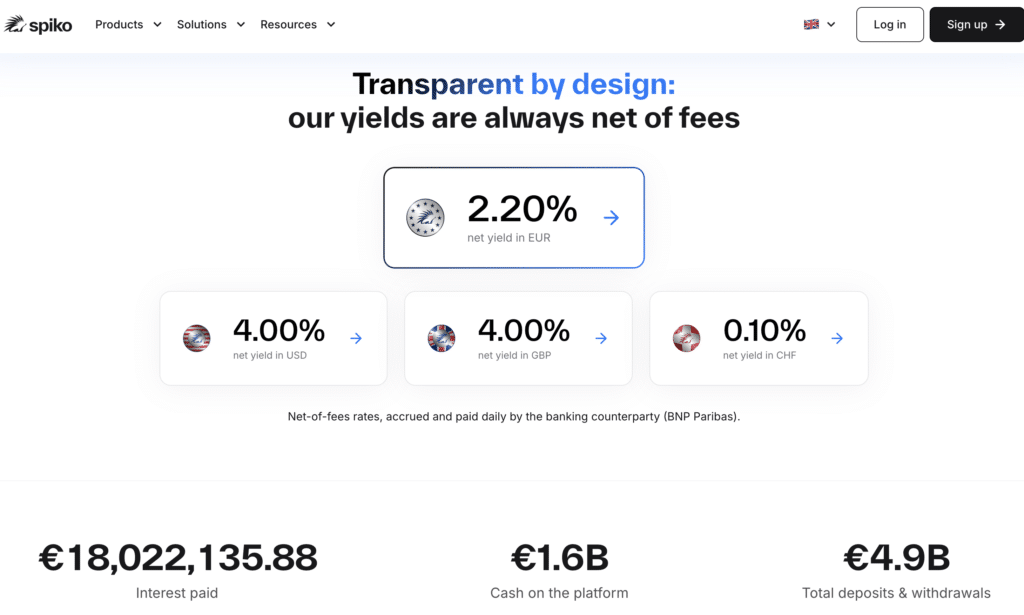
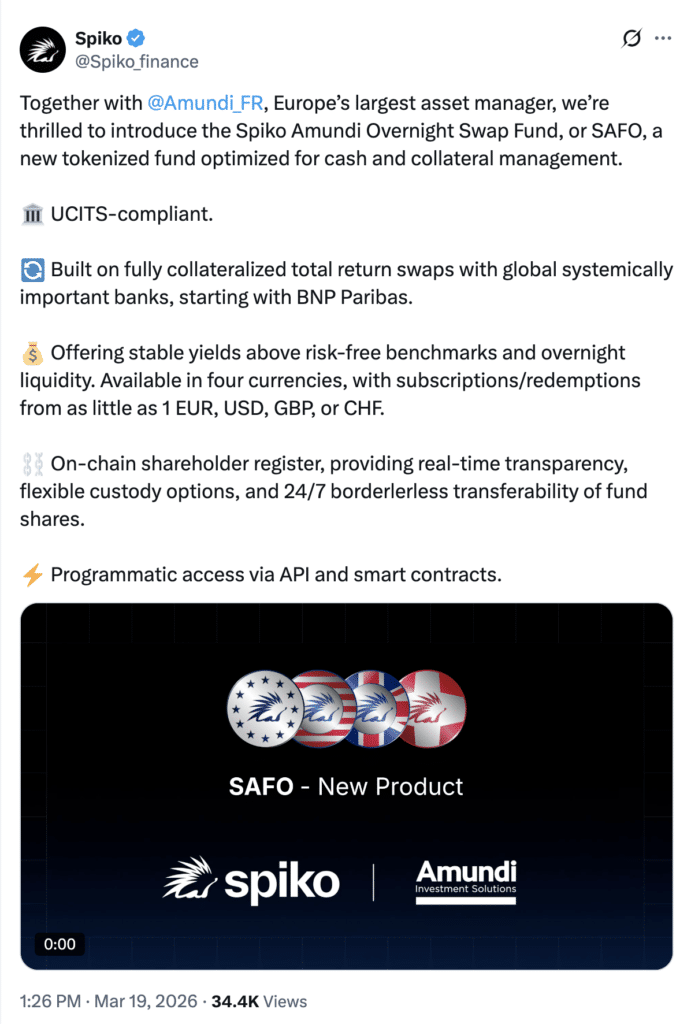
The product structure involves the Spiko Amundi Overnight Swap Fund, also known as SAFO. Rather than functioning as direct SOL ownership, the structure generates yield using fully collateralized total return swaps supported by major banking institutions.
This approach gives institutions exposure to blockchain settlement infrastructure while maintaining familiar compliance protections.
The UCITS fund on Solana model blends traditional finance with blockchain efficiency, creating another example of expanding Solana finance adoption.
Amundi Solana Partnership Builds Multi-Chain Institutional Infrastructure
The Amundi Solana UCITS Fund does not represent an isolated experiment.
Amundi and Spiko previously expanded treasury infrastructure across multiple blockchain ecosystems, including Ethereum, Polygon, Arbitrum, Base, Starknet, Stellar, and Etherlink. Solana becomes another strategic layer inside that broader digital asset framework.
The growing Amundi Solana partnership reflects institutional thinking increasingly centered on blockchain interoperability rather than chain exclusivity.
Traditional finance firms entering crypto rarely place all infrastructure onto a single network. Multi-chain strategies reduce operational concentration risks while improving flexibility.
The collaboration also strengthens broader narratives around Spiko Finance Solana integration and demonstrates how regulated capital increasingly embraces blockchain settlement systems.
Institutional adoption rarely happens overnight. It develops gradually through infrastructure expansion, compliance validation, and operational testing. Solana appears to be checking those boxes.
Solana Institutional Adoption Grows in Europe
European regulation continues shaping crypto market evolution.
The Amundi Solana UCITS Fund enters the market as Europe strengthens regulatory frameworks surrounding digital assets. The Markets in Crypto-Assets framework continues creating more clarity for institutions exploring blockchain opportunities.
Large allocators often prioritize regulatory certainty before deploying capital. Pension funds, treasury operations, and institutional asset managers generally require compliance structures before considering blockchain exposure.
That environment increasingly supports broader Solana institutional adoption grows in Europe trends. Cross-border fund distribution also strengthens the opportunity.
The structure supports multiple currencies, including EUR, USD, GBP, and CHF. Lower operational friction improves accessibility for institutional capital pools operating across different jurisdictions. The result creates stronger conditions for expanding Solana blockchain fund participation throughout Europe.

Why Amundi Choosing Solana Matters for Crypto Adoption
The Amundi Solana UCITS Fund highlights a larger shift happening across digital finance.
Institutional investors increasingly evaluate blockchain infrastructure based on settlement speed, transaction efficiency, compliance compatibility, and scalability. Solana continues improving its position across those categories.
The network already supports growing payment integrations and financial infrastructure expansion. Institutional product development adds another layer.
Questions surrounding Why Amundi choosing Solana matters for crypto adoption ultimately connect back to credibility.
Large institutions moving toward blockchain infrastructure often influence broader market behavior. Smaller institutions frequently follow established financial leaders once operational models prove successful.
The growing relationship between traditional finance and blockchain technology suggests Institutional investors move toward Solana blockchain infrastructure for strategic reasons rather than speculation.
That distinction matters for long-term adoption.
Conclusion
The Amundi Solana UCITS Fund represents more than another blockchain headline. It reflects a broader transformation happening inside institutional finance.
Europe’s largest asset manager entering regulated blockchain infrastructure signals growing confidence in Solana’s long-term role within digital financial markets. Combined with expanding infrastructure partnerships, increasing institutional participation, and improving regulatory clarity, Solana continues strengthening its position inside global capital markets.
Institutional adoption develops slowly until momentum reaches critical mass. The latest Amundi launches UCITS fund on Solana blockchain milestone suggests blockchain finance may be moving closer to that inflection point.
Investors, analysts, and market participants should continue monitoring institutional allocation trends, regulatory developments, and infrastructure expansion shaping the next phase of blockchain adoption.
Appendix: Glossary of Key Terms
UCITS: European regulatory framework governing transferable securities investment funds.
SOL: Native cryptocurrency powering the Solana blockchain.
Institutional Adoption: Process where large financial organizations integrate blockchain or digital assets into operations.
Tokenization: Converting traditional financial assets into blockchain-based representations.
AUM (Assets Under Management): Total market value of financial assets managed by an institution.
Total Return Swap: Financial derivative allowing exposure to asset performance without direct ownership.
Frequently Asked Questions About Amundi Solana UCITS Fund
What is the Amundi Solana UCITS Fund?
The Amundi Solana UCITS Fund is a regulated investment structure connected to Solana blockchain infrastructure through a partnership involving Amundi and Spiko Finance.
Does the fund directly hold SOL?
No. Available information indicates the structure primarily operates through collateralized financial instruments rather than direct SOL ownership.
Why does institutional adoption matter for Solana?
Institutional participation can improve liquidity, strengthen infrastructure development, and expand long-term blockchain adoption.
How Amundi Solana UCITS fund impacts SOL adoption?
Institutional validation often improves credibility and attracts additional financial market participation.
References
Disclaimer:
This content is for informational purposes only and should not be considered investment advice. Cryptocurrency markets remain volatile and involve substantial risk.
Read More: Amundi Solana UCITS Fund Signals Growing Institutional Confidence in SOL">Amundi Solana UCITS Fund Signals Growing Institutional Confidence in SOL
0
0

 Manage all your crypto, NFT and DeFi from one place
Securely connect the portfolio you’re using to start.

0
0

0
0

0
0
