
Algorand Price Surges 50% as Google Highlights Post-Quantum Blockchain Progress

0
0

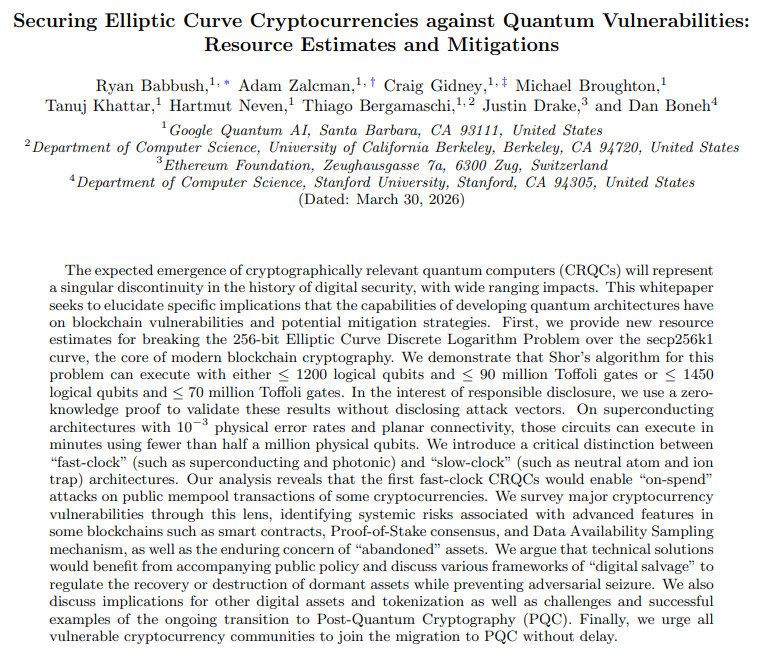
Algorand quantum security came into focus after a Google Quantum AI paper described the network as a live example of post-quantum cryptography being deployed on an otherwise quantum-vulnerable blockchain. This recognition quickly influenced market behavior, pushing ALGO up by nearly 50% from $0.08 to $0.12 within a week.
The token is now trading around $0.1240. The rise came shortly after a decline, showing how fast market sentiment can change when real technical progress is acknowledged. It also shifted attention toward how leading blockchain networks are getting ready to deal with future risks from quantum computing.
What does Algorand quantum security reveal about its technological position?
Algorand quantum security reflects a shift from theory to early-stage implementation. The Google Quantum AI paper pointed to the network as a real-world case where post-quantum tools are already in use, even if not across the full system.

The blockchain still relies on Ed25519 for core consensus and transactions, leaving it exposed under advanced quantum conditions. However, Falcon digital signatures have been deployed for smart transactions and state proofs. These state proofs are cryptographic attestations verifying blockchain state across chains, offering a functional layer of security experimentation.
Falcon verification is also available as a primitive within the Algorand Virtual Machine for developers. This gives builders direct access to post-quantum tools rather than limiting progress to theoretical design.
Why did ALGO price surge so sharply?
The move from $0.08 to $0.12 shows a clear response to institutional validation. Traders viewed the Google paper as confirmation that Algorand’s work is already active in parts of the network.
The token is now trading around $0.1240, up 6.35% in the last 24 hours, indicating continued interest after the initial jump. Algorand quantum security became a key focus as the paper gained attention, especially when compared to larger networks that are still working out their approach.
The timing supported the rally, as the token had recently reached an all-time low before turning upward. Market sentiment changed quickly, with attention shifting toward networks that can show working infrastructure instead of relying only on long-term plans.
How does the network address quantum risks in practice?
Algorand quantum security is based on a layered approach rather than a complete overhaul. Falcon signatures are operational in parts of the network, particularly in smart transactions, but not in the consensus layer.
State proofs play a key role. These are cryptographic attestations verifying blockchain state across chains, enabling secure data validation between systems. This adds a functional dimension to post-quantum experimentation.
The network also supports native key rotation. Users can update private keys linked to their accounts, which may ease future transitions. However, Google noted that this mechanism “does not provide quantum security at present, but facilitates future migration.”
The first post-quantum-secured transaction was executed in 2025, marking a practical milestone. Still, the implementation remains partial rather than system-wide.
What challenges do Bitcoin and Ethereum face?
The paper outlined increasing pressure on legacy blockchain systems. For Bitcoin, a quantum computer with fewer than 500,000 physical qubits could potentially break its elliptic-curve cryptography, lowering earlier security assumptions.
The challenge is compounded by legacy exposure. Around 6.7 million BTC remain in older Pay-to-Public-Key addresses where public keys are visible, including coins long associated with Satoshi Nakamoto. This creates a migration challenge that is both technical and coordination-driven.
Ethereum faces a broader exposure. Once a transaction is made, public keys become permanently visible on-chain. The paper highlighted that the top 1,000 wallets, holding about 20.5 million ETH, could be vulnerable under advanced quantum scenarios.
The risks extend further. At least 70 major ETH contracts have administrator keys visible on-chain, including those controlling stablecoin minting and other critical permissions.
In addition, Ethereum’s validator set, Layer 2 systems, and data infrastructure rely on cryptographic components described as vulnerable. With roughly 37 million ETH staked, any transition would require coordination across multiple layers of the ecosystem.
What does this mean for the broader crypto industry?
The findings reinforce that quantum risk is no longer abstract. Lower thresholds for breaking existing cryptography have intensified scrutiny across blockchain networks.
Algorand quantum security stands out because it demonstrates partial deployment rather than theoretical planning. This distinction places it ahead in implementation terms, while still acknowledging unresolved gaps.

The broader implication is clear. Networks must balance security upgrades with governance constraints, especially those prioritizing backward compatibility.
Conclusion
Algorand quantum security now sits at the center of an important shift in blockchain infrastructure. The move from $0.08 to $0.12 shows that the market is recognizing real progress already built into the network.
Google noted that Algorand’s advantage is narrower than recent enthusiasm suggests, pointing to solid development rather than a complete solution. The network shows early implementation, but it does not yet provide full end-to-end quantum resistance.
At the same time, Bitcoin and Ethereum face not only technical challenges but also politically heavy governance issues when it comes to large-scale upgrades. As quantum risks continue to develop, the focus is likely to move from discussion toward coordinated action across the industry.
Glossary
Post-Quantum Cryptography: Future-ready security built to handle quantum-level threats
Falcon Signatures: A stronger way to secure transactions against next-gen risks
State Proofs: A way to verify blockchain data across different networks
Ed25519: A widely used system today but not designed for quantum threats
Quantum Computing: Advanced computing that could break current security systems
Frequently Asked Questions About Algorand Quantum Security
What is Algorand quantum security?
Algorand quantum security means the network is getting ready to stay safe from future quantum threats.
Why are Bitcoin and Ethereum at risk?
Bitcoin and Ethereum are at risk as their current security may not handle future quantum attacks.
Is Algorand fully protected from quantum attacks?
No Algorand is not fully protected yet, but it has already started using safer technologies.
Why did ALGO price increase recently?
ALGO price increased because the Google paper boosted confidence in its technology.
What does this mean for the crypto market?
This means more blockchain networks may upgrade their security to face future risks.
Sources:
Read More: Algorand Price Surges 50% as Google Highlights Post-Quantum Blockchain Progress">Algorand Price Surges 50% as Google Highlights Post-Quantum Blockchain Progress
0
0

 Manage all your crypto, NFT and DeFi from one place
Securely connect the portfolio you’re using to start.


0
0

0
1