
Zcash News: THORChain ZEC Pool Goes Live, What Happens to ZEC Next?

0
0
Zcash News: Why Did THORChain's ZEC Pool Launch Matter Today?
This Zcash News update starts with a milestone two years in the making. THORChain announced on Oct. 2, 2026, that its ZEC liquidity pool is now live, with every node on the network completing a churn and beginning to monitor the Zcash chain.
That gives Zcash a new, permissionless venue for liquidity. But a live pool is not the same as live trading, and THORChain itself was careful to separate the two.
At a Glance
-
THORChain's $ZEC liquidity-pool went live Oct. 2, following a completed node rotation (churn).
-
All THORChain nodes are now monitoring the Zcash chain.
-
Trading functionality is described as the next step, not yet active.
-
Liquidity is currently shallow; THOR-Chain flagged slippage risk for early traders.
-
The integration builds on an earlier protocol-upgrade adding Zcash UTXO handling, RPC logic, and a ZEC price oracle.
-
The launch arrives amid renewed scrutiny of THORChain over its role in laundering funds from the 2025 Bybit hack and the September 2026 Bitget hack.
What Did THORChain Actually Announce About ZEC?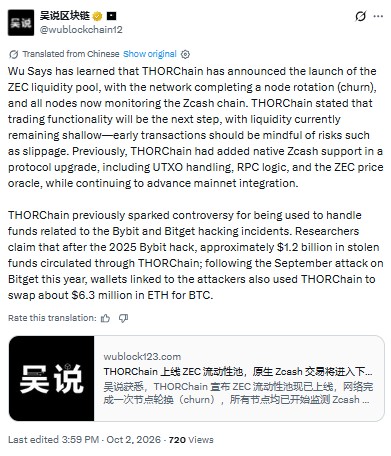
According to a translated post from Wu Says (@wublockchain12), THORChain confirmed the $ZEC liquidity pool has launched, with the network completing a node rotation and all nodes now tracking the Zcash chain. THORChain stated that trading functionality will be the next step.
Liquidity remains shallow for now, and THORChain explicitly warned early traders to be mindful of risks like slippage. That's a direct, sourced caution, not speculation. A thin pool means a single sizable trade can move the price meaningfully, something anyone using the pool in its early days should weigh before transacting.
What Groundwork Did THORChain Already Lay for Zcash?
This pool launch didn't appear out of nowhere. Previously, THORChain added native Zcash support in a protocol upgrade, covering UTXO handling (the accounting model Zcash's transparent transactions use), RPC logic (the communication layer letting THORChain's infrastructure interact with the Zcash chain), and a ZEC price oracle.
THORChain said it continues to advance mainnet integration, meaning the pool launch is one step in an ongoing rollout rather than a single, finished event.
Is THORChain's ZEC Pool the Same as ZEC Trading?
No, and that distinction is the core of today's Zcash News. A live liquidity pool with monitoring nodes is infrastructure. Native swap trading is the function that infrastructure is meant to support, and THOR-Chain was explicit that trading comes next, not simultaneously.
In practical terms, this phased approach mirrors how the protocol has rolled out other chain integrations before: deposits and basic chain monitoring first, native swap functionality activated afterward once the pool and node setup are confirmed stable.
Why Is the protocol Facing Scrutiny Right Now?
Here's where this Zcash News update has to include some uncomfortable context. the protocol has previously sparked controversy for being used to handle funds related to the Bybit and Bitget hacking incidents.
Researchers have traced roughly $1.2 billion in stolen funds from the February 2025 Bybit hack moving through the network as attackers converted stolen Ether into Bitcoin.
Following the September 2026 attack on Bitget, which drained roughly $387.5 million, wallets linked to the attackers also used the protocol to swap millions from ETH into BTC.
Bitget's CEO, Gracy Chen, publicly asked the network to refuse service to the attacker-linked addresses; the protocol declined, stating that "a halt is not a selective freeze of specific funds or an individual swap," and that the protocol "doesn't censor by design."
This history doesn't change what today's $ZEC pool launch technically is, but it's relevant context for anyone evaluating the protocol's broader reputation as it expands into new assets.
the protocol ZEC Integration: Timeline So Far
| Stage | Status | What It Means |
| Protocol upgrade (prior) | Completed | Added native Zcash UTXO handling, RPC logic, and ZEC price oracle |
| Node rotation (churn) | Completed, Oct. 2 | All the network nodes now monitor the Zcash chain |
| ZEC liquidity venue | Live, Oct. 2 | Permissionless liquidity venue now exists for ZEC |
| Native asset trading | Not yet active | Described by the protocol as the next step |
| Deep liquidity | Not yet established | Current liquidity is shallow; slippage risk flagged |
What Should Zcash and Users Watch Next?
A few concrete things are worth tracking as this ZEC News story develops: an official announcement confirming native asset trading has actually activated, liquidity depth in the liquidity venue growing beyond its current shallow state, and whether the network faces further pressure over hack-linked fund flows as its asset coverage keeps expanding.
None of this predicts the asset's price, and each item can change quickly.
Conclusion: What Does This Mean for Zcash Right Now?
Zcash just gained a new, permissionless liquidity venue, but not yet a new trading venue. The protocol was clear about that sequencing itself. For now, the venue exists, nodes are watching the chain, and liquidity is thin. The next real test of this integration will be when native swaps actually go live, and whether early liquidity holds up once trading begins.
YMYL Disclaimer
This article is for information only and is not financial, legal, or investment advice. Regulatory and protocol-developments can change quickly. Crypto assets are volatile, and you can lose money. Please verify details with official sources before making any financial decision.
0
0


 Manage all your crypto, NFT and DeFi from one place
Securely connect the portfolio you’re using to start.


