
Australia’s 40-Year Economic Plan Flags AI Shift, Skips Crypto

0
0
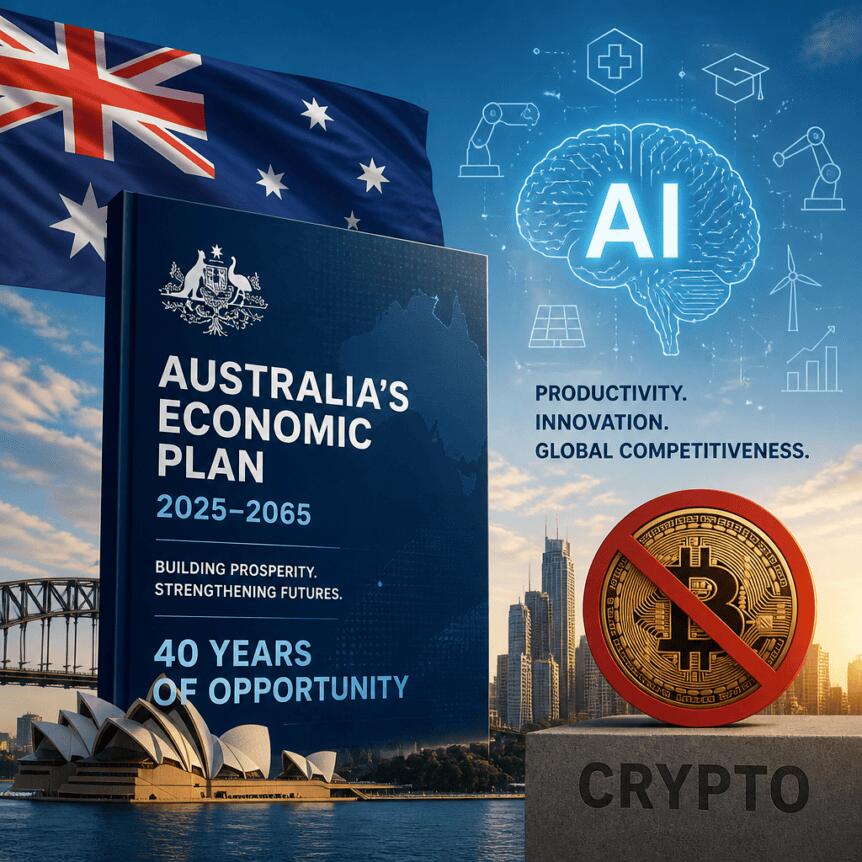
Australia’s latest Intergenerational Report, outlining economic trends expected to shape the country over the next 40 years, spotlights artificial intelligence and four other large-scale transitions—but it notably does not mention crypto or digital assets. The Treasury’s assessment arrives as policymakers elsewhere in Australia continue to probe tokenization and “financial infrastructure” upgrades that could support the kind of automated systems now being discussed in AI policy.
Released by the Australian Treasury on Monday, the report argues that “agentic” AI—systems that can act more autonomously and coordinate tasks—has become significantly more capable and widely used, including outperforming humans on some benchmarks. In an emailed response, Coinbase Australia country director John O’Loghlen said the outlook’s focus on AI overlooks what he called the financial infrastructure those agents would require.
Key takeaways
- The Australian Treasury’s 40-year Intergenerational Report highlights agentic AI as a major economic transition, but does not reference crypto or digital assets.
- Coinbase Australia’s John O’Loghlen criticized the omission, arguing the report fails to address the financial rails needed for AI-driven agents.
- Treasury’s parallel “Financial Innovation Strategy” links agentic systems to faster, interoperable, programmable payment infrastructure.
- O’Loghlen pointed to regulatory clarity from the Digital Asset Platform framework while urging similar rules for stablecoin stored-value and tokenized markets.
Intergenerational planning: AI in, crypto out
The Intergenerational Report identifies five transitions expected to have a profound impact on Australia’s economy: geopolitical conflicts, an aging population, a shift to clean energy, industrial transformation toward services, and—prominently—new technology driven by artificial intelligence.
In the AI section, Treasury describes agentic AI systems as having advanced rapidly, becoming “significantly” more capable, more autonomous, and more widely used. The report also characterizes these systems as having surpassed human-level performance on some benchmarks, positioning AI not just as an incremental tool but as an operational shift that could change how economic activity is organized.
Yet the report’s scope, as presented in the public text summarized in the coverage, leaves out any explicit discussion of digital assets. That absence matters for market participants because policy roadmaps can influence how regulators prioritize infrastructure reforms, licensing categories, and interoperability standards—areas that have become central to tokenized finance.
Criticism from the industry: “the rails” for AI agents
Coinbase Australia country director John O’Loghlen responded directly to the omission. According to his emailed comments, the Intergenerational Report makes clear that Australia’s prosperity over the next 40 years depends on adopting new technology and boosting productivity, but “completely misses the financial infrastructure those agents will need.”
He also noted that previous Intergenerational Reports have not addressed digital assets, suggesting the new omission is consistent with a longer pattern rather than a one-off oversight. Still, the timing is notable: the same period has seen Australian institutions increase attention to tokenized finance and financial infrastructure upgrades.
One example referenced in the coverage is a digital finance estimate from Australia’s Digital Finance Cooperative Research Centre, which projected that digital finance innovations could generate 24 billion Australian dollars (about $17.1 billion) in annual economic gains. While that figure is not tied to the Intergenerational Report’s conclusions directly, it strengthens the argument that tokenization-related policy has been moving alongside AI-focused planning.
Why the “Financial Innovation Strategy” matters for tokenized payments
Even though the Intergenerational Report does not mention crypto, Treasury has addressed tokenized finance indirectly through a separate publication: its “Financial Innovation Strategy,” released on Sept. 3. In that document, Treasury discusses how agentic systems could reshape transaction patterns by increasing automated and machine-to-machine payments.
According to the coverage, the strategy links these changes to the need for payment systems that are real-time, interoperable, and programmable. That is precisely the set of capabilities that developers and regulators often associate with tokenized payment networks—especially in contexts involving stablecoins, automated treasury flows, and composable financial services.
For investors and builders, this split between high-level macro planning and more technical financial-infrastructure policy is a meaningful signal. It suggests that while the Intergenerational Report frames “the why” of economic transformation, the operational groundwork may be covered elsewhere through targeted regulatory strategies and frameworks.
Regulatory momentum: from digital asset frameworks to stablecoins
In his comments, O’Loghlen argued that Australia has already moved in the right direction by building regulatory clarity. He referenced progress “in recent years,” including the Digital Asset Platform framework, which he said has provided necessary regulatory clarity.
However, he said the next step is not just to expand AI capability—it is to extend regulatory focus to the infrastructure that enables tokenized value transfer. In particular, O’Loghlen called for similar attention to the “tokenized stored-value facility framework” for stablecoins and clearer rules for tokenized markets.
The emphasis on “rails” is where the two parts of the story connect. Treasury’s financial strategy highlights interoperable, programmable payment systems as agentic AI increases automated transactions. O’Loghlen’s response argues that without defined rules for stablecoins and tokenized markets, the financial plumbing required for these systems may lag behind the pace of AI adoption.
In other words, the omission in the Intergenerational Report may be more than a wording choice. It can reflect how policymakers categorize digital assets—sometimes as a technical subset of financial innovation rather than a macro-economic driver—while the separate regulatory documents attempt to translate those capabilities into practical infrastructure standards.
Readers should watch whether Treasury’s financial-infrastructure agenda builds out toward stablecoin stored-value facilities and tokenized market rules, and whether future high-level economic reporting begins to integrate digital assets more explicitly alongside AI-driven automation. The immediate uncertainty is not whether agentic systems will increase demand for machine-to-machine payments, but how quickly the legal and technical frameworks for tokenized settlement can keep pace with that demand.
This article was originally published as Australia’s 40-Year Economic Plan Flags AI Shift, Skips Crypto on Crypto Breaking News – your trusted source for crypto news, Bitcoin news, and blockchain updates.
0
0

 Manage all your crypto, NFT and DeFi from one place
Securely connect the portfolio you’re using to start.


