
AUD/USD Price Forecast: Bullish Rebound Ignites as RBA’s Bullock Clarifies Inflation Was Already High

0
0
BitcoinWorld
AUD/USD Price Forecast: Bullish Rebound Ignites as RBA’s Bullock Clarifies Inflation Was Already High
The Australian dollar staged a significant recovery against the US dollar this week, with the AUD/USD pair climbing from 0.6520 to 0.6585 following crucial clarification from Reserve Bank of Australia Governor Michele Bullock regarding inflation context. This currency movement represents a pivotal shift in market sentiment as traders reassess monetary policy expectations for both Australia and the United States. Governor Bullock’s statements during her parliamentary testimony provided essential context about Australia’s inflationary environment, directly impacting currency valuation models and trader positioning.
AUD/USD Technical Analysis and Price Action
The AUD/USD currency pair demonstrated remarkable resilience during Thursday’s trading session, bouncing from critical support levels. Technical indicators now suggest potential for further upward movement. The pair found solid footing at the 0.6520 support zone, which has held firm on three separate occasions this quarter. This level corresponds with the 61.8% Fibonacci retracement from the October 2024 highs.
Market analysts immediately noted the significance of this rebound. Furthermore, the Relative Strength Index (RSI) climbed from oversold territory below 30 to a more neutral 45 within 24 hours. This rapid recovery indicates substantial buying pressure entering the market. The moving average convergence divergence (MACD) histogram also showed early signs of bullish divergence prior to Governor Bullock’s comments.
Key Technical Levels to Monitor
Traders should watch several critical price levels in the coming sessions. Immediate resistance sits at 0.6600, a psychological barrier that has capped advances twice this month. A decisive break above this level could trigger stop-loss orders and accelerate gains toward 0.6650. Conversely, support remains firm at 0.6520, with additional protection at 0.6480 should selling pressure reemerge.
| Level | Type | Significance |
|---|---|---|
| 0.6650 | Resistance | Previous swing high, 50-day MA |
| 0.6600 | Resistance | Psychological barrier, recent high |
| 0.6585 | Current Price | Post-Bullock speech level |
| 0.6520 | Support | Triple bottom, Fibonacci level |
| 0.6480 | Support | 2025 yearly low |
RBA Governor’s Inflation Clarification and Market Impact
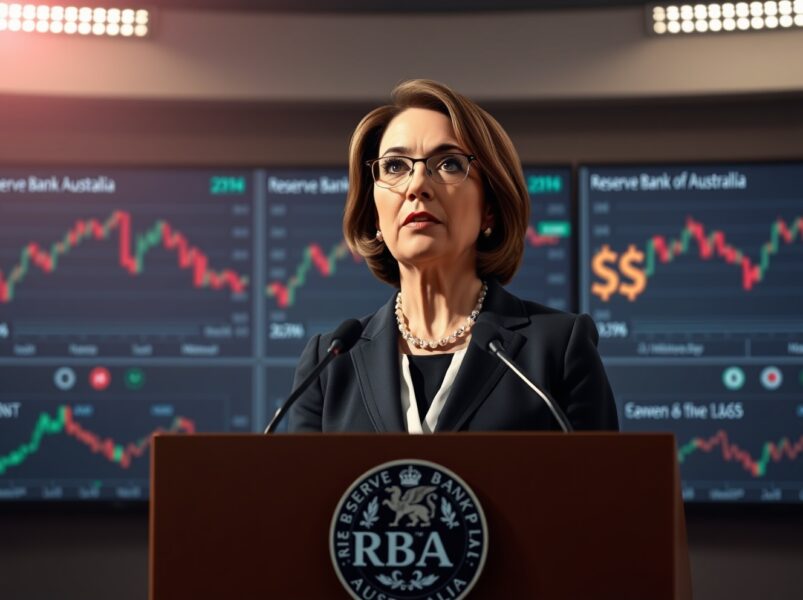
Reserve Bank of Australia Governor Michele Bullock provided crucial context during her appearance before the House of Representatives Standing Committee on Economics. She emphasized that Australia’s inflation trajectory differed significantly from other developed economies. Specifically, Bullock clarified that inflationary pressures in Australia were already elevated before recent global commodity price movements.
This clarification carries substantial implications for monetary policy. Markets had previously priced in aggressive rate cuts from the RBA, assuming the central bank would follow the Federal Reserve’s expected easing cycle. However, Bullock’s statements suggest the RBA may maintain a more hawkish stance than anticipated. Consequently, interest rate differential expectations between Australia and the United States have narrowed, supporting the Australian dollar’s recovery.
Inflation Context and Historical Comparison
Australia’s inflation narrative requires understanding of its unique economic circumstances. Unlike the United States and Europe, where post-pandemic inflation surged dramatically in 2022-2023, Australia experienced a more gradual increase. The country’s consumer price index (CPI) reached its peak of 7.8% in December 2022, nearly a full percentage point below the US peak of 9.1% in June 2022.
However, Australian inflation has proven more persistent during the disinflation phase. The latest quarterly data shows Australia’s CPI at 4.1% year-over-year, while the United States has achieved greater progress with inflation at 3.2%. This persistence explains the RBA’s cautious approach and supports Governor Bullock’s emphasis on context.
Global Monetary Policy Divergence and AUD Implications
The AUD/USD forecast increasingly depends on monetary policy divergence between the Reserve Bank of Australia and the Federal Reserve. Recent communications from both central banks reveal contrasting approaches to inflation management. The Federal Reserve has signaled potential rate cuts beginning in mid-2025, citing progress toward its 2% inflation target.
Conversely, the RBA maintains a more cautious outlook. Governor Bullock’s testimony reinforced this position, highlighting several factors unique to Australia’s economy:
- Services inflation persistence: Australian services inflation remains elevated at 5.3%
- Wage growth: Australia’s wage price index shows 4.2% annual growth
- Housing costs: Rental inflation continues at 7.8% due to supply constraints
- Productivity challenges: Weak productivity growth exacerbates unit labor costs
These factors collectively suggest the RBA may delay rate cuts relative to other major central banks. This policy divergence creates favorable conditions for Australian dollar strength against currencies from economies with more aggressive easing cycles.
Expert Analysis and Market Reactions
Financial institutions have adjusted their AUD/USD forecasts following Governor Bullock’s clarification. Commonwealth Bank of Australia economists now project the pair could reach 0.6700 by the end of the second quarter. Similarly, Westpac Banking Corporation revised its short-term outlook from bearish to neutral with upward bias.
Market positioning data from the Commodity Futures Trading Commission (CFTC) reveals significant changes. Speculative net short positions on the Australian dollar decreased by 12,000 contracts in the week following Bullock’s testimony. This represents the largest weekly reduction in bearish bets since September 2024, indicating substantial sentiment shift among institutional traders.
Commodity Price Influence on Australian Dollar Valuation
Beyond monetary policy, commodity markets continue influencing AUD/USD price action. Australia remains a major exporter of several key commodities, creating correlation between their prices and currency valuation. Recent movements in these markets provide additional context for the Australian dollar’s rebound.
Iron ore prices have stabilized above $120 per metric ton after declining earlier this quarter. This stabilization removes a significant headwind for the currency. Similarly, copper prices have gained 8% month-over-month amid supply concerns and green energy demand. Gold prices reaching record highs above $2,400 per ounce further support resource-linked currencies like the Australian dollar.
The correlation between Australia’s terms of trade and its currency remains historically strong. With commodity prices showing resilience despite global growth concerns, fundamental support exists for continued Australian dollar strength. This commodity backdrop complements the improved monetary policy outlook following Governor Bullock’s clarification.
Risk Sentiment and Global Macroeconomic Factors
Global risk appetite significantly impacts AUD/USD as a traditional risk-sensitive currency pair. Recent improvements in market sentiment have provided additional tailwinds. The VIX volatility index, often called the “fear gauge,” has declined to its lowest level since January 2025.
Equity markets have shown resilience despite lingering economic uncertainties. The S&P 500 achieved new record highs this month, while Asian markets demonstrated strength. This improved risk environment typically benefits higher-yielding currencies like the Australian dollar against safe-haven counterparts like the US dollar.
Geopolitical developments also warrant monitoring. Tensions in critical shipping lanes have eased recently, reducing supply chain concerns that previously pressured global growth expectations. While risks remain, the current environment appears more favorable for risk assets and correlated currencies.
Conclusion
The AUD/USD forecast has shifted meaningfully following RBA Governor Michele Bullock’s clarification about Australia’s inflation context. The currency pair’s rebound from key support levels reflects reassessment of monetary policy divergence between Australia and the United States. Technical indicators suggest further upside potential if the pair can sustain momentum above critical resistance levels.
Fundamental factors including commodity price stability and improved risk sentiment provide additional support for the Australian dollar. While challenges remain, particularly regarding domestic inflation persistence, the current environment appears favorable for continued AUD strength against the US dollar. Market participants should monitor upcoming economic data releases and central bank communications for confirmation of this evolving trend.
FAQs
Q1: What specifically did RBA Governor Michele Bullock clarify about inflation?
Governor Bullock clarified that Australia’s inflation was already elevated before recent global commodity price movements, emphasizing that the country’s inflationary trajectory differed from other developed economies and required context-specific policy responses.
Q2: How does this clarification affect interest rate expectations?
The clarification suggests the Reserve Bank of Australia may maintain higher interest rates for longer than previously anticipated, reducing expectations for aggressive rate cuts and narrowing the policy divergence with the Federal Reserve.
Q3: What key technical levels should traders watch for AUD/USD?
Traders should monitor resistance at 0.6600 and 0.6650, with support at 0.6520 and 0.6480. A break above 0.6600 could signal further gains, while holding above 0.6520 maintains the bullish structure.
Q4: How do commodity prices influence the Australian dollar?
As a major commodity exporter, Australia’s currency correlates with prices of iron ore, copper, gold, and other resources. Recent stabilization in commodity markets provides fundamental support for AUD valuation.
Q5: What global factors could impact the AUD/USD forecast?
Key factors include Federal Reserve policy decisions, global risk sentiment, geopolitical developments affecting trade routes, and economic data from major trading partners like China and the United States.
This post AUD/USD Price Forecast: Bullish Rebound Ignites as RBA’s Bullock Clarifies Inflation Was Already High first appeared on BitcoinWorld.
0
0

 Manage all your crypto, NFT and DeFi from one place
Securely connect the portfolio you’re using to start.

0
0


