
16 Nobel Laureates Warn: Economic Impact of AI Could Dwarf Industrial Revolution

0
0
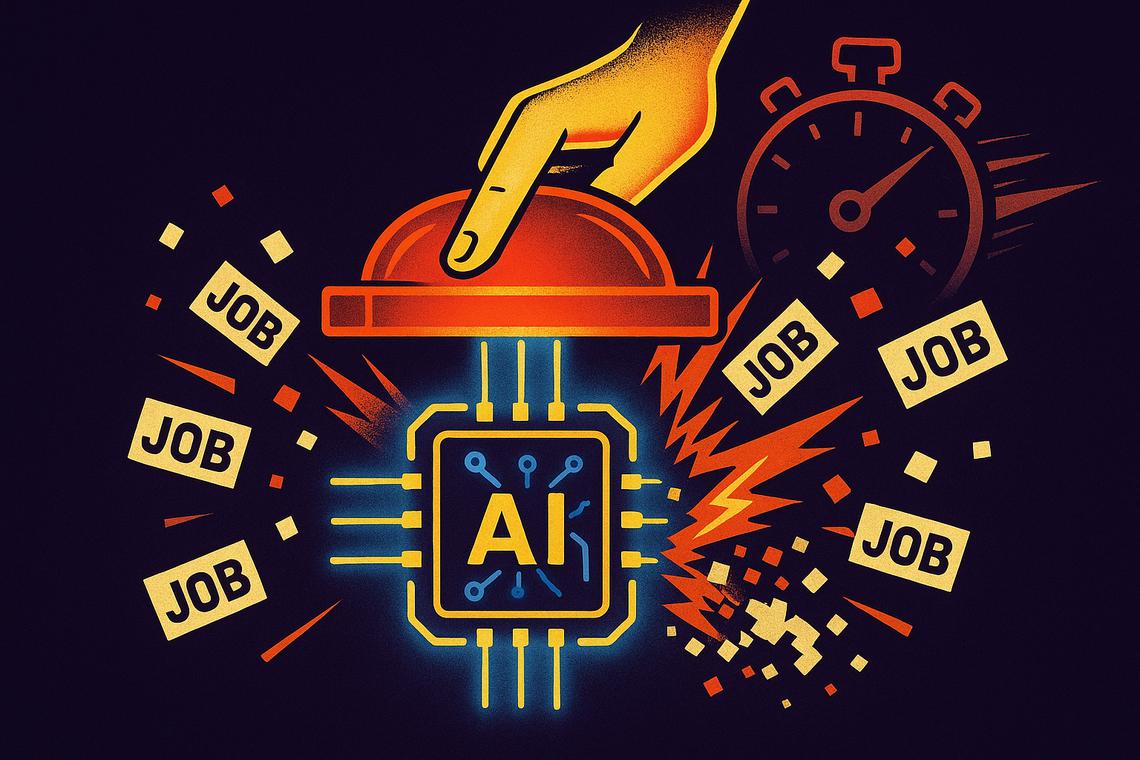
Something unusual happened on July 13, 2026. More than 200 of the world’s most decorated economists, computer scientists, and AI researchers signed a four-sentence letter — and those four sentences are making headlines precisely because of how bluntly they frame the economic impact of AI. Their message: institutions must act now, before the window closes.
Key takeaways
- More than 200 economists and AI researchers, including 16 Nobel laureates, signed an open letter urging immediate action on AI’s economic risks.
- Executives from Anthropic, Google, and OpenAI were among the signatories, alongside top economists and computer scientists.
- The letter warns AI could trigger an economic transformation larger than the Industrial Revolution, but happening far faster.
- Key risks cited include large-scale job displacement; key opportunities include major gains in living standards.
- The letter was organized by Stanford University’s digital economy lab and calls for new incentives, guardrails, and institutions to guide AI development.
Urgent Call for Action on AI’s Economic Impact
The letter does not hedge. It opens by warning that AI “may become radically more powerful over the next 10 years” and immediately frames what that means for economies and workers. The signatories describe a potential transformation that could dwarf the Industrial Revolution in scale — while unfolding over a vastly shorter time frame. That combination of magnitude and speed is precisely what makes the situation feel different from previous waves of technological disruption.
At its core, the statement carries a dual message: enormous opportunity on one side, serious structural risk on the other.
Significant risks from large-scale job displacement
The letter names large-scale job displacement as the defining risk. Unlike previous automation waves that primarily affected manual labor, AI’s reach extends across knowledge work, creative industries, and professional services. The speed of the transformation matters as much as the scale — workers, governments, and educational systems may not have the time they historically needed to adapt.
Potential major gains in living standards
The same letter that warns of displacement also points to the upside. Major gains in living standards are within reach if AI’s productivity benefits are broadly distributed. That tension — between disruption and prosperity — runs through the entire document and explains why the signatories chose urgency over caution as their tone.
Prominent Signatories and Organizers
The weight behind this letter is hard to dismiss. It carries the signatures of more than 200 economists and AI researchers, among them 16 Nobel Prize winners. That is not a fringe group raising speculative concerns — it is arguably the densest concentration of economic expertise ever assembled around a single AI policy statement.
Tech executives from Anthropic, Google, and OpenAI
What makes the list of signatories especially striking is the presence of executives from Anthropic, Google, and OpenAI — the very companies building the systems the letter warns about. Their willingness to co-sign a document calling for guardrails on their own industry is either a sign of genuine concern or, at minimum, an acknowledgment that the governance conversation can no longer be deferred.
Stanford University’s digital economy lab as organizer
The letter was organized by Stanford University’s digital economy lab, which lends it institutional credibility beyond a grassroots petition. Stanford’s involvement signals that this is a considered, coordinated academic position — not a reactive statement driven by headlines.
Scope and Speed of AI’s Economic Transformation
The Industrial Revolution comparison is not rhetorical flourish. It is the analytical center of the letter’s argument. That transformation reshaped labor markets, urban geography, political institutions, and living conditions over roughly a century. The signatories are warning that AI’s economic transformation could compress a comparable shift into a decade or two.
AI’s rapid power increase over the next decade
The letter’s projection that AI “may become radically more powerful over the next 10 years” reflects a broad consensus among researchers who study AI capability trajectories. Models are improving across reasoning, coding, scientific research, and decision-making at a pace that outstrips most forecasts made just five years ago.
Transformation exceeding the Industrial Revolution in scale and speed
If the signatories are right about the speed, the implications for policy are severe. Democratic institutions, labor laws, social safety nets, and educational systems all move slowly. An economic transformation that outpaces institutional adaptation is, by definition, one that leaves people behind — which is precisely the scenario the letter is trying to prevent.
Recommendations to Guide AI Development
The letter’s policy ask is deliberately broad. Leaders must “build the incentives, guardrails, and institutions needed to steer AI in a direction that complements humans and benefits society.” Four sentences, one clear directive.
The deliberate brevity may be a strategic choice. A short, unambiguous statement signed by 200-plus heavyweights is harder to dismiss than a detailed policy proposal that invites line-by-line debate. The signatories appear to be forcing the question onto the agenda first, leaving the design of specific interventions for the legislative and regulatory processes that follow.
Expert Perspectives on AI’s Economic Future
Yoshua Bengio’s statement on AI transforming economies
Among the signatories, Yoshua Bengio — computer scientist and AI pioneer — issued a separate statement reinforcing the letter’s urgency. “It is highly plausible that AI will drastically transform our economies,” Bengio said, grounding the claim not in speculation but in the observable trajectory of AI development. Bengio’s credibility on this point is considerable: he is one of the foundational researchers whose work made modern AI possible.
The fact that someone with Bengio’s deep technical knowledge is calling for governance measures — rather than urging acceleration — carries a different weight than the same message delivered by a policy generalist. When the people who built the tools start signing letters about institutional guardrails, the conversation has moved past theoretical risk.
FAQ
Who signed the open letter calling for AI economic action?
More than 200 economists and AI researchers, including 16 Nobel laureates, along with computer scientists and executives from Anthropic, Google, and OpenAI signed the letter.
What does the letter warn about AI’s economic impact?
The letter warns that AI could cause large-scale job displacement but also bring major gains in living standards, describing a potential economic transformation larger than the Industrial Revolution, unfolding far more quickly.
Who organized the open letter on AI’s economic impact?
The letter was organized by Stanford University’s digital economy lab.
What timeframe do signatories expect for AI’s increasing power?
The signatories expect AI to become radically more powerful over the next 10 years.
Article produced with the assistance of artificial intelligence and reviewed by the editorial team.
0
0

 Manage all your crypto, NFT and DeFi from one place
Securely connect the portfolio you’re using to start.

0
0


0
0

0
0