
Uniswap’s New Strategy: Less Reward, More Execution

0
0

Uniswap is making a calculated bet that could reshape how decentralized exchanges think about liquidity altogether. Rather than continuing to chase liquidity providers with ever-larger reward pools, the protocol is now leaning on something less flashy but arguably more durable: better execution. It’s a shift that says a lot about where the DEX landscape is heading in 2026, and it puts Uniswap in a position where the payoff, if it works, could be substantial.
A Departure From the Old Playbook
For years, Uniswap relied on a fairly straightforward formula. Offer generous trade-based incentives, pull in liquidity providers, and let deep pools do the rest of the work in attracting traders. That approach worked well enough during the V3 era, when competition among decentralized exchanges wasn’t nearly as fierce as it is now. But markets change, and so does what actually moves the needle for traders.
The new proposal on the table would trim LP incentive payouts by as much as 33%. On paper, that sounds like a step backward for anyone providing liquidity. In practice, though, Uniswap is wagering that tighter spreads and lower slippage will draw in enough additional trading volume to more than offset what LPs lose in direct rewards. It’s a bit like a store lowering prices instead of running loyalty promotions, betting that foot traffic alone will keep the lights on.
Why Execution Quality Matters More Now
Traders don’t just care about where liquidity sits, they care about what it costs them to actually use it. Slippage, price impact, and fee efficiency all factor into whether someone routes a trade through Uniswap or somewhere else. By focusing on execution rather than raw incentive size, Uniswap is essentially trying to make itself the path of least resistance for anyone moving serious volume.
This matters even more for larger trades, where poor execution can eat into returns fast. A swap that looks fine on a small scale can turn costly once size enters the picture, and that’s exactly the kind of friction Uniswap wants to eliminate.
The Numbers Behind the Strategy
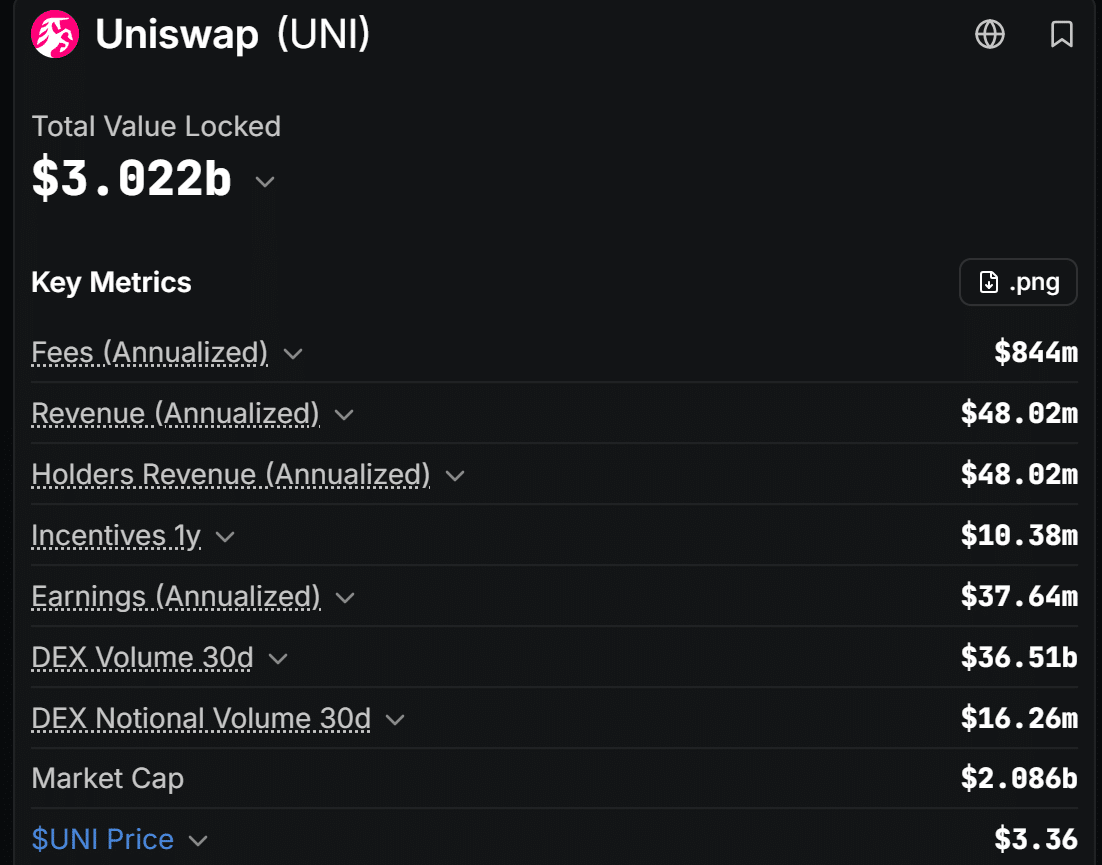
At the time of writing, Uniswap holds a total value locked of approximately $3.02 billion, with monthly trading volume hovering near $36 billion. Those figures still place Uniswap ahead of most competitors, even as rival platforms continue chipping away at its market share. The question isn’t whether Uniswap remains a major player today, it’s whether this new incentive structure keeps it there a year from now.
Uniswap’s Stablecoin Push
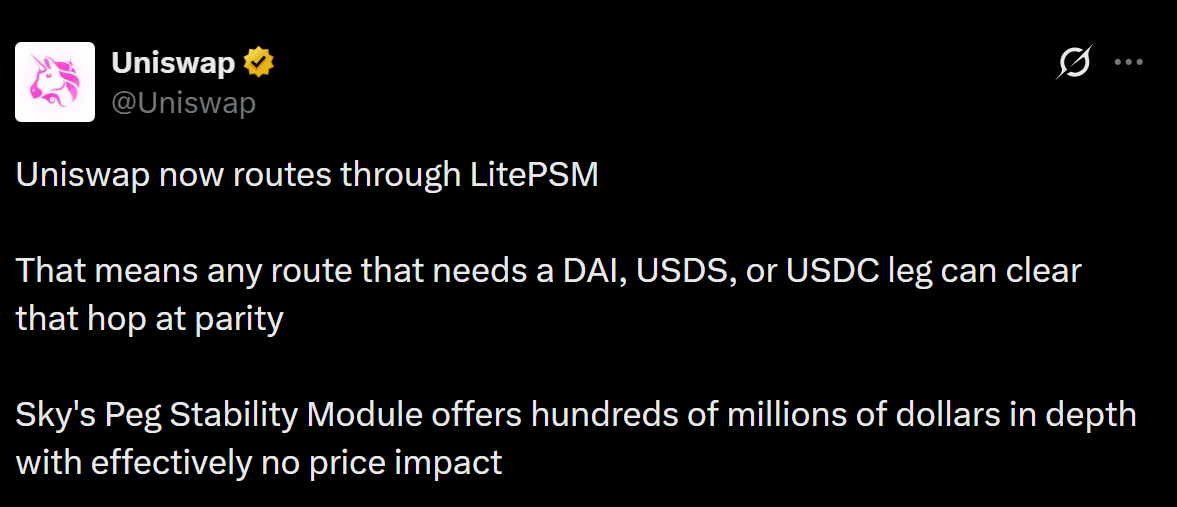
Uniswap’s philosophy is already playing out through its integration with Sky’s LitePSM module, which enables zero-slippage swaps between USDS, DAI, and USDC. This isn’t a minor technical footnote either. Deeper, more efficient stablecoin liquidity means lower execution costs across the board, particularly for large transactions that would otherwise nudge prices in unfavorable directions.
Layered on top of that is the connection to Sky’s FX Layer, which effectively turns what used to be simple parity-based routing into something closer to genuine financial infrastructure. It’s a subtle but meaningful upgrade, and one that positions Uniswap as more than just a trading venue.
The Risk Uniswap Is Taking
Liquidity providers, generally speaking, follow the money. If a competing exchange rolls out juicier rewards, capital can migrate quickly, sometimes within days. Uniswap knows this, and the entire strategy hinges on trading activity rising fast enough to make the reduced incentives feel like a non-issue for LPs sticking around.
There’s no guarantee this plays out smoothly. If volume doesn’t climb the way Uniswap expects, liquidity could thin out at exactly the wrong moment, and rivals offering fatter yields would be more than happy to scoop up the difference.
Conclusion
Uniswap’s decision to prioritize execution over higher LP incentives is a gamble rooted in long-term thinking rather than short-term liquidity grabs. Whether it pays off depends almost entirely on adoption. If traders notice the difference and keep coming back, Uniswap strengthens a position it’s held for years. If not, the protocol risks handing an opening to competitors who are still playing the incentive game the old-fashioned way.
FAQs
What is Uniswap changing exactly?
Uniswap is reducing LP trading incentives by up to 33% while focusing on execution quality.
Why would lower incentives help Uniswap?
Better execution can attract more trading volume, which may offset reduced LP rewards over time.
What is Uniswap’s current TVL?
Around $3.02 billion at the time of writing.
What role does the LitePSM integration play?
It allows zero-slippage swaps between major stablecoins, improving overall liquidity efficiency.
Glossary
Liquidity Provider (LP): A user who deposits assets into a pool to enable trading and earn fees.
Slippage: The difference between expected and actual trade price.
TVL: Total value locked, or the total assets held within a protocol.
PSM: Peg Stability Module, used to maintain stablecoin parity.
Read More: Uniswap’s New Strategy: Less Reward, More Execution">Uniswap’s New Strategy: Less Reward, More Execution
0
0

 Manage all your crypto, NFT and DeFi from one place
Securely connect the portfolio you’re using to start.

0
0

0
0

0
0

0
0