
Uniswap News Today: $5.2M Daily Fees, UNI Buyback and Token Burn Live
0
0
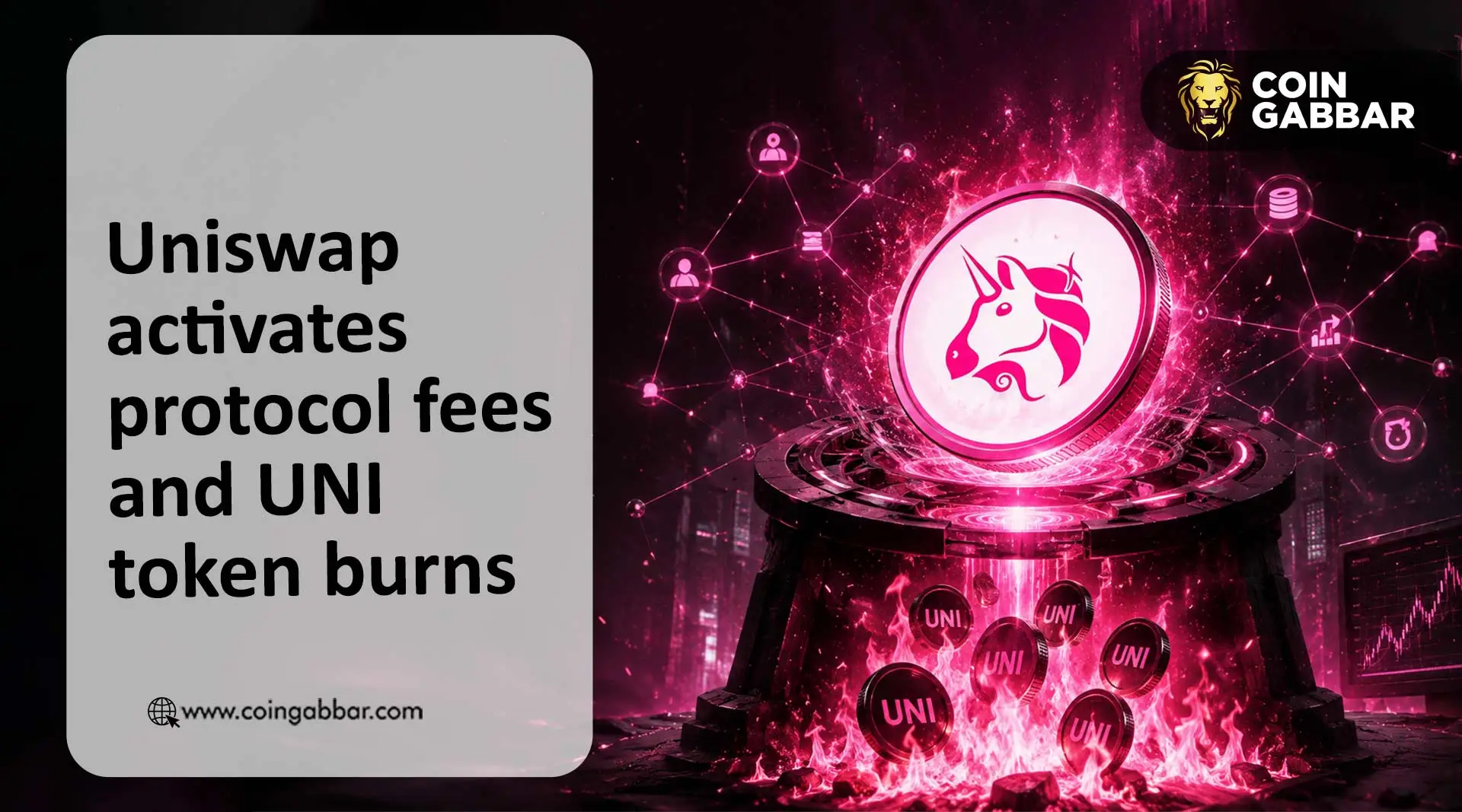
Uniswap News Today: UNI Token Burn Live After $5.2M Daily Protocol Fee
Two stablecoin giants. That's it — that's the entire list of protocols now out-earning Uniswap daily. While traders were busy watching Hyperliquid and Pump.fun chase volume records, Uniswap quietly built a charge engine that most of the market hasn't clocked yet.
And the part almost nobody is talking about? Where that money is actually going next. We break down exactly what changed — and what to watch next.
What Happened: Uniswap's Fee Numbers Explained
Uniswap founder Hayden Adams revealed on X that the protocol is currently generating around $5.2 million in daily fees. This places it behind only Tether and Circle in daily fee generation across the entire crypto industry.
Independent data from DeFiLlama backs this up, showing Uniswap's trailing 24-hour chrage at approximately $5.13 million — confirming it as the top-ranked decentralized exchange on the platform's fee leaderboard.
The scale becomes clearer when compared to rivals. Uniswap's fee output significantly outpaces protocols like Hyperliquid and Pump.fun, both of which have seen major trading volume surges of their own in recent months.
What makes this ranking notable is that the company Uniswap now keeps. Tether and Circle generate fee revenue by managing the two largest stablecoins in existence, USDT and USDC, meaning their fee income is tied to trillions of dollars in cumulative settlement activity.
For a decentralized exchange protocol to sit directly beneath them — ahead of newer, high-momentum platforms like Hyperliquid's perpetuals engine and Pump.fun's memecoin launchpad — signals that Uniswap's liquidity depth and multichain reach are translating into real, measurable revenue rather than just headline trading volume.
Adams' post appears to have caught even long-time observers off guard, given how much attention rival protocols have absorbed in recent market cycles.
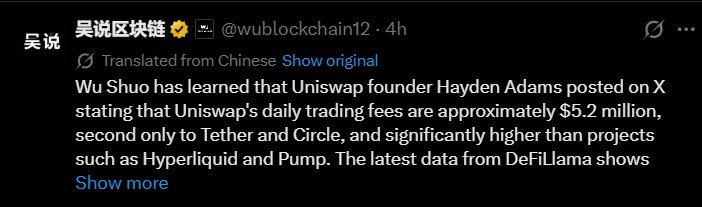
Source: Wu Blockchain X
Key Details: Where the Volume Is Coming From
Uniswap fees dominance is being driven by roughly $2.19 billion in daily trading volume spread across 47 different blockchain networks, giving it an estimated 46% share of the entire DEX market.
A notable contributor to this surge is the Robinhood Chain integration, which reportedly accounts for over 85% of certain flows into the protocol. This partnership has quietly become one of the biggest volume drivers for Uniswap this year.
The 47-chain footprint is itself a signal of how far Uniswap's deployment strategy has expanded beyond its Ethereum mainnet roots. Rather than relying on a single dominant chain, fee generation is now distributed across a wide network of Layer 2s and alternative chains, reducing dependency on any one ecosystem's activity levels.
This diversification helps explain why Uniswap's 46% DEX market share has held steady even as competitors post individual volume spikes.
The Robinhood Chain contribution stands out specifically because it suggests retail-facing platforms integrating Uniswap's infrastructure directly could become an increasingly important fee source, potentially adding a new, more consistent revenue stream on top of Uniswap's existing organic trading activity.
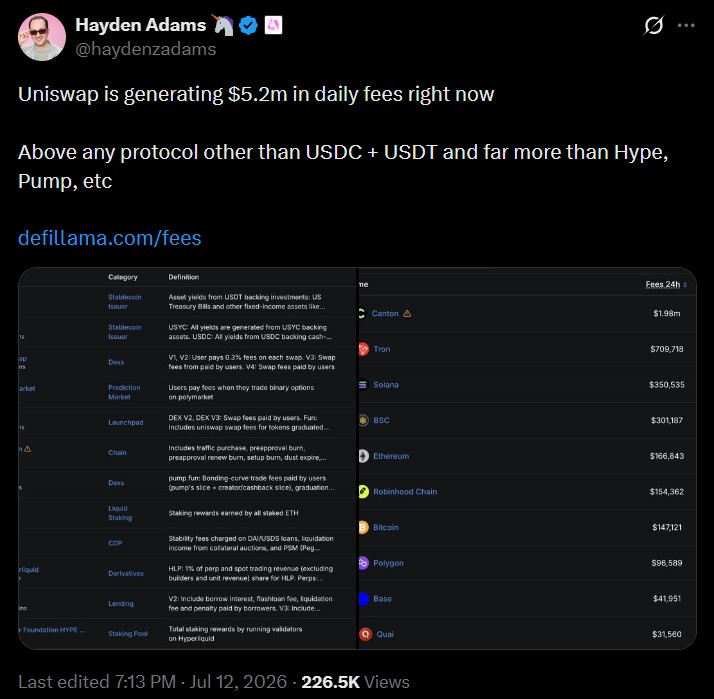
Source: Official Post
Why It Matters: The UNI Burn Mechanism
This is where things get interesting for UNI holders. Adams confirmed that protocol fees have officially been switched on, and buybacks and burns of the UNI token are now underway.
This marks the first sustained burn mechanism in Uniswap's history. For years, trading fees flowed exclusively to liquidity providers, leaving UNI holders with a token that captured little direct value from the protocol's massive usage.
Adams noted that many users still haven't registered this shift, with replies to his post frequently assuming fees remain switched off — a sign the market hasn't fully priced in the change yet.
What to Watch Next
Three governance proposals are currently being voted on, and their outcomes could determine how much additional revenue flows into future burns:
-
Fee activation on Robinhood Chain (v2 and v3)
-
Protocol fees activation for Uniswap v4
-
Bridge cleanup covering fee routes on X Layer, Avalanche network, MegaETH, and Soneium
Traders watching UNI's price action in the coming weeks should keep an eye on how these votes resolve, since expanded capture across more chains could accelerate the burn rate further.
Conclusion
Uniswap protocol has quietly become one of the highest fee-generating app in crypto, trailing only Tether and Circle. With protocol charge now active and UNI burns underway, the token's value proposition is shifting in real time. The real question is how far governance takes this — and whether upcoming votes push fee capture even higher.
Disclaimer: This article is for informational purposes only and does not constitute financial or investment advice. Cryptocurrency markets are highly volatile and carry significant risk. Readers should conduct their own research (DYOR) before making any investment decisions. CoinGabbar is not responsible for any financial losses incurred.
0
0


 Manage all your crypto, NFT and DeFi from one place
Securely connect the portfolio you’re using to start.


0
0