
Is Ethereum a Bad Investment? Price Analysis and Future Outlook

0
0
As of May 19, 2026, the second-largest cryptocurrency by market capitalization is hovering at $2,116.7, leaving many retail and institutional investors asking a blunt question: Is Ethereum a bad investment?
To understand why sentiment has flipped so aggressively to the bearish side, one only needs to look at the historical comparisons circulating through the trading community. A popular visual contrast highlights Ethereum’s valuation exactly five years ago versus today.
At first glance, a 50% decline over a five-year horizon paints a grim picture for an asset often touted as "ultrasound money." However, evaluating whether an asset is a poor investment requires digging beneath the surface of raw price data into technical indicators, macroeconomic pressures, and on-chain health.
Is ETH Coin a Bad Investment?
Whether $Ethereum is a bad investment depends entirely on your trading time horizon and risk tolerance.
For short-term swing traders, ETH is currently exhibiting a highly volatile, bearish structure that carries significant downside risk toward the $2,000 support level. For long-term investors, however, historical data and on-chain fundamentals suggest this deep correction represents a classic cyclical re-accumulation phase rather than a permanent structural failure.
Ethereum Price Analysis over the Years
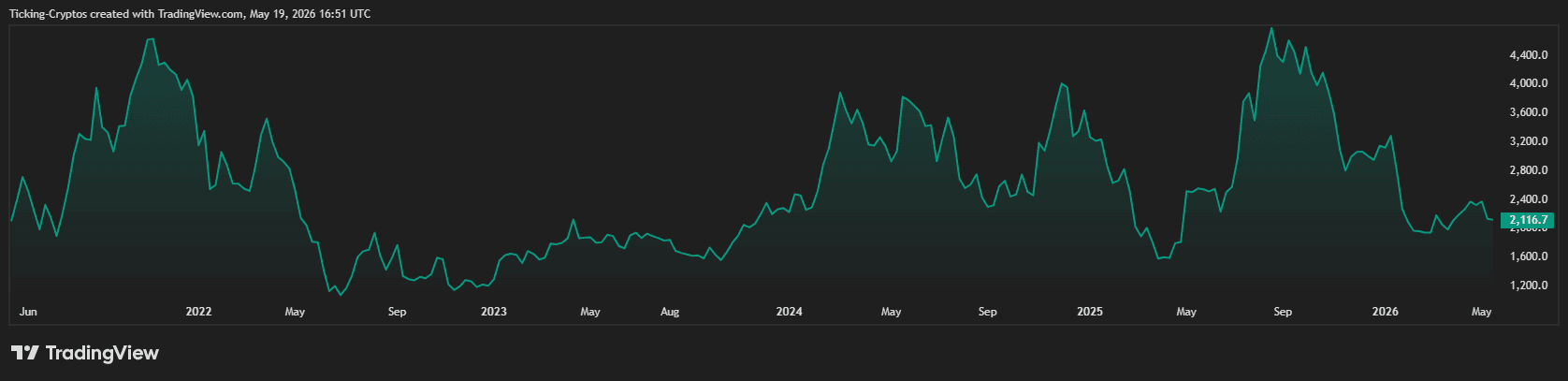
Looking at the multi-year ETHUSD chart, the asset has established a wide, macro-scale trading range. Following its peak near $4,946 earlier in the cycle, Ethereum has retraced roughly 57%, landing it back into the critical liquidity pocket between $2,000 and $2,300.
Key Support and Resistance Levels
- Immediate Support ($2,088): This represents the critical 0.5 Fibonacci retracement level. Daily and weekly candle closes must defend this area to prevent a deeper capitulation event.
- Psychological Floor ($2,000): If $2,088 fails to hold, the active impulse wave is highly likely to flush out leveraged long positions down to the flat $2,000 support mark.
- Primary Upside Target ($2,462 - $2,561): A successful defense of the current floor exposes a path to the 0.618 Fibonacci level, which acts as the initial validation gate for a structural trend reversal.
A significant silver lining on daily timeframes is the Gaussian Channel, which has recently flipped from purple (bearish) to green (bullish). Statistically, when ETH sits at the lower boundary of a green Gaussian Channel—similar to the market structure observed in mid-2025—it has historically served as a Launchpad for multi-month rallies.
Macroeconomic Headwinds: Why is Crypto Crashing?
The current downward trajectory of the broader crypto market is not happening in a vacuum. Ethereum’s price drop is heavily correlated with shifting global macroeconomic factors and sudden geopolitical escalations.
1. The Crude Oil Price Shock
The single biggest short-term headwind for Ethereum right now is the price of oil. Since late February, crude oil has surged over 66%, climbing from $65 to over $110 per barrel (Brent crude).
This massive energy spike triggers immediate inflation anxieties across traditional financial systems. When inflation threats loom, central banks—including the Federal Reserve—are forced to keep interest rates elevated for longer. This directly drains liquidity out of high-beta risk assets like technology stocks and cryptocurrencies. The inverse correlation between ETH and crude oil recently hit an all-time high of -0.40, showcasing exactly how macro factors are suppressing token valuations.
2. Geopolitical Tensions & Liquidations
Recent political friction in the Middle East has triggered widespread risk-off behavior. Warnings regarding stalled ceasefire talks led to over $580 million in overnight liquidations across the crypto market, forcing leveraged traders to sell off assets rapidly and driving the spot price of Ethereum straight through its $2,200 support floor.
Divergent On-Chain Data: Price vs. Ecosystem Health
While the spot price looks weak, Ethereum's underlying network fundamentals tell a completely different story. There is a glaring divergence between negative price action and positive ecosystem growth:
- Record Staking Participation: Despite ETH declining significantly year-to-date, the total supply of Ethereum locked in staking contracts has actually increased from 29% to 31%. Long-term holders are opting to earn yield rather than dump their tokens into the market.
- Supply Scarcity: This steady influx of staked capital actively removes millions of ETH from liquid circulation on cryptocurrency exchanges, lowering the structural sell pressure.
- Institutional Tokenization: Major financial institutions continue to deploy tokenized funds on the Ethereum mainnet. Financial analysts like Fundstrat's Tom Lee maintain that tokenization and the rise of decentralized, agentic AI applications will serve as the core structural drivers for Ethereum throughout the remainder of 2026.
Before executing a long-term strategy, investors should review their execution venue via an exchange comparison and ensure assets are secured using offline infrastructure, which you can verify in our comprehensive hardware wallets review.
Ethereum Price Prediction: What Lies Ahead?
| Time Horizon | Bearish Scenario | Bullish Scenario (Target) |
|---|---|---|
| Short-Term (Q2 2026) | Breakdown below $2,000 toward $1,850 | Bounce off Fib support to $2,462 |
| Medium-Term (End of 2026) | Prolonged consolidation under $2,200 | Recovery to macro resistance at $3,424 |
| Long-Term (Cycle Target) | Structural breakdown below $1,500 | Ascending channel continuation to $6,000 |
The Bearish Case
If crude oil remains above $110 and institutional capital continues to flow out of spot ETH ETFs, the asset will likely lose the $2,088 Fibonacci support line. This will drag the price down to the psychological floor of $2,000, where a broader market panic could temporarily wick the price down to $1,850 to sweep liquidity.
The Bullish Case
If Ethereum successfully prints a daily close above the current $2,116 node and the broader markets stabilize from geopolitical shocks, a relief rally to $2,462 is expected via Elliott Wave analysis. In the longer term, assuming the green Gaussian Channel structure mirrors past cycles, the current $2,100 level could be remembered as a generational macro bottom before an eventual push toward five-digit valuations.
Verdict: Is Ethereum a Bad Investment?
Ethereum is not a bad investment, but it is currently a painful one.
The asset is caught in a macro-driven liquidity squeeze. However, given its structural deflationary mechanics, expanding institutional tokenization use cases, and a rising staking ratio that locks up supply, the token retains some of the strongest risk-adjusted upside potential in the digital asset sector. Investors looking to enter the market should avoid over-leveraged positions and focus on dollar-cost averaging (DCA) around key structural support zones.
Track real-time valuations and historic performance curves directly on our ETH-USD Ticker Page.
0
0


 Manage all your crypto, NFT and DeFi from one place
Securely connect the portfolio you’re using to start.

0
0


0
0

0
0