
Ethiopia slashes Bitcoin mining power by 77% over hydropower shortage: report

0
0
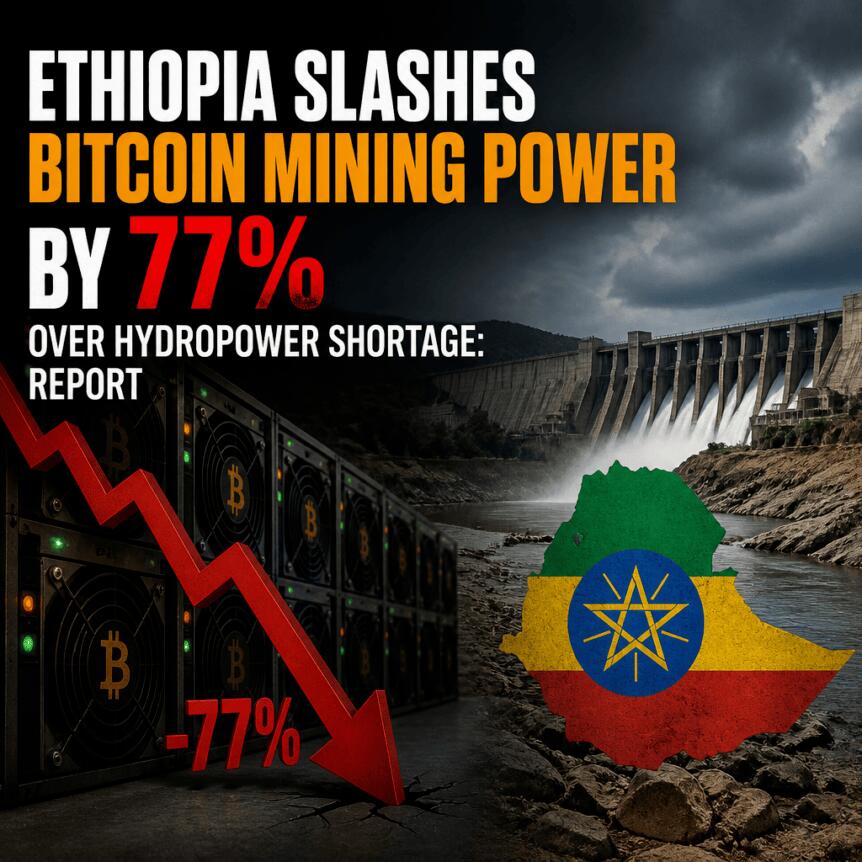
Ethiopia has reportedly cut the electricity it delivers to Bitcoin mining operations amid worsening drought conditions tied to El Niño, according to Bloomberg. The reduction reportedly brought miner power down to 23% of contracted levels as lower water inflows strained the country’s hydroelectric system.
In a Tuesday report, Bloomberg said El Niño intensified dry weather across eastern Africa, reducing reservoir inflows by 20%. Ethiopian Electric Power (EEP) chief executive Ashebir Balcha told the outlet that the utility prioritized households and industrial customers as hydropower availability fell.
Key takeaways
- Ethiopia reportedly reduced Bitcoin mining power deliveries to 23% of contracted levels due to a 20% drop in reservoir inflows, according to Bloomberg.
- EEP says it cut miner supply in stages—initially to 75% of contracted levels—before easing further to 50% and then 23%.
- With miners reportedly taking 35% of EEP revenue last fiscal year and using close to one-third of national electricity output, the decision highlights how mining supply depends on hydrology.
- EEP plans a reassessment in October, with potential for deeper reductions or electricity export restrictions.
Hydropower shortage forces EEP to prioritize demand
EEP’s decision underscores the vulnerability of mining operations that rely on affordable, flexible electricity sourced from hydropower. Bloomberg reported that EEP began by cutting deliveries to 75% of contracted levels, then lowered deliveries to 50%, before ultimately reaching 23% as reservoir inflows continued to weaken.
The executive’s rationale was straightforward: in periods of constrained hydropower generation, utilities typically must allocate electricity to essential consumption first. Balcha indicated that EEP would reassess conditions in October, and that the company could respond with additional reductions or even restrict electricity exports to neighboring countries if supply tightness persists.
For miners with long-term power arrangements, staged curtailments can materially affect operating costs and uptime. They may also raise questions about how renewable-leaning power contracts are structured during extreme weather—especially when the same electricity must serve both residential and industrial users.
Why Ethiopia’s mining share makes curtailments consequential
Bitcoin mining’s footprint in Ethiopia is unusually large relative to many jurisdictions, which is why a hydro-driven cut can ripple through both energy economics and broader mining capacity decisions.
Bloomberg reported that miners accounted for 35% of EEP’s revenue in the last fiscal year and consume almost one-third of Ethiopia’s electricity output. That concentration means a contraction in deliveries affects EEP’s income stream, while also demonstrating how miners’ ability to operate can be limited by national supply constraints.
The country’s low-cost hydropower has also helped attract overseas mining capacity. Bloomberg noted international interest, including Phoenix Group, which expanded its Ethiopian mining capacity to 132 megawatts in April 2025, following earlier additions covered by Cointelegraph. Earlier buildouts suggest investors have been willing to underwrite costs based on access to relatively inexpensive electricity—an assumption now directly challenged by drought conditions.
More restrictive mining economics after Bitcoin halvings
Beyond Ethiopia’s immediate supply pressures, a separate discussion among Bitcoin analysts is pointing to broader headwinds for mining demand for electricity and capital. Economist Saifedean Ammous, author of The Bitcoin Standard, argued in a Tuesday post on X that global Bitcoin mining electricity consumption and capital expenditure may have peaked in 2024 to 2025.
Ammous’s reasoning centers on Bitcoin’s halving mechanism, which cuts the block reward miners receive by half roughly every four years. He suggested that if mining rewards keep shrinking in dollar terms, mining operations could slow or contract unless there is a significant counterweight—such as a sustained rise in Bitcoin’s price.
In the same post, Ammous said Bitcoin would need to increase more than 18.92% per year to keep the dollar value of newly mined coins growing, even before accounting for dollar depreciation. The argument effectively ties mining profitability to two variables: the mechanical reduction in issuance and the market price offsetting that reduction.
He also referenced price weakness, noting that Yahoo Finance data shows Bitcoin is down more than 35% over the past 12 months. In that context, Ammous said it would be expected for mining activity to slow, contract, or at least not expand—unless mining metrics improve.
AI computing competition may further complicate mining’s power equation
Ammous also raised a competitive angle: artificial intelligence data centers may provide an alternative use for power and infrastructure that miners otherwise monetize. The logic is that when mining returns weaken, electricity access and specialized connectivity can become more attractive for other high-demand compute consumers.
To support that perspective, he cited VanEck data, and Miner Weekly’s June estimate that public miners could require around $50 billion to build planned AI infrastructure. The implication is not that miners abandon Bitcoin entirely overnight, but that weaker mining economics may encourage some companies to redirect capital toward AI-related opportunities.
Ammous framed his conclusions as a testable hypothesis. He acknowledged that significantly higher transaction fees—or a sustained recovery above Bitcoin’s previous electricity-consumption peak—could invalidate the view that mining power demand has topped out.
For now, Ethiopia’s curtailment adds a concrete, near-term reminder that mining depends not only on market prices and halving cycles, but also on local energy availability and national policy tradeoffs. Readers should watch EEP’s October reassessment for potential additional constraints, alongside broader industry signals on whether global mining electricity use stabilizes or declines as reward economics continue to tighten.
This article was originally published as Ethiopia slashes Bitcoin mining power by 77% over hydropower shortage: report on Crypto Breaking News – your trusted source for crypto news, Bitcoin news, and blockchain updates.
0
0

 Manage all your crypto, NFT and DeFi from one place
Securely connect the portfolio you’re using to start.


