
Bitcoin ATM in Germany: Fees, BaFin Authorisation and Tax

0
0
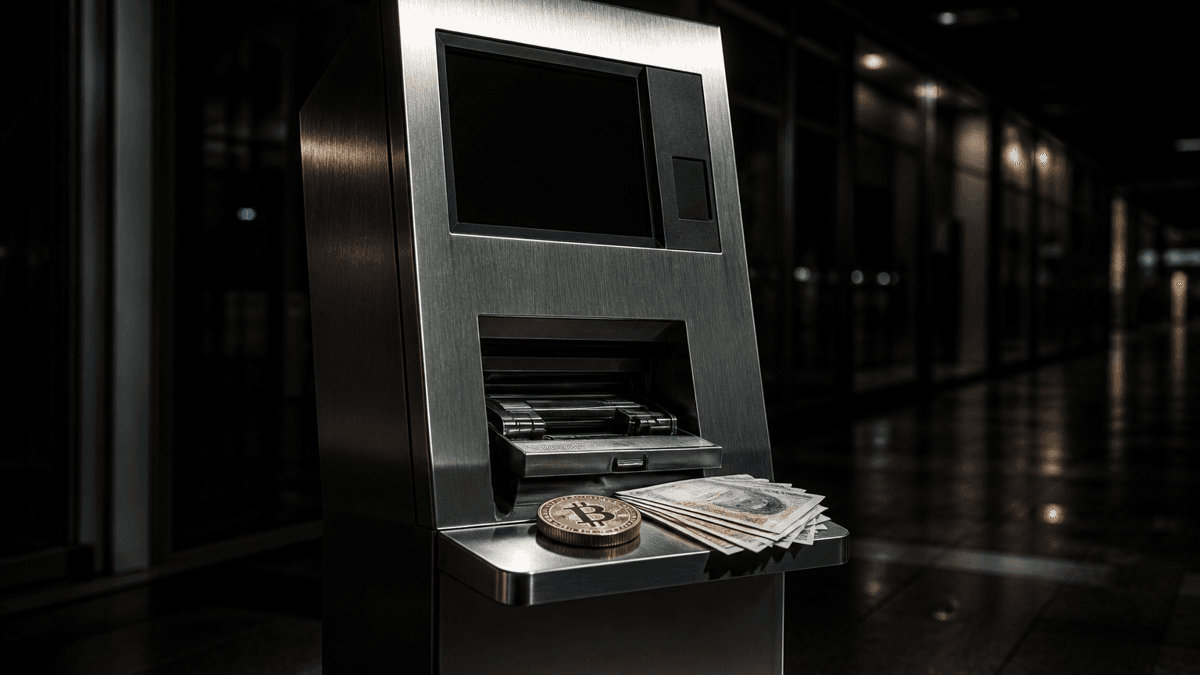
A Bitcoin ATM is a publicly sited exchange machine where you swap cash for Bitcoin. This is permitted in Germany, but only with a BaFin authorisation for the operator. It is almost always expensive: while online trading venues charge between one and one and a half percent, the markups at a machine run to ten percent and more, according to the consumer advice centre of North Rhine-Westphalia. So anyone who only wants to know whether the box in the shopping centre is legal and what it costs already has the short answer: legal yes, cheap no.
This piece answers the questions that come after that. How the process works technically at the device, at what amount your ID is demanded, what happens for tax purposes when you receive coins for cash, and how to recognise a machine operated without authorisation. Unlike at a bank branch, nobody stands across the counter from the customer at a machine to answer questions.
Are Bitcoin ATMs legal in Germany?
Yes, though not without conditions. As long ago as September 8, 2020, BaFin clarified that publicly siting machines at which cryptocurrencies can be acquired or disposed of constitutes proprietary trading under Section 1(1) sentence 2 no. 4 lit. c of the German Banking Act, and in some circumstances also financial commission business. Proprietary trading in this context means that the operator buys and sells the crypto assets for its own account as a service for others. Both are activities requiring authorisation under Section 32 of the German Banking Act.
For you as a user a simple dividing line follows from this. The purchase itself is never prohibited, nor is holding crypto assets in private wealth. The only person committing an offence is whoever operates such a machine without the necessary authorisation. BaFin cites a sentencing range of up to five years' imprisonment for this. Your risk is a different one: you feed cash into a device whose operator may not be subject to supervision at all, and if something goes wrong you have neither deposit protection nor a complaints body.
Since the European crypto regulation MiCA, a second layer has been added. A provider offering crypto services commercially needs an authorisation as a crypto-asset service provider, CASP in supervisory language. For the ATM question one point matters above all: supervision of the operator is mandatory, not decoration.
Bitcoin ATM, BTM or crypto machine: what the terms mean
Four labels circulate for the same device. Bitcoin ATM is the English abbreviation for "automated teller machine" and thus literally the Bitcoin cash machine; in German usage operators mostly say crypto machine or exchange machine, occasionally also BTM for "Bitcoin teller machine". Anyone searching for locations will find the same devices under all four terms.
Technically they split into two classes. One-way machines only sell: you feed in cash and receive coins at your address. Two-way machines additionally accept crypto and pay out notes. This distinction determines whether the trip to the device is worth anything to you at all, because most cash machines for crypto assets sited in Germany handle only the first direction.
These devices differ from bank cash machines in one decisive respect: behind a bank machine stands a credit institution with deposit protection, behind a crypto machine a trading company. Your transactions do not run through an account but over the blockchain, and nobody reverses them.
How a Bitcoin ATM works: from banknote to wallet
The process resembles a ticket machine more than the cash machine at your own bank. You select the cryptocurrency on the screen, present your receiving address and push banknotes into the note feed. The device reads the receiving address as a QR code that you bring along in the wallet app on your phone or on a paper printout. A wallet in this sense is not an account but an application that manages your keys and generates addresses for incoming payments.
The operator then sends the purchased coins to that address as an ordinary transaction on the blockchain. Two points about this matter more in practice than they sound. First, a transaction once dispatched is final; there is no chargeback as with a direct debit. Second, the address is genuinely yours only if you control the wallet yourself. Anyone using the deposit address of a trading platform at the machine does not give away control, but shifts it, and has to accept that platform's withdrawal rules.
Some devices offer to generate a new wallet for you during the process and print the access data on a receipt. That receipt is then the key to the money. If it is lost, the coins are no longer reachable, with nobody able to help. Anyone carrying their access data solely on a strip of paper has no second copy for that event.
Where Bitcoin ATMs stand in Germany and why there are so few
Typical locations are kiosks, shopping arcades, petrol stations and the occasional supermarket, mostly in larger cities. Public maps such as Coin ATM Radar list devices together with addresses, but these directories rest on operators' own reports and are therefore patchy. An entry proves neither that a machine is still standing nor that it is operated lawfully.
By international comparison Germany is a dwarf. In the United States crypto machines in supermarkets and petrol stations are part of everyday life; here the density is lower by orders of magnitude. The reason lies in the authorisation requirement: anyone wanting to site the devices lawfully needs a BaFin authorisation, must comply with anti-money-laundering rules, verify identities and report suspicious cases. An operation with few locations can barely carry that load, and that is exactly why the numbers stay small.
The consumer advice centre of North Rhine-Westphalia also points out that at the machines sited in Germany it is as a rule only possible to buy. Anyone wanting to turn coins into cash needs a different route in any case. That is no marginal detail but, for many, the decisive point in deciding whether the trip to the device is worth making.
The BaFin raid of August 2024 and what it reveals about the market
On August 20, 2024 the financial supervisor seized 13 crypto machines in a Germany-wide operation. Around 60 officers were deployed across 35 locations in the course of the action, supported by the police and the Deutsche Bundesbank and in coordination with the Federal Criminal Police Office. Alongside the devices, BaFin retained just under 250,000 euros in cash. All the confiscated machines were, according to the authority, operated without the required authorisation.
For investors the interesting part is less the number than the ratio. Thirteen devices at thirty-five locations visited is a substantial share measured against Germany's modest stock. Anyone buying at a machine is moving in a market segment where the supervisor regularly finds something. BaFin names money laundering risk explicitly as its motive: exchange machines at which the due diligence requirements are not observed lend themselves to it because of the anonymity.
How to check a provider before the first euro changes hands is something we have described step by step in our running series on BaFin warnings and provider checks. The same check you run on an unknown online platform belongs before the trip to a machine too.
Fees at a Bitcoin ATM: the markup sits in the exchange rate
At a machine the fee rarely appears on the screen as a euro amount. The markup sits in the rate at which the device sells you the coins. This gap between the market price at the large trading venues and the price at the machine is called the spread, and it is the real bill. A device can therefore claim quite accurately that it charges no separate fee and still be more expensive by a double-digit margin.
The orders of magnitude are documented. The consumer advice centre of North Rhine-Westphalia cites fees of ten percent and more. A German machine operator put its markup to Tagesschau at eight percent per transaction, citing the higher upkeep costs of physical devices, while online one to one and a half percent is usual. Both figures show the same range: the machine costs roughly five to ten times the online route.
On small amounts that barely registers; on larger ones it becomes the deciding factor. Eight percent on 1,000 euros is 80 euros that your purchase first has to make back. A look at our crypto exchange comparison shows what the same sum costs at a regulated trading venue. Anyone paying the price difference anyway should at least know what for.
How much Bitcoin do you get for 100 euros at an ATM?
Let us work it through without quoting a price, so the figure still holds tomorrow. Of 100 euros in cash, roughly 8 euros go to the operator at an eight percent markup, or 10 euros at ten percent. That leaves about 90 to 92 euros actually converted into Bitcoin. How many fractions of a coin that amounts to follows from the day's price, since Bitcoin can be divided to eight decimal places; the smallest unit is called a satoshi.
Then comes a second item that is readily overlooked: the network fee for the transfer to your address. This fee depends on how busy the blockchain is and is as a rule deducted from the payout amount. On a purchase of 100 euros it can sit in the cents range during a quiet phase, yet become noticeable under heavy load. So do not only ask the machine what you pay; look at what actually arrives at your address.
A third effect concerns denominations. Many devices accept only certain notes and give no change in euros. The remaining amount then either goes entirely into the purchase or not at all. Anyone budgeting exactly 100 euros should check on the screen beforehand which amounts the device handles at all.
KYC at the machine: from 1,000 euros the operator wants to know who you are
The idea of shopping anonymously at a machine does not survive contact with the law. KYC stands for "know your customer" and denotes the duty to establish a customer's identity. According to BaFin, an operator of crypto machines must carry out this identification either at the start of the business relationship or whenever customers outside such a relationship exchange values of 1,000 euros or more.
That threshold is lower than many assume. BaFin expressly corrected its own press release on this point in September 2024: the first version spoke of cash amounts above 10,000 euros, while the corrected version states the limit of 1,000 euros. In practice this means that even a mid-sized purchase calls for ID, a mobile number or a facial capture. If indications of illegal origin of the money or a link to terrorist financing are added, the operator must report this to the Financial Intelligence Unit.
A device that demands no identification whatsoever on four-figure amounts is therefore not a stroke of luck but a warning sign. It means either that the operator is not applying the due diligence requirements or that it is not under supervision in the first place. Either should make you turn around before the first note disappears into the feed.
Selling Bitcoin at an ATM: why getting cash back is the harder route
Technically two-way machines can pay out as well: you send coins to an address the device displays and, after confirmation on the network, notes are dispensed. In Germany, however, this route is mostly not provided for at the devices in place, according to the consumer advice centre of North Rhine-Westphalia. Anyone wanting to sell therefore almost always ends up back at a trading venue linked to a bank account.
There is also a timing problem. Between dispatching your transaction and the payout lies the confirmation time on the network, and during that period the price keeps moving. Some devices guarantee you a rate for a short window, others settle only on confirmation. For larger amounts that is a poor starting position, because you carry the price risk without being able to intervene.
The third point is the cash limit in the other direction. The same anti-money-laundering duties apply on payout, and operators additionally set their own daily limits. Anyone turning up expecting to convert a larger holding into notes on the spot will run into those limits. The orderly route runs through a trading venue where you know the payout channels and timings in advance.
Tax on an ATM purchase: holding period, threshold and the receipt as proof
The purchase itself triggers no tax, whether at a machine or online. Only the later sale becomes relevant for tax, and for that Section 23 of the German Income Tax Act on private sales transactions applies. The holding period is one year: if not more than one year lies between acquisition and disposal, the gain is taxable; after that it stays untaxed in private wealth.
Then there is the threshold. Gains stay tax free if the total gain from all private sales transactions in the calendar year amounts to less than 1,000 euros. Threshold means: once the amount is reached, the entire gain is taxable, not merely the part above it. These basics, together with savings plans, ETPs and mining, are written up in detail in our overview of Bitcoin and tax in Germany.
The real pitfall with an ATM purchase is the evidence. At a trading venue every order generates a record that you export years later as a tax report. At a machine you get a thermal paper receipt whose print fades, or an email confirmation if you have supplied an address. The Federal Ministry of Finance restated the cooperation and record-keeping duties for crypto assets in its circular of March 6, 2025 and requires comprehensible details on acquisition, disposal and the prices applied. So photograph the receipt while still at the device and file the image with your tax records.
In practice three details belong together: the date and time of the purchase, the euro amount paid including the markup, and the transaction identifier on the network through which the inflow to your address can be evidenced. Anyone buying regularly does better with a tool from our comparison of crypto tax tools, because machine purchases can be entered there as a manual booking with evidence attached.
How to spot an illegally operated crypto ATM
There is no official plaque, but there are indicators. A lawfully operated device names the operator with its full company name and address, carries terms of business and an imprint, and points to a complaints procedure. If these details are missing, or if only a brand name without a legal form appears, that is the first clue.
The second check costs two minutes: look up the operator in BaFin's company database and, in parallel, in the list of warning notices. If you cannot find the company there as supervised, the basis for operation is missing. How this check runs in detail is set out in our guide to regulated crypto exchanges, which works through the same criteria for online providers.
The third point is the behaviour of the device. If it dispenses with any identification on four-figure amounts, presses for cash payment without a receipt, or generates the wallet itself and keeps a copy of the access data, then it is not working to the due diligence requirements that apply in this market. You know the same logic from fake verification sites online that harvest wallet access by feigning an official-sounding check.
Risks at the machine: what can go wrong and what nobody will refund
The consumer advice centre of North Rhine-Westphalia advises restraint on crypto assets generally and recommends risking at most an allocation of five percent of one's wealth, and that only with money one could do without if it came to it. It gives two reasons that weigh especially heavily at a machine: Bitcoin is not legal tender, and there is no legal right to return it.
On top of that come risks that do not exist in this form online. A typing error or a misread QR code sends the coins to a stranger's address with no way to retrieve them. A faulty note feed turns a purchase into a dispute with a company you can reach only through a telephone number on the casing. And anyone standing at the device under time pressure because someone on the phone is pushing them to do so is with high probability the victim of a fraud scheme in which machines serve as a payout channel for criminals.
The rules protect you only indirectly here. They are addressed to the operator rather than to you: what is required is authorisation, identification and reporting channels. Losses from a misdirected purchase will be refunded by no authority, and by no deposit protection fund either.
ATM, exchange or broker: when the detour through cash makes sense
There are cases in which the surcharge is defensible. Anyone without access to a trading account, anyone wanting to swap a small sum into coins without a bank connection, or anyone wanting to follow the process physically once, will find a low-threshold entry point at a machine. For amounts in the tens of euros, the difference between one and ten percent is small in absolute terms.
As soon as three-figure or larger sums are involved, the arithmetic tips. You then pay a markup at the device that can equal half a year of price movement, without getting more security for it. A regulated trading venue offers you an order book, limit orders, a comprehensible statement and, in a dispute, an address. The machine offers proximity and speed.
Anyone wanting to buy regularly should be thinking about a savings plan rather than individual purchases at changing devices. That way the documentation you later need for tax arises automatically, and the average price smooths out outliers. We have worked through the comparison of a one-off purchase and a savings plan with concrete figures elsewhere.
Bitcoin ATM: what to take away
- Check the operator before you insert the first note. The company name, address and BaFin authorisation must be findable; if there is no identification on four-figure amounts, something is wrong. Apply the same standard to online providers, see our overview of regulated crypto exchanges.
- Secure the evidence the same day. A photo of the receipt, the purchase date, the euro amount and the transaction identifier belong filed together, otherwise you cannot later prove the one-year holding period. A tool from our comparison of crypto tax tools takes the bookkeeping off your hands.
- Weigh the markup against the online route. Eight to over ten percent at a machine against one to one and a half percent online: from three-figure amounts upwards, the comparison in our overview of crypto exchanges almost always pays off.
(As of September 21, 2026. This article is not investment advice. Prices and fee structures change; check the terms with the provider before you buy.)
0
0


 Manage all your crypto, NFT and DeFi from one place
Securely connect the portfolio you’re using to start.


