
Bitcoin AI Correlation Weakens as Big Tech Loses Nearly $800B

0
0

This article was first published on The Bit Journal.
Bitcoin has shown surprising resilience after nearly $800 billion was erased from the market value of America’s biggest technology companies. Could Bitcoin AI correlation be breaking away from the AI-driven equity trade that has dominated markets in recent weeks?
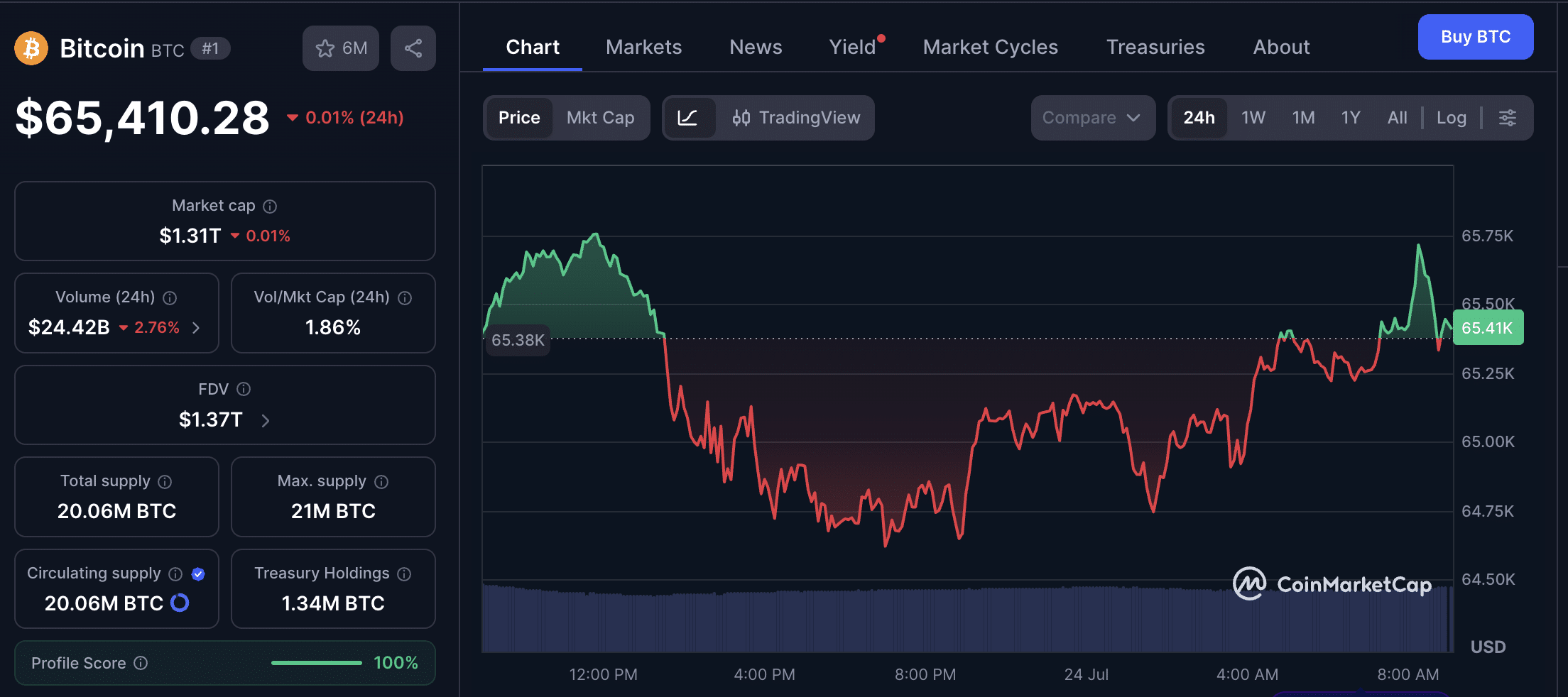
BTC hovered around $65,400 during Asian trading, down less than 1% over the previous 24 hours but still posting weekly gains. Ether slipped to around $1,879, while Dogecoin, Solana, XRP, and Hyperliquid’s HYPE also traded lower.
Even so, crypto’s losses were modest compared with the sharp decline that swept through Wall Street after investors questioned whether Big Tech’s massive artificial intelligence spending is becoming unsustainable.
AI Spending Concerns Trigger Tech’s Biggest Rout in Months
The selloff began after earnings reports from Alphabet and Tesla raised concerns over the increasing cost of artificial intelligence infrastructure.
Alphabet increased its projected capital expenditure to as much as $205 billion this year, while Tesla warned that 2026 would be “a massive capex year” as it continues investing heavily in AI, robotics, autonomous driving, and computing infrastructure.
Although both companies continued generating strong revenue, investors focused instead on shrinking free cash flow and the growing cost of maintaining leadership in the AI race.
The Magnificent Seven collectively lost roughly $797 billion in market capitalization during Thursday’s session, their worst one-day performance since the tariff-driven market turmoil of April 2025.
The S&P 500 fell about 1.2%, while the Nasdaq 100 declined nearly 2% as investors rotated away from high-growth technology names.

Bitcoin AI Correlation Faces Its First Real Test
For much of July, Bitcoin had behaved almost like another AI-related asset.
As semiconductor shares and AI infrastructure companies rallied, Bitcoin generally moved in the same direction. Likewise, weakness in chipmakers frequently spilled into cryptocurrencies, pressing the idea that digital assets had become another expression of investor enthusiasm for artificial intelligence.
This Friday’s market action challenged that.
Despite one of the largest single-day losses for mega-cap technology stocks in more than a year, Bitcoin remained remarkably stable. Instead of following equities lower, the cryptocurrency largely held its ground, suggesting crypto traders may have started responding to a different set of catalysts.
That does not necessarily mean Bitcoin has fully decoupled from technology stocks. One trading session rarely establishes a lasting market trend, especially during earnings season when volatility tends to increase.
Still, this stands out after several weeks of unusually tight correlation between AI equities and digital assets.
Bitcoin Miners Still Tie Crypto to the AI Economy
A complete separation between Bitcoin and the AI trade may also prove difficult because many publicly traded mining companies have expanded beyond cryptocurrency.
Firms such as Core Scientific, Hut 8, Iris Energy and others have now put themselves out as providers of high-performance computing infrastructure for artificial intelligence workloads.
That has created another channel through which AI investment cycles can influence parts of the crypto ecosystem.
If enterprise AI spending slows over a prolonged period, demand for data-center capacity could soften, potentially affecting miners that now generate revenue from both Bitcoin mining and AI computing services.
In other words, Bitcoin AI correlation may have resisted this particular equity shock, but longer-term links between artificial intelligence and digital assets remain intact.
What Could Drive Bitcoin From Here?
Whether Bitcoin continues outperforming technology stocks will likely depend on factors beyond AI spending alone.
Institutional demand through spot Bitcoin ETFs, macroeconomic data, interest-rate expectations, and geopolitical developments remain drivers of cryptocurrency prices.
Those catalysts could increasingly outweigh short-term moves in semiconductor and AI stocks if digital assets continue attracting independent capital.
Investors will also be watching upcoming earnings from other major technology companies, including Microsoft, Meta Platforms, and Amazon. If concerns over AI spending spread further across the sector while Bitcoin maintains relative stability, the case for a weakening correlation could become stronger.
For now, however, analysts caution against drawing wide conclusions about Bitcoin AI correlation from a single trading session.
Crypto and equities have repeatedly diverged during periods of heightened volatility before re-establishing their historical relationships.
Conclusion
Bitcoin AI Correlation remains an important market theme, but today’s trading offered the strongest evidence yet that cryptocurrencies may not always move with AI-driven equities.
While Alphabet and Tesla’s aggressive spending plans erased nearly $800 billion from the value of the Magnificent Seven, Bitcoin absorbed the shock with only modest losses.
Upcoming corporate earnings, institutional crypto flows, and the overall macroeconomic outlook still remain constant determinants in the current market outlook.
Glossary
Magnificent Seven: The group of seven mega-cap U.S. technology companies that have led equity market performance.
Capital Expenditure (CapEx): Corporate investment in long-term assets such as AI infrastructure, servers, and data centers.
Free Cash Flow: Cash remaining after a company covers operating and capital expenses.
Bitcoin Miner: A company or participant that validates Bitcoin transactions while earning block rewards.
AI Infrastructure: Hardware, chips, networking equipment, and computing facilities used to develop and operate artificial intelligence models.
Correlation: A statistical relationship describing how closely two assets move together.
Frequently Asked Questions About Bitcoin AI Correlation
Why did Bitcoin outperform Big Tech stocks?
Bitcoin experienced only modest losses while technology shares fell sharply, suggesting crypto investors were influenced by factors beyond concerns over AI spending.
What caused the Magnificent Seven selloff?
Investors reacted negatively to higher AI infrastructure spending forecasts from Alphabet and Tesla, raising concerns about free cash flow and future returns on investment.
Is Bitcoin still correlated with AI stocks?
Bitcoin AI correlation remains significant, but the latest trading session suggests the correlation may be weakening. More data will be needed to confirm whether the divergence is sustainable.
Why does AI spending matter for crypto?
Many Bitcoin mining companies have diversified into AI data-center operations, while investor appetite for technology assets often influences demand for cryptocurrencies.
References
Read More: Bitcoin AI Correlation Weakens as Big Tech Loses Nearly $800B">Bitcoin AI Correlation Weakens as Big Tech Loses Nearly $800B
0
0

 Manage all your crypto, NFT and DeFi from one place
Securely connect the portfolio you’re using to start.


0
0

0
0