
Ethereum Volatility Hits Multi-Year Lows as Traders Watch for ETH Breakout Toward $4,000

0
0

This article was first published on The Bit Journal.
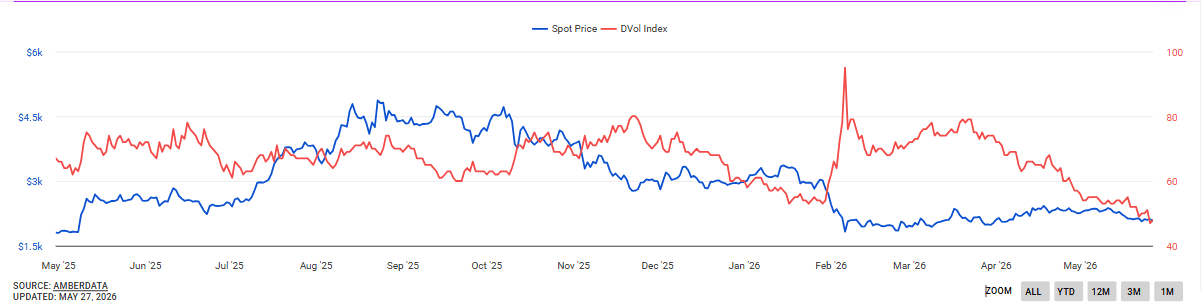
Ethereum volatility has fallen to one of its lowest levels since 2024, raising speculations that ETH might be gearing up for another major price swing after months of being stuck around $2,000.
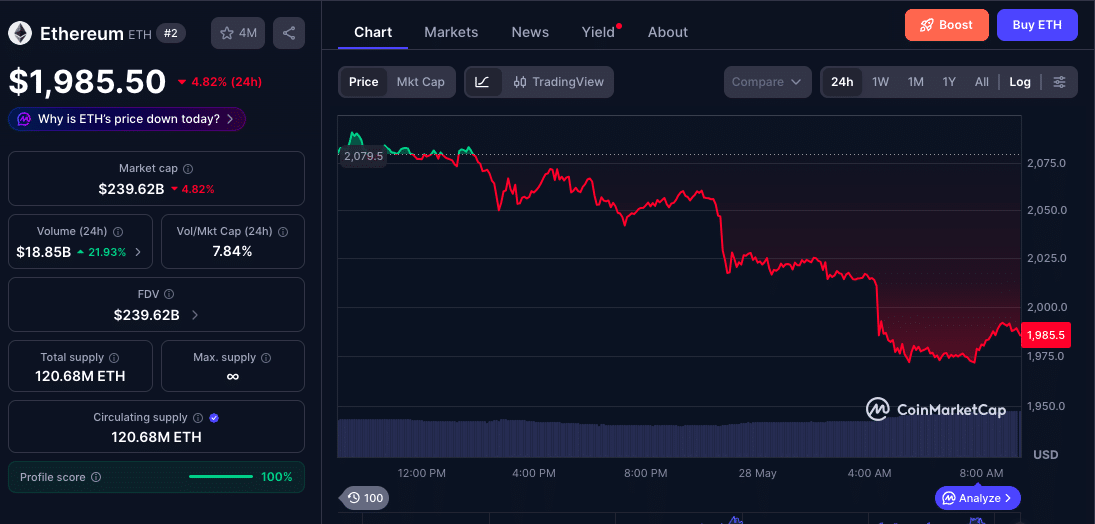
ETH has traded in a tight zone all of 2026with buyers repeatedly defending the $2,000 support zone. Now, analysts are of the opinion that the sudden drop in Ethereum volatility might actually signal that a bigger breakout phase is approaching.
According to Amberdata market reports, Ethereum volatility index just dropped below 50 and is now at 48. Last time this kind of volatility was seen was back in January 2024, shortly before ETH surged from roughly $2,230 to $4,170 within months.
That earlier move delivered gains of nearly 170%, making traders wonder whether history might repeat itself.
Ethereum Volatility Could Signal An Accumulation Phase
When Ethereum volatility is low, it often means large investors are quietly building up their positions beneath the radar. Traders tend to scale back their aggressive bets, and price stabilizes, before momentum returns. Several technical indicators now point toward similar conditions.
Ethereum’s Bollinger Bands on longer timeframes have gotten tighter, while historical volatility is hovering near its 2024 lows. ETH has also managed to hold above $2,000 even as the rest of the altcoin market gets weak.
Glassnode analyst Chris Beamish recently pointed out that Bitcoin volatility has also compressed to historically low levels. With BTC DVOL at 35, investors are expecting a crypto market expansion on the cards.
On-chain data also shows whale investors are accumulating more ETH again. A market report from this month noted that large ETH-holding wallets accumulated more than 140,000 ETH in a matter of days. At the same time, nearly 30% of Ethereum’s circulating supply is still staked out, which means less sell pressure on the market.
That tighter supply structure is fueling bullish expectations, even if ETH is not doing too much right now.
Can ETH Break Above That $2,200 Barrier?
Even though things look promising, ETH still has to overcome a really tough hurdle before breaking above higher levels.
Analysts are all fixed on the $2,200 – $2,400 area right now. ETH has struggled to reclaim that range consistently throughout 2026.
Ethereum is still stuck in a much bigger consolidation structure after the sharp losses earlier in the year. Technical analysts are looking at $2,460 as the upper breakout level that would probably ease bearish pressure off the market.
If ETH can finally break through that resistance with real volume, it is possible the market could see a quick run to the $3,000 and even on up to $4,000.
Still, there are some analysts who remain cautious because ETH has repeatedly failed to sustain breakout attempts this year.
Competition and a Weak Sentiment Still Putting Pressure on Ethereum
Despite the improvements in Ethereum’s situation, the coin is still facing some tough challenges.
ETH remains down sharply from previous highs, while the ETH/BTC ratio recently touched fresh lows.
Some activity and liquidity have also shifted toward faster chains and newer narratives tied to AI-focused crypto projects.
Investor frustration has become more visible inside the Ethereum ecosystem itself. Discussions around Ethereum’s long-term value proposition have intensified as rival networks continue attracting users and revenue.
Recent reporting has really revealed the tension inside the Ethereum Foundation, and then concerns about Ethereum’s direction amid rising institutional competition.
Can Ethereum Still Make it Up to $4,000?
The current volatility setup in Ethereum bears a few similarities to what happened before the big price moves in the past. However, analysts warn that just because the volatility is going down, doesn’t mean that Ethereum is going to go through a big breakout.
For the bulls, all they have to do is hold support above the $2,000 mark and reclaim the $2,200-$2,400 resistance zone.
If buyers manage that, ETH could regain momentum toward $3,000 before testing the psychological $4,000 level again.
Failure to break resistance, however, may leave Ethereum stuck inside another extended consolidation range.
Conclusion
Ethereum volatility has dropped to levels last seen before ETH’s powerful 2024 rally. This has put a lot of traders on high alert that another big price move could be just around the corner.
Low volatility, investors buying up more and more of the coin, and the supply getting tighter are all still pointing to a good case for Ethereum.
Still, Ethereum has serious competition to deal with and market sentiment is cautious right now. All eyes are on when the price is going to finally break above that key resistance level and send ETH rallying towards $4,000.
Glossary
Ethereum volatility: This is a measure of how fast the price of ETH is moving over time.
Bollinger Bands: These are technical indicators that help track how volatile the price is and the range.
Staking: Locking ETH to help secure the Ethereum network while earning rewards.
Whale wallets: Crypto wallets holding large amounts of digital assets.
Accumulation: A market phase where investors buy up assets over time.
Frequently Asked Questions About Ethereum Volatility
Why is Ethereum volatility a big deal?
Low volatility in Ethereum often means that a larger price move could be approaching.
What resistance level are traders watching?
Analysts are keeping an eye on the $2,200 to $2,400 range.
Can ETH ever make it back up to $4,000?
A break above resistance could definitely open the door for ETH to make it back up to $4,000.
Why has Ethereum been struggling?
Competition from rival blockchains, uncertainty and weak sentiment that have slowed momentum down.
References
Read More: Ethereum Volatility Hits Multi-Year Lows as Traders Watch for ETH Breakout Toward $4,000">Ethereum Volatility Hits Multi-Year Lows as Traders Watch for ETH Breakout Toward $4,000
0
0


 Manage all your crypto, NFT and DeFi from one place
Securely connect the portfolio you’re using to start.

0
0


