
How Hyperliquid USDC Partnership Could Strengthen HYPE Market Outlook

0
0

Hyperliquid USDC deal has brought new focus to stablecoin income sharing in crypto markets. The agreement gives USDC a preferred role on Hyperliquid’s perpetual futures exchange.
Analysts said the structure could move reserve-income benefits toward the platform. They also said Circle and Coinbase may face margin pressure as revenue-sharing terms change under the latest agreement with both firms.
Hyperliquid USDC Deal Shifts Reserve Income Model
The agreement, announced last Thursday, makes Circle’s USDC the official Aligned Quote Asset on Hyperliquid. Coinbase will deploy USDC treasury assets, while Circle will handle minting, redemptions, and cross-chain infrastructure.
The revenue-sharing terms were not disclosed. Analysts said the framework could let Hyperliquid receive most of the reserve income generated by USDC deposits.
The Hyperliquid USDC deal changes the balance between stablecoin issuers and crypto trading platforms. Income that previously flowed mainly to Circle and Coinbase could now support Hyperliquid revenue and token buybacks.
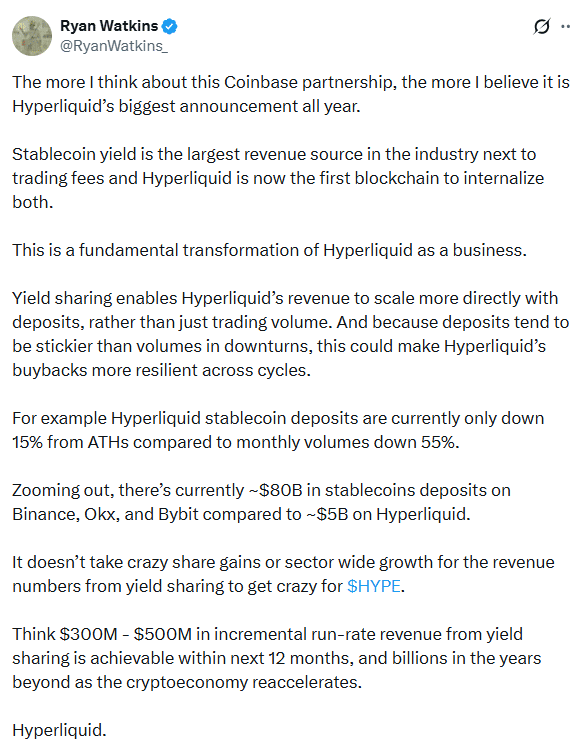
Syncracy Capital co-founder Ryan Watkins said the partnership changes the protocol’s business model. It can now capture trading fees and stablecoin yield.
USDC Quote Asset Role Changes Economics
USDC will serve as Hyperliquid’s official quote asset under the Aligned Quote Asset framework. That status gives the stablecoin a role inside the exchange’s market structure.
The framework also gives Hyperliquid stronger economics from deposits. The Hyperliquid USDC deal shows how trading venues may use liquidity to negotiate better terms.
Yield Sharing Could Support Revenue
Watkins said yield sharing lets Hyperliquid revenue scale with deposits, not only trading volume. He added that deposits usually stay steadier than trading activity during market downturns.
That structure could make token buybacks more resilient across cycles. It may also reduce Hyperliquid’s dependence on trading volumes alone.
HYPE Buyback Outlook Draws Attention
Watkins estimated that the deal could channel $135 million to $160 million in revenue and buybacks from USDC yield sharing. He said stablecoin balance growth could lift added revenue to $300 million to $500 million.
HYPE recently outperformed the wider crypto market. The token gained nearly 10% over the past week, according to the market data.
Circle and Coinbase Face Margin Pressure
Compass Point analysts Ed Engel and Mike Donovan estimated a $60 million to $80 million annual EBITDA loss for Circle and Coinbase combined. They said the firms are sharing more reserve income with Hyperliquid than before.
Hyperliquid’s roughly $5.1 billion USDC supply generates about $180 million in annual gross profit for Coinbase and Circle combined, the analysts estimated. The Hyperliquid USDC deal could weigh on stablecoin-related earnings.

DeFi Platforms May Seek Similar Terms
Engel and Donovan said other DeFi protocols may demand similar yield-sharing arrangements. They pointed to platforms such as Polymarket and Jupiter as possible examples.
That risk matters for stablecoin issuers. More platforms could seek reserve income in return for preferred access to users and liquidity.
Stablecoin Consolidation Comes Into Focus
The agreement also formalizes a strategy Hyperliquid began last year through its Aligned Quote Asset framework. Instead of building around Native Markets’ USDH, Hyperliquid now appears to be working with established stablecoin firms.
Paul Howard, senior director at Wincent, said the market may be entering a phase of stablecoin consolidation. He said fewer stablecoins and conversion layers could improve capital flows and liquidity efficiency.
Conclusion
The Hyperliquid USDC deal gives Hyperliquid a larger share of stablecoin economics. It also places Circle and Coinbase under margin pressure as reserve income moves into a new sharing structure.
The final impact will depend on stablecoin balances, interest rates, and user activity on the exchange. Analysts see the model as a major development for Hyperliquid revenue and HYPE buyback support.
Appendix Glossary of Key Terms
Aligned Quote Asset: A preferred asset used for trading and pricing on Hyperliquid.
Reserve Income: Earnings generated from assets backing stablecoin deposits.
Yield Sharing: A model where stablecoin income is shared with another platform.
HYPE Token: Hyperliquid’s native token linked to its ecosystem.
Token Buybacks: Purchases of a token by a protocol or company.
EBITDA: A measure of earnings before interest, taxes, depreciation, and amortization.
Stablecoin Consolidation: A trend where fewer large stablecoins dominate market activity.
Frequently Asked Questions About Hyperliquid USDC deal
1- What is the deal about?
It makes USDC the official Aligned Quote Asset on Hyperliquid, with Coinbase deploying most USDC treasury assets and Circle handling core stablecoin services.
2- Why does it matter for HYPE?
Analysts said USDC yield sharing could create more revenue for Hyperliquid, which may support token buybacks.
3- How could Circle and Coinbase be affected?
Compass Point analysts estimated the arrangement could reduce their combined annual EBITDA by about $60 million to $80 million.
4- Could other DeFi platforms copy this model?
Analysts said other platforms may seek similar reserve-income sharing terms from stablecoin issuers.
References
Read More: How Hyperliquid USDC Partnership Could Strengthen HYPE Market Outlook">How Hyperliquid USDC Partnership Could Strengthen HYPE Market Outlook
0
0


 Manage all your crypto, NFT and DeFi from one place
Securely connect the portfolio you’re using to start.


0
0

0
0

0
0