
Solana (SOL) Reclaims $72 as On-Chain Metrics Signal Slowing Momentum
0
0
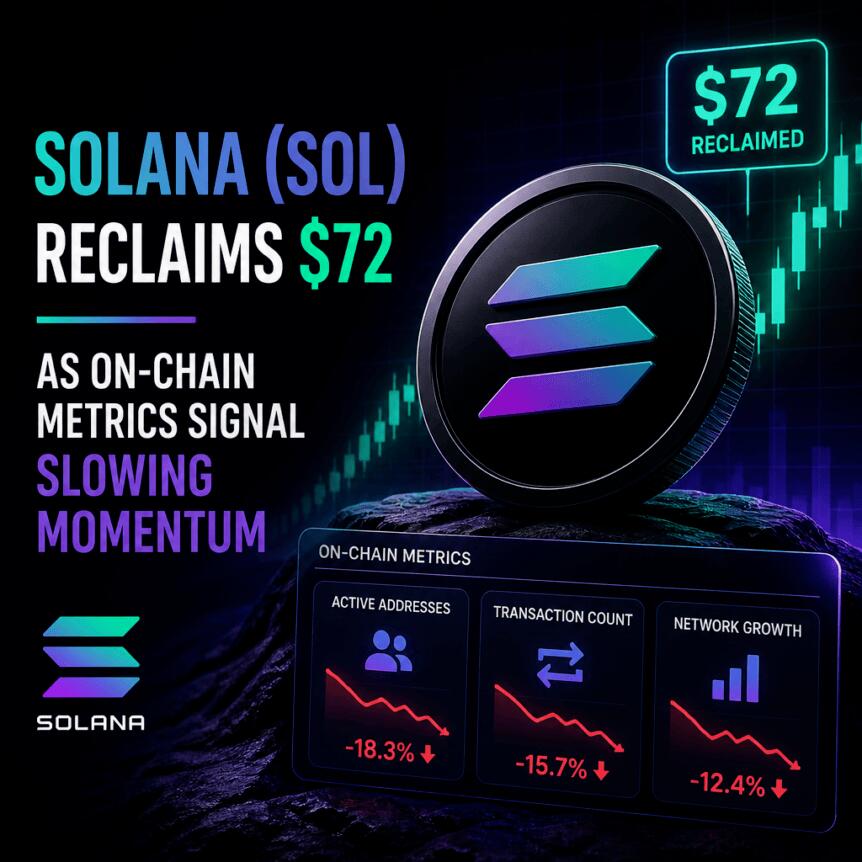
Solana’s native token SOL rebounded sharply this week, climbing to around $72 on Friday after falling to about $64 the day before. Traders pointed to renewed optimism around tokenized assets on the network—particularly tokenized stock products—while market data also highlighted a more fragile foundation for sustained momentum: Solana’s onchain liquidity and DEX activity have been cooling.
The result is a mixed near-term picture for investors. Futures positioning has turned more bullish, but DeFi metrics—especially Total Value Locked (TVL) and decentralized exchange volumes—show that demand for SOL-linked onchain activity remains uneven.
Key takeaways
- SOL’s move back to ~$72 comes as tokenized stocks on Solana posted more than $113 million in 24-hour volume, per Jupiter Aggregator data.
- Still, Solana TVL fell 11% over the past month, including declines across major protocols such as Kamino, Raydium, and Binance Staked SOL.
- DEX volumes on Solana have dropped to about $10 billion per week from roughly $30 billion in early February, alongside weaker decentralized application revenues.
- Solana’s DApp economy appears concentrated: Cointelegraph cited that Pump.fun accounts for about 30% of Solana DApp revenue, tying activity to memecoin dynamics.
- While SOL futures funding rose to around 10% (highest in June), the level remains within a range often described as closer to neutral than “overheated.”
Tokenized stocks lift activity, but liquidity remains a question
One of the clearest drivers behind SOL’s optimism is activity tied to tokenized equities trading on Solana. According to Jupiter Aggregator, tokenized stock instruments traded for more than $113 million over 24 hours. For traders watching for catalysts to sustain an “altcoin season” narrative on Solana, these volumes offer a tangible signal that new demand is showing up where it matters: in spot liquidity and swap flow on Solana’s venues.
However, the story isn’t uniformly bullish. The same data segment raised concerns about liquidity depth inside automated market-maker pools, especially as multiple issuers compete for similar exposure. Thin liquidity can make price discovery more volatile and can reduce the stickiness of trading demand if users find spreads widen or exits become harder during fast moves.
There’s also a timing wrinkle: many tokenized instruments launched recently, which can correspond with low holder counts. That doesn’t automatically invalidate the trend, but it does mean investors should watch whether participation broadens beyond the initial launch cycle.
TVL and DEX volumes point to softer baseline demand
Outside of the tokenized equities narrative, broader Solana DeFi conditions have weakened. DefiLlama data referenced in the report shows Solana’s TVL declined 11% over the past month. At the same time, Ethereum’s layer-2 network Base has reduced the gap between the two ecosystems, putting more competitive pressure on Solana’s standing as a high-throughput DeFi hub.
Looking at protocol-level declines, the report cited a 19% TVL drop in Kamino, a 20% trim by Binance Staked SOL, and a 17% decline by Raydium. Not every protocol moved in the same direction: xStocks reportedly grew TVL by 31%, aligning with the upbeat headlines around tokenized products.
Still, the DEX picture is the part that may temper expectations. Solana decentralized exchange volumes fell to around $10 billion per week from $30 billion in early February, and the downtrend coincided with declining DApp revenues. In practical terms, tokenization can create bursts of activity, but if overall exchange throughput remains muted, SOL demand tied to transaction processing may struggle to sustain a strong rally on its own.
Pump.fun concentration and leverage positioning add volatility
The next issue for readers is concentration risk in Solana’s DApp revenue. Cointelegraph cited that Pump.fun accounts for roughly 30% of Solana DApp revenue. That matters because Pump.fun’s output is closely tied to memecoin cycles, which can be intense but also short-lived.
CoinGecko’s research, referenced in the report, indicated that 80% of tokens launched on Pump.fun within less than 48 hours, based on a sample of 18.7 million tokens. Dune data cited alongside it suggested that 55% of involved addresses lost up to $1,000. The combination of rapid launches and high loss rates is not necessarily a direct bearish signal for SOL—but it does underline that a large share of onchain revenue may be driven by speculative dynamics rather than steady, utility-driven retention.
Meanwhile, derivatives markets have shifted more optimistic. The report referenced a funding-rate gauge from Laevitas, noting that bullish leverage demand increased on Friday and that the funding rate reached its highest level in June. The current funding rate of about 10% was described as not “excessive,” since a 6% to 12% band is often treated as neutral. Still, the report highlighted that SOL’s recovery—up roughly 14% from the $64 low—helped reverse earlier bearishness reflected in negative funding rates.
For traders, this implies a more supportive short-term backdrop: funding turning positive can reflect demand to stay long. But when tokenization narratives are active while baseline DeFi usage cools, leverage can also amplify drawdowns if liquidity thins again or if tokenized trading interest fades.
Airdrop hopes and new tokenized infrastructure may matter—competition is real
Some of SOL’s momentum is linked to expectations around potential network airdrops, though the timing and specific launch schedule remain uncertain. The report pointed to various projects and metrics that traders may associate with an “ecosystem runway,” including OnRe reinsurance (with $200 million in TVL), Bulk perpetual DEX (aggregate open interest of $325 million), and Loopscale lending platform (TVL of $79 million).
Even so, the report urged caution about assuming SOL must reclaim the $80 level seen on June 1. The reason is competition—not just from within Solana’s own tokenization ecosystem, but also from other venues and centralized platforms. The report specifically noted increased competition in tokenized stock trading from Hyperliquid and from centralized exchanges on competing chains.
One example cited was a strategic partnership between OKX and the NYSE parent company, reportedly using Ethereum-based systems. For investors, this is a reminder that the “tokenized equities” narrative isn’t exclusive to Solana. If liquidity and user attention fragment across networks and regulated rails, SOL’s tokenization volumes could remain high at times while still failing to translate into durable onchain strength.
What to watch next is whether Solana can convert tokenized-equities volume into broader, repeatable onchain activity—measured through sustained TVL and DEX throughput—while futures funding stays positive without turning extreme. If SOL’s rally holds alongside improving liquidity depth in tokenized pools, the current optimism may solidify; if DEX volumes and revenues keep slipping, the market may treat tokenized stock flows as temporary.
This article was originally published as Solana (SOL) Reclaims $72 as On-Chain Metrics Signal Slowing Momentum on Crypto Breaking News – your trusted source for crypto news, Bitcoin news, and blockchain updates.
0
0


 Manage all your crypto, NFT and DeFi from one place
Securely connect the portfolio you’re using to start.


0
0

0
0

0
0