
CLARITY Act News: 5 Top Firms Support Crypto Bill As Senate Vote Nears

0
0

CLARITY Act News Today: Will Senate Pass Crypto Bill Before August?
The CLARITY Act is back in the spotlight this week as Senate Republicans race to secure a procedural vote before the August recess. At the same time, SEC Chairman Paul Atkins has pledged support, Aave founder Stani Kulechov has weighed in on what the bill means for banks, and major Wall Street firms have publicly backed the legislation.
Here's a full breakdown of where things stand, what's holding the bill up, and what could happen next.
At a Glance: CLARITY Act News Today
-
Senate Vote: Procedural vote targeted before August recess
-
60-Vote Hurdle: 60 votes needed to advance the bill
-
Ethics Dispute: Democrats seek restrictions on Trump family crypto profits
-
SEC Support: Paul Atkins backs the bill and offers technical assistance
-
Banking Impact: Bill could expand banks’ digital asset activities
-
Wall Street Support: BlackRock, Goldman Sachs, Fidelity, Franklin Templeton and SoFi back the bill
-
Bank Concerns: Stablecoin yields may trigger deposit outflows
-
Next Step: Final Senate debate could move to September
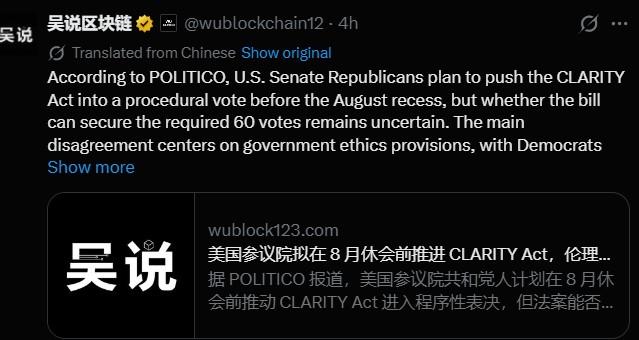
Source: Wu Blockchain X Account
CLARITY Act News Today: Senate Republicans Push for Procedural Vote
Senate Republicans are trying to schedule a procedural vote on the CLARITY Act before lawmakers leave for their August recess.
The move would force moderate Senate Democrats, who have spent months negotiating over the bill, into a formal up-or-down vote. The challenge is clearing the Senate's 60-vote threshold, a bar that requires meaningful bipartisan support.
With the legislative calendar shrinking fast and a handful of GOP senators still undecided, the outcome of the procedural vote remains genuinely uncertain heading into the final stretch before recess.
CLARITY Act Faces Key Hurdles Over Trump Crypto Ethics Rules
The single biggest obstacle to passage is a government ethics provision tied to President Trump's crypto business interests. Democrats want language that limits how Trump and his family can profit from digital asset ventures while the bill becomes law.
Progressive voices, including Senator Elizabeth Warren, have argued that supporting the bill without stronger ethics guardrails would amount to caving to a wealthy industry lobby and could expose the financial system to added risk.
Republicans previously circulated ethics language backed by the White House, but Democrats rejected it as inadequate, with Senator Ruben Gallego dismissing the draft in blunt terms.
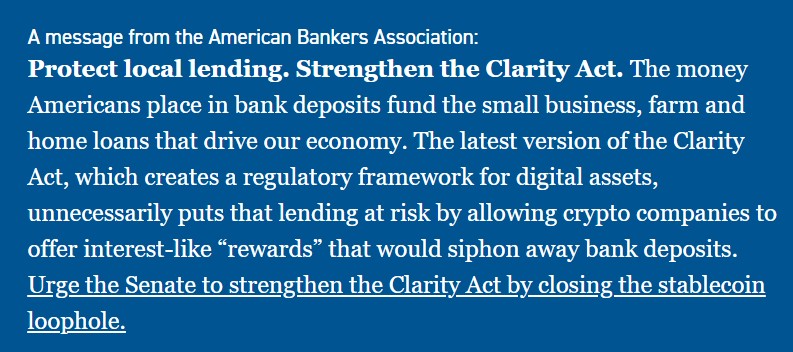
Source: POLITICO
Ruben Gallego and Thom Tillis Negotiate New CLARITY Act Ethics Language
In response to the rejected draft, Gallego has been working directly with Republican Senator Thom Tillis of North Carolina to craft an alternative version of the ethics provisions.
Their counteroffer reportedly includes a demand Democrats have pushed hard for: giving state attorneys general, not just the Department of Justice, the authority to enforce the ethics rules.
Tillis has signaled that this enforcement expansion will likely be part of what gets sent back to the White House, describing the discussions as having reached a workable starting point. Gallego has said lawmakers are close to finalizing language to submit within days.
SEC Chair Paul Atkins Backs CLARITY Act and Offers Technical Support
Adding regulatory weight to the push, SEC Chairman Paul Atkins stated he will support Congress as it advances the CLARITY Act, including offering technical assistance during the process.
Atkins framed American leadership in digital finance as requiring a regulatory framework that matches the energy of American innovators.
His comments reflect a broader view within the SEC that clear rules, rather than continued regulatory ambiguity, are necessary for the U.S. to stay competitive in the global digital asset market.
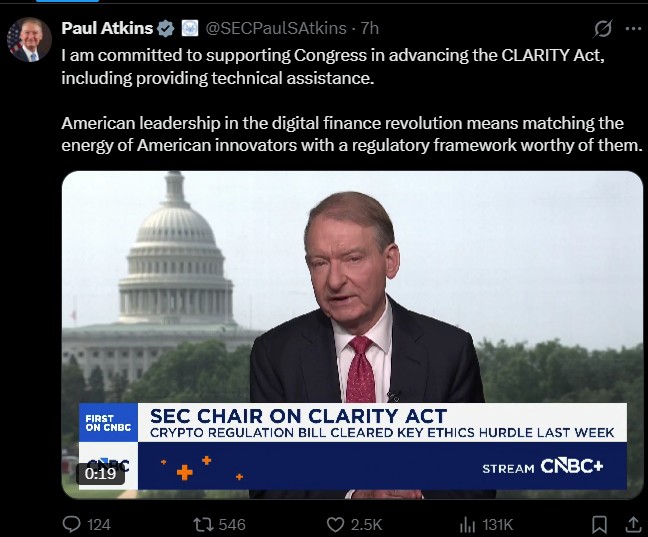
Source: SECPaulAtkins X Account
Aave Founder Says CLARITY Act Could Expand Banks' Digital Asset Authority
Aave founder Stani Kulechov offered his own take on the bill's implications, arguing it would hand banks clear statutory authority to work with digital assets and distributed ledger technology.
According to Kulechov, this would let banks move into custody, staking, and lending activities without needing prior notice or approval, a shift he described as a significant expansion of the total addressable market for crypto.
Aave itself echoed this sentiment, noting the bill would give developers who write and publish open-source code the legal certainty needed to keep building DeFi infrastructure in the United States.
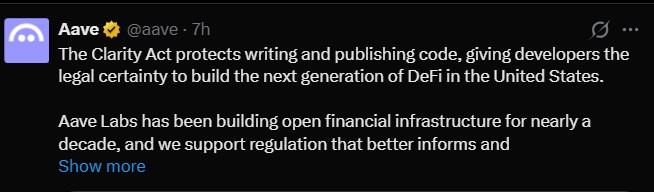
Source: Aave X Account
CLARITY Act Gains Support From BlackRock, Goldman Sachs and Other Wall Street Firms
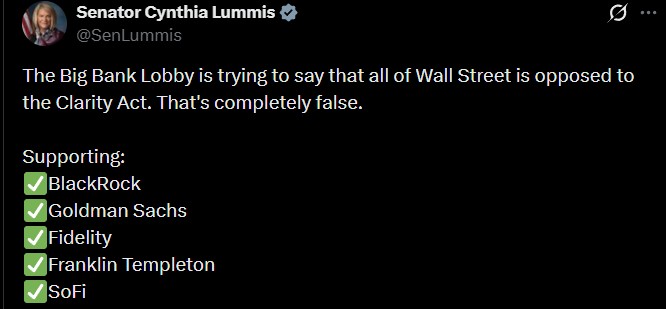
Not all of Wall Street opposes the bill, despite claims from banking lobbyists. Senator Cynthia Lummis has pushed back on the narrative that the entire banking industry is against the Act, pointing to support from BlackRock, Goldman Sachs, Fidelity, Franklin Templeton, and SoFi.
Their backing centers on the regulatory certainty the bill would provide, along with the innovation and institutional adoption it could unlock across the digital asset space.
Banking Industry Raises Stablecoin Yield and Deposit Flight Concerns
Not every Republican is fully on board, however. Some GOP senators, including John Cornyn and John Curtis, have voiced concern that stablecoin yield programs could pull deposits out of traditional banks by functioning too much like standard checking or savings accounts.
Senator Mike Rounds has said the yield issue needs refinement, while Senator Josh Hawley remains uncommitted, citing pressure from local banks in his home state. These concerns highlight the ongoing lobbying tension between traditional banking interests and the crypto industry as the bill nears a floor vote.
Source: SenLummis X Account
CLARITY Act Timeline
-
July 28, 2026 → Aave protocol founder Stani Kulechov says the CLARITY Act could expand banks’ digital asset activities, including custody, staking and lending.
-
July 29, 2026 → SEC Chair Paul Atkins says he will support Congress in advancing the CLARITY Act and provide technical assistance.
-
Before August Recess → Senate Republicans aim to hold a procedural vote, but the bill needs 60 votes to advance.
-
Next Few Days → Ruben Gallego and Thom Tillis are working on alternative ethics language and plan to send it to the White House.
-
August 2026 → Senate lawmakers are scheduled to leave for recess, limiting the time available for full debate.
-
September 2026 → If the procedural vote succeeds but the Senate cannot complete debate before recess, final consideration could move to September.
Conclusion
The bill stands at a pivotal moment, with Senate Republicans pushing for momentum before recess while ethics disputes, bank concerns, and vote-counting math complicate the path forward. Strong backing from the SEC, DeFi market leaders, and major financial institutions signals real momentum, but the bill's fate ultimately rests on a handful of undecided senators.
Disclaimer: This article is for informational purposes only and does not constitute financial, legal, or investment advice. Cryptocurrency markets and legislation are highly volatile and subject to change; readers should conduct their own research before making decisions.
0
0

 Manage all your crypto, NFT and DeFi from one place
Securely connect the portfolio you’re using to start.

0
0

0
0

0
0

0
0