7 Cheaper CoinDesk API Alternatives With Free Tiers

Written by Tigran Mkrtchyan · Reviewed and fact-checked by Narek Gevorgyan · Published June 23, 2026 · Last updated September 4, 2026 · Pricing and limits verified September 2026
Before this guide starts, some credit where it is due.
CoinDesk has reported on this industry since 2013. In crypto years, that is close to forever. It covered Bitcoin when most newsrooms still treated the word as a punchline. Its Bitcoin Price Index became a number the whole market quoted. The BBC, Bloomberg, and Reuters all leaned on it. Consensus grew into the event the whole industry flew to each year. Then CoinDesk broke the report that set off the FTX collapse. More than a decade in, that record stands.
So no, this is not a hit piece. The respect is real.
But the CoinDesk that developers reach for is not the newsroom. It is the data API, and that API has a different story. The original free Bitcoin Price Index endpoint made CoinDesk a fixture in crypto tutorials for years. Then the data product grew up. CoinDesk folded in CryptoCompare, later rebranded CCData, and the developer API became CoinDesk Data: institutional market feeds, regulated indices, a news API, and price history reaching back to 2010.
Powerful stack. Also a gated one.
Builders start there, ship a first version, then hit the walls. The first wall is access. On May 21, 2026, CoinDesk retired its free API tier. Accounts without a subscription simply stopped getting data. The second wall is pricing. No paid plan lists a public price. Every tier routes through a sales conversation, which is a strange first step when you just want to poll a ticker.
The third wall is scope. CoinDesk API answers what the market is doing. It does not answer what is in a wallet, what a trade earned, or which pool a position is farming. There is no balance lookup by address, no per-wallet profit and loss, no DeFi positions. For a price-and-indices product that is fine. For a modern app, it is half the picture.
That is why searches for CoinDesk API alternatives keep climbing. A real free tier. Public pricing. And the portfolio layer a market feed cannot give.
CoinDesk has long been a default name in crypto data. But defaults change. Builders increasingly prefer all-in-one crypto APIs over institutional market feeds they cannot self-serve, and they want to read a price before they read a contract.
This guide ranks the seven strongest options for 2026. We checked public pricing pages, docs, and API terms on June 23, 2026. Real pricing, real limits, and honest fits. No vague claims, no recycled numbers.
Seven providers, seven different jobs. You should leave with a clear shortlist, not a longer one.
Want the wider field first? Start with our roundup of the best crypto API providers.
For onchain Ethereum data, consider an Ethereum data API.
Why developers look for CoinDesk API alternatives
Let’s be fair first. CoinDesk Data API does its core job well. Sales-gated and pricey, but well. Aggregate price history reaches back to 2010, the deepest record in this guide. Market data spans 300+ exchanges and 10,000+ coins. CoinDesk Indices carry regulated, benchmark-grade lineage. A news API and social feeds ride alongside the prices.
The friction starts with access. On May 21, 2026, CoinDesk retired its free API tier. Accounts without a subscription stopped returning data. The free road is closed.
Pricing is the next wall. No paid plan has a public price. Every tier routes through sales, so even a small project has to start with a quote. For budget-stage builders, that is a barrier before the first call.
Scope is the last wall. CoinDesk API has no wallet balance lookup by address. No per-wallet transactions or P&L. No DeFi position tracking. No token security checks. It is built for institutions and media products, not for apps that live around a user’s portfolio. If your roadmap includes any of that, you need another provider anyway.
New to this space? Our beginner’s guide to crypto APIs covers the building blocks first.
How we evaluated these alternatives
We scored every provider on six factors. Each one maps to a real build decision.
Comparing the top 7
Pricing and scope separate these providers faster than feature lists. Here is the full picture side by side.
| Provider | Free tier | Entry paid (commercial) | Cost per 1K calls | Beyond market data | MCP / AI |
|---|---|---|---|---|---|
| CoinStats API | 20,000 credits/mo, commercial use | $49/mo, 1M credits | ~$0.05 📉 | Wallet, DeFi, P&L, exchange sync, token risk | ✅ Official, with portfolio data |
| CryptoHFTData | ✅ Free, full datasets | No published paid tier | $0 | L2 order books, tick trades, funding | ✕ None |
| Messari API | ✅ Free basic tier | Enterprise, sales-quoted | Not public† | News, research, fundraising, governance | ✅ AI Copilot |
| Amberdata | ❌ Trial key only | Not published | Not published | Derivatives, onchain, DeFi analytics | ❌ None |
| CoinPaprika API | 20,000 calls/mo, personal only | $99/mo, 400,000 calls | ~$0.25 | DEX data via DexPaprika | ✅ Official |
| Glassnode API | ❌ None | $999/mo + API add-on | Not public† | Onchain analytics, derivatives metrics | ✅ Beta |
| DexScreener API | ✅ Fully free, 300 req/min | No self-serve paid tier | $0 | DEX pairs only | ❌ Community only |
On entry pricing, CoinStats API publishes a flat rate near $0.05 per 1,000 calls and a commercial free tier. CoinDesk API lists no public price and retired its free tier on May 21, 2026. CoinStats API is the only provider here pairing a commercial free tier with a portfolio layer.
The top 7 CoinDesk API alternatives
CoinStats API
CoinStats API covers the core market data jobs most products need. Coverage spans 100,000+ coins, 200+ exchanges, and 120+ blockchains. Prices, charts, metadata, and market insights ship in one schema. The data powers a portfolio platform with 1M monthly users.
The real difference is the portfolio layer. Pass a wallet address and get token balances back, priced. This works across 70+ EVM chains, Solana, and Bitcoin. Bitcoin supports xpub, ypub, and zpub keys. CoinDesk API offers none of this.
Transactions arrive pre-classified with USD values and per-trade profit or loss. DeFi positions resolve per wallet across 10,000+ protocols. Staking, lending, and liquidity all detected automatically. Exchange sync covers 200+ venues, including Binance, Coinbase, and Hyperliquid. Token Risks endpoint flags honeypots, hidden fees, and pausable transfers. It runs on the free tier.
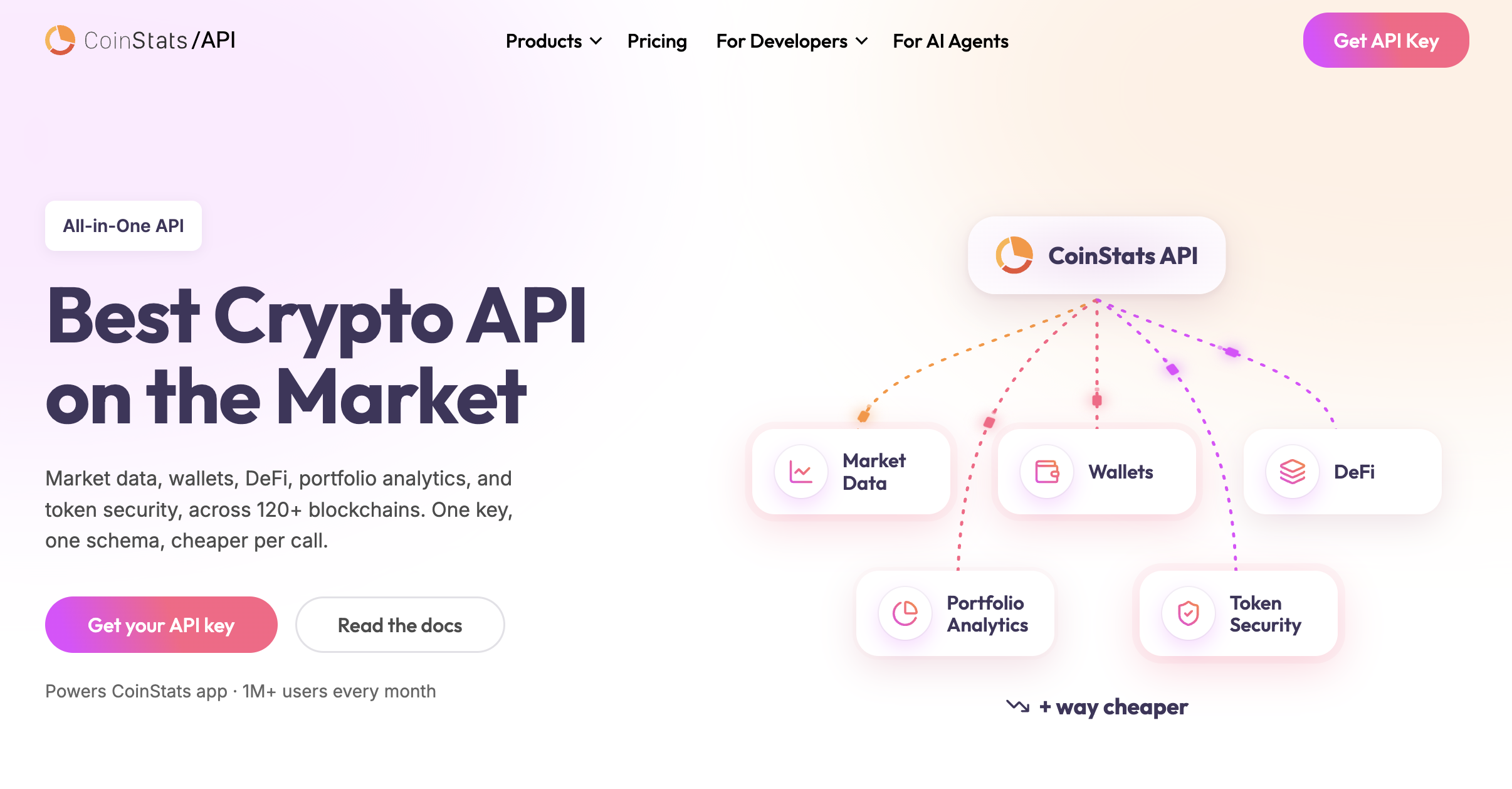
For AI builders, MCP Server exposes wallet, DeFi, and portfolio data natively. Pricing stays simple, and public. The free tier gives 20,000 credits a month with commercial use allowed. Starter costs $49 a month for 1,000,000 credits at 30 requests per second. That is roughly $0.05 per 1,000 calls, published and self-serve. CoinDesk API lists no public price and retired its free tier in May 2026.
- 100,000+ coins, 200+ exchanges, and 120+ blockchains covered.
- Wallet balances by address across EVM, Solana, and Bitcoin.
- Transactions pre-classified with per-trade profit and loss.
- DeFi positions across 10,000+ protocols in one call.
- Exchange account sync for 200+ venues.
- Token Risks endpoint and MCP Server on the free tier.
- Market, wallet, DeFi, and exchange data in one key.
- Lowest published entry cost per call among paid providers here.
- Free tier allows commercial use.
- Token security checks included free.
- Official MCP Server with portfolio data.
- Aggregate price history is shallower than CoinDesk API’s 2010 archive.
- No regulated benchmark indices of its own.
- Credit-based pricing needs a quick mental model.
CryptoHFTData
CryptoHFTData answers the CoinDesk API problem in the bluntest way available. It gives the data away. Every dataset downloads at no cost, and no paid plan is published today. During research for this guide we pulled a single hour of Binance futures order book data and received 2.9 million rows. The depth is genuine. These are incremental updates carrying exchange sequence IDs, so the book rebuilds tick by tick rather than arriving as a fixed top-of-book snapshot.
Coverage runs to nine exchanges across spot, futures, and perps. Binance, Bybit, OKX, Kraken, Bitget, and BitMEX sit alongside newer perp venues Hyperliquid, Lighter, and Aster. Data types cover L2 order books with snapshots and deltas, tick trades, funding rates, open interest, mark price, and liquidations. History is the honest weak spot. Records start June 28, 2025 for the four largest venues, so this archive is young.
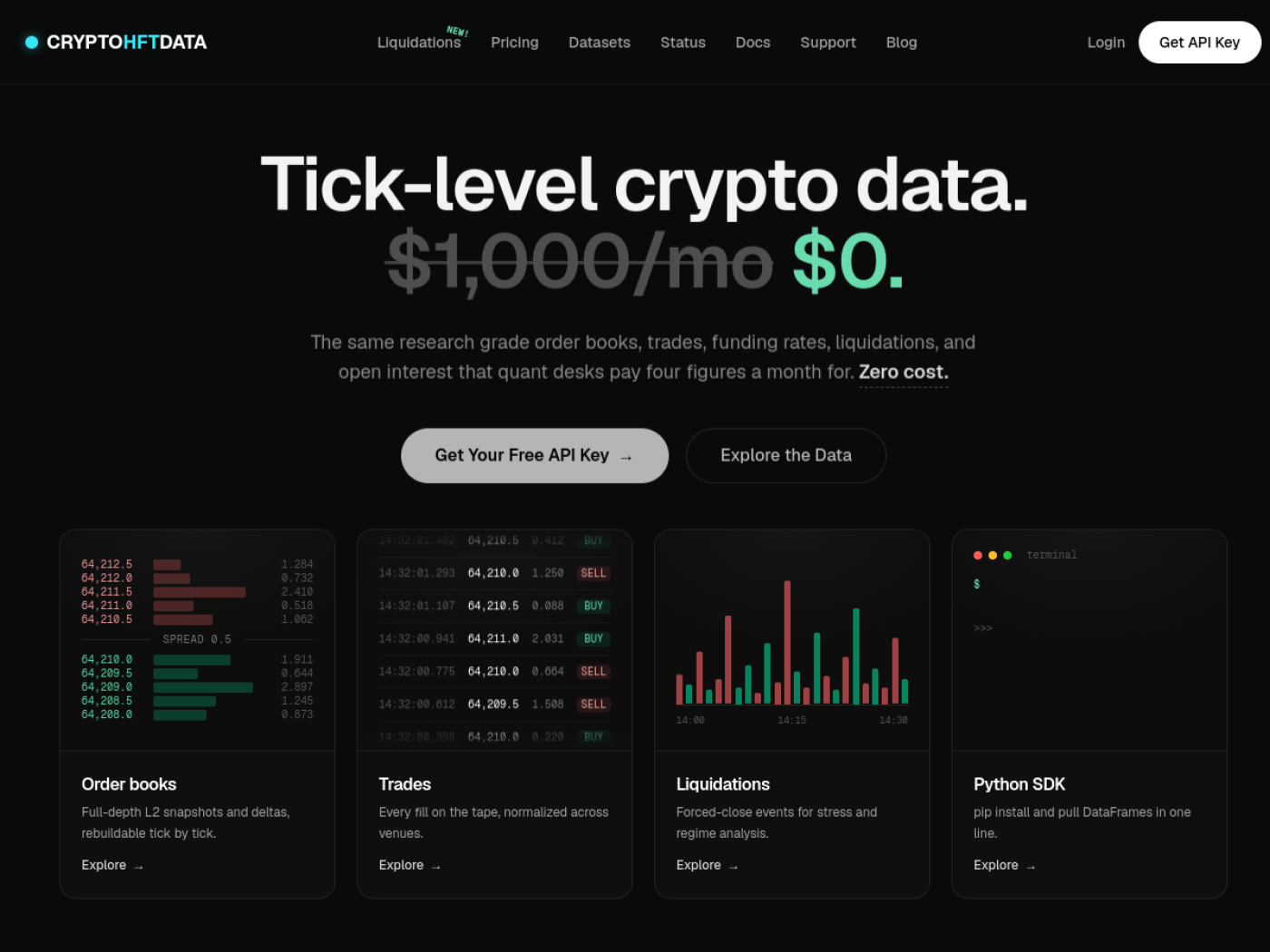
Delivery is flat files rather than a live feed. Data arrives as hourly Parquet, compressed with zstd, landing roughly fifteen minutes after each hour closes. You can pull files through a Python SDK, a REST download endpoint, or S3-compatible storage using your own credentials. That shape suits backtesting and microstructure research well. It does not suit an app that needs a price this second.
- Nine exchanges across spot, futures, and perps.
- Full-depth L2 books with exchange sequence IDs.
- Tick trades, funding, open interest, and liquidations.
- Hourly Parquet via Python SDK, REST, or S3.
- MIT-licensed SDK with fifteen releases shipped.
- Public status endpoint for per-exchange health.
- Free access to genuine full-depth order books.
- Books rebuild tick by tick, not fixed snapshots.
- Covers Hyperliquid, Lighter, and Aster perps.
- History starts mid-2025, so backtests stay short.
- Hourly batches with lag, not a live feed.
- No named team, entity, or funding disclosed.
Messari API
If you want CoinDesk API mostly for its news and editorial weight, Messari API is the closest match in spirit. Market data covers price, volume, and OHLCV for 40,000+ assets across 150+ exchanges. On top sits a news feed from 500+ sources, asset-tagged and AI-summarized. It is the intelligence stack CoinDesk built its name on, in a different shape.
The depth is in the extras. Protocol and diligence research run to 250+ reports. Fundraising data covers 14,000+ rounds, 15,000+ investors, and 1,000+ funds. Governance proposals span 100+ protocols, and token unlock schedules track 200+ projects. Onchain metrics reach across 25+ networks. Messari leans AI-native: the Copilot answers natural-language questions and runs async Deep Research, and its x402 endpoints let agents pay per call in stablecoins.
Access is the catch. Messari retired its older Lite and Pro plans. The paid path is now Enterprise, quoted by sales, with extra seats reported near $5,000. A free basic tier remains, capped around 200 requests a minute and limited to asset and market endpoints. News, intelligence, and fundraising sit behind Enterprise. For usage-based access, the x402 endpoints price per call, with a news feed call near $0.55 and a time-series call near $0.15.
- Market data for 40,000+ assets across 150+ exchanges.
- News from 500+ sources with AI summaries.
- Research and diligence reports, 250+ and counting.
- Fundraising, governance, and token-unlock datasets.
- Messari AI Copilot and async Deep Research.
- Best research, news, and fundraising intelligence here.
- AI-native, with Copilot and pay-per-call agent access.
- Free basic tier to start testing.
- Full datasets gated behind sales-quoted Enterprise.
- No wallet or portfolio layer by address.
- No regulated price indices like CoinDesk.
Amberdata
Amberdata serves desks, not hobby projects. Market data covers spot and derivatives venues at L1 and L2 depth. Funding rates, open interest, and liquidations come standard. Options analytics reach back to April 2019 on Deribit, with hourly volatility surfaces.
Onchain coverage spans eight blockchains, alongside DeFi DEX and lending data. Delivery is the institutional tell: REST, WebSocket, and CloudSync into S3, Snowflake, or Databricks. Kaiko acquired Amberdata in June 2026, so expect product consolidation ahead.

Pricing starts steep. There is no free tier, only a temporary trial key. Amberdata publishes no API prices. The pricing page lists a Startup tier and an Enterprise tier. Both route to a quote form. Market data sells through a self-serve order scoped by exchange and data class. The list price is not shown publicly.
- Spot and derivatives market data at order book depth.
- Options analytics with volatility surfaces since 2019.
- Onchain data across eight blockchains.
- DeFi DEX and lending protocol coverage.
- CloudSync delivery to S3, Snowflake, and Databricks.
- Best-in-class derivatives and options analytics.
- Warehouse-native delivery for data teams.
- Strong per-call value within one venue.
- No published API pricing at any tier.
- Most products are sales-quoted enterprise deals.
- No MCP server or agent tooling.
CoinPaprika API
CoinPaprika API is the closest like-for-like swap on this list. It covers 58,000+ assets and 360+ exchanges through a clean REST interface. You can start without an API key. Tickers, OHLCV, exchange data, and search all work out of the box.
The free tier gives 20,000 calls a month, but personal use only. Commercial projects start at the $99 Starter plan with 400,000 calls a month. That works out near $0.25 per 1,000 calls. Flat and predictable, with no credit multipliers. Five years of daily history come included at that tier. Higher tiers run to 1,000,000 calls at $199 and 5,000,000 at $799.
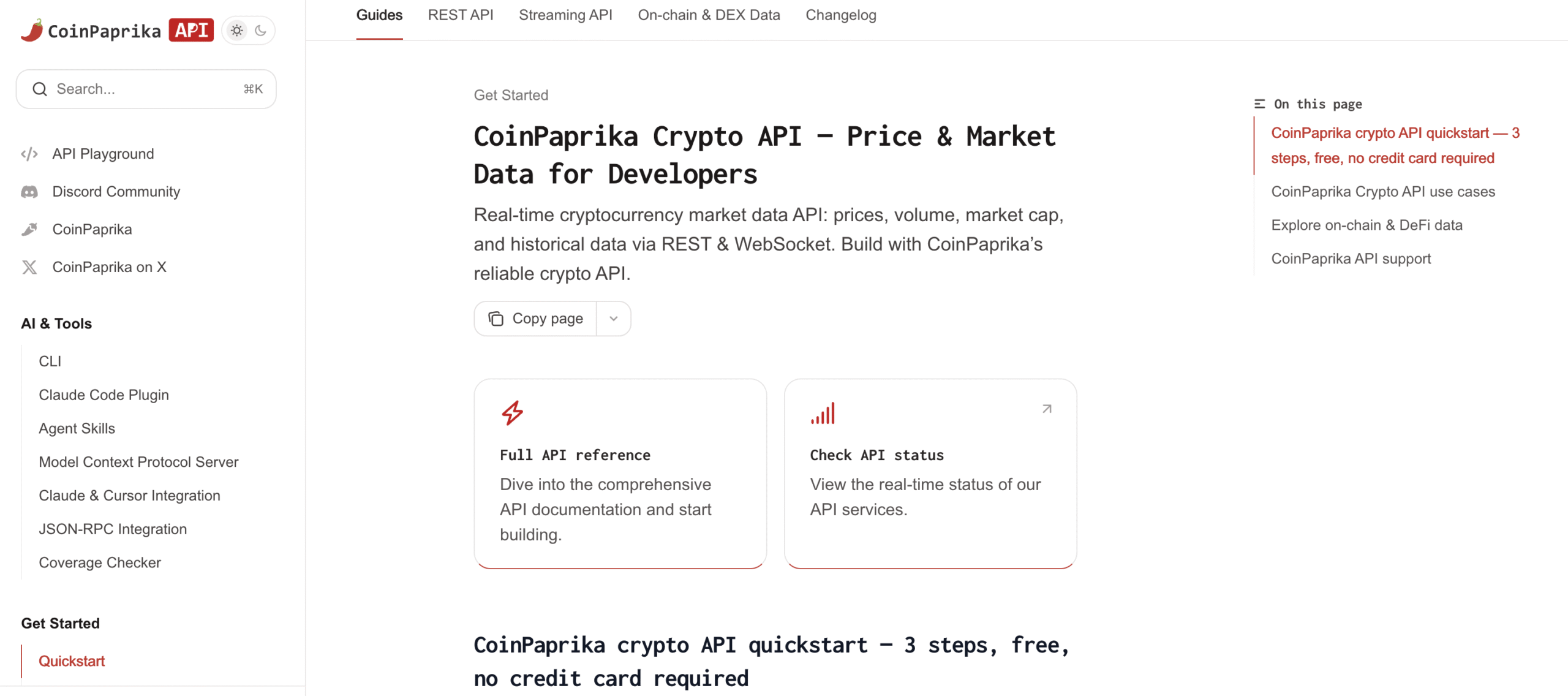
The AI story is real. CoinPaprika runs a hosted MCP server, plus a separate DexPaprika MCP for DEX pairs. Official SDKs cover Python, Go, PHP, and JavaScript. The gaps sit higher up: WebSockets, SLAs, and redistribution rights are Enterprise-only. Granular OHLCV intervals start at the $799 Business plan.
- 58,000+ assets and 360+ exchanges.
- Keyless access for quick starts.
- 400,000 calls a month at the $99 entry plan.
- Hosted MCP server plus DexPaprika for DEX data.
- Official SDKs in four languages.
- High call volumes for the price.
- Simple, predictable REST design.
- Official MCP servers, free to try.
- Free tier blocks commercial use.
- No wallet, DeFi, or portfolio endpoints.
- WebSockets and SLA locked to Enterprise.
Glassnode API
Glassnode API plays a different sport than CoinDesk API. It serves 800+ onchain metrics across 1,000+ assets. Supply distribution, address activity, miner flows, and entity-adjusted figures. Bitcoin history runs from 2009. Derivatives and ETF metrics round out the research stack.
Entity adjustment is the moat. Glassnode clusters addresses into real-world entities before computing metrics. That removes noise that raw chain data carries. Point-in-time versions prevent lookahead bias in backtests. The REST design is clean, with uniform metric paths. The default rate limit is 600 requests a minute. An official MCP server is in beta.
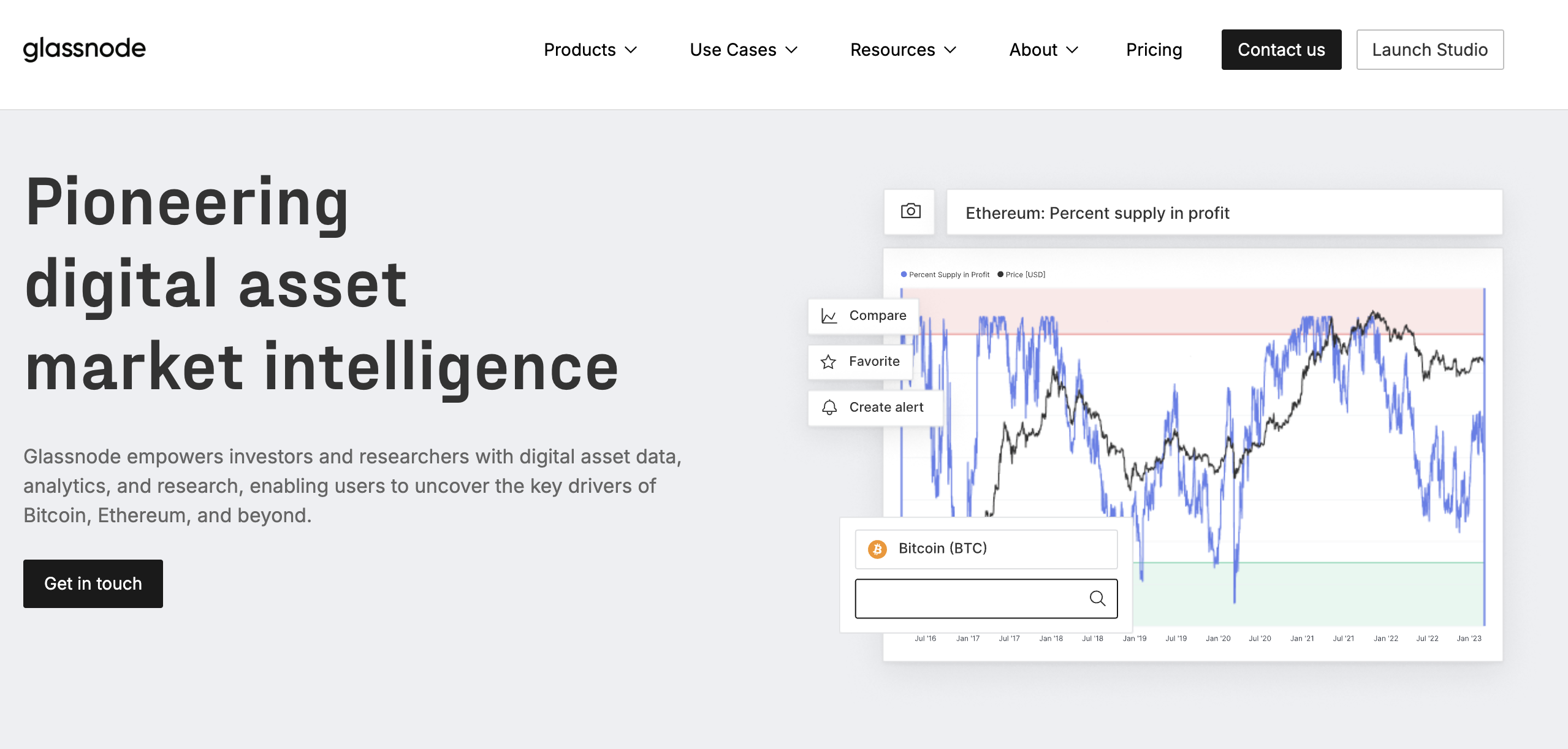
The price reflects the audience. There is no free API tier. API access requires the Studio Professional plan at $999 a month, billed yearly. An API add-on comes on top, quoted by sales. Requests meter as credits: one for Bitcoin, two for any other asset.
- 800+ onchain metrics across 1,000+ assets.
- Entity-adjusted and point-in-time data.
- Bitcoin chain history from 2009.
- Derivatives and ETF metrics included.
- Official MCP server in beta.
- Unmatched onchain metric depth and rigor.
- Entity adjustment removes chain-data noise.
- Trusted by research and trading desks.
- Roughly $12,000 a year before the API add-on.
- No public API pricing or self-serve path.
- Narrow asset universe versus aggregators.
DexScreener API
DexScreener API costs nothing. No API key, no card, no published paid tier. It returns real-time DEX pair snapshots across 80+ chains and hundreds of DEXes. Price, liquidity, volume, buy/sell counts, FDV, and pair age come back in one call.
Rate limits are workable. Pair, search, and token endpoints allow 300 requests a minute. Profile and boost endpoints allow 60. Commercial use is permitted, with one carve-out. You cannot build a product that competes directly with DexScreener.
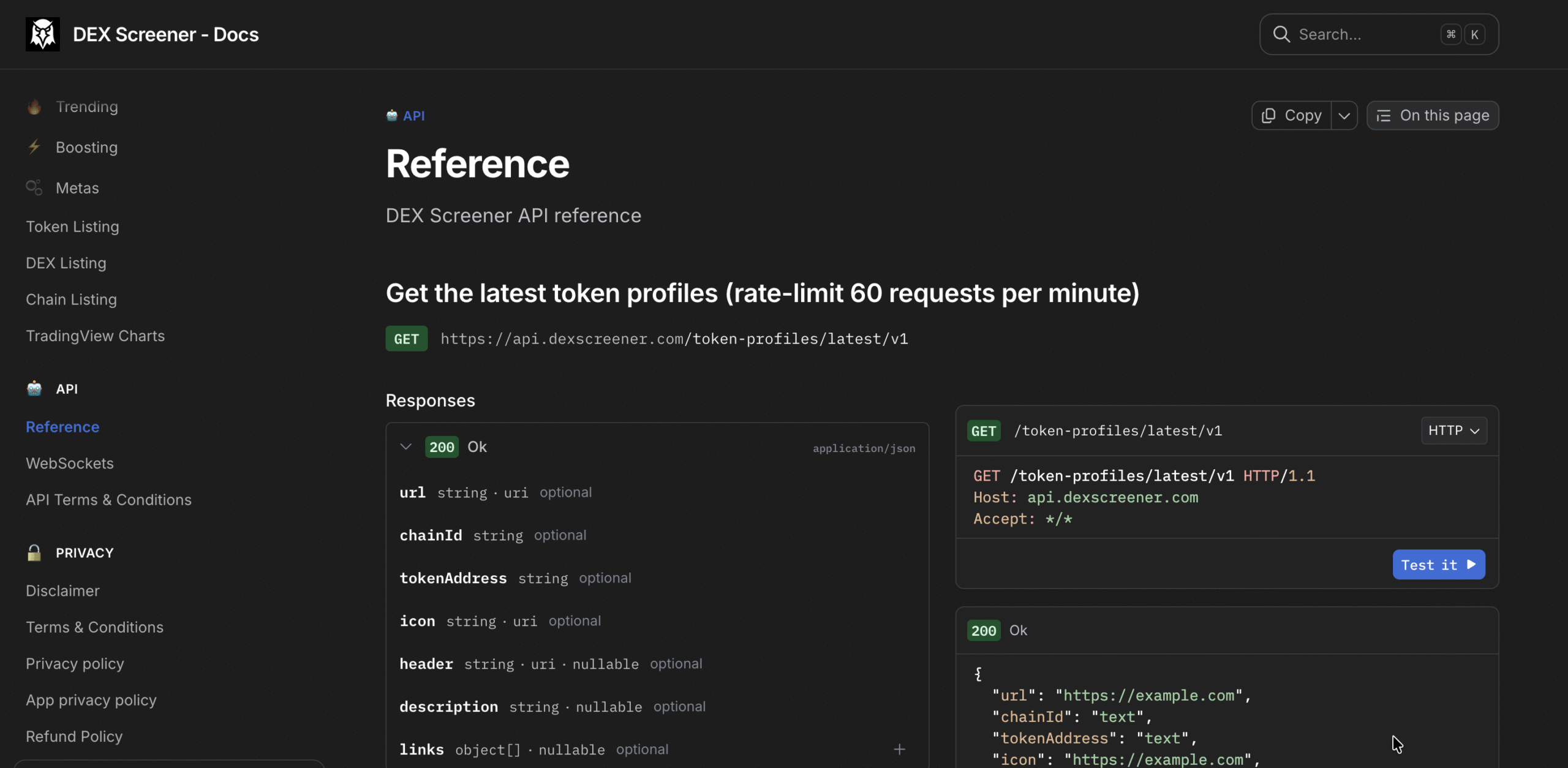
Know the tradeoffs before you commit. The public API serves snapshots only, with no historical OHLCV. There is no SLA, no support tier, and limits can change anytime. No official MCP server exists, only community builds. For memecoin screeners and token bots, none of that may matter.
- Free access with no API key.
- DEX pairs across 80+ chains.
- Liquidity, volume, and buy/sell breakdowns.
- 300 requests a minute on pair endpoints.
- Commercial use allowed within the terms.
- Free at useful rate limits.
- Fast, fresh memecoin and DEX pair data.
- Zero setup friction.
- Snapshots only; no historical candles via API.
- No SLA and no support commitments.
- DEX-only scope; no CEX or portfolio data.
Coverage and delivery compared
Scope varies as much as price. This table shows what each key actually reaches.
| Provider | Assets | Exchanges | Chains | Historical depth | Delivery |
|---|---|---|---|---|---|
| CoinStats API | 100,000+ coins | 200+ | 120+ blockchains | Full market history | REST + MCP |
| CryptoHFTData | Major pairs | 9 | CEX and perps | Tick data to June 2025 | Parquet, REST, S3 |
| Messari API | 40,000+ assets | 150+ | 25+ networks | Multi-year, tier-gated | REST + AI |
| Amberdata | Not published | 29 spot + 22 derivatives | 8 blockchains | Options to 2019 | REST, WS, CloudSync |
| CoinPaprika API | 58,000+ assets | 360+ | DEX via DexPaprika | 5 yrs daily at entry | REST + MCP |
| Glassnode API | 1,000+ assets | Spot + ETF feeds | Major chains | Bitcoin to 2009 | REST + CLI |
| DexScreener API | DEX tokens | DEX only | 80+ chains | Snapshots only | REST |
Which one should you pick?
Conclusion
CoinDesk API remains a serious institutional data source. A gated, expensive one, but serious. Deep history, regulated indices, and a real news feed. Nothing here changes that. But 2026 builds need more than aggregated prices and a sales call.
The specialists earn their slots. CryptoHFTData owns free tick data. Messari API owns research and news. Glassnode API owns onchain research. DexScreener API owns free DEX pairs. Same treatment for our own API: top CoinStats API alternatives. Amberdata serves institutional derivatives desks.
For everyone else, the math favors breadth. CoinStats API covers the core market data most products need. Then it adds wallet balances, DeFi positions, P&L, exchange sync, and token risk checks. One key, one schema, a published price, and a free tier that allows commercial use.
Start with the free tier and test it against your roadmap.
Frequently Asked Questions CoinDesk API alternatives
Quick answers to common questions about CoinDesk API alternatives.
Is CoinDesk API free?
Not anymore. CoinDesk retired its free API tier on May 21, 2026, so accounts without a subscription stopped getting data. Paid plans are sales-quoted. For a free option, CoinStats API gives 20,000 credits a month with commercial use, and DexScreener API is fully free.
What happened to CoinDesk’s Bitcoin Price Index API?
CoinDesk made its name on a simple, free Bitcoin Price Index endpoint that powered countless tutorials. The data API carrying the CoinDesk name today is a different, institutional product, the former CryptoCompare. The free API tier behind it was retired in May 2026.
Is CoinDesk API the same as CryptoCompare?
Effectively yes. CoinDesk acquired CryptoCompare, later rebranded CCData, and its developer API now lives as CoinDesk Data at developers.coindesk.com. The API status page still sits on a cryptocompare.com address.
Does CoinDesk have a news API?
Yes. A news and social data feed rides alongside the price endpoints. Messari API is the closest alternative for news combined with research and market intelligence.
How much does CoinDesk API cost?
CoinDesk does not publish API pricing. Every plan routes through sales. The free tier was retired on May 21, 2026, so a subscription is now required for any access.
What is the best free CoinDesk API alternative?
CoinStats API offers 20,000 free credits a month with commercial use allowed. For DEX-only data, DexScreener API is fully free. CoinPaprika API has a free tier for personal use.
What is the best CoinDesk API alternative?
For most teams, CoinStats API. It covers the core market data jobs and adds wallet, DeFi, and portfolio endpoints. It also keeps a commercial free tier and lists entry pricing near $0.05 per 1,000 calls.
What is similar to CoinDesk API?
Amberdata is the closest match for institutional market data. Messari API covers research and news. CryptoHFTData serves free order book archives. CoinStats API adds the market-plus-portfolio layer most apps need.
Which CoinDesk alternatives have MCP or AI access?
CoinStats API and CoinPaprika API run official MCP servers, and CoinStats API is the only one exposing wallet and portfolio data through MCP. Messari API is AI-native through its Copilot. Glassnode API has an MCP server in beta.
Which CoinDesk alternative is best for indices and benchmarks?
Regulated indices are CoinDesk’s signature. Without it, Amberdata and CoinStats API provide reference and market data at depth, while Messari API adds research context around the numbers.
Do I need more than one crypto API?
Sometimes. Specialist jobs like tick data or onchain research may warrant a second key. Most consumer apps run on one aggregator. New to the space? Our beginner’s guide to crypto APIs covers the basics.
What rate limits does CoinDesk API have?
CoinDesk enforces limits on a per-second, minute, hour, day, and month basis, returning a 429 error when you exceed your key’s allowance. The exact caps depend on your sales-quoted plan.
Does CoinDesk API offer historical OHLCV data?
Yes. Daily, hourly, and minute history are a core strength, with aggregate price data reaching back to 2010. CoinStats API and CryptoHFTData also serve historical market data if you need an alternative.
Can I get wallet and portfolio data from CoinDesk API?
No. CoinDesk API has no wallet balance lookup by address, no per-wallet profit and loss, and no DeFi positions. CoinStats API returns priced balances across 70+ EVM chains, Solana, and Bitcoin. Our guide to the best crypto wallet APIs covers this in depth.
Tigran is the Head of Digital Marketing at CoinStats, working across crypto and consumer apps. His writing covers first-hand crypto experience and marketing case studies from that work. He has taken the stage at industry-leading conferences like MAU Vegas, Business of Apps Berlin, and App Promotion Summit London.
More from Tigran on the CoinStats blog · LinkedIn · X