Top 7 CoinMarketCap API Alternatives for Crypto Data in 2026

Written by Tigran Mkrtchyan · Reviewed and fact-checked by Narek Gevorgyan · Published June 12, 2026 · Last updated September 4, 2026 · Pricing and limits verified September 2026
Picture crypto in 2017.
No wallets to speak of. No DeFi. Just one question, asked a million times a day. What is it worth?
One site answered, and the whole world bookmarked it. CoinMarketCap turned a chaotic market into a readable list. Journalists quoted it. Funds tracked it. Your taxi driver checked it at red lights.
That was the unglamorous work of pushing web2 into the web3 world. Respect for that. Sincerely.
Then crypto grew up, and so did the questions.
What is in this wallet? What did this trade actually earn? Which pool is this position farming? A price list cannot answer those. And the developers asking them hit a different problem first: the bill.
CoinMarketCap API meters everything in credits. One call can burn two, four, or more. The free Basic plan allows 15,000 credits a month. Paid plans start at $29 a month. Per call, that is about 4x more than CoinStats API.
So builders shop around. That is why searches for CoinMarketCap API alternatives keep climbing. Cheaper calls. Tick-level data. And above all, the portfolio layer a price feed cannot give.
This guide ranks the seven strongest options for 2026. We checked public pricing pages, docs, and API terms on June 13, 2026. No vague claims, no recycled numbers.
Seven providers, seven different jobs. By the end you should have a shortlist of one, maybe two.
Want the wider field first? Start with our roundup of the best crypto API providers.
Many developers also need a crypto API for Ethereum.
Why developers look for CoinMarketCap API alternatives
Let’s be fair first. CoinMarketCap API does its core job well. Pricey at scale, but well. Prices, listings, and OHLCV history ship cleanly. Exchange reference data covers 790+ venues. The brand has anchored price reporting since 2013.
The friction starts with the credit model. The free Basic plan gives 15,000 credits a month. A single call can cost two, four, or more credits. Cached data still burns credits.
Per call, the entry math is steep. $79 for 450,000 credits works out to about $0.18 per 1,000. Several CoinMarketCap API alternatives undercut that by a wide margin.
Scope is the other wall. CoinMarketCap API has no wallet balance lookup by address. No per-wallet transactions or P&L. No DeFi position tracking. Token security stops at DEX-level checks. If your roadmap includes any of those, you need another provider anyway.
We ran the full head-to-head already. See our CoinMarketCap API vs CoinStats API comparison.
How we evaluated these alternatives
We scored every provider on six factors. Each one maps to a real build decision.
Comparing the top 7
Pricing and scope separate these providers faster than feature lists. Here is the full picture side by side.
| Provider | Free tier | Entry paid (commercial) | Cost per 1K calls | Beyond market data | MCP / AI |
|---|---|---|---|---|---|
| CoinStats API | 20,000 credits/mo, commercial use | $49/mo, 1M credits | ~$0.05 📉 | Wallet, DeFi, P&L, exchange sync, token risk | ✅ Official, with portfolio data |
| Messari API | Free tier, key required | Enterprise or x402 | Pay-per-call* | Research, news, unlocks, fundraising | ✅ Official |
| CoinDesk Data API | ❌ Retired May 2026 | Sales-quoted | Not public | Indices, news, social, onchain supply | ✅ Official |
| Amberdata | ❌ Trial key only | Not published | Not published | Derivatives, onchain, DeFi analytics | ❌ None |
| CoinPaprika API | 20,000 calls/mo, personal only | $99/mo, 400,000 calls | ~$0.25 | DEX data via DexPaprika | ✅ Official |
| Glassnode API | ❌ None | $999/mo + API add-on | Not public | Onchain analytics, derivatives metrics | ✅ Beta |
| DexScreener API | ✅ Fully free, 300 req/min | No self-serve paid tier | $0 | DEX pairs only | ❌ Community only |
On entry pricing, CoinStats API runs about 4x cheaper per call than CoinMarketCap API. It is the only provider here combining market, wallet, DeFi, portfolio, and token security data under one key.
The top 7 CoinMarketCap API alternatives
CoinStats API
CoinStats API covers the core market data jobs most products need. Coverage spans 100,000+ coins, 200+ exchanges, and 120+ blockchains. Prices, charts, metadata, and market insights ship in one schema. The data powers a portfolio platform with 1M monthly users.
The real difference is the portfolio layer. Pass a wallet address and get token balances back, priced. This works across 70+ EVM chains, Solana, and Bitcoin. Bitcoin supports xpub, ypub, and zpub keys. CoinMarketCap API offers none of this.
Transactions arrive pre-classified with USD values and per-trade profit or loss. DeFi positions resolve per wallet across 10,000+ protocols. Staking, lending, and liquidity all detected automatically. Exchange sync covers 200+ venues, including Binance, Coinbase, and Hyperliquid. Token Risks endpoint flags honeypots, hidden fees, and pausable transfers. It runs on the free tier.
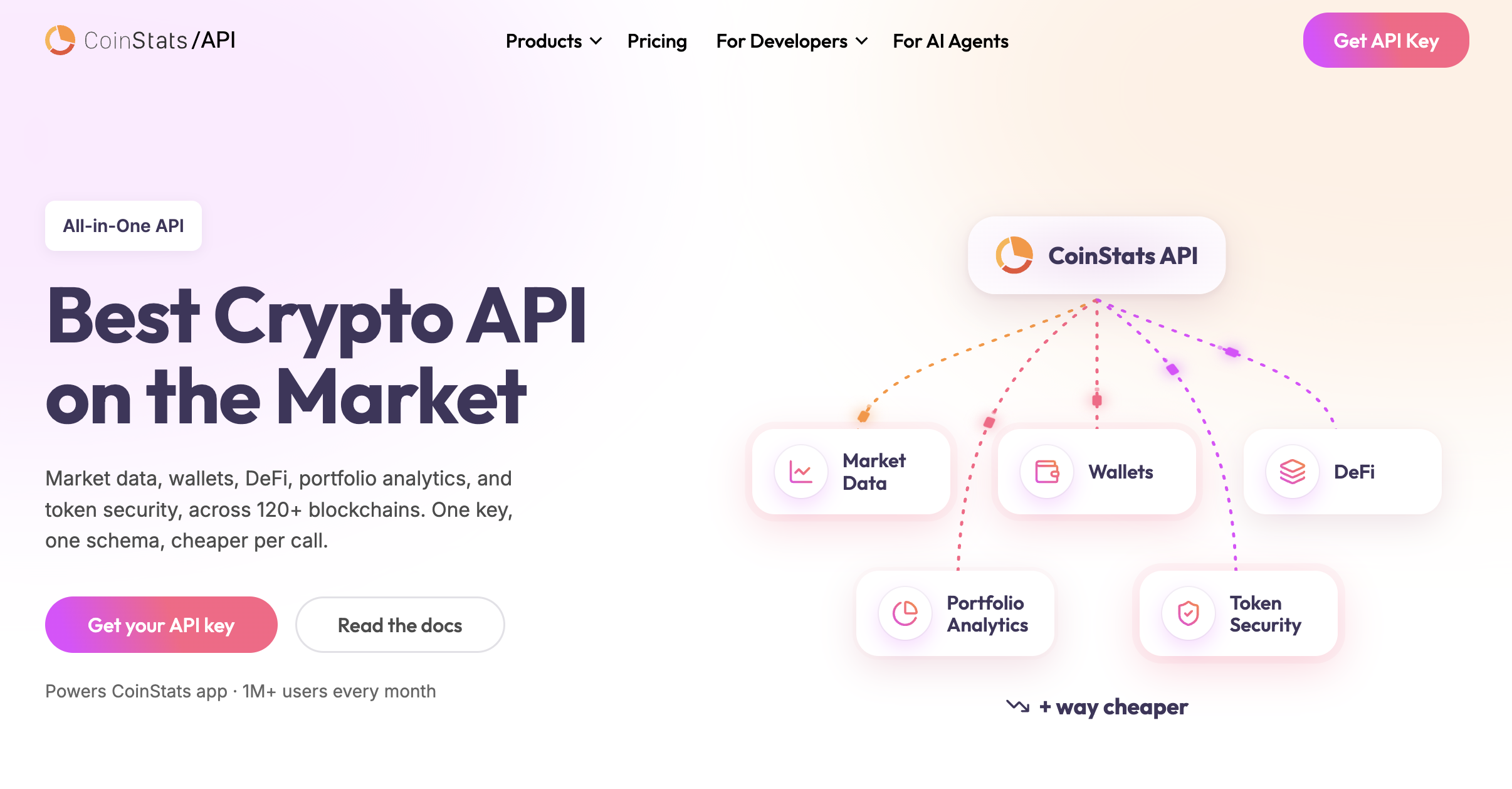
For AI builders, MCP Server exposes wallet, DeFi, and portfolio data natively. Pricing stays simple. The free tier gives 20,000 credits a month with commercial use allowed. Starter costs $49 a month for 1,000,000 credits at 30 requests per second. That is roughly $0.05 per 1,000 calls. About 4x cheaper than CoinMarketCap API at entry.
- 100,000+ coins, 200+ exchanges, and 120+ blockchains covered.
- Wallet balances by address across EVM, Solana, and Bitcoin.
- Transactions pre-classified with per-trade profit and loss.
- DeFi positions across 10,000+ protocols in one call.
- Exchange account sync for 200+ venues.
- Token Risks endpoint and MCP Server on the free tier.
- Market, wallet, DeFi, and exchange data in one key.
- Lowest published entry cost per call among paid providers here.
- Free tier allows commercial use.
- Token security checks included free.
- Official MCP Server with portfolio data.
- Exchange ticker reference feeds are narrower than CoinMarketCap API.
- No tick-level order book data for trading systems.
- Credit-based pricing needs a quick mental model.
Messari API
Messari API is the research and intelligence specialist on this list. It tracks 40,000+ assets, 200+ protocols, and 25+ networks. News pulls from 500+ sources. Fundraising, token unlocks, and vesting come structured, not scraped.
The AI layer is the standout. MessariAI answers questions in plain language. An official MCP server exposes research and timeseries to agents. Deep-research tools generate full reports on demand. Delivery spans REST, a Bulk API, a TypeScript SDK, and spreadsheet add-ins.

Pricing is not a flat per-call rate. There is a free tier with an API key. Self-serve Lite and Pro plans were retired. Recurring paid access now routes through Enterprise. An x402 option meters pay-per-call, from free endpoints to about $1 per call.
- 40,000+ assets, 200+ protocols, and 25+ networks.
- News from 500+ sources, structured and tagged.
- Token unlocks and vesting for 200+ projects.
- Fundraising, M&A, and investor database.
- Official MCP server and MessariAI.
- REST, Bulk API, SDK, and spreadsheet add-ins.
- Deepest research, news, and fundraising data here.
- Strong AI layer with an official MCP server.
- Free tier to start, no card required.
- No wallet, DeFi, or portfolio layer by address.
- No flat per-call price; paid access is quoted.
- Premium market data sits behind Enterprise.
CoinDesk Data API
CoinDesk Data API bundles the widest editorial stack in this guide. Market data covers 300+ exchanges, 10,000+ coins, and 300,000+ trading pairs. Aggregate price history reaches back to 2010. That is the deepest record here.
The extras separate it. CoinDesk Indices carry FCA-authorized lineage and benchmark tens of billions in assets. A news API and social data ride alongside the price feeds. Onchain supply data is included too. Delivery is REST plus WebSocket streaming. A hosted MCP server went live this year.
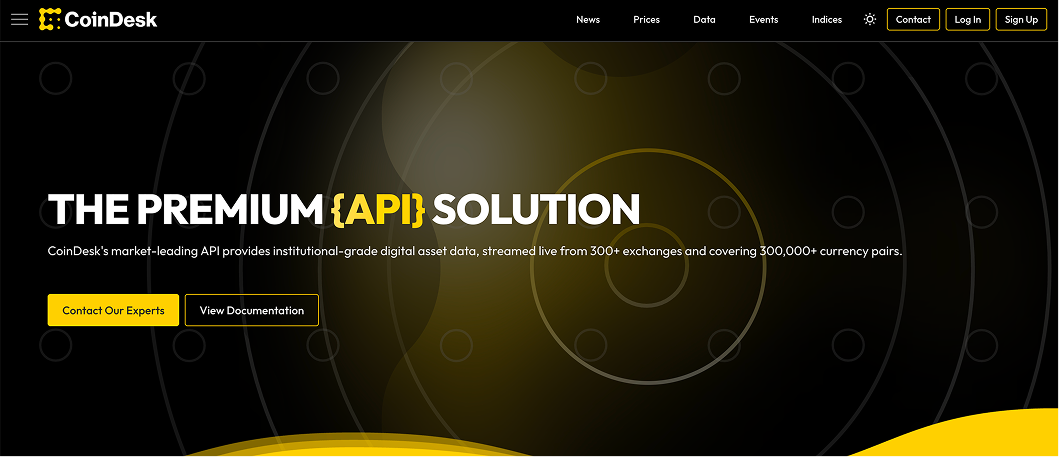
Access is the catch. The free tier was retired in May 2026. Accounts without a subscription lost API access entirely. No paid plan has public pricing. Every tier routes through sales. Budget-stage teams should look elsewhere first.
- 300+ exchanges, 10,000+ coins, 300,000+ pairs.
- Aggregate price history back to 2010.
- Regulated benchmark indices.
- News and social data APIs.
- REST, WebSocket, and a hosted MCP server.
- Deepest aggregate price history available.
- Indices, news, and market data in one contract.
- Institutional-grade uptime claims.
- Free tier retired in May 2026.
- No public pricing; sales-only access.
- No wallet or portfolio layer by address.
Amberdata
Amberdata serves desks, not hobby projects. Market data covers spot and derivatives venues at L1 and L2 depth. Funding rates, open interest, and liquidations come standard. Options analytics reach back to April 2019 on Deribit, with hourly volatility surfaces.
Onchain coverage spans eight blockchains, alongside DeFi DEX and lending data. Delivery is the institutional tell: REST, WebSocket, and CloudSync into S3, Snowflake, or Databricks. Kaiko acquired Amberdata in June 2026, so expect product consolidation ahead.

Pricing starts steep. There is no free tier, only a temporary trial key. Amberdata publishes no API prices. The pricing page lists a Startup tier and an Enterprise tier. Both route to a quote form. Market data sells through a self-serve order scoped by exchange and data class. The list price is not shown publicly.
- Spot and derivatives market data at order book depth.
- Options analytics with volatility surfaces since 2019.
- Onchain data across eight blockchains.
- DeFi DEX and lending protocol coverage.
- CloudSync delivery to S3, Snowflake, and Databricks.
- Best-in-class derivatives and options analytics.
- Warehouse-native delivery for data teams.
- Strong per-call value within one venue.
- No published API pricing at any tier.
- Most products are sales-quoted enterprise deals.
- No MCP server or agent tooling.
CoinPaprika API
CoinPaprika API is the closest like-for-like swap on this list. It covers 50,000+ assets and 350+ exchanges through a clean REST interface. You can start without an API key. Tickers, OHLCV, exchange data, and search all work out of the box.
The free tier gives 20,000 calls a month, but personal use only. Commercial projects start at the $99 Starter plan with 400,000 calls a month. That works out near $0.25 per 1,000 calls. Flat and predictable, with no credit multipliers. Five years of daily history come included at that tier.
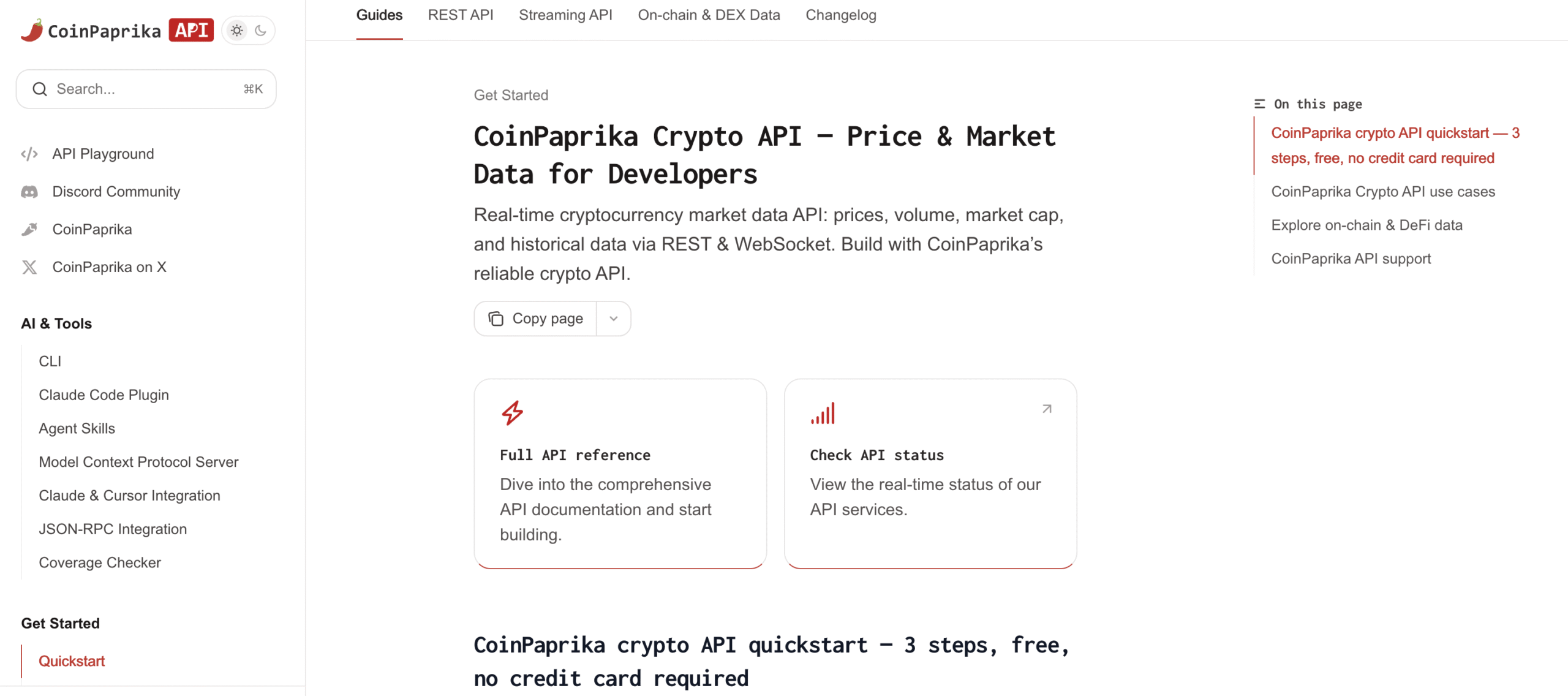
The AI story is real. CoinPaprika runs a hosted MCP server, plus a separate DexPaprika MCP for DEX pairs. Official SDKs cover Python, Go, PHP, and JavaScript. The gaps sit higher up: WebSockets, SLAs, and redistribution rights are Enterprise-only. Granular OHLCV intervals start at the $799 Business plan.
- 50,000+ assets and 350+ exchanges.
- Keyless access for quick starts.
- 400,000 calls a month at the $99 entry plan.
- Hosted MCP server plus DexPaprika for DEX data.
- Official SDKs in four languages.
- High call volumes for the price.
- Simple, predictable REST design.
- Official MCP servers, free to try.
- Free tier blocks commercial use.
- No wallet, DeFi, or portfolio endpoints.
- WebSockets and SLA locked to Enterprise.
Glassnode API
Glassnode API plays a different sport than CoinMarketCap API. It serves 800+ onchain metrics across 1,000+ assets. Supply distribution, address activity, miner flows, and entity-adjusted figures. Bitcoin history runs from 2009. Derivatives and ETF metrics round out the research stack.
Entity adjustment is the moat. Glassnode clusters addresses into real-world entities before computing metrics. That removes noise that raw chain data carries. Point-in-time versions prevent lookahead bias in backtests. The REST design is clean, with uniform metric paths. The default rate limit is 600 requests a minute. An official MCP server is in beta.
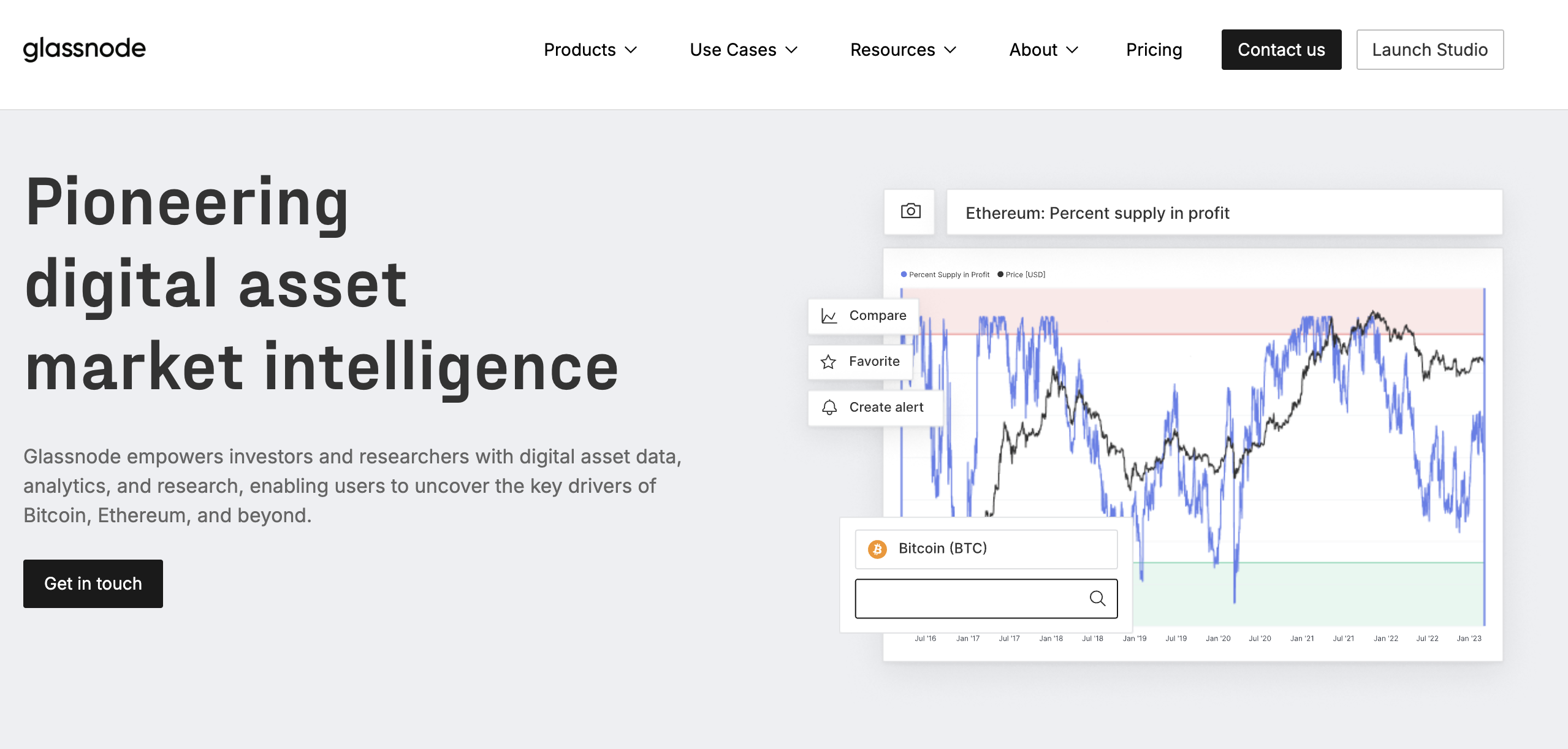
The price reflects the audience. There is no free API tier. API access requires the Studio Professional plan at $999 a month, billed yearly. An API add-on comes on top, quoted by sales. Requests meter as credits: one for Bitcoin, two for any other asset.
- 800+ onchain metrics across 1,000+ assets.
- Entity-adjusted and point-in-time data.
- Bitcoin chain history from 2009.
- Derivatives and ETF metrics included.
- Official MCP server in beta.
- Unmatched onchain metric depth and rigor.
- Entity adjustment removes chain-data noise.
- Trusted by research and trading desks.
- Roughly $12,000 a year before the API add-on.
- No public API pricing or self-serve path.
- Narrow asset universe versus aggregators.
DexScreener API
DexScreener API costs nothing. No API key, no card, no published paid tier. It returns real-time DEX pair snapshots across 80+ chains and hundreds of DEXes. Price, liquidity, volume, buy/sell counts, FDV, and pair age come back in one call.
Rate limits are workable. Pair, search, and token endpoints allow 300 requests a minute. Profile and boost endpoints allow 60. Commercial use is permitted, with one carve-out. You cannot build a product that competes directly with DexScreener.
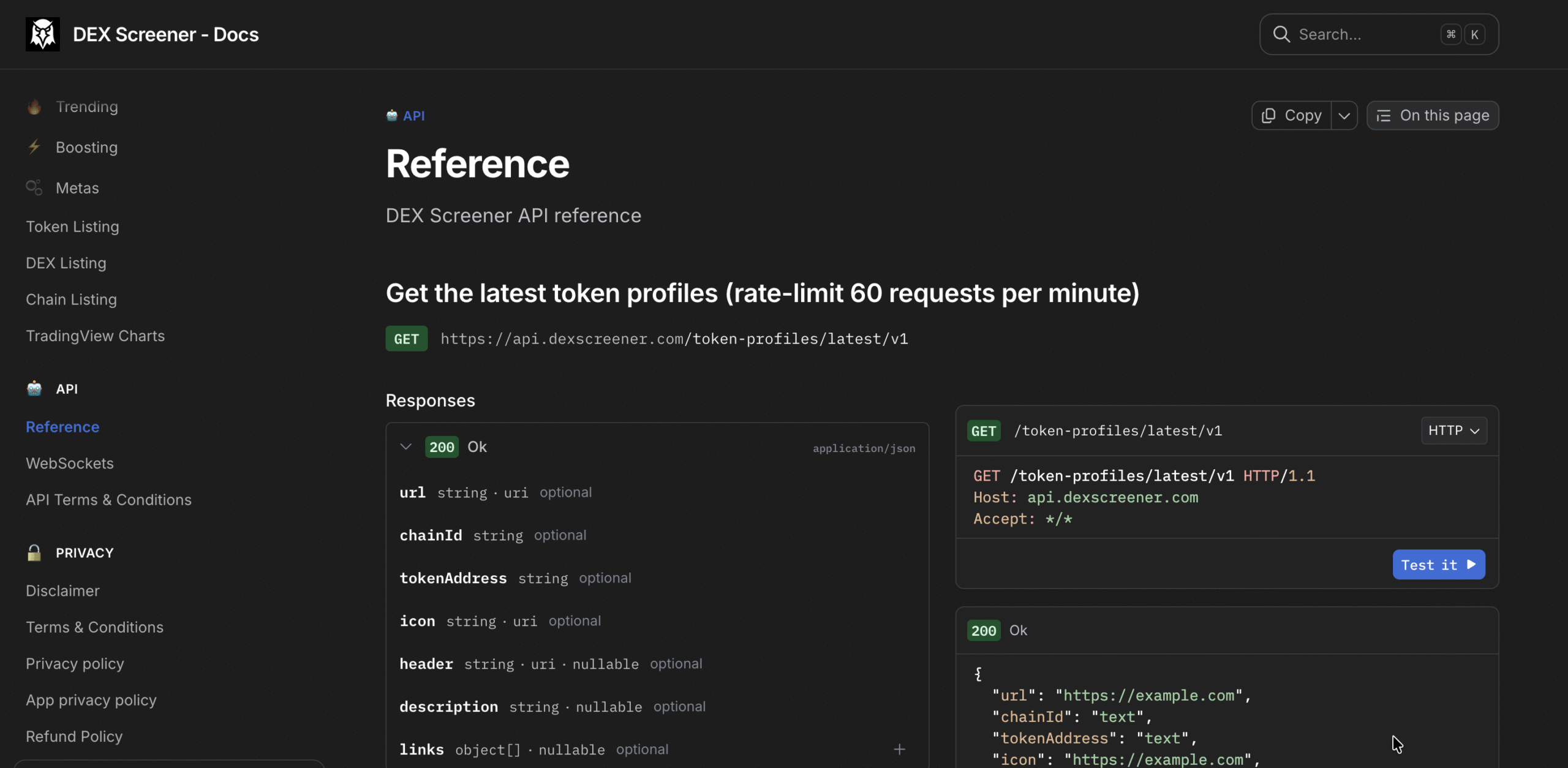
Know the tradeoffs before you commit. The public API serves snapshots only, with no historical OHLCV. There is no SLA, no support tier, and limits can change anytime. No official MCP server exists, only community builds. For memecoin screeners and token bots, none of that may matter.
- Free access with no API key.
- DEX pairs across 80+ chains.
- Liquidity, volume, and buy/sell breakdowns.
- 300 requests a minute on pair endpoints.
- Commercial use allowed within the terms.
- Free at useful rate limits.
- Fast, fresh memecoin and DEX pair data.
- Zero setup friction.
- Snapshots only; no historical candles via API.
- No SLA and no support commitments.
- DEX-only scope; no CEX or portfolio data.
Coverage and delivery compared
Scope varies as much as price. This table shows what each key actually reaches.
| Provider | Assets | Exchanges | Chains | Historical depth | Delivery |
|---|---|---|---|---|---|
| CoinStats API | 100,000+ coins | 200+ | 120+ blockchains | Full market history | REST + MCP |
| Messari API | 40,000+ assets | Aggregated | 25+ networks | Configurable timeseries | REST + Bulk + MCP |
| CoinDesk Data API | 10,000+ coins | 300+ | Select onchain | Aggregate to 2010 | REST + WS |
| Amberdata | Not published | 29 spot + 22 derivatives | 8 blockchains | Options to 2019 | REST, WS, CloudSync |
| CoinPaprika API | 50,000+ assets | 350+ | DEX via DexPaprika | 5 yrs daily at entry | REST + MCP |
| Glassnode API | 1,000+ assets | Spot + ETF feeds | Major chains | Bitcoin to 2009 | REST + CLI |
| DexScreener API | DEX tokens | DEX only | 80+ chains | Snapshots only | REST |
Which one should you pick?
Migrating off a different provider? See the Top 5 Dune Sim API alternatives.
Conclusion
CoinMarketCap API remains a solid market data source. An expensive one, but solid. Nothing here changes that. But 2026 builds need more than aggregated prices.
The specialists earn their slots. Messari API owns research and news. Glassnode API owns onchain research. DexScreener API owns free DEX pairs. Amberdata and CoinDesk Data API serve institutional contracts. We gave CoinStats API the same treatment in CoinStats API alternatives, ranked.
For everyone else, the math favors breadth. CoinStats API covers the market data CoinMarketCap API users rely on. Then it adds wallet balances, DeFi positions, P&L, exchange sync, and token risk checks. One key, one schema, about 4x cheaper at entry.
Start with the free tier and test it against your roadmap.
Frequently Asked Questions
Quick answers to common questions about CoinMarketCap API alternatives.
Does CoinMarketCap offer an API?
What is similar to CoinMarketCap API?
Do I need more than one crypto API?
Can I get wallet balances from CoinMarketCap API?
Which CoinMarketCap API alternatives have MCP servers?
Does CoinDesk Data API still have a free tier?
Is DexScreener API really free?
Is CoinMarketCap API free?
What is the best free CoinMarketCap API alternative?
Which crypto APIs allow commercial use on a free tier?
What is the cheapest crypto API per call?
What is the best CoinMarketCap API alternative?
What is the alternative to CoinMarketCap?
What is better than CoinMarketCap API?
Which alternative is best for trading bots?
Which alternative is best for onchain analytics?
Tigran is the Head of Digital Marketing at CoinStats, working across crypto and consumer apps. His writing covers first-hand crypto experience and marketing case studies from that work. He has taken the stage at industry-leading conferences like MAU Vegas, Business of Apps Berlin, and App Promotion Summit London.
More from Tigran on the CoinStats blog · LinkedIn · X