CoinGecko API vs CoinStats API: 2026 Comparison

Written by Tigran Mkrtchyan · Reviewed and fact-checked by Narek Gevorgyan · Published September 4, 2026 · Last updated September 4, 2026 · Pricing and limits verified September 2026
Four invoices render one portfolio screen.
Nobody tells you that on day one. Here is how it happens.
You ship prices first. One key, one API, one schema. It feels easy, because it is.
Then a user asks what is in their wallet.
CoinGecko API cannot answer that. Not on Demo, not on Enterprise. So you add an indexer. Second key, second schema, second invoice.
Then someone stakes into a protocol. Your app shows their wallet as nearly empty. So you add a DeFi positions provider. Third key.
Then they want cost basis and profit. Almost nobody sells that as data. You write it yourself.
Then a user buys a honeypot and blames your app. So you add a token security provider. Fourth key.
Four rate limits. Four status pages you now watch. Four schema migrations you never planned for.
The problem was never price. It was scope.
Some credit before we go further. Most crypto products start on CoinGecko API, and ours did too. 44 million tokens. 240 networks. Twelve years of price history. Over 10 billion API requests served a month. That is not an accident, and this is not a takedown.
This guide compares the two on scope. Pricing, free tiers, rate limits, coverage, and what each one actually returns. Where CoinGecko API is the better pick, we say so plainly. Two of the six use cases below go its way.
You should leave knowing which one fits your build. Want the wider field first? Start with our roundup of the best crypto API providers.
Every number here came from a public source we opened ourselves. Pricing pages, API docs, terms of service, and review-platform listings.
What we tested. We ran both free tiers against the same job. Render a wallet screen with balances, live prices, and 24 hour change. We counted the calls, the keys, and the joins each one needed.
How we priced it. Cost per 1,000 calls uses each provider’s cheapest paid plan. Credit-weighted endpoints are priced at their documented credit cost, not an average. Annual discounts are noted where they change the answer.
What we did not test. Enterprise contracts, custom rate limits, and uptime over time. Latency benchmarks are absent on purpose. They depend on your region and your caching, so ours would not predict yours.
What each API actually covers
Both are REST data APIs. Neither runs nodes. Neither broadcasts transactions. That is where the similarity stops.
CoinGecko API is a market data API. It answers questions about assets and markets. What is this token worth. Where does it trade. What did it do last year. It answers those at enormous breadth.
CoinStats API is a market data API with a wallet layer attached. It answers the same asset questions. It also answers questions about a person. What does this address hold. What did they pay for it. Where is it staked right now.
That split decides your architecture, not just your bill.
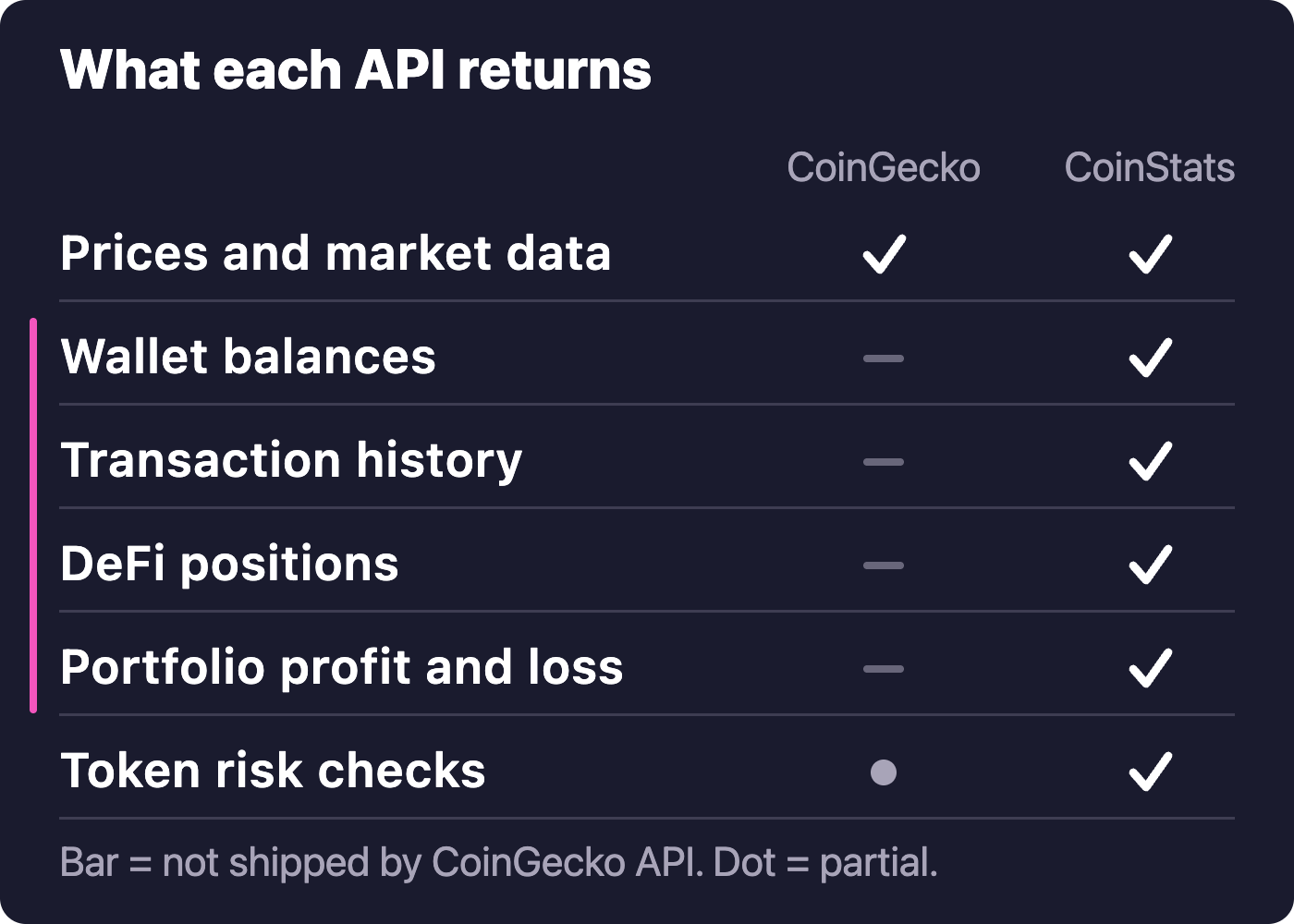
What you bolt on around a market data API
A market data API answers questions about tokens. Products get asked questions about people.
“What do I hold” is not a market data question. It is a wallet question. CoinGecko API has no endpoint that takes an arbitrary address and returns its holdings. We checked every tier. There is none.
The closest thing is a top-holders leaderboard. It ranks the biggest holders of a token you name. Profit and loss come with it. Useful, but you cannot look up a wallet.
Here is what that means for a normal portfolio screen.
| What your screen shows | CoinGecko API | What you add |
|---|---|---|
| Token prices and charts | Yes | Nothing |
| Balances for a wallet address | No | An indexer |
| Transaction history for that address | No | The same indexer, or another |
| Staking, lending, and LP positions | No | A positions provider |
| Cost basis and profit or loss | No | Your own engineering |
| Honeypot and contract risk | Partial | A security provider |
Every “no” in that middle column is a vendor. Every vendor is a key, a credit model, and a rate limit. Plus a status page you now watch.
The joins are the part nobody budgets for. Your indexer returns a contract address. Your market data API keys on its own coin id. Those two namespaces do not match. So you build a mapping table and maintain it forever.
Reliability compounds the wrong way too. Assume each of four services runs at 99.9%. Chained, that is 99.6% together. 44 minutes of monthly downtime becomes nearly three hours. No single vendor got worse. You just chained four of them.
CoinStats API collapses those four vendors into one. Same key, same schema, same invoice. Balances come back already priced, so there is no join to maintain.
That is the whole argument. Not that CoinGecko API is bad at its job. That its job is one layer of four.
Pricing compared
CoinGecko API pricing is simpler on paper. Read the credit models before the prices. They work differently. That difference decides which one is cheaper for you.
| CoinGecko API | CoinStats API | |
|---|---|---|
| Free tier credits | 10,000 a month | 20,000 a month |
| Free tier rate limit | 100 calls a minute | 2 requests a second |
| Free tier endpoints | 60+, several gated above Demo | Same data as the paid plans |
| Entry paid plan | Basic, $35 a month | Starter, $49 a month |
| Entry plan credits | 100,000 | 1,000,000 |
| Entry plan rate limit | 300 calls a minute | 30 requests a second |
| Credit model | Flat. 1 REST request costs 1 credit | Weighted. 1 to 5,000 by endpoint |
| Cost per 1,000 market calls | ~$0.35 | ~$0.05 📉 |
| Next tier up | Analyst, $129, 500,000 credits | Standard, $199, 5,000,000 credits |
| Overage | $0.0005 a call | Not publicly listed |
CoinGecko API is flat. Each successful REST request generally costs one credit. A simple price lookup and a full market chart cost the same. WebSocket responses cost 0.1 credit and webhook events cost 10. That is easy to forecast, and it is a genuinely good design.
CoinStats API is weighted. A coin price costs 1 credit. A wallet balance costs 40. DeFi positions cost 400, and that endpoint needs a paid plan. Token Risks costs 5,000.
So the honest comparison depends on what you call.
For basic market data, CoinStats API runs about $0.05 per 1,000 calls. CoinGecko API runs about $0.35. That is roughly 7x cheaper at entry.
For wallet calls the flat model wins per call. A CoinStats wallet balance works out near $1.96 per 1,000 requests. That is more than CoinGecko charges for a call. But CoinGecko API cannot make that call at all. You would pay a second vendor for it anyway.
That ratio is per call, not per invoice. Under about 100,000 calls a month, CoinGecko Basic is the smaller bill. The CoinStats advantage shows up as volume climbs.
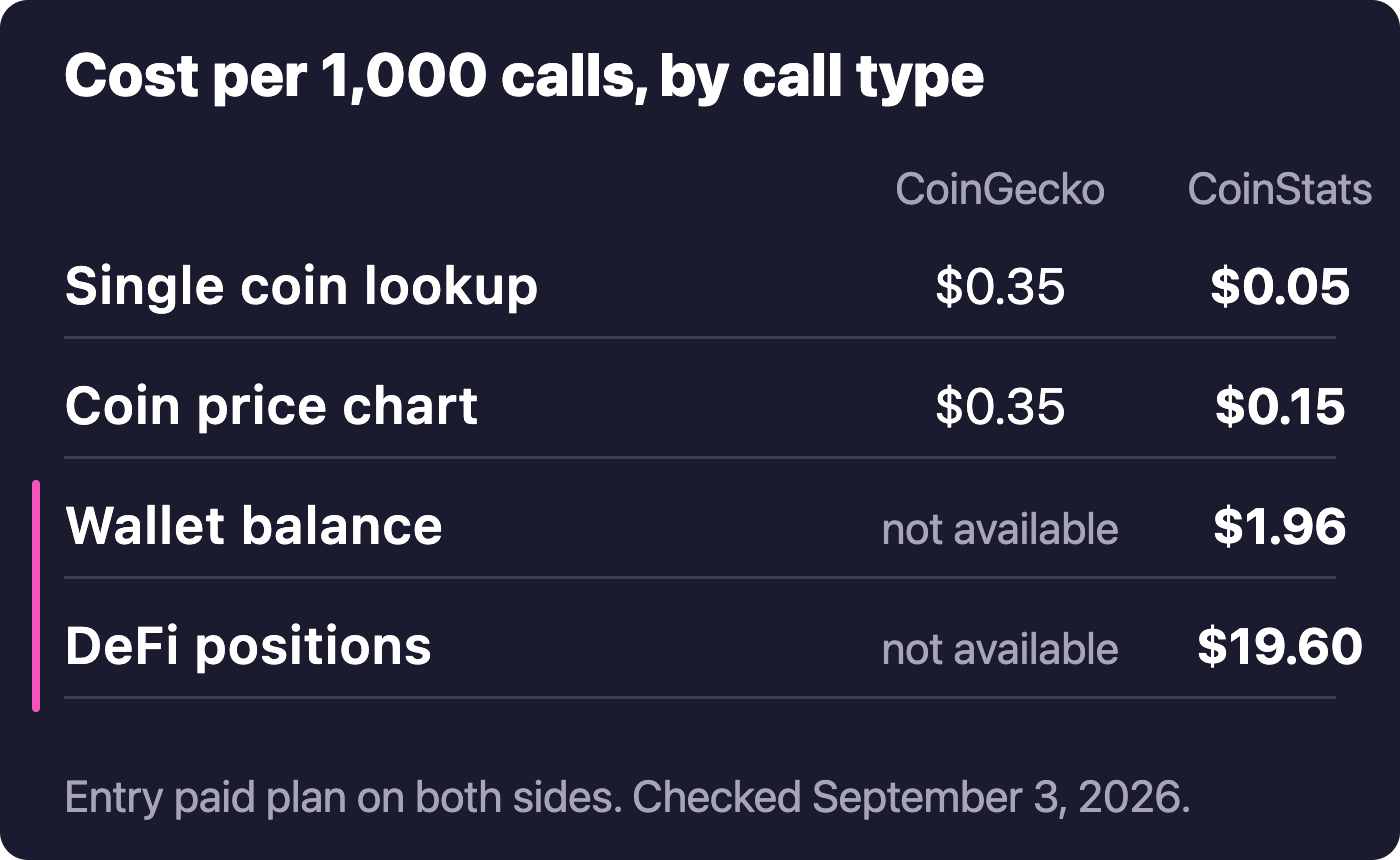
Compare stacks, not line items. One key at $49 against $35 plus an indexer plus a positions provider.
Free tiers, rate limits, and the license
Free tiers decide whether you can prototype. Licenses decide whether you can ship. They are not the same question.
CoinGecko API Demo gives 10,000 credits a month at 100 calls per minute. That limit more than tripled on 17 May 2026, up from 30. Any guide still quoting 30 is out of date.
There is also a keyless public API with 50+ endpoints. No account, no key, roughly 10 to 30 calls a minute. CoinGecko’s own docs call it unsuitable for production workloads.
Licensing is messier than either pricing page suggests. On CoinGecko’s pricing page, the commercial license row is a cross for Demo. The API terms read differently. Section 4.1.6 says you may charge for products that integrate the API. Section 4.3 asks for a “Powered by CoinGecko” credit. That attribution clause carries no tier carve-out. It applies on paid plans too.
CoinStats API free gives 20,000 credits a month at 2 requests per second. Commercial use attaches to paid plans. Read the terms before shipping on free.
What free does give you is the full dataset. It is not a feature-gated demo. The free plan returns the same data as Starter, Standard, and Business.
CoinGecko Demo works differently. It exposes 60+ endpoints and gates a long list above them. WebSocket, webhooks, and top gainers and losers all sit higher. So does custom-range OHLC.
The rate limits are shaped differently, so compare them carefully. 100 calls a minute averages 1.7 a second. 2 requests a second is 120 a minute. Those land close enough that credits and licensing decide it, not throughput.
Be honest about where that leaves you. Need 300 calls a minute on a tight budget? CoinGecko Basic at $35 is the cheaper door.
Coverage compared
| CoinGecko API | CoinStats API | |
|---|---|---|
| Assets | 44,000,000+ tokens | 100,000+ coins |
| Exchanges | 1,900+ | 200+ |
| Networks | 240+ | 120+, 74 of them EVM |
| DeFi | 1,800+ DEXs tracked | 10,000+ protocols, positions resolved |
| Price history | 12+ years, gated by tier | Up to 10 years |
| Endpoints | 60+ to 90+ by tier | 80+ documented |
| Wallet layer | None | Balances, transactions, DeFi, profit and loss |
CoinGecko API wins this table, and it is not close. On raw breadth, nothing in this comparison competes.
Read the DeFi row carefully though. Those two numbers measure different things. CoinGecko tracks DEX pools and their prices. CoinStats resolves positions inside protocols for a given wallet. Both are useful. Neither replaces the other.
The question is whether breadth is your actual constraint. List long-tail tokens? Need exchange reference data across 1,900 venues? Then CoinGecko API wins, and this guide is over. Most consumer apps price the top few thousand assets and never touch the tail.
One call or several
Breadth is one question. Response shape is another, and it costs more engineering time.
Say you render a wallet screen. Balances with token names, live prices, and 24 hour change.
On CoinStats API that is one call. A wallet balance request returns holdings with prices, metadata, and change already attached. It costs 40 credits for a single chain. Coverage spans EVM chains, Solana, and Bitcoin, including xpub, ypub, and zpub keys. HD wallets cost 4,000 credits, since one call derives every address behind the key.
Building the same screen on a market data API takes three steps. Fetch balances from an indexer. Map every contract address to a coin id. Fetch prices for those ids.
Step two is where the time goes. Contract addresses and coin ids are separate namespaces. A new token lands with no mapping. Your user sees a blank row where their money should be.
Transactions work the same way. CoinStats returns them pre-classified. Each carries USD value at the time of the trade. Per-trade profit or loss comes with it. That is the input a tax tool needs. Our guide to crypto wallet APIs goes deeper on that layer.
AI, MCP, and streaming
Both ship MCP servers. That is worth saying plainly. It gets claimed as a differentiator. It is not one.
CoinGecko runs a keyless Model Context Protocol endpoint. There is a keyed one and a local npm package. CoinStats runs one at mcp.coinstats.app with an OAuth flow. Claude, Cursor, and VS Code connect to either.
What differs is what the tools can reach. CoinGecko MCP exposes market data. CoinStats MCP Server exposes wallet, DeFi, and portfolio tools as well. For an agent answering “what is in this wallet”, that gap is everything.
Both meter per call onchain now. CoinGecko charges $0.01 USDC per request through x402. CoinStats starts at $0.001 for market calls, settled on Base.
Streaming goes the other way, and we lose that one. CoinGecko API ships WebSocket from Basic up, across four channels. Webhooks landed in May 2026. CoinStats API is REST only. No sockets, no push, no event stream.
Need sub-second price pushes? That is a real reason to pick CoinGecko API.
What developers actually rate them
Review platforms barely cover crypto APIs. What exists is thin on both sides. Read it as signal, not proof.
We could borrow that app store number and call it an API score. We are not going to. It rates a portfolio app that a million people use monthly. It says nothing about endpoint behavior under load.
The G2 reviews are worth reading for what developers praise. Documentation clarity, response times, and support turnaround come up repeatedly. One CTO on G2 wrote that “the documentation is clear, the response times are fast, and the rate limits are generous.” A Product Hunt reviewer called it “the most reliable crypto price data api I have had the pleasure of working with.”
Those are fair descriptions. CoinGecko API is a mature product with a long track record.
The honest read is that neither score should decide your integration. Fifteen reviews cannot tell you whether an API fits your architecture. Both free tiers are open and neither asks for a card. Build the same screen twice and count the calls.
Which one should you pick?
Price tickers and market dashboards
Live price streaming
Long-tail token research
Portfolio trackers and wallet apps
Crypto tax and accounting tools
AI agents that read wallets
Conclusion
Two products, two jobs.
CoinGecko API is a market data API with exceptional breadth and real streaming. Are prices, charts, and exchange coverage the product? It is hard to beat.
CoinStats API is a market data API with a wallet layer attached. Balances, DeFi positions, profit and loss, and token risk under one key.
The choice is not really which is better. It is how many vendors you want to run.
Count the keys before you commit. If one API answers every question your screen asks, that is the win. If it cannot, the second vendor is never the last one.
Frequently Asked Questions CoinGecko API vs CoinStats API
Is CoinGecko API still free?
Is CoinGecko safe to use?
What is CoinStats API?
Can I use CoinGecko API and CoinStats API together?
How much does CoinGecko API cost?
What rate limits does CoinGecko API have?
Which is cheaper, CoinGecko API or CoinStats API?
Can I use CoinGecko API commercially on the free plan?
Can I get wallet balances from CoinGecko API?
Does CoinGecko API support WebSocket?
How much historical price data does each provide?
Do both have MCP servers?
Which crypto API is the best?
What is better than CoinGecko API?
What is the best CoinGecko API alternative?
Should I use an API or run my own nodes?
Tigran is a growth marketer at CoinStats, working across crypto and consumer apps. He has tracked his own crypto since 2017. That spans centralized exchanges, hardware wallets, and DeFi positions. The habit shapes how he tests these products. He connects real accounts rather than reading feature lists.
He writes about portfolio tracking, wallet data, and crypto market tools.
More from Tigran on the CoinStats blog · LinkedIn · X