Top 7 Amberdata API Alternatives for Crypto Data in 2026

Written by Tigran Mkrtchyan · Reviewed and fact-checked by Narek Gevorgyan · Published August 9, 2026 · Last updated September 4, 2026 · Pricing and limits verified September 2026
Before this guide starts, the news that brought you here.
On June 2, 2026, Kaiko acquired Amberdata. Terms stayed confidential.
Searches for Amberdata API alternatives climbed from there.
The problem with Amberdata was never the data.
It built the options layer almost nobody else would touch. Genesis Volatility in 2022, rebuilt as Amberdata Derivatives. Greeks, implied volatility surfaces and gamma exposure, all by API.
Desks paid for it because it worked.
The problem was what it cost. And now, who owns it.
Nothing has been switched off. Amberdata still sells its API, and the docs are live. No sunset notice exists, and none is implied here.
The concern is quieter than a shutdown. Two vendors with heavy product overlap are now one. Reference data, pricing feeds and derivatives analytics all exist twice. Someone will eventually decide which stack survives.
Buyers hate that uncertainty in a production data path.
Cost and access were already a wall for smaller teams. Amberdata publishes no API prices at all. Its pricing page lists a Startup tier and an Enterprise tier. Both route to a quote form. There is no API free tier, only a trial key on request.
You cannot budget a roadmap against a quote form.
So this guide ranks seven providers that can carry the load instead. We checked public pricing pages, docs and API terms on August 6, 2026. Real pricing, real limits and honest fits.
Each pick targets a different job. All-in-one product data, institutional reference rates or normalized exchange feeds. Tick-level derivatives history, volatility surfaces, onchain metrics or custom queries. You should leave with a clear shortlist, not a longer one.
Want the wider field first? Start with our roundup of the best crypto API providers.
Building for trading systems or AI agents? See our ranking of the best crypto APIs for trading and AI agents.
Why developers look for Amberdata API alternatives
Let’s be fair first. Amberdata does its core job well. Spot and derivatives market data sit alongside onchain and DeFi coverage. Options analytics run deep, with volatility surfaces and gamma exposure. Delivery reaches REST, WebSocket, S3, Snowflake and Databricks.
That is a serious institutional stack. It was built for desks, not side projects.
The friction starts at access. Amberdata publishes no self-serve API pricing today. The pricing page shows two unnamed tiers and a quote form. There is no API free tier. A trial key arrives only after a demo request.
For a small team, that is a two-week detour before the first call.
Then comes the consolidation question. Kaiko closed the acquisition in June 2026. Both companies sell reference data, pricing feeds and derivatives analytics. Overlap on that scale usually ends with one platform retiring. No timeline has been published, and none may exist yet.
Agent tooling is the third gap. Amberdata ships no official Model Context Protocol server. Its docs index carries no MCP entry. Many teams now wire crypto data into Model Context Protocol clients. They need a provider that already speaks it.
Most Amberdata alternatives here do.
How we evaluated these alternatives
We scored every provider on six factors. Each one maps to a real build decision.
One factor deserves a note. Reference rates and indexes carry regulatory weight in Europe. The EU Benchmarks Regulation sets the rules administrators follow. If your product quotes a benchmark, that lineage matters more than latency.
Comparing the top 7
Pricing transparency separates these providers faster than feature lists. Here is the full picture side by side.
| Provider | Free tier | Entry paid (published) | Cost per 1K calls | Beyond market data | MCP / AI |
|---|---|---|---|---|---|
| CoinStats API | 20,000 credits/mo, commercial use | $49/mo, 1M credits | ~$0.05 📉 | Wallet, DeFi, P&L, exchange sync, token risk | ✅ Official, with portfolio data |
| Coin Metrics (Talos) | Community tier, no key needed | Not publicly listed | Not public | Network data, reference rates, indexes | ❌ None |
| Laevitas | x402, no signup | $500/mo Enterprise | $0.001/call* | Options analytics, gamma, flow | ✅ Official |
| Tardis.dev | Self-hosted clients only | $350/mo single data class | Not per call | Options chains, L3 books, liquidations | ❌ None |
| Block Scholes | Trial API key | From £499/mo | Not public | Volatility surfaces, options, funding | ✅ Official |
| Glassnode API | ❌ None | $49/mo billed yearly* | Not public | Onchain, ETF and derivatives metrics | ✅ Official |
| Dune | ✅ Free plan includes API | Analyst tier* | Credit-based | Decoded onchain and DeFi data | ✅ Official |
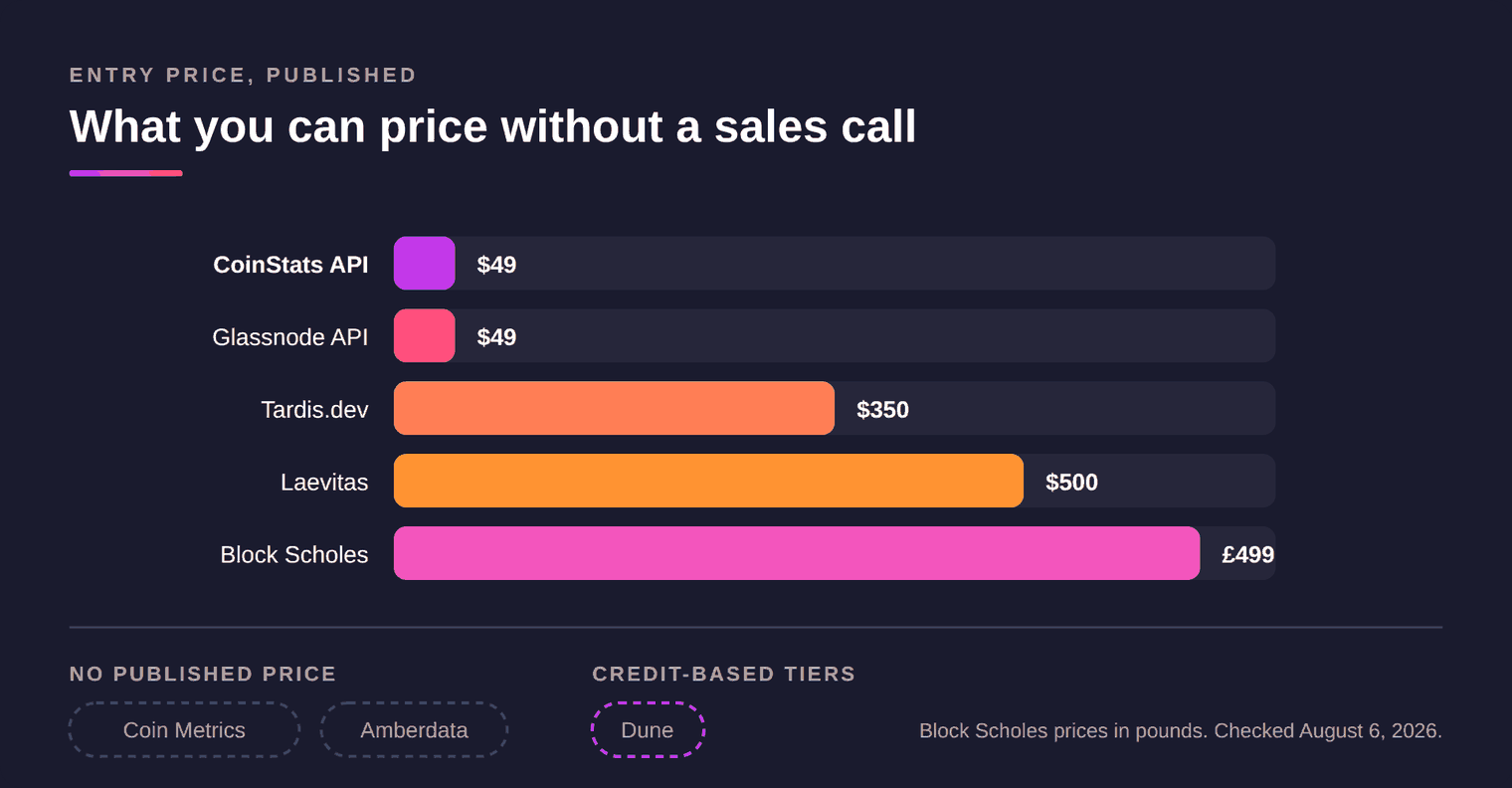
CoinStats API publishes its entry price at roughly $0.05 per 1,000 calls. Only CoinStats API here pairs a commercial free tier with portfolio data.
The top 7 Amberdata API alternatives
CoinStats API
CoinStats API covers the market data jobs most products need. Coverage spans 100,000+ coins, 200+ exchanges and 120+ blockchains. Prices, charts, metadata and market insights ship in one schema. The data powers a portfolio platform with 1M monthly users.
The real difference is the portfolio layer. Pass a wallet address and get token balances back, priced. This works across EVM chains, Solana and Bitcoin. Bitcoin supports xpub, ypub and zpub keys.
Transactions arrive pre-classified with USD values and per-trade profit or loss. DeFi positions resolve per wallet across 10,000+ protocols. Staking, lending and liquidity all detected automatically. Exchange sync covers 200+ venues, including Binance, Coinbase and Hyperliquid. Token Risks endpoint flags honeypots, hidden fees and pausable transfers. It runs on the free tier.
For AI builders, MCP Server exposes wallet, DeFi and portfolio data natively. Pricing stays simple and public. The free tier gives 20,000 credits a month with commercial use allowed. Starter costs $49 a month for 1,000,000 credits. That is roughly $0.05 per 1,000 calls, published and self-serve. Amberdata lists no public price and offers no API free tier.
- 100,000+ coins, 200+ exchanges and 120+ blockchains covered.
- Wallet balances by address across EVM, Solana and Bitcoin.
- Transactions pre-classified with per-trade profit and loss.
- DeFi positions across 10,000+ protocols in one call.
- Exchange account sync for 200+ venues.
- Token Risks endpoint and MCP Server on the free tier.
- Market, wallet, DeFi, portfolio and token security data in one key.
- Lowest published entry cost per call among paid providers here.
- Free tier allows commercial use.
- Pricing is public, so budgets are predictable.
- Official MCP Server with portfolio data.
- No options analytics or volatility surfaces.
- No tick-level order book data for trading systems.
- No warehouse sync into Snowflake or Databricks.
Coin Metrics (Talos)
Coin Metrics is the closest structural match to Amberdata. It sells market data, network data, indexes and reference rates together. Network metrics for Bitcoin and Ethereum run back to genesis. Atlas adds entity-level blockchain data on top.
Methodology is the moat. Coin Metrics documents how each metric is computed. Reference rates and index families are built for audit, not vibes. That is what funds and administrators actually buy. Delivery covers REST v4, WebSocket, flat-file feeds and a Python client.
There is a Community tier and it needs no API key. It allows 10 requests every 6 seconds per IP. Coverage is a subset, with 30 days of Atlas history. Reference rates return the last 7 data points only. Paid pricing is not publicly listed and routes through sales.
One caveat matters here. Talos acquired Coin Metrics in July 2025. Its marketing site now redirects to talos.com. Products and API docs remain active under the Coin Metrics name. So it carries the same consolidation story Amberdata now carries.
- Network data for major chains back to genesis.
- Reference rates and index families built for audit.
- Atlas entity-level blockchain data.
- Spot and derivatives market data from major venues.
- REST, WebSocket and flat-file delivery.
- Free Community tier with no API key.
- Documented, auditable metric methodology.
- Deepest network data record among these providers.
- Community tier needs no key or card.
- No public paid pricing, so evaluation is sales-gated.
- No official MCP server.
- Owned by Talos. The marketing site now redirects.
Laevitas
If Amberdata Derivatives was your reason for the contract, start here. Laevitas ships the GVOL metric set almost item for item. Implied volatility surfaces, Greeks, skew and term structure all arrive by API. So does gamma exposure, which most alternatives simply do not carry.
Coverage runs Deribit, Binance, OKX, Bybit and Coincall. Bullish options data was added in April 2026. Open interest, volume and flow break down by strike and expiry. Funding rates and liquidations ride alongside on the futures side.
Pricing has two doors. Seat plans run free, $50 for Premium and $500 for Enterprise. API keys sit behind the Enterprise tier, which is steep. The second door is far cheaper. API V2 takes x402 payments at $0.001 a call. No key and no signup are needed.
- Implied volatility surfaces, Greeks, skew and term structure.
- Gamma exposure by date and maturity.
- Open interest, volume and flow by strike.
- Funding rates and liquidations across major venues.
- REST, WebSocket and an official MCP server.
- x402 pay per call at $0.001, no signup.
- Closest like-for-like replacement for Amberdata Derivatives.
- Gamma exposure and dealer positioning, rare in this field.
- Cheapest real entry point, through x402 at $0.001.
- Seat-based API access starts at $500 a month.
- CME coverage is limited endpoints only.
- Historical depth is not documented per endpoint.
Tardis.dev
Tardis.dev does one job and does it deeply. It archives tick-level market data from 50+ exchanges. L2 and L3 order book snapshots land as daily flat files. Incremental updates, trades and quotes come too. Liquidations, funding rates and open interest ship as well.
Options are the reason it sits this high. Full options chains with Greeks are archived from Deribit, OKX and Bybit. That is the dataset Amberdata Derivatives buyers actually care about. Development stays active, with changelog entries through July 24, 2026.
Pricing is published and steep. Single data classes run $350 a month for Academic use. Solo is $700, Professional is $1,000 and Business is $3,000. All-exchange access runs from $650 to $6,000 depending on tier. Real-time streaming is free through open-source clients you host yourself, with no API key.
- Tick-level archives across 50+ exchanges.
- L2 and L3 order book snapshots and updates.
- Options chains with Greeks from major venues.
- Liquidations, funding rates and open interest.
- Daily CSV flat files plus an HTTP replay API.
- Self-hosted open-source clients for live streams.
- Deepest tick-level derivatives archive here.
- Pricing is published, unusual at this tier.
- Self-hosted streaming costs nothing.
- Expensive relative to everything else on this list.
- No onchain, DeFi or wallet data.
- No official MCP server.
Block Scholes
Block Scholes targets the exact niche Amberdata built with GVOL. It publishes options data across listed strikes and expiries. Volatility surfaces are SVI-calibrated, with surface points available on demand. Perpetual funding, open interest and futures basis ride alongside.
Coverage spans 22+ venues, with options history back to 2020. Delivery runs REST and WebSocket, plus push and pull oracles for onchain consumers. An official MCP server ships too, with a documented client setup.
Self-serve plans start from £499 a month. Note the currency is pounds, not dollars. Tiers run Core, Prime and Enterprise. Core serves hourly REST, while Prime adds minutely data and WebSocket. Billing period sets lookback: monthly gives a week, yearly gives three years. A free trial API key is available from the console.
- SVI-calibrated volatility surfaces on demand.
- Options across all listed strikes and expiries.
- Funding, open interest and futures basis.
- REST, WebSocket and onchain oracle delivery.
- Options history back to 2020 across 22+ venues.
- Official MCP server with a documented client.
- Published entry price for institutional options data.
- Free trial API key without a sales call.
- Oracle delivery suits onchain products.
- Only the entry price is public, not each tier.
- Derivatives only, with no onchain wallet data.
- Lookback depends on how you choose to bill.
Glassnode API
Glassnode API covers the onchain half of Amberdata, then keeps going. It serves hundreds of metrics across major assets. Supply distribution, address activity, miner flows and entity-adjusted figures all ship. Bitcoin history runs from 2009.
Its 2026 releases moved onto Amberdata turf directly. Perp and spot order-book metrics arrived. An IBIT options suite and gamma exposure heatmaps followed. Macro and traditional finance series joined the same API. An official MCP server is included on paid tiers.
Pricing needs care. Advanced lists at $49 a month, billed annually, with VAT excluded. The plan table shows API Light on Advanced. History caps at 14 days, with daily resolution. The FAQ on the same page says API access is a Professional add-on. Confirm which applies before you commit.
- Hundreds of onchain metrics across major assets.
- Entity-adjusted data that filters chain noise.
- Bitcoin chain history from 2009.
- Options, ETF and macro series added in 2026.
- Order-book depth and imbalance metrics.
- Official MCP server on paid tiers.
- Cheapest published entry among institutional names here.
- Metric depth and rigor trusted by research desks.
- Options and ETF coverage keeps expanding.
- Conflicting statements about API access on Advanced.
- Metric-based, so no raw transaction data.
- Several DeFi protocol metrics were removed in 2026.
Dune
Dune answers the DeFi questions Amberdata packaged for you. It holds decoded onchain data across 100+ chains. You write SQL against it, then expose saved queries through a REST API. DEX trades, contract events and protocol activity all sit there.
The tradeoff is honest. You build the dataset yourself instead of buying a curated one. In exchange you are not limited to a vendor’s metric list. Webhooks and data transformations cover scheduled pipelines.
The free plan includes API access, which is rare at this level. It allows 15 requests a minute on low-limit endpoints and 40 on high-limit ones. Storage caps at 100 MB. Paid tiers are listed on the pricing page. An official MCP server runs at api.dune.com.
- Decoded onchain data across 100+ chains.
- SQL query engine with a REST API on results.
- DEX trades, contract events and protocol activity.
- Webhooks and scheduled data transformations.
- Free plan that includes API access.
- Official remote MCP server.
- Free tier with real API access.
- Unlimited flexibility on DeFi questions.
- Large public library of existing queries.
- Query latency, so not a low-latency feed.
- No derivatives or exchange market data.
- Credit accounting needs monitoring at scale.
Coverage and delivery compared
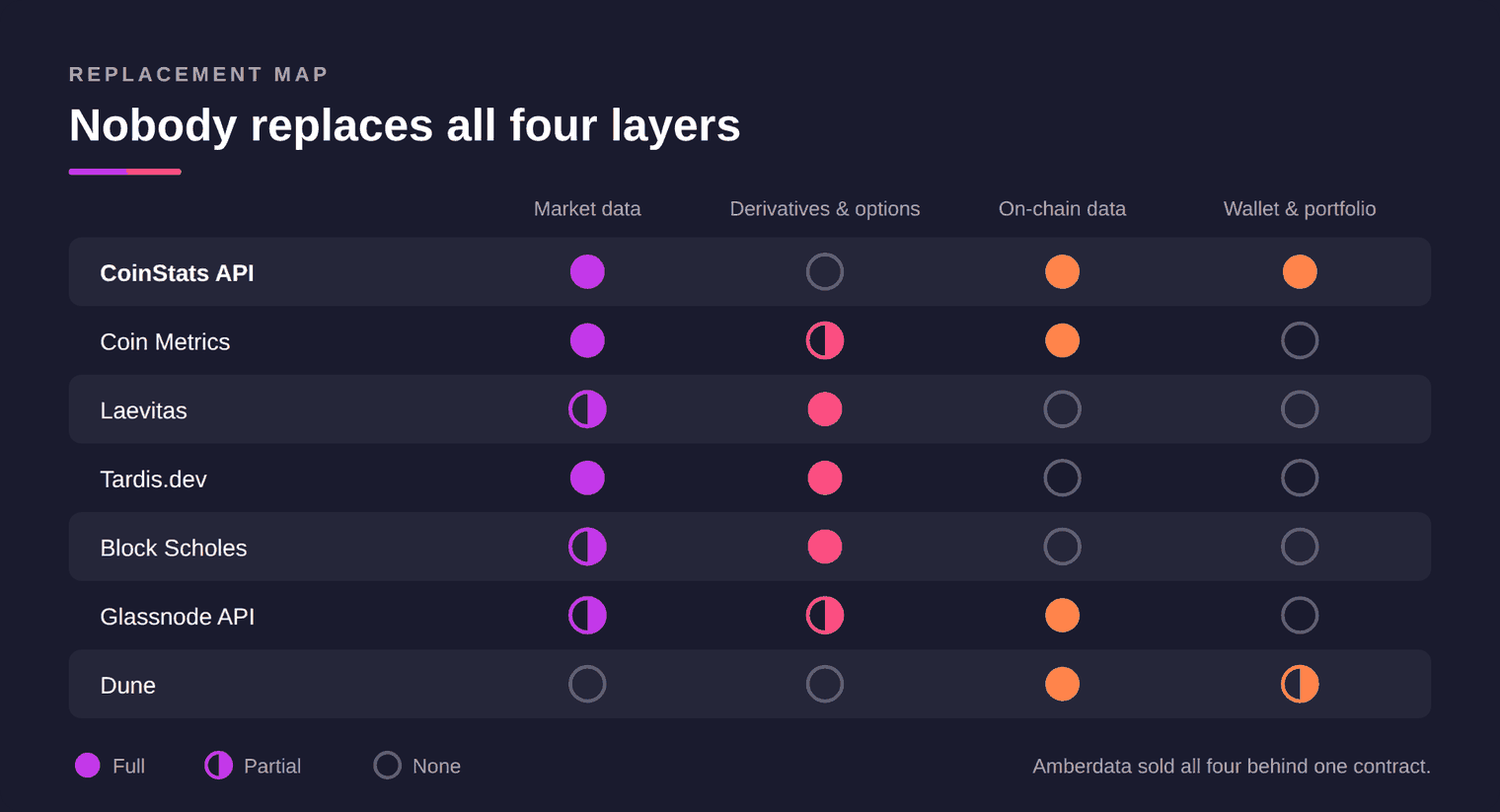
Scope varies as much as price. This table shows what each key actually reaches.
| Provider | Assets | Venues | Chains | Historical depth | Delivery |
|---|---|---|---|---|---|
| CoinStats API | 100,000+ coins | 200+ exchanges | 120+ blockchains | Full market history | REST + MCP |
| Coin Metrics (Talos) | Broad institutional set | Major spot and derivatives | Major chains | Network data to genesis | REST, WS, flat files |
| Laevitas | Options and perps | 6+ options venues | Hyperliquid only | Not documented | REST, WS, MCP |
| Tardis.dev | Instrument level | 50+ exchanges | CEX only | Options with Greeks archived | Flat files, replay API |
| Block Scholes | Options and perps | 22+ venues | Oracle output onchain | Options to 2020 | REST, WS, oracles |
| Glassnode API | Major assets | Spot, perps and ETF | Major chains | Bitcoin to 2009 | REST, CLI, MCP |
| Dune | Onchain tokens | DEX only | 100+ chains | Full chain history | SQL, REST, webhooks |
Which one should you pick?
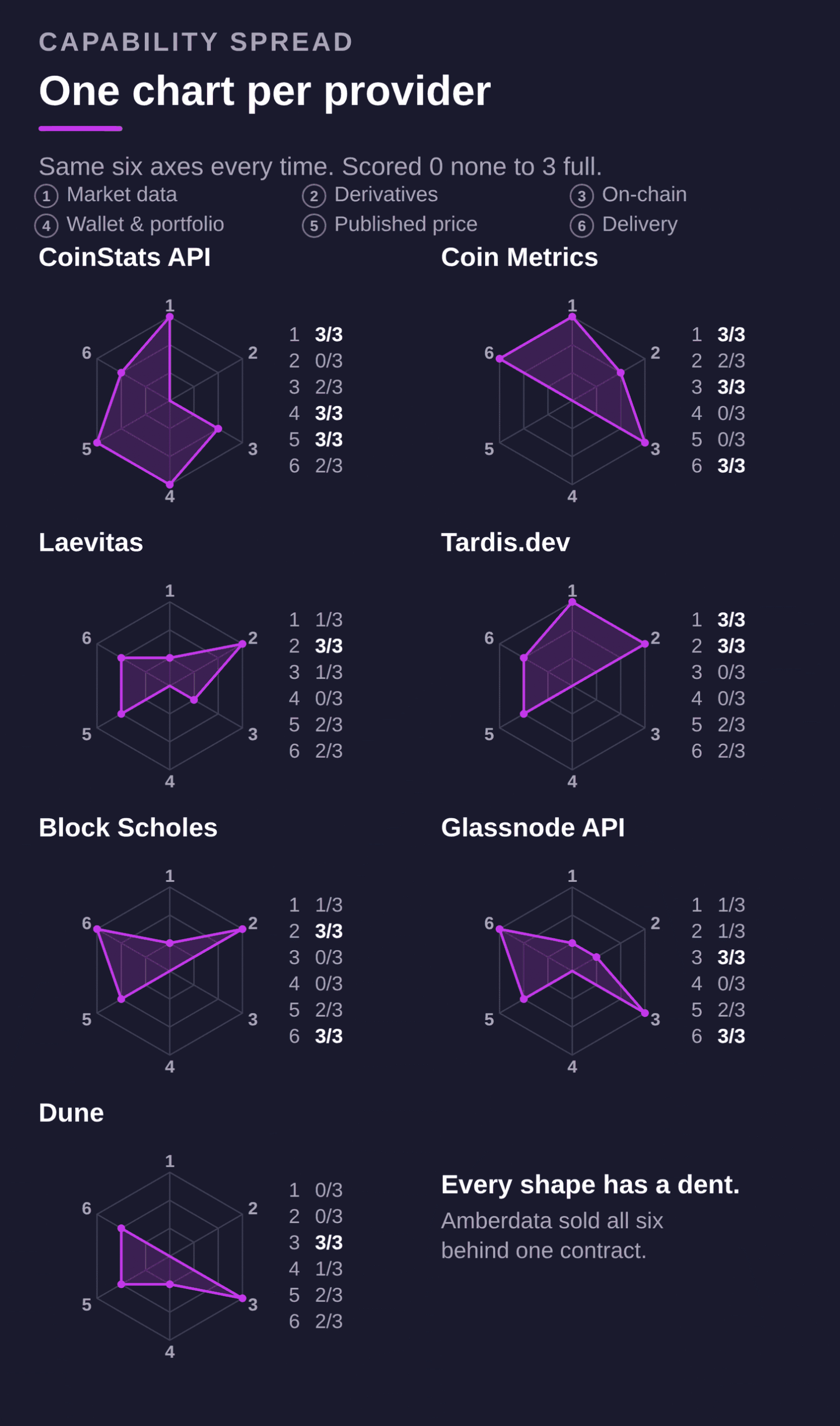
Amberdata is not alone this year. Dune sunset Sim in August. Our Sim API replacements guide covers that migration.
Conclusion
Amberdata built something real. The derivatives and options stack earned its reputation. Nothing here changes that record.
But 2026 buying decisions turn on access. A quote form is friction. No free tier is friction. An unresolved merger is risk you did not sign up for.
The specialists still earn their slots. Coin Metrics owns auditable rates. Laevitas owns options positioning and gamma. Tardis.dev owns tick archives. Block Scholes owns volatility surfaces. Glassnode API owns onchain research. Dune owns custom queries. Weighing CoinStats API itself? See the CoinStats API alternatives we ranked the same way.
For product teams, the math favors breadth and clarity. CoinStats API covers market data. Then it adds wallets, DeFi positions, portfolio analytics and token risk checks. One key, one schema, one published price.
Start with the free tier and test it against your roadmap.
Frequently Asked Questions Amberdata alternatives
Quick answers to common questions about Amberdata API alternatives.
Did Kaiko acquire Amberdata?
Yes. The acquisition was announced on June 2, 2026. Terms were not disclosed. Both companies described it as consolidation of digital asset data.
Is Amberdata shutting down?
No. Amberdata still sells its API, and the docs remain live. No sunset or migration notice has been published. The open question is product overlap between the two stacks.
How do I get an Amberdata API key?
Through a demo or trial request on the Amberdata site. There is no self-serve signup for the API. Most alternatives here issue a key immediately.
Who is the CEO of Amberdata?
Shawn Douglass, who co-founded the company in 2017. Joanes Espanol is co-founder and CTO. Amberdata now sits inside Kaiko.
Is Amberdata API free?
No. There is no API free tier. A trial API key is available after a demo request. The derivatives analytics platform offers a separate free signup.
How much does Amberdata cost?
Amberdata publishes no API prices. Its pricing page lists a Startup tier and an Enterprise tier. Both route to a quote form. Budget teams should assume a sales cycle.
What is the best free Amberdata alternative?
CoinStats API offers 20,000 free credits a month with commercial use allowed. Dune includes API access on its free plan. Coin Metrics runs a Community tier with no key.
What is the best Amberdata API alternative?
For most product teams, CoinStats API. It covers market data and adds wallet, DeFi, portfolio analytics and token security endpoints. Entry pricing is published at roughly $0.05 per 1,000 calls.
What is better than Amberdata?
It depends on the job. CoinStats API wins on price transparency and portfolio data. Laevitas wins on options positioning and gamma. Tardis.dev wins on tick-level derivatives history.
What is similar to Amberdata?
Coin Metrics is the closest structural match. It sells market data, network data and reference rates together. Block Scholes covers the options and volatility side.
Do I need more than one crypto data API?
Sometimes. Options analytics or tick archives may need a specialist key. Most product teams can run on one aggregator. Our guide to the best crypto wallet APIs covers the wallet side.
Which Amberdata alternatives have MCP servers?
CoinStats API, Laevitas, Block Scholes, Glassnode API and Dune all run official MCP servers. Coin Metrics and Tardis.dev do not. Amberdata ships none.
Which alternative is best for crypto options and volatility data?
Block Scholes for live calibrated surfaces. Tardis.dev for archived options chains with Greeks. Laevitas is cheaper, though API access sits on a $500 seat.
Which alternative is best for onchain analytics?
Glassnode API leads on metric depth and rigor. Dune wins when you need custom logic. CoinStats API covers wallet-level balances and DeFi positions by address.
Is there level 2 order book data for crypto?
Yes. Tardis.dev archives L2 and L3 snapshots as flat files for replay. Coin Metrics serves order book snapshots through its market data feed.
Tigran is the Head of Digital Marketing at CoinStats, working across crypto and consumer apps. His writing covers first-hand crypto experience and marketing case studies from that work. He has taken the stage at industry-leading conferences like MAU Vegas, Business of Apps Berlin, and App Promotion Summit London.
More from Tigran on the CoinStats blog · LinkedIn · X