Kalshi Promo Code COINSTATS: $50 Bonus (August 2026)

Written by Tigran Mkrtchyan, growth marketer at CoinStats · Fact checked by Narek Gevorgyan, Founder and CEO of CoinStats · Last updated Aug 18, 2026
Disclosure: this link pays both of us. You get $50 in Kalshi credits, we get a commission from Kalshi. It costs you nothing extra, and it did not buy our 4.7/5 rating.
The Kalshi promo code COINSTATS gives new users a $50 sign-up bonus in trading credits after their first $25 in perpetuals trades. This Kalshi promo was last verified today, August 18. You’ll need the code to unlock the offer and start trading crypto perpetuals on Kalshi.
Kalshi is a CFTC-regulated exchange, and since June it has been the only US venue offering regulated crypto perpetual futures. Our code pays a fixed $50, which matters more than it sounds. Most Kalshi codes pay a randomised amount, and Kalshi’s own terms show that seven users in ten receive $15 from those. We break that down further below.
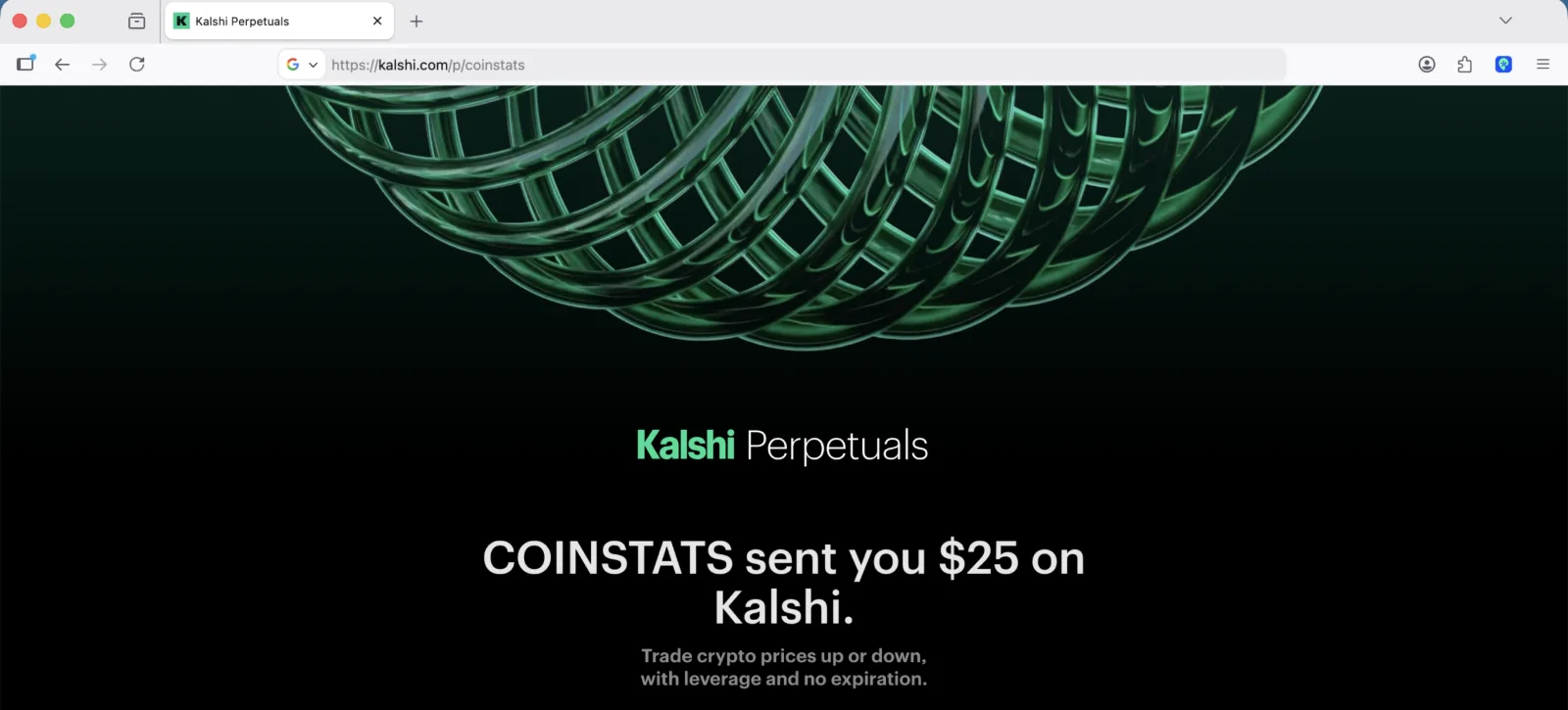
Sign up at Kalshi with promo code COINSTATS here and get $50 in bonus credits after trading $25 in perpetuals.
Jump to: Details · How to claim · Terms · Markets · States · Perpetuals · Fees · App · FAQ
Kalshi promo code details
Here is everything the offer involves in one place. We took these terms from Kalshi’s referral and promo code program terms and its referral program FAQ rather than from other promo pages, several of which disagree with each other.
Swipe sideways to see the full table →
| Detail | What you get |
|---|---|
| Kalshi promo code | COINSTATS |
| Kalshi bonus offer | Trade $25 in perpetuals, get $50 in bonus credits |
| Bonus type | Fixed $50, not a randomised draw |
| Where the credit lands | Your perpetuals balance |
| Deadline to qualify | 7 days from account opening |
| Code entry window | 72 hours after sign-up, or before your first deposit, whichever comes first |
| Credit arrives | Up to 24 hours after you qualify |
| Credit expiry | 7 days after it lands |
| Withdrawable | No. Profits made with it are |
| Minimum age | 18+ |
| Minimum deposit | $10 ($1,000 by wire) |
| Deposit methods | ACH, debit card, wire, crypto, PayPal, Venmo, Cash App |
| Regulator | CFTC (Designated Contract Market) |
| Our rating | 4.7 out of 5 |
| Promo code last verified | August 18, 2026 |
How to sign up with the Kalshi promo code
The whole process takes about ten minutes plus a short wait for identity checks. Do the perpetuals application early, because it’s the step people forget and the one that eats into your 7-day window.
- Open the sign-up page through our link. Use the button on this page and the code applies automatically. You can also type COINSTATS by hand on the date-of-birth screen.
- Create your account. Sign up with Google, Apple, or an email address. Kalshi asks for your date of birth on the second screen, and that is where the code field sits.
- Verify your identity. Kalshi is a regulated exchange, so KYC is mandatory. You’ll need a government ID and a selfie. Most approvals come back quickly.
- Apply for perpetuals access. Perpetuals sit behind a short questionnaire about your trading experience. Kalshi can decline applications, and a tutorial is required before your first trade.
- Deposit and trade $25. Fund the account, then complete $25 in perpetuals trades within 7 days of opening it. Trades do not need to win. The $50 credit lands within 24 hours.
Three things worth getting right. Apply for perps access before you deposit, so the qualifying clock isn’t running while you wait for approval. Qualify at 1x leverage, because $25 of margin at 1x meets the $25 trading requirement with liquidation nowhere in sight. And watch two clocks, not one: 7 days from sign-up to complete the trades, then 7 days from when the credit lands to use it.
Claim your Kalshi bonus here, and remember to use the Kalshi promo code COINSTATS.
What you actually get: COINSTATS vs “up to $500”
Search for a Kalshi promo code and the numbers don’t agree. One site says $20, another $35, and several say “up to $500”. None of them are lying. They’re describing the same lottery. Kalshi’s standard referral program pays a randomised amount, and the odds are printed in Kalshi’s own program terms.
Average payout across all five tiers: $25.05. Source: Kalshi Referral and Promo Code Program Terms.
Seven in ten people on the “up to $500” offer receive $15. Roughly one in 285 receives the headline number. COINSTATS pays a flat $50 instead, which is more than 94% of lottery entrants actually get. You give up a 0.35% shot at $500, and we think that’s a fair trade.
There is a second difference that matters. The standard referral program is a Predictions offer: you qualify by trading $25 on event contracts and the credit lands in your predictions balance. COINSTATS is a perpetuals offer. You qualify by trading $25 in perps and the credit lands in your perps balance. If crypto perpetuals are why you’re opening a Kalshi account, that is the balance you want the money in.
Kalshi sign up bonus terms and conditions
The Kalshi sign up bonus comes with terms that decide whether you keep the money. These are the ones that matter.
- You must trade $25, not deposit $25. Kalshi measures trade size, not profit or loss. A losing trade counts the same as a winning one, and you don’t need to wait for a position to settle.
- The qualifying window is 7 days from account opening. Referral codes get 7 days and promo codes get 30. COINSTATS runs on both programs, so we tell everyone 7. Finishing early costs nothing.
- The credit expires 7 days after it lands. Kalshi states this in three separate places. Plan your trades before you claim.
- The bonus is not cash. Kalshi requires you to trade an amount equal to the credit before profits become withdrawable. After that, profits made with the credit can go to your bank. The original $50 cannot.
- Perps credits stay in your perps balance. Kalshi keeps perpetuals and prediction markets in separate balances and the credit can’t move between them.
- Eligibility. 18 or older, US resident, KYC complete, and no prior Kalshi account in your name. One code per account, so you can’t stack COINSTATS with another referral.
- Kalshi can change or end the program. The terms reserve the right to amend the offer. We re-check it at least monthly and stamp the date at the top of this page.
Kalshi promo code mistakes to avoid
Most people who miss out on a Kalshi bonus don’t get rejected. They trip over one of the same seven things. All of them are avoidable.
- Depositing before entering the code. The code window closes at your first deposit, even if it’s minutes after sign-up. Enter COINSTATS first, fund second.
- Skipping the perpetuals application. The bonus is a perps offer. If you’re not approved for perps you can’t complete the qualifying trades, and the 7-day clock doesn’t wait for your application.
- Using an old account. The offer is for new users with no prior Kalshi account. A second account in your name won’t qualify and can get both closed.
- Treating the credit as cash. It isn’t withdrawable. Trade it once, and only the profits can leave.
- Letting the credit expire. Seven days from the moment it lands. If you claim on a Friday and don’t open the app until the following weekend, it’s gone.
- Looking for it in the wrong balance. Perps credits sit in the perps balance under Activity, then Credit. They never appear in your predictions balance.
- Shortcutting the $25 with leverage. Higher leverage reaches $25 of notional with less margin, but it also puts a liquidation price close to the entry. Qualify at 1x.
How we rate the Kalshi promo code: 4.7 out of 5
We score every promo code we cover on the same six factors, and the headline rating is the average. Kalshi’s COINSTATS offer scores 4.7. Here is where the points come from and where they don’t.
Swipe sideways to see the full table →
| Factor | Score | Why |
|---|---|---|
| Bonus value | 4.7 | A flat $50 for $25 traded beats the randomised $15 most Kalshi codes actually pay |
| Terms fairness | 4.2 | Low bar to qualify, but a 7-day credit expiry and no cash-out on the credit itself |
| Regulation and trust | 5.0 | CFTC-designated exchange with a CFTC-registered clearinghouse since 2020 |
| Fees | 4.8 | 12 bps taker on perps, free ACH both ways, no settlement fee on event contracts |
| App and platform | 4.8 | 4.8 on iOS from 469,000 ratings; separate balances take a minute to learn |
| Support | 4.5 | Fast in-app chat and email, but no phone line and no published response target |
The score is editorial. It isn’t paid for, and Kalshi does not review this page before it goes live. When the terms change, the score changes with them.
Featured Kalshi crypto markets (as of August 18, 2026)
Kalshi prices every contract in cents, and the price doubles as the market’s probability. A Yes price of 58c means traders put the odds near 58%. Buy Yes at 58c and the contract pays $1 if it settles Yes. Here are live prices from the two busiest crypto boards this morning, both settling on August 21.
Bitcoin price on August 21
Swipe sideways to see the full table →
| Bitcoin closes at or above | Yes | No | 24h volume |
|---|---|---|---|
| $63,000 | 80c | 19c | 22,051 |
| $63,500 | 72c | 27c | 14,400 |
| $64,000 | 58c | 40c | 37,860 |
| $64,500 | 43c | 56c | 37,344 |
| $65,500 | 19c | 79c | 33,193 |
| $66,000 | 11c | 87c | 13,856 |
Implied Bitcoin pricing sits near $64,200 on this board, and the $63,000 strike has traded more than 208,000 contracts in total.
Ethereum price on August 21
Swipe sideways to see the full table →
| Ethereum closes at or above | Yes | No | 24h volume |
|---|---|---|---|
| $1,810 | 93c | 5c | 2,145 |
| $1,850 | 81c | 18c | 3,381 |
| $1,890 | 56c | 41c | 310 |
| $1,930 | 28c | 69c | 4,878 |
| $1,970 | 10c | 87c | 2,351 |
| $2,010 | 3c | 95c | 5,721 |
Implied Ethereum pricing sits near $1,890, with a move above $2,010 priced at roughly 3%.
Prices from the Kalshi public API on August 18, 2026 (contracts KXBTCD and KXETHD). Each strike is a separate Yes/No contract, so prices across rows don’t add up to $1. Prices move constantly.
These are event contracts. Perpetual futures trade alongside them with no expiry date, and the COINSTATS credit is for perpetuals, covered in full further down.
Start trading at Kalshi with code COINSTATS and get $50 in bonus credits.
What markets can you trade on Kalshi?
Kalshi runs two products under one login. Event contracts are the original business: Yes or No questions that settle at $1 or $0. Perpetual futures are the newer one: leveraged long or short positions on crypto prices with no expiry. Most promo pages only describe the sports side. Here is the whole catalogue.
Crypto event contracts
Kalshi’s public API lists more than 120 crypto series. The busiest are the daily price markets for Bitcoin and Ethereum (tickers KXBTCD and KXETHD), which ask whether the price will close above a set of strikes on a given day. Around those sit range markets (KXBTC, KXETH), fifteen-minute up-or-down markets on BTC, XRP, ADA and ZEC, yearly high and low markets, all-time-high markets, a Bitcoin-versus-Ethereum market, daily markets on DOGE, SHIB, LTC and DOT, and a USDC de-peg market. The year-end Bitcoin and Ethereum range series, KXBTCY and KXETHY, currently carry no trading fee at all under Kalshi’s fee schedule.
Economics
CPI, Fed decisions and the Fed funds rate, GDP, non-farm payrolls, and the unemployment rate each have their own series (KXCPI, KXFED, KXFEDDECISION, KXGDP, KXPAYROLLS, KXU3). These are the markets Kalshi was built for and they trade heavily around every release. Note that most of them carry a small maker fee, unlike the crypto year-end series.
Politics and elections
Presidential and midterm markets, control of the House and Senate, and a long tail of policy questions. Election markets are the category most affected by state litigation; Nevada and Washington restrict them, and the section on availability below has the detail.
Culture, weather, and sports
Award shows, box office, weather thresholds, and the sports book: game winners, season champions, player props, and multi-leg combos. Sports is where Kalshi’s state fights are concentrated. If you’re on Kalshi for crypto, none of that touches your account, but it explains most of the headlines you’ll read about the company.
Perpetual futures
At least thirteen crypto assets with leverage, funding every eight hours, and no expiry. This is the product the COINSTATS bonus is tied to, and it gets its own section below.
Kalshi referral code vs promo code
People search for both terms, and Kalshi does treat them as two programs with different rules. COINSTATS works either way, so you don’t need to choose, but the difference matters because the deadlines aren’t the same.
Swipe sideways to see the full table →
| Referral code | Promo code | |
|---|---|---|
| Who issues it | Any existing Kalshi user | A partner or media brand |
| Time to qualify | 7 days from account opening | 30 days from account opening |
| Reward shape | Usually the randomised ladder | Often a negotiated flat amount |
| Referrer reward | Yes, capped at 40 referrals | Not applicable |
| Where to enter it | Date-of-birth screen at sign-up | Same screen |
| Can you use both | No, one code per account | No, one code per account |
On the referrer side, an existing user can refer up to 40 people. Reward amounts are personalised per account, and Kalshi shows your figure under Menu, then Rewards. The referrer has to be a US person in good standing who has traded at least $25 on event contracts, and there is a lifetime earnings cap that Kalshi tracks in the same Rewards section.
Kalshi promo code vs other prediction market promos
Swipe sideways to see the full table →
| Kalshi (code COINSTATS) | Polymarket | |
|---|---|---|
| Sign-up bonus | $50 fixed, after $25 traded | Varies by campaign |
| Bonus shape | Flat amount | Varies |
| Regulation | CFTC-designated contract market | Onchain settlement |
| Funding | Bank, card, wire, crypto | Stablecoin deposits |
| Crypto perpetuals with leverage | Yes, 13 assets | No |
For event contracts both are worth a look. For leveraged crypto on a US-regulated venue with a fixed sign-up bonus, Kalshi is currently the only option.
What is Kalshi and how does it work?
Kalshi is a US exchange for trading on the outcome of real events. Every market is a question with a Yes and a No side. Contracts trade between 1c and 99c and each one settles at $1 or $0. Buy Yes at 40c and, if the event happens, you receive $1. If it doesn’t, you receive nothing. Markets cover economics, politics, weather, culture, and sports.
Pricing is peer to peer. Kalshi doesn’t set a line the way a sportsbook does; you trade against other users on an order book, and you can sell out of a position before it settles.
In June 2026 Kalshi added crypto perpetual futures, becoming the first US venue to list them. A perpetual is a futures contract with no expiry date. You go long or short on the price of an asset and hold for as long as you like, with funding payments between longs and shorts keeping the perp price close to spot. The mechanics are the same as offshore crypto perps; the difference is that Kalshi’s run on a CFTC-regulated exchange with US clearing. The bonus in this article applies to perpetuals.
Is Kalshi legit?
Yes, and the specifics are public. Kalshi is regulated by the Commodity Futures Trading Commission, which designated KalshiEX LLC as a Designated Contract Market in November 2020 under Section 5 of the Commodity Exchange Act. That is the same registration category used by established US futures exchanges. Clearing runs through Kalshi Klear, a CFTC-registered derivatives clearing organisation, so client funds and market integrity sit under federal oversight.
Account security
Two-factor authentication is available on every account, Face ID is on by default on compatible devices, and Kalshi added ID checks and selfie verification for higher-risk accounts in May 2026. Perpetuals margin sits at the clearinghouse rather than in an operating account, which is also why it earns interest. None of this makes trading safe, but it does make the venue a different animal from an offshore exchange holding your keys.
What legit does not mean
Legit doesn’t mean available everywhere. Several states are contesting Kalshi’s sports event contracts in court. None of that touches the exchange’s federal status, but it does affect which markets you see, so the next section covers it state by state.
How the CFTC regulates Kalshi
The phrase “CFTC-regulated” gets used loosely, so here is what it means in Kalshi’s case. In November 2020 the Commodity Futures Trading Commission issued an Order of Designation to KalshiEX LLC granting it status as a designated contract market. That is the licence category for US futures exchanges. It comes with core principles the exchange has to keep meeting on market surveillance, financial resources, recordkeeping, and the prevention of manipulation, and it means Kalshi’s contracts are listed under federal commodities law rather than any state’s gambling code.
Clearing is separate from trading. Trades on Kalshi clear through Kalshi Klear, a derivatives clearing organisation registered with the CFTC, which is where perpetuals margin sits and why it earns interest. Kalshi describes itself as the first regulated exchange dedicated to event contracts, and the CFTC’s own actions have backed that framing: in August the Commission invoked emergency authority to order Kalshi to keep operating in New York, with its chairman saying that Congress did not intend derivatives exchanges to be regulated under a patchwork of state gaming laws.
None of that settles the state cases. It does mean that when you deposit at Kalshi you are dealing with a federally supervised exchange and a federally registered clearinghouse, which is a different risk profile from an offshore venue with no regulator at all.
A short history of Kalshi
Kalshi was founded in 2018 by Tarek Mansour and Luana Lopes Lara, two former quant traders who wanted a regulated place to trade on real-world events. It spent two years working with the CFTC before receiving its designation in November 2020 and opened to the public in 2021 with markets on economics, weather, and politics.
The company’s first big legal fight was over election markets. The CFTC tried to block contracts on control of Congress, and Kalshi won in federal court in the autumn of 2024, which is why US users could trade the 2024 election on a regulated venue. Sports event contracts followed in early 2025 and drew the wave of state cease-and-desist letters and lawsuits that make up most of the litigation table above.
In May 2026 Kalshi announced perpetual futures, and in June it became the first US company to list them, starting with Bitcoin and Ethereum and expanding to at least 13 crypto assets. That launch is the reason a crypto portfolio tracker is writing about a prediction market, and it’s the product the COINSTATS bonus is tied to.
Where Kalshi is available
This section is wrong on most promo pages, so read it carefully. Several sites claim Kalshi is fully blocked in four states. Court records don’t support that. No US state currently blocks the whole Kalshi platform. What states have restricted are specific contract categories, mostly sports. Here is the current picture from court orders and attorney general filings.
Swipe sideways to see the full table →
| State | What is restricted | Status |
|---|---|---|
| California | Nothing currently | Tribal lawsuit on appeal at the Ninth Circuit |
| Texas | Nothing currently | Attorney general investigating |
| New York | Nothing currently | State suit filed; CFTC ordered Kalshi to keep operating |
| Florida | Nothing | No active challenge |
| Michigan | Sports contracts only | Geofenced. Politics and economics still live |
| Nevada | Sports, elections, entertainment | Geofenced under a settlement |
| Washington | Seven categories including sports | From September 2. Commodities and finance exempt |
| Utah | Nothing yet | Ruling allows enforcement, no block imposed |
| Massachusetts | Nothing currently | Injunction stayed pending appeal |
| Maryland, Ohio | Sports contracts | Disputed and under appeal |
| New Jersey, Tennessee | Nothing | Courts have ruled in Kalshi’s favour |
Kalshi in California
Kalshi is live in California. A group of tribal governments has sued under the Indian Gaming Regulatory Act, arguing that sports contracts amount to unlicensed gaming, and the case is on appeal at the Ninth Circuit. Nothing is blocked while that plays out. California is Kalshi’s largest state by population, so a ruling here would matter more than most.
Kalshi in Texas
Kalshi is live in Texas. The attorney general has opened an investigation but has not filed suit or sought an injunction, and no market category is geofenced. Texas has no legal sportsbooks, which makes Kalshi’s sports contracts unusually popular there and unusually exposed if the state acts.
Kalshi in New York
Kalshi is live in New York, and this is the state to watch. The attorney general filed a civil enforcement action on July 31 over sports event contracts. On August 11 the CFTC invoked emergency authority and ordered Kalshi to keep operating in the state, arguing that a federally designated exchange cannot be regulated under a patchwork of state gaming laws. A Connecticut federal judge ruled four days later that the CFTC cannot override a court in that state, so the question of who wins this fight is open.
Kalshi in Florida
Kalshi is live in Florida with no active challenge, no investigation we could find, and no geofenced categories.
The legal picture in more detail
The pattern across the country is a fight over one product line, sports event contracts, and one legal question, whether a CFTC-designated exchange is subject to state gambling law. Kalshi’s biggest win came in April, when the Third Circuit ruled that New Jersey cannot regulate its prediction market. Tennessee went the same way at district level, and Minnesota’s statutory ban, the first in the country, was blocked by a federal court before it could be enforced.
The other side of the ledger is real. Michigan’s attorney general obtained a temporary restraining order that forced Kalshi to geofence sports contracts by August 12, with a possible fine of $500,000 a day. Nevada reached a settlement requiring sports, election and entertainment contracts to be geofenced by the same date, and is now seeking daily fines on the grounds that the geofence failed. Washington’s order of August 12 is the broadest: seven categories must be geofenced by September 2, though commodities, climate, economics and finance are expressly exempt and users may close existing positions. Ohio upheld a $5 million fine at the lower court, Maryland denied Kalshi an injunction, and both are on appeal. Massachusetts granted an injunction in January that is stayed while the state’s highest court decides.
Roughly a dozen more states, including Arizona, Illinois, Iowa, Louisiana, Rhode Island and Wisconsin, have cases running without any block in place. The picture changes weekly. We update the table above when an order takes effect, not when a suit is filed.
Kalshi vs traditional sportsbooks and betting apps
A lot of people arrive at Kalshi from sportsbooks and expect the same thing with a different logo. It isn’t, and the differences explain both the appeal and the legal fights.
Probabilities, not odds
A sportsbook quotes -110 or +240. Kalshi quotes 52c or 29c, and the number is the market’s probability. There is no vig baked into the line; the fee is a separate, published formula charged on the trade.
No house on the other side
Sportsbooks set a line and take the other side of your bet. On Kalshi you trade against other users on an order book. That means Kalshi has no interest in whether you win, and it also means thin markets can have wide spreads.
You can exit early
A bet is locked until the game ends. A Kalshi contract can be sold back to the market at any time before settlement, which lets you take profit or cut a loss the way you would with a stock.
Federal, not state, regulation
Sportsbooks are licensed state by state. Kalshi is designated by the CFTC and argues that federal law pre-empts state gambling rules. That argument is why it can operate in states with no legal sportsbook, and it is exactly what the litigation above is about.
Kalshi perpetuals: what you’re actually trading
Most Kalshi promo guides skip this because they’re written by sports desks. Our bonus is a perpetuals offer, so here is what you’re trading. Kalshi announced perps on 29 May 2026. Bitcoin went live on 3 June, Ethereum on 4 June, and XRP and Solana within the week. Volume passed $1 billion in the first week and $5.5 billion by mid June, and Kalshi has said it wants to extend perps beyond crypto.
Assets and contract sizes
Kalshi’s help center lists perpetuals on 13 crypto assets: BTC, ETH, SOL, XRP, DOGE, LINK, DOT, LTC, BCH, SUI, XLM, SHIB, and HBAR. Its leverage page also shows NEAR, ZEC and HYPE, so the list is growing. Bitcoin contracts are sized at 0.0001 BTC, so the minimum position is one contract, a few dollars. Kalshi says minimums for other assets vary and does not publish them all.
Leverage
Kalshi publishes maximum leverage per asset. Bitcoin sits near 5.9x and Ethereum near 4.5x. Litecoin is around 3.7x, Chainlink 3.4x, Bitcoin Cash 3.0x, and XRP, DOGE and SOL sit between 2.6x and 2.7x, with the smaller assets around 2x. Figures were current as of 29 July 2026 and can change. That is a fraction of what unregulated venues advertise, and it’s the trade-off for a regulated exchange with US clearing.
Funding
Funding settles every 8 hours at 12am, 8am, and 4pm ET. The rate is a time-weighted average of the premium between the perp price and the index over the preceding interval, clamped at plus or minus 2%, and rates below 0.01% in either direction are rounded to zero. Longs pay shorts when the rate is positive and shorts pay longs when it’s negative. Funding is a transfer between traders; Kalshi doesn’t take a cut. It shows up line by line in your transaction history.
Pricing, margin, and liquidation
Prices reference CF Benchmarks indices rather than a single exchange feed. Bitcoin uses the BRTI, updated every second, and markets trade 24/7. Margin posted for perps sits at the clearinghouse and earns roughly 3.25% APY while it’s there. If a position’s equity falls below its maintenance requirement it is liquidated. Kalshi’s mandatory tutorial covers how that works before you can trade, and the practical advice is the same on every venue: keep leverage low and margin comfortable.
Access is gated
Perpetuals aren’t open to every verified account. You submit a questionnaire on trading experience and risk tolerance, applications can be declined, and a tutorial is mandatory before your first trade. Start this step early.
A note on the legal debate
Because funding creates ongoing payments between participants, there was a public debate in June over whether Kalshi’s perps are legally futures or swaps. That is a question for lawyers and the CFTC. For a trader, the relevant fact is that they are listed on a designated contract market and cleared through a registered clearinghouse.
Kalshi perpetuals vs a typical offshore exchange
Swipe sideways to see the full table →
| Kalshi perpetuals | Typical offshore perp exchange | |
|---|---|---|
| Regulator | CFTC, US clearing | Often none, or a light offshore licence |
| Maximum leverage | About 6x on BTC | 50x to 100x commonly advertised |
| Reference price | CF Benchmarks indices | Exchange’s own index |
| Idle margin | Earns interest, about 3.25% APY | Usually earns nothing |
| Identity checks | Full KYC | Varies, sometimes none |
| Open to US residents | Yes | Usually not, officially |
| Assets | 13 crypto perps | Hundreds |
The honest summary is narrow and safe versus broad and fast. If you want 50x on a memecoin, Kalshi is the wrong venue. If you want regulated leverage on majors funded from a US bank account, it’s the only one.
How to trade on Kalshi
Two products, two workflows. Both are simpler than they look, but the order types and the two balances trip up almost everyone the first time.
Placing your first event contract trade
Open a market and you’ll see a Yes price and a No price in cents. Decide which side you’re on and how many contracts you want; the app shows the cost and the payout if you’re right. A quick order fills immediately at the best available price. A limit order lets you name your price and rests on the book until someone matches it, which is the better choice in thin markets. Once you’re in, the position sits under Portfolio. You can hold to settlement, when the contract pays $1 or $0, or sell back to the market at any point before that.
Placing your first perpetuals trade
Perps have their own section and their own balance, so move funds there first. Pick an asset, choose long or short, and set your size and leverage; the app shows the margin required and the liquidation price before you confirm. Funding then accrues every eight hours for as long as you hold. Close the position from Portfolio when you want out. For the COINSTATS bonus you need $25 in perps trades inside your first week, and 1x on Bitcoin is the low-drama way to get there.
Kalshi Pro
On desktop, Kalshi Pro is a separate trading terminal with depth of book, faster order entry, and multi-market views. Casual users won’t miss it. Anyone trading perps seriously should try it.
Kalshi Combos
Combos let you bundle several event contracts into a single position, the prediction-market cousin of a parlay. They’re mostly a sports feature and Kalshi runs a separate incentive program around them. They aren’t relevant to the perps bonus, but you’ll see them on the home screen.
Open your Kalshi account with promo code COINSTATS and trade $25 in perps for a $50 bonus.
Kalshi API and tools for active traders
Kalshi runs a public trading API alongside the app, and it’s how we pulled the Bitcoin and Ethereum boards above. The REST endpoints expose series, events, markets, order books, and exchange status, and there’s a Crypto category with more than 120 series to filter on. Prices are returned as fixed-point dollar strings to four decimal places, because Kalshi moved to sub-penny pricing: the finest increment is a hundredth of a cent, and event contracts can be traded in fractions down to 0.01 of a contract. Authenticated endpoints add order placement and portfolio data for automated strategies.
If you’re the kind of trader who wants that, three things are worth knowing. Filter market calls by series ticker, because an unfiltered request returns multi-leg parlay shards with garbled titles and no volume. Pass a minimum close time, or the API returns strikes that have already expired but are still flagged open. And treat the funding rate and the leverage limits as data you re-read, not constants, since both move.
On the portfolio side, CoinStats API covers the other end of the same workflow: wallet balances, exchange positions, and DeFi holdings across 200+ exchanges and 120+ blockchains, so a Kalshi perps position can sit next to everything else you hold.
Kalshi fees
A bonus is only worth claiming if fees don’t eat it. Kalshi publishes a full fee schedule, effective 7 July 2026, so the maths is public. There is no membership fee and no settlement fee on either product.
Perpetuals fees
Fees are charged on notional value, not on the margin you post, so a $250 position opened with $50 of margin pays fees on $250. Per the Kalshi fee schedule, new accounts start at the base tier and rates fall with 30-day trailing volume.
Swipe sideways to see the full table →
| 30-day volume | Taker | Maker |
|---|---|---|
| Under $100K | 12.0 bps | 5.0 bps |
| $100K+ | 10.0 bps | 4.0 bps |
| $300K+ | 8.0 bps | 3.2 bps |
| $1M+ | 6.0 bps | 2.4 bps |
| $3M+ | 5.0 bps | 2.0 bps |
| $10M+ | 4.0 bps | 1.6 bps |
| $30M+ | 3.5 bps | 1.4 bps |
| $100M+ | 3.2 bps | 1.2 bps |
| $300M+ | 3.0 bps | 1.0 bps |
| $1B+ | 2.8 bps | 0.8 bps |
| $3B+ | 2.6 bps | 0.6 bps |
In plain terms, the base taker rate is 0.12% of position size. Trading $25 of notional costs about three cents, and opening and closing costs about six. There is no separate financing charge for leverage; funding is peer to peer, and idle margin earns interest rather than costing it. From the $30M tier upward, maker rates also require a minimum share of Kalshi’s perps maker volume.
Event contract fees
Event contracts use a different formula. The taker fee is 0.07 multiplied by the number of contracts, the price, and one minus the price, rounded up to a hundredth of a cent. It peaks when a market trades near 50c: 100 contracts at 50c cost $1.75, while 100 contracts at 10c cost 63 cents. Maker fees default to zero, but the fee schedule applies a maker fee of 0.0175 on the same formula to most high-volume series, including the major sports and economics markets. A handful of series carry no fee at all, and the year-end Bitcoin and Ethereum range markets are among them.
Deposit and withdrawal fees
ACH is free both ways. Card deposits carry a fee of up to 2%. Wires are free from Kalshi’s side but your bank may charge. Crypto deposits can carry provider and network fees; withdrawals in every published method are free. The full banking tables are below.
Kalshi banking methods
Kalshi supports seven ways to fund an account. ACH is free and is the sensible default, and withdrawals are free on every method Kalshi publishes.
Deposits
Swipe sideways to see the full table →
| Deposit method | Minimum | Fees | Processing time |
|---|---|---|---|
| Bank transfer (ACH) | $10 | None | Up to 5 business days to settle |
| Debit card | $10 | Up to 2% | Usually instant |
| Wire transfer | $1,000 | None | Same day if received before 4pm ET |
| Crypto | Shown in app | Provider and network fees | Up to 30 minutes |
| PayPal | $10 | First deposit free, then up to 2% | Not published |
| Venmo | $10 | First deposit free, then up to 2% | Not published |
| Cash App | Not published | None | Not published |
A few practical notes. ACH deposits can take one to four business days to leave your bank and up to five to settle, but Kalshi may credit part of the amount immediately so you can start trading. Wires must be received by Kalshi Klear before 4pm ET to be attributed the same day, and anything under $1,000 is returned. Crypto deposits for US users route through a third-party processor, so the supported coins and networks, and your limit, are shown on the deposit screen rather than in a public list. Kalshi also supports real-time payments where your bank offers them, which land within minutes.
Withdrawals
Swipe sideways to see the full table →
| Withdrawal method | Fees | Processing time |
|---|---|---|
| Debit card | None | Normally instant, up to a few hours |
| Bank transfer (ACH) | None | A few business days |
| Crypto | None | Usually within 30 minutes |
| PayPal and Venmo | None | Not published |
| Wire transfer | Not published | For amounts above $500,000 |
Limits and security holds
Kalshi doesn’t publish numeric deposit or withdrawal maximums. Limits are personalised per account, grow with activity, and appear on the Manage funds screen. Card and ACH deposits carry a short security hold on the deposited amount, and it works like this.
Swipe sideways to see the full table →
| Deposited via | Withdraw to the same method | Withdraw to a different method |
|---|---|---|
| Debit card, Apple Pay, Google Pay | Once the deposit settles | Up to 2 days after settlement |
| Bank (ACH) | Once the deposit settles | Up to 2 days after settlement |
| PayPal, Venmo | No hold | No hold |
| Crypto | No hold | No hold |
| Wire | No hold | No hold |
Holds apply only to the original deposit. Earnings beyond what you put in can be withdrawn as soon as they are settled cash. Crypto withdrawals require that you’ve made a crypto deposit first.
Kalshi app review: user experience
Kalshi ships an iOS app, an Android app, and a full desktop site, and the apps carry the same markets as desktop, including perpetuals. The iOS app is on version 9.9.112 as of 17 August, needs iOS 15 or later, and Kalshi ships updates most weeks. The Android app passed a million downloads and was last updated on 13 August.
Getting around
The home screen groups markets by category, with crypto, economics, politics, and sports each getting a tab and trending markets sitting at the top with live volume. Search works on market name and ticker, so typing “BTC” surfaces the daily and range markets straight away.
Order types
Kalshi offers quick orders and limit orders. Quick orders fill at the best available price; limit orders rest on the book until matched. The distinction isn’t obvious to first-time users, so read the confirmation screen before you tap.
The perpetuals section
Perpetuals live in their own section with a separate balance and margin account. That split is easy to miss, and your bonus credit appears only in the perps balance. Bonus credits show under Activity, then Credit; program terms and your referral figure sit under Rewards. The mandatory tutorial covers margin, funding, and liquidation before your first trade, and it’s worth doing properly.
Kalshi app ratings (as of August 18, 2026)
Swipe sideways to see the full table →
| App store | Rating | Number of reviews |
|---|---|---|
| Apple App Store | 4.8 out of 5 | 469,000 |
| Google Play | 4.7 out of 5 | 98,200 |
It’s hard to fault the Kalshi app on core user experience. It’s fast, clean, and stable. The two things to learn are the order types and the two balances, and both are covered in the tutorial.
Download the Kalshi app and sign up with promo code COINSTATS for a $50 bonus after $25 in perps trades.
Kalshi customer support
Swipe sideways to see the full table →
| Channel | Detail |
|---|---|
| Live chat | In-app and web messenger while logged in. Kalshi calls this the fastest route |
| support@kalshi.com, for when chat is unavailable | |
| Phone | Not offered |
| Social | @Kalshi on X, plus Discord, Instagram, TikTok, and LinkedIn |
Kalshi publishes no response time target and says times vary with volume and the nature of the request. For bonus questions, use chat while logged in, because that agent can see your account. Have your account email and the market ticker to hand, and if it’s about the COINSTATS credit, the date you signed up and the date you completed the $25 in trades. The help center covers most routine questions, including deposits, KYC, and perps eligibility, and is worth a search before you open a ticket.
Kalshi promos and bonuses for existing users
The $50 sign-up bonus is for new accounts only. Existing users have several ongoing programs instead, all listed under Menu, then Rewards, and at kalshi.com/incentives. A rewards badge on a market page tells you that market is in a live program.
Volume Incentive Program
You earn a share of a reward pool in proportion to your share of total volume in an eligible market. Kalshi’s own example: a $1,000 pool and 10% of the volume earns you $100. Rewards are capped at half a cent per contract, so a thousand contracts earns at most $5. The program runs through September 2027, needs no enrolment, and excludes Kalshi staff, market makers with existing agreements, brokers, and international users.
Liquidity Incentive Program
This one pays for resting orders near the reference price. Kalshi snapshots the order book once a second at a random moment, scores each order by size and distance from the reference, and pays out per period on that score. Daily rewards run from $1 to $1,000 per market, a final reward under $1 isn’t paid, and periods run up to 31 days and can overlap. Above IRS reporting thresholds you’ll need a verified SSN on file.
Referral program
You can refer up to 40 people. Reward amounts are personalised, so check your Rewards section for your figure. Your friend has to enter your code within 72 hours and before their first deposit, complete KYC, and meet a trading requirement. Credits expire seven days after issue and aren’t cash, though profits made with them are withdrawable.
Perpetuals promotions
Kalshi runs new-user perps promos of the kind this page is about, referral bonuses when a friend enables perps, and occasional survey credits by email. Credits land in the perps balance only and expire in seven days. Kalshi is clear that these are not always available to every user.
Everything else
There is a Combo Incentive Program, a Liquidity Provider Program for larger participants, and two bug bounties, one for market issues and one for the app and website. Rewards are not credited in real time; final scoring happens after a program period ends and payment follows in a later run.
Kalshi responsible trading tools
Kalshi groups these under Responsible Risk Management in the sidebar menu once you’re logged in.
Swipe sideways to see the full table →
| Tool | What it does |
|---|---|
| Trading Break | Restricts trading for a day or more. You can’t sell open positions during a break |
| Voluntary Self-Exclusion | Restricts your access to Kalshi markets for a set term |
| Personalized Funding Cap | Caps how much you can deposit in a calendar month |
| Inner Circle | Shares your trading activity with chosen friends or family |
| Health Check | Suggests deposit limits based on your trading patterns |
Two details worth knowing before you set anything. A responsibility action can’t be lifted once taken; it runs to its expiration date and support can’t reverse it, so choose durations carefully. And a funding cap takes effect immediately but any increase only applies from the next calendar month, and wire deposits aren’t accepted while a cap is on.
Kalshi partners with Birches Health for problem gambling support and lists the National Council on Problem Gambling and the 988 Suicide and Crisis Lifeline. It also participates in SelfExclude.io, which applies a self-exclusion across several prediction market platforms at once.
Should you claim the Kalshi promo code?
A $50 bonus is not a reason to open a leveraged trading account. It is a reason to use our code if you were going to open one anyway. Here is the honest split.
Claim it if
- You already trade crypto perps somewhere else
- You want a regulated US venue for leverage on majors
- You can trade $25 within your first week
- You’re fine with KYC and an ID check
- You’ll use the credit within 7 days of it landing
Skip it if
- You’ve never traded with leverage before
- You want to withdraw the $50 as cash
- You won’t be trading again for weeks
- You only want sports or election markets
- Higher leverage matters more to you than regulation
New traders should treat perpetuals carefully. Leverage multiplies losses as well as gains, and a $50 credit does not offset a bad position. If you’re new to perps, the mandatory tutorial is worth more than the bonus.
Kalshi promo code review: our takeaways
Pros
- Flat $50 bonus, not a randomised draw
- Low bar to qualify at $25 traded
- Losing trades still count
- Fees to qualify are a few cents
- CFTC-regulated with US clearing
- Free withdrawals on every published method
- Margin earns interest while posted
Cons
- Credits expire after only 7 days
- The $50 itself is never withdrawable
- A deposit closes the code window early
- Perpetuals access can be declined
- Leverage is low next to offshore venues
- No phone support
- State rules on event contracts shift monthly
Our rating: 4.7 out of 5. The Kalshi promo code COINSTATS is a fixed $50 for $25 traded, which is better than the randomised offer most sites promote. It isn’t free money. You’re trading leveraged crypto on a regulated exchange and the credit itself isn’t withdrawable. It suits traders who were going to try Kalshi perps anyway, or anyone who wants regulated leverage on majors from a US bank account. It doesn’t suit anyone hunting for withdrawable cash or for 50x on small caps.
If you claim it, do three things: enter the code before your first deposit, apply for perps access before you fund, and trade at 1x to qualify. And once you’re running positions across several venues, CoinStats tracks wallets and exchange accounts in one place across 200+ exchanges and 120+ blockchains, which beats checking five apps. If you build on the data side, our crypto API guide covers the same venues.
Latest Kalshi updates
- Aug 15, 2026 A Connecticut judge ruled the CFTC cannot override the court on state actions against Kalshi.
- Aug 13, 2026 The Android app was updated and now shows 4.7 stars from 98,200 reviews.
- Aug 12, 2026 Washington’s amended injunction took effect, ordering seven contract categories geofenced by September 2.
- Aug 11, 2026 The CFTC invoked emergency authority and ordered Kalshi to keep operating in New York.
- Jul 31, 2026 The New York Attorney General filed a civil enforcement action over sports event contracts.
- Jul 7, 2026 A new fee schedule took effect, including the tiered perpetuals fees above.
- Jun 16, 2026 Perpetual futures volume passed $5.5 billion and Kalshi signalled plans beyond crypto.
- Jun 10, 2026 Solana perpetual futures went live with a zero-fee promotional period.
- Jun 9, 2026 XRP perpetuals launched; perps volume crossed $1 billion within a week of launch.
- Jun 4, 2026 Ethereum perpetual futures went live.
- Jun 3, 2026 Bitcoin perpetuals launched, the first CFTC-regulated perpetual futures in the US.
- May 29, 2026 Kalshi announced perpetual futures, becoming the first US company to offer them.
- May 4, 2026 Kalshi added Inner Circle, Health Check, ID checks and default Face ID as customer safeguards.
- Apr 7, 2026 The Third Circuit ruled New Jersey cannot regulate Kalshi’s prediction market.
Kalshi promo code FAQ
Quick answers to the questions people ask most about the Kalshi promo code, the bonus terms, perpetuals, and Kalshi itself.
What is the Kalshi promo code?
How to get free $50 on Kalshi?
Can I add a promo code after signing up?
What is the difference between a Kalshi referral code and a promo code?
Where do I enter the Kalshi promo code?
Does Kalshi have a sign up bonus?
Do I need to deposit to get the bonus?
Can I withdraw my Kalshi bonus?
How long does the Kalshi bonus last?
Does the bonus work on sports markets?
Do losing trades count toward the $25?
How to get $500 from Kalshi referral?
How to get $10 bonus on Kalshi?
Does Kalshi have codes for existing users?
Does Kalshi have a no deposit bonus?
What are Kalshi perpetuals?
What are Kalshi’s fees?
How does funding work on Kalshi perps?
What is the minimum deposit on Kalshi?
Can I have two Kalshi accounts?
Is my money safe on Kalshi?
What is Kalshi Pro?
What is the minimum trade on Kalshi?
Does Kalshi have a desktop app?
How do I take a break or self-exclude on Kalshi?
Is Kalshi legit?
Is Kalshi legal in my state?
Is Kalshi legal in California, Texas, New York and Florida?
Is Kalshi a sportsbook?
Can I use Kalshi outside the US?
Does Kalshi have a phone number?
Disclaimer
Affiliate disclosure. CoinStats earns a commission when you sign up to Kalshi through links on this page. This does not change what you pay or the bonus you receive, and it did not influence our rating. Kalshi does not review or approve this page.
Not financial advice. This article is for informational purposes only. It is not financial, investment, tax, or legal advice, and it is not a recommendation to open an account or place any trade. Event contracts and perpetual futures carry a risk of substantial loss, and leverage increases that risk. You can lose more than your bonus credit and more than you planned to risk. Only trade with money you can afford to lose.
Accuracy. Bonus terms, fees, leverage limits, app ratings, market prices, and state availability change often. Everything on this page was accurate on the date shown at the top and is re-checked at least monthly, but you should verify current terms on kalshi.com before you deposit. Where Kalshi does not publish a figure, we say so rather than guessing.
Eligibility. The Kalshi promo code COINSTATS is available to new US users aged 18 or over who complete identity verification. Participation may be restricted in some jurisdictions and some contract categories are unavailable in some states.
Responsible trading. If trading stops being fun, Kalshi’s Responsible Risk Management tools let you set a funding cap, take a break, or self-exclude. If gambling is a problem for you or someone you know, call or text 988, or contact the National Council on Problem Gambling at 1-800-GAMBLER.