Top 5 Aggregated Crypto Exchange APIs in 2026 (Free + Paid)

Written by Tigran Mkrtchyan · Reviewed and fact-checked by Narek Gevorgyan · Published July 23, 2026 · Last updated September 4, 2026 · Pricing and limits verified September 2026
Two winters ago I tried to build a tiny price widget. Just my coins, on a screen by my desk.
It looked easy. Pull a price, show a number. It was not easy. One exchange showed Bitcoin at one price. Another sat three dollars off. A third rate-limited me by lunch.
By Sunday night I had four tabs of docs open. Each API spoke its own dialect. My little widget still showed the wrong number. I gave up and closed the laptop.
That weekend taught me the real lesson. The hard part is not the chart. The hard part is clean data from many exchanges at once. Someone has to blend those feeds for you.
One thing you should know first. I work at CoinStats. So yes, I have a horse in this race. I will say so plainly and let you judge.
So I did the homework. I researched every aggregated market data API I could find. I use CoinStats API as my starting point, and I will explain why.
Below are my five picks for aggregated crypto exchange market data in 2026. CoinStats API is first. I will be honest about why.
We make CoinStats API, so yes, we are biased. We know it. So this guide sticks to plain facts. Endpoints, coverage, and public pricing. The verdict is yours.
- Aggregated APIs return prices and volumes from many exchanges through one schema.
- CoinStats API bundles market, wallet, DeFi, portfolio, and token security data behind one key.
- Coinpaprika offers broad self-serve market data with an MCP server.
- Kaiko fits institutions that need benchmark-grade reference data.
- Most providers now ship MCP, so judge the data underneath.
What makes a good crypto exchange market data API
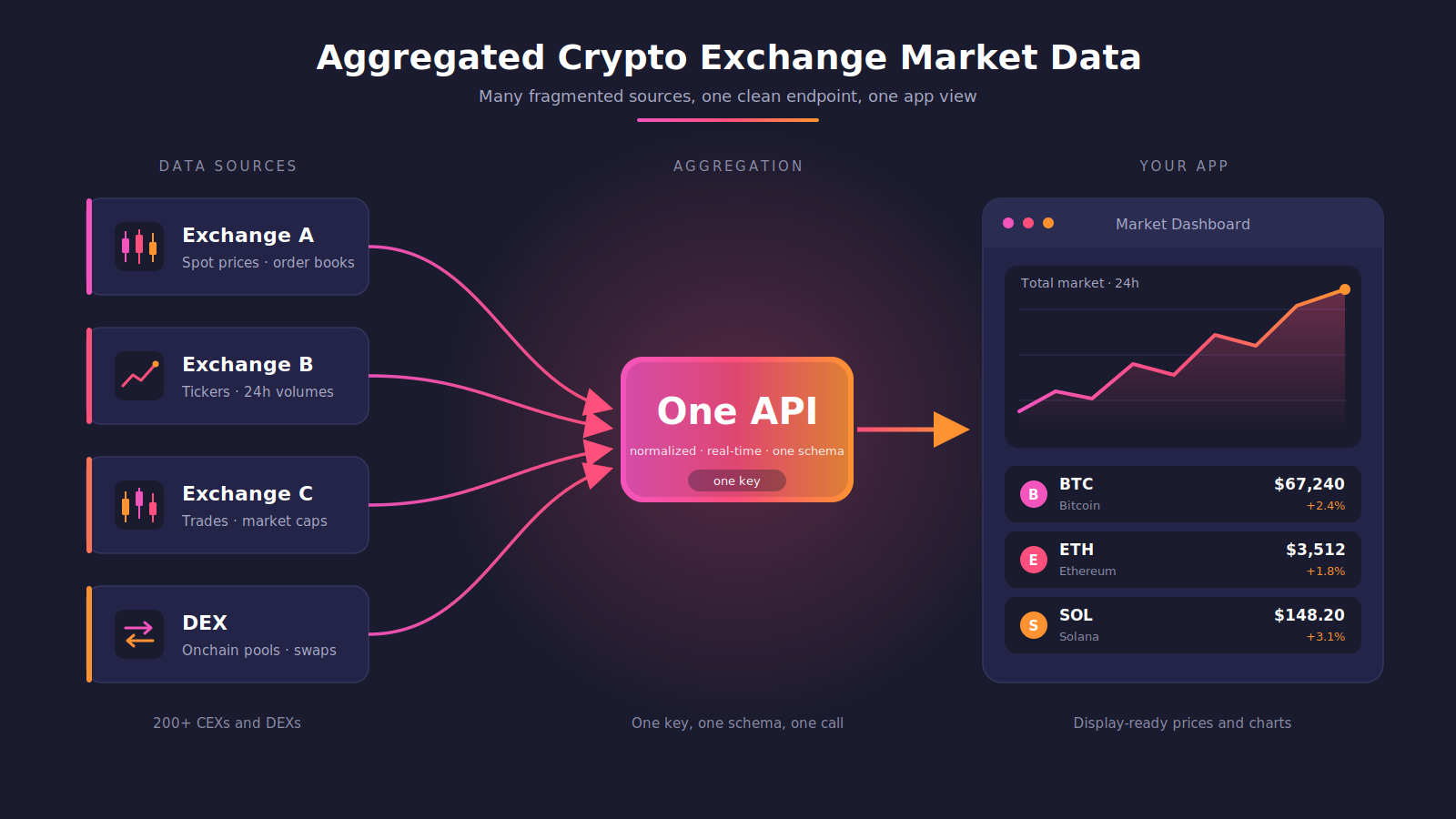
Start with what the word aggregated means here. A single exchange API returns data from one venue. A raw node or RPC endpoint returns unindexed blockchain data. An aggregated market data API does something different. It pulls prices and volumes from many exchanges. Then it returns them in one clean schema.
The messiness is real. Every exchange documents its own format. One venue returns candles one way. The next uses different field names and pagination. Prices for the same coin can even disagree across venues. An aggregator blends and normalizes all of it. You get one schema instead of ten integrations.
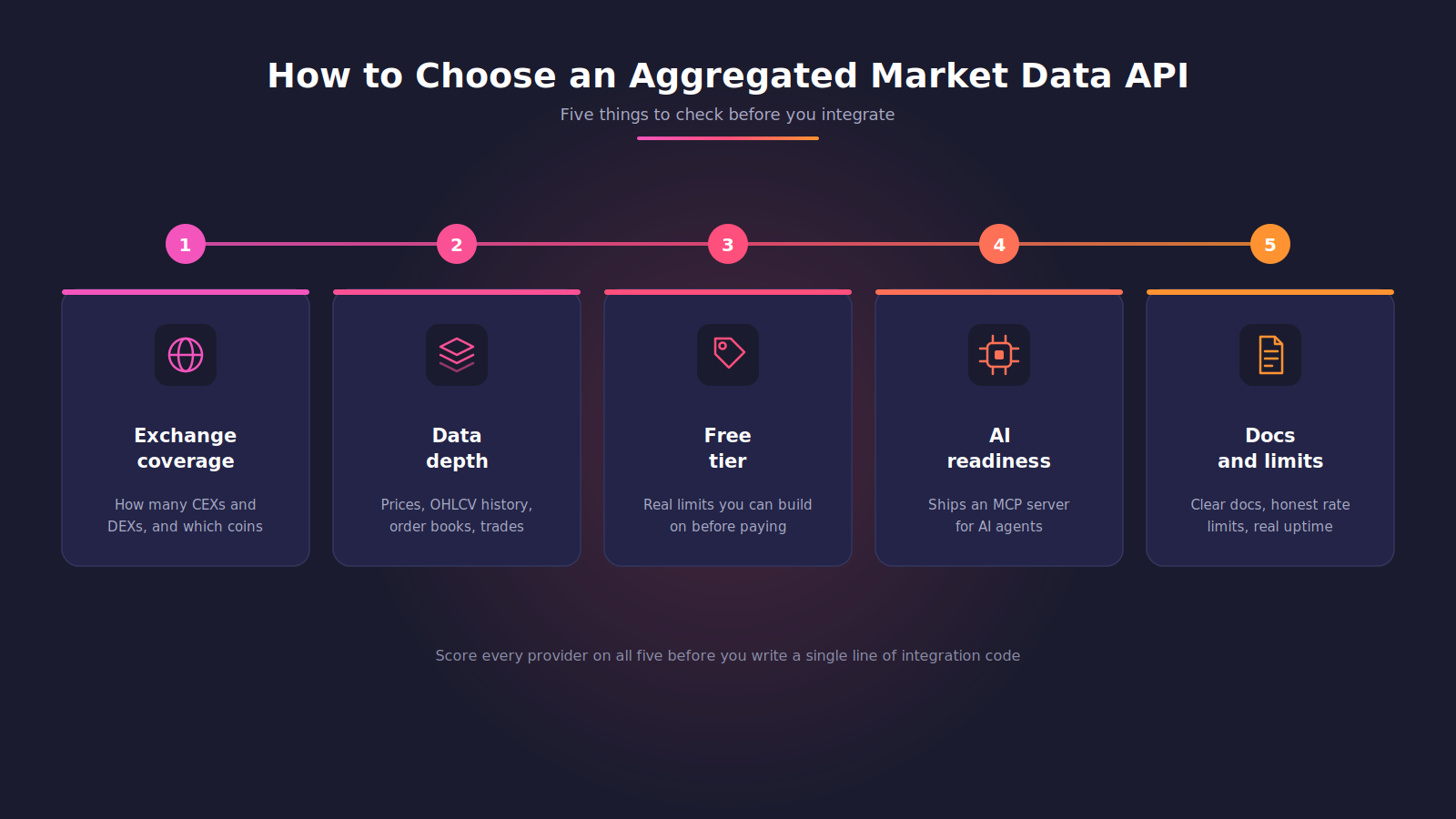
Judge each provider on five things:
- Exchange coverage. How many centralized and onchain venues, and which coins.
- Data depth. Prices, OHLCV history, order books, and trade data.
- Free tier. Real limits you can build on before paying.
- AI readiness. A first-party MCP server for agent workflows.
- Docs and limits. Clear docs, honest rate limits, and real uptime.
One note on MCP. By 2026 most serious providers ship an MCP server. So it is a baseline feature, not a differentiator. The real question is the data underneath the endpoint. For more, see our guide to crypto APIs for trading and AI agents.
Starting with no budget? Compare the free crypto market data APIs first.
The 5 best aggregated crypto exchange APIs at a glance
| Provider | Best for | Free tier | Entry price | AI (MCP) |
|---|---|---|---|---|
| CoinStats API | All-in-one market, wallet, DeFi data | 20,000 credits/mo | Credit-based, scales with use | Yes |
| Coinpaprika | Broad self-serve market data | 20,000 calls/mo | From $99/mo | Yes |
| Kaiko | Institutional benchmark data | No free tier | Not publicly listed | No |
| Twelve Data | Multi-asset data with a free tier | 800 requests/day | From $79/mo | Yes |
| Birdeye | Onchain and DEX market data | 30,000 CU/mo | Usage-based plans | Yes |
Pricing and limits verified September 2026. Check each provider’s site before you build.
CoinStats API

CoinStats API bundles market data, wallets, DeFi, portfolio, and token security into one schema. One key returns prices, balances, and positions across 200+ exchanges and 120+ chains. You skip stitching separate price, wallet, and DeFi providers together.
- Real-time prices, market caps, and volumes for 100,000+ coins.
- Wallet balances, transactions, and DeFi positions across 120+ chains.
- Historical charts and price history for market analysis.
- REST plus an MCP server for AI agent workflows.
What to verify: Credit costs rise when you query many chains at once.
One example. You pass a wallet address to CoinStats Crypto API. You get balances, DeFi positions, and live prices in one response. For a wider view, see our guide to the best crypto API.
Developers were stitching five services together to answer one question. Now one wallet address returns the whole picture. Prices, balances, DeFi, portfolio, and token security in a single call. The teams winning in 2026 ship fast on clean data. That is what we build for.
Coinpaprika
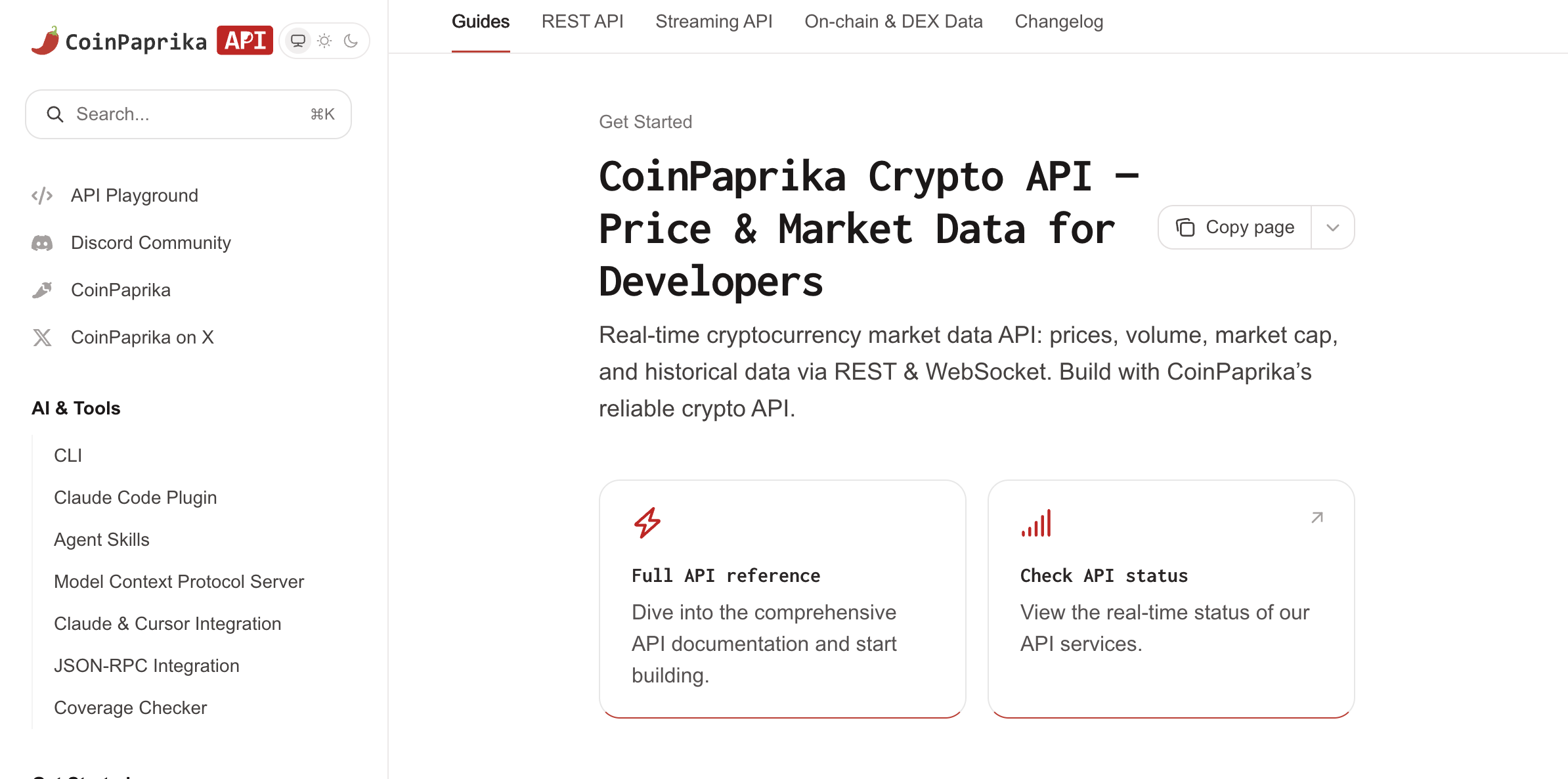
Coinpaprika aggregates market data across 370+ exchanges and thousands of coins. It returns prices, volumes, market caps, and OHLCV through one REST schema. An official MCP server and higher-tier streaming round out the stack.
- Prices, market caps, and volumes for thousands of coins.
- OHLCV candles and historical market data.
- Streaming API on the Enterprise tier.
- Official MCP server for AI clients.
What to verify: Free tier caps the number of tracked assets.
One call to the tickers endpoint returns prices and volumes for thousands of coins. You can filter by coin or by exchange. Historical endpoints return OHLCV for backtests. That covers most dashboard and research needs.
Kaiko

Kaiko serves institutional-grade market data across 100+ centralized and onchain venues. It focuses on benchmark reference prices, indices, and derivatives data. In 2026 Kaiko acquired Amberdata, widening its coverage further.
- Benchmark reference prices and regulated indices.
- Trade, order book, and derivatives data.
- Coverage across 100+ CEXs and DEXs.
- Built for compliance and reporting needs.
What to verify: Access is sales-gated, so expect a quote, not self-serve signup.
One feed gives you reference prices and derivatives together. Order book and trade data arrive standardized across venues. That matters for audits and index construction. Expect an onboarding call, not an instant key.
Twelve Data
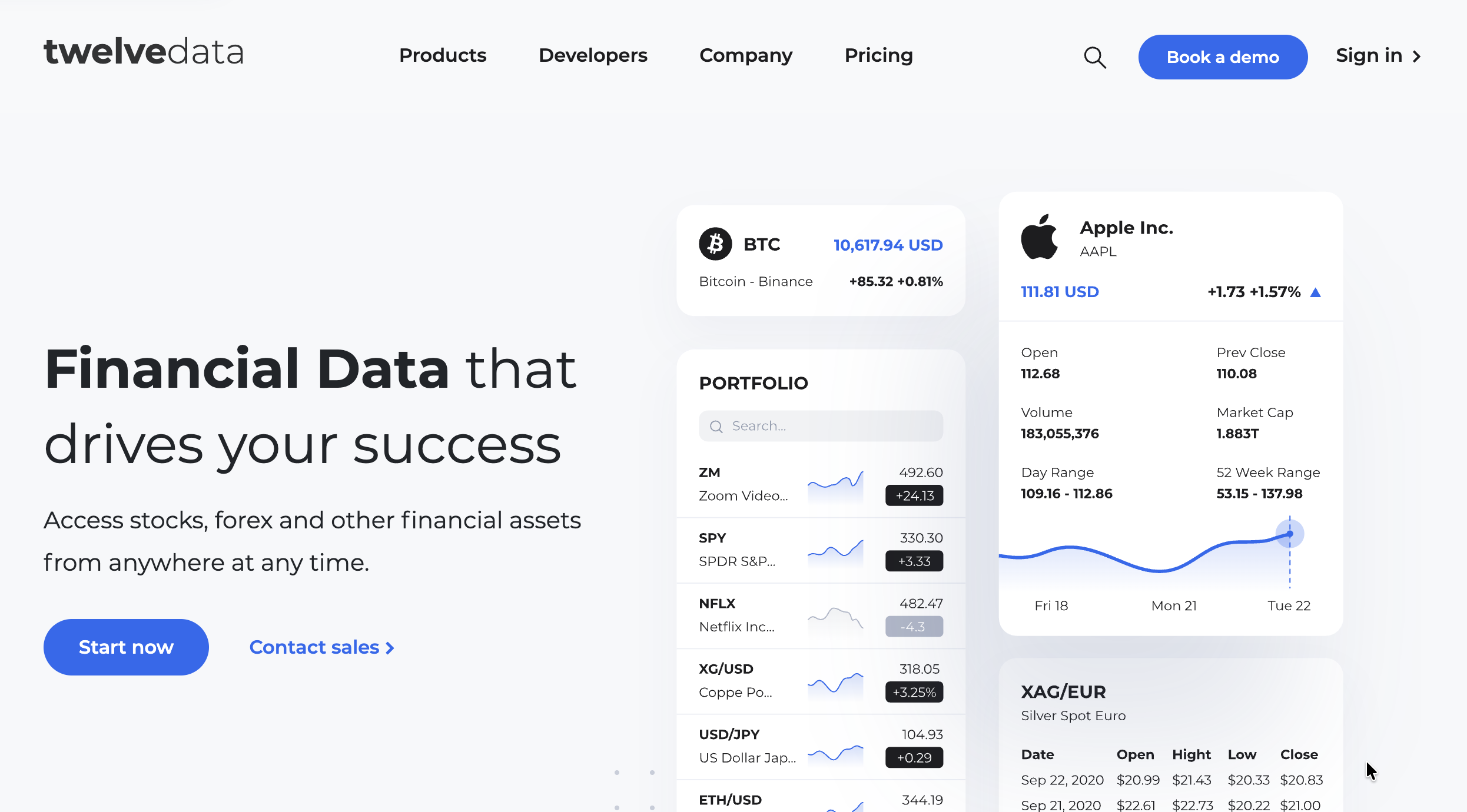
Twelve Data covers 180+ crypto exchanges alongside stocks and forex. It returns real-time prices, OHLCV, and 100+ technical indicators. A generous free tier and an official MCP server make it easy to test.
- Real-time prices across 180+ crypto exchanges.
- OHLCV history and technical indicators.
- WebSocket streaming on paid plans.
- Official MCP server for AI tools.
What to verify: No order book depth or crypto derivatives data.
One request returns a live quote plus the day OHLC. You can add indicators like RSI in the same call. Crypto, stocks, and forex share one schema. That helps when your app spans more than crypto.
Birdeye
Birdeye aggregates onchain and DEX market data across many chains. It returns real-time prices, OHLCV, and trade data for tokens. WebSocket streaming and an official MCP server support live apps.
- Real-time token prices from DEX pools.
- OHLCV candles and trade history.
- WebSocket streaming for live updates.
- Official MCP server for AI agents.
What to verify: DEX focus means lighter centralized exchange coverage.
One call returns a token price, liquidity, and recent trades. You get onchain data without running your own indexer. Pair and pool endpoints surface new DEX listings. That suits Solana and multichain DEX apps.
Crypto exchange API feature and pricing comparison
Here is how the five compare on the details that matter. Use it to shortlist before you test.
| Provider | Free tier | Entry price | Order book | OHLCV | Streaming | MCP |
|---|---|---|---|---|---|---|
| CoinStats API | 20,000 credits/mo | Credit-based | No | Yes | No | Yes |
| Coinpaprika | 20,000 calls/mo | $99/mo | No | Yes | Enterprise | Yes |
| Kaiko | None | Not listed | Yes | Yes | Yes | No |
| Twelve Data | 800 req/day | $79/mo | No | Yes | Paid | Yes |
| Birdeye | 30,000 CU/mo | Usage-based | No | Yes | Yes | Yes |
Order book means Level 2 depth. Streaming means WebSocket. Verified July 2026.
Top picks by category
Market, wallet, and DeFi data behind one key.
Pick this to cover most data needs at once.
Broad exchange and coin coverage with quick signup.
Pick this for fast, self-serve market data.
Benchmark reference prices and regulated indices.
Pick this when compliance and audits matter.
Crypto data alongside stocks and forex.
Pick this to prototype without early cost.
Live token prices and trades from DEX pools.
Pick this for onchain and DEX coverage.
Comparison by use case
Market data and wallet apps
Top pick: CoinStats API. It joins balances, prices, and DeFi in one call.
See our best crypto wallet APIs guide.
Price tickers and dashboards
Top pick: Coinpaprika. Broad coin coverage with streaming updates.
Alternatives: Twelve Data, CoinStats API.
Institutional benchmarks and indices
Top pick: Kaiko. Reference prices built for compliance.
Alternatives: CoinStats API for broad coverage.
Onchain and DEX analytics
Top pick: Birdeye. Live DEX pool prices and trades.
Alternatives: CoinStats API for CEX and DeFi.
Historical data and backtesting
Top pick: CoinStats API. Long price history through one schema.
Alternatives: Coinpaprika, Twelve Data.
AI agents and MCP workflows
Top pick: CoinStats API. One MCP server for market and wallet data.
Alternatives: Coinpaprika, Twelve Data, Birdeye.
How to choose your market data API
Start from your use case, not the homepage logo. A portfolio tracker needs different data than a trading dashboard. Write down the exact fields your app renders. Then test against that list.
Test the free tier first. Send real requests for the coins and exchanges you care about. Check coverage, latency, and rate limits under load. Read the actual response body, not the marketing copy. The shape of the data tells you more than any feature list.
Then weigh cost against usage. Credit-based and per-request models scale differently. A cheap tier can get expensive at production volume. Estimate your monthly calls before you commit. You can test all five, including CoinStats API, on a free tier.
Community and further reading
Representative of recurring threads on choosing a crypto market data API. Swap in a real screenshot before publish.
Frequently asked questions about crypto market data APIs
What is a crypto market data API?
What is an aggregated crypto exchange API?
What is the best crypto market data API?
What is the difference between a market data API and a trading API?
How do I get real-time crypto prices from an API?
Can I get OHLCV and historical data from a market data API?
Do these APIs cover DEXs as well as centralized exchanges?
Which crypto data API works with AI agents and MCP?
Is there a free crypto market data API?
How many requests do free crypto data APIs allow?
Why do some providers hide their pricing?
What is the best crypto API for developers?
What is the best crypto API for portfolio and wallet data?
How do I choose a crypto market data API?
Tigran is the Head of Digital Marketing at CoinStats, working across crypto and consumer apps. His writing covers first-hand crypto experience and marketing case studies from that work. He has taken the stage at industry-leading conferences like MAU Vegas, Business of Apps Berlin, and App Promotion Summit London.
More from Tigran on the CoinStats blog · LinkedIn · X