7 Best Crypto APIs for Trading & AI Agents in 2026 (Free + Paid)

Written by Tigran Mkrtchyan · Reviewed and fact-checked by Narek Gevorgyan · Published July 22, 2026 · Last updated September 3, 2026 · Pricing and limits verified September 2026
- What makes a good crypto API
- The 7 best crypto APIs at a glance
- CoinStats API
- Birdeye
- CoinDesk Data
- The Graph Token API
- Chainbase
- GoldRush
- Nansen
- Top picks by category
- Comparison by use case
- What you can build
- Latency, history, and streaming
- How to choose your crypto API
- Further reading
- Frequently asked questions
A few weeks ago I tried to build a tiny crypto agent for fun. The goal was simple. Ask it a question in plain English. Let it answer with live market data.
Wiring it to an AI client took one evening. The model was happy to reason about trades. Then it went quiet. It had no prices and no balances to read.
That was the real lesson. Spinning up an agent is the easy part now. Feeding it clean crypto data is where the work hides. A bot is only as smart as its feed.
So I stopped guessing and did the homework. I tested every crypto API I could sign up for. I checked coverage, pricing, and AI-agent support. This guide is what I found.
Here are my seven crypto API picks for 2026. They cover both jobs: trading data and AI agents. Full disclosure: I work at CoinStats. So CoinStats API is first, and I will explain why.
We make CoinStats API, so yes, we are biased. We know it. So this guide sticks to plain facts: endpoints, coverage, and public pricing. The verdict is yours.
- CoinStats API bundles market, wallet, DeFi, portfolio, and token security.
- Trading bots need clean prices, order books, and derivatives feeds.
- AI agents need an MCP server, not just a REST endpoint.
- Most serious providers now ship an official MCP server.
- Free tiers let you test coverage before you pay.
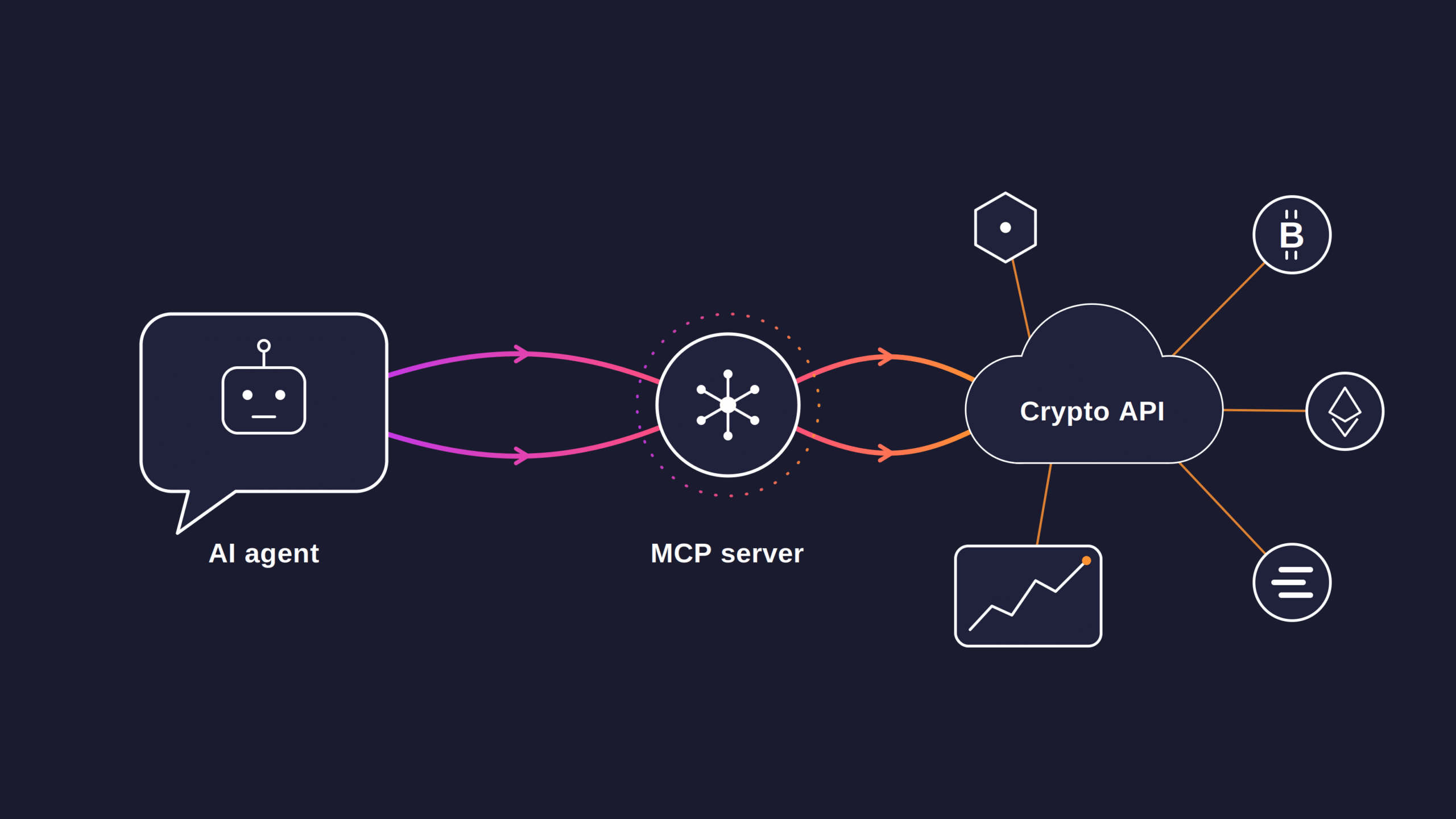
How an AI agent reads crypto market data through an MCP server.
What makes a good crypto API
Start with one split. Some APIs give you raw blockchain access through RPC nodes. Others give you clean, indexed data you can read right away.
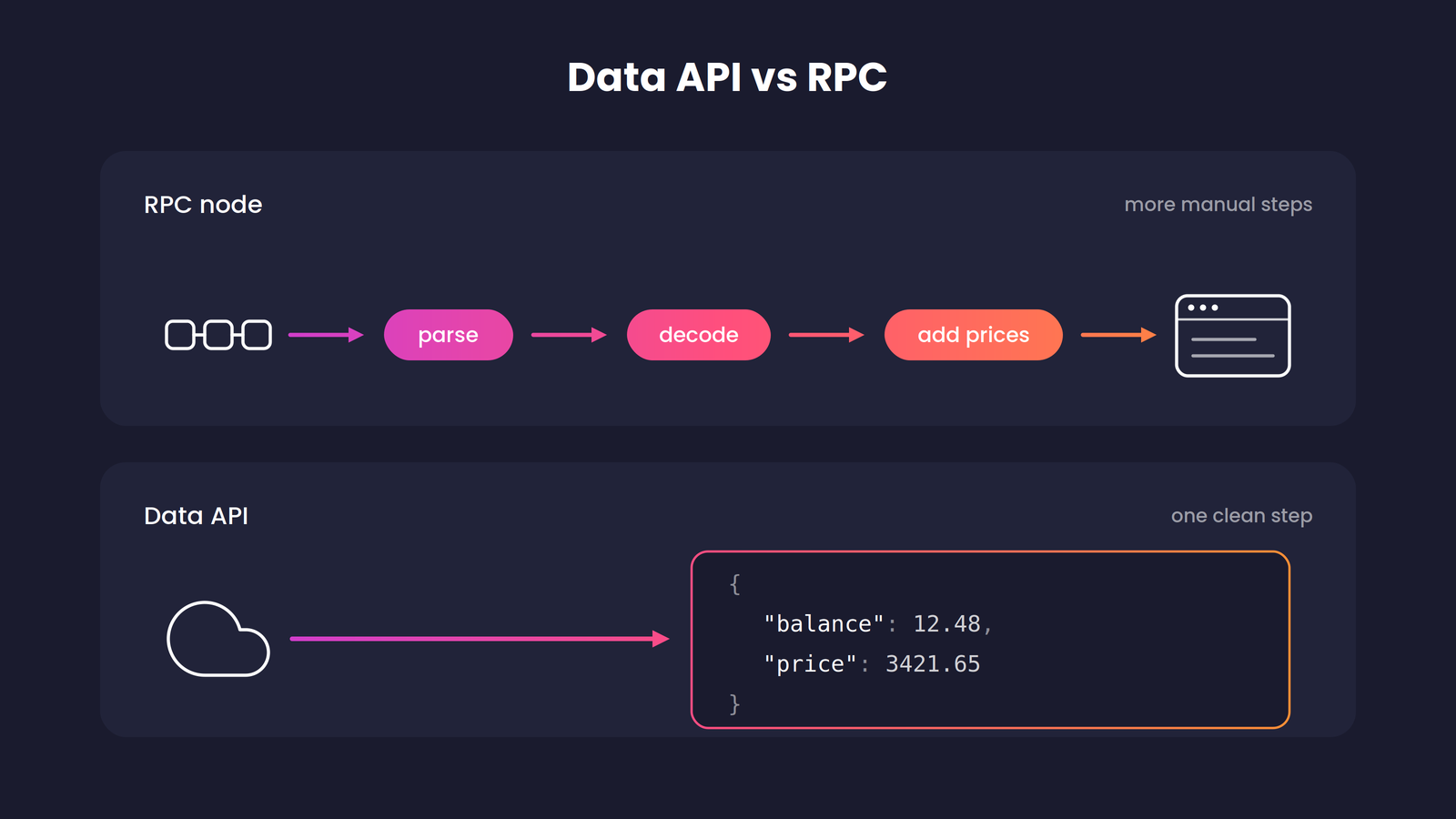
A data API returns clean JSON. An RPC node leaves you to parse it.
Trading bots and AI agents almost always want the second kind. They need prices, balances, and positions in a usable shape. New to wallet data? Start with our guide on what a crypto wallet API is. For background, see our primer on how a blockchain API works.
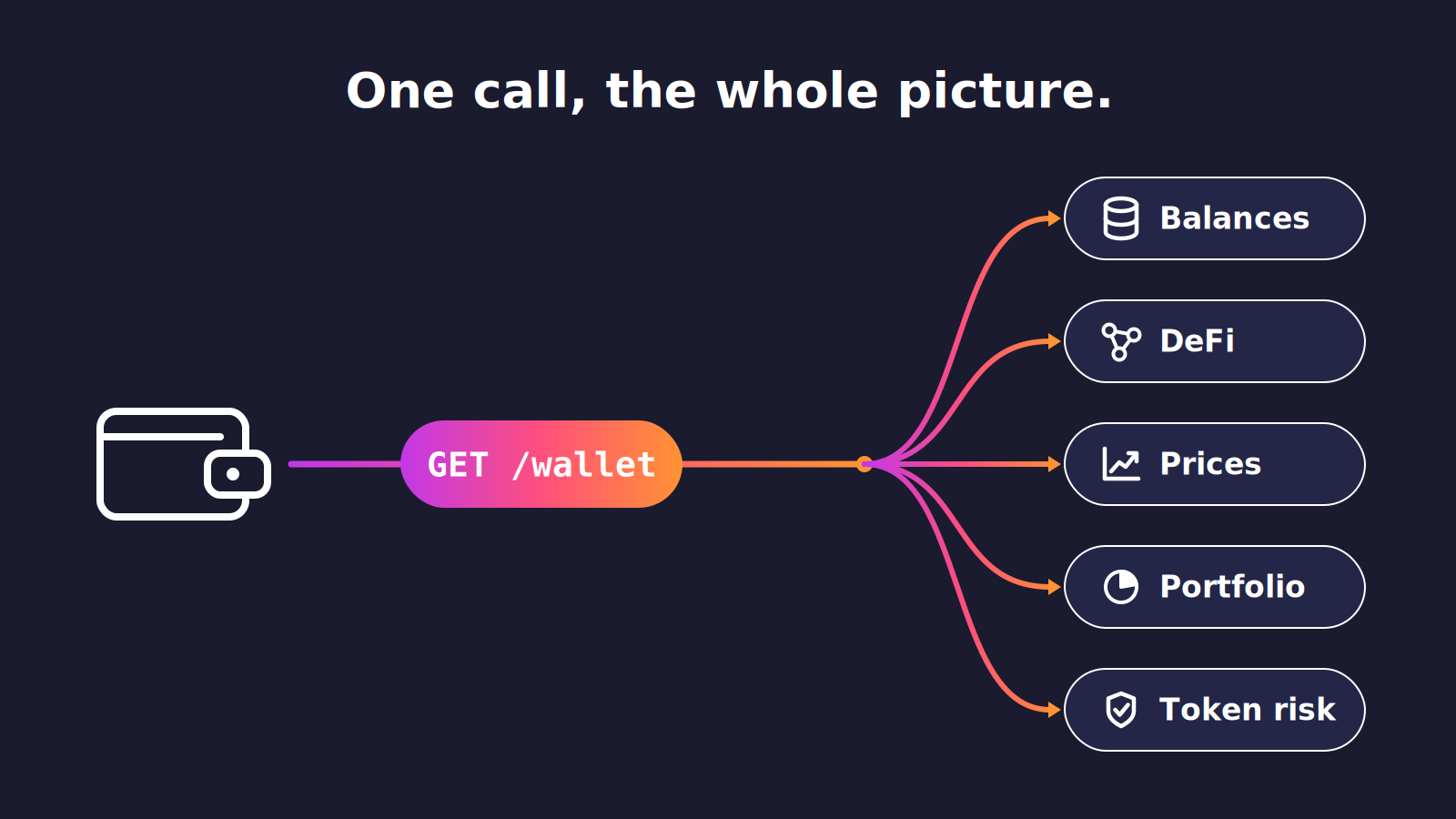
One wallet call returns balances, DeFi, prices, and token risk.
Then five things separate a good API from a weak one:
The chains, exchanges, and assets your users actually hold.
Prices, order books, DeFi, and derivatives, not just tickers.
Enough room to test coverage before a card.
An official MCP server your agents can call.
Clear rate limits and a schema that stays stable.
One note on MCP. Most serious providers here ship an official server now. So MCP is table stakes, not a tiebreaker. The real difference is the data underneath.
The 7 best crypto APIs at a glance
| Provider | Best for | Free tier | Entry price | AI (MCP) |
|---|---|---|---|---|
| CoinStats API | Market, wallet, DeFi, portfolio, token security | 20,000 credits/mo | Credit-based | MCP Server |
| Birdeye | Real-time DEX trading data | 30,000 CU/mo | From $39/mo | MCP |
| CoinDesk Data | Institutional benchmarks | None (retired 2026) | Sales-quoted | MCP |
| The Graph Token API | Onchain, DEX, perps | Free to start | Usage-based | MCP |
| Chainbase | AI-ready multichain data | 200K credits/mo | From $99/mo | MCP |
| GoldRush | Multichain wallet, price | 14-day trial | From $10/mo | MCP |
| Nansen | Smart money signals | Trial credits | From $49/mo | MCP |
Pricing and limits verified July 2026.
Coverage tells you which provider fits which job. This matrix maps each API to five common data needs.
| Provider | Market prices | Wallet + portfolio | Onchain / DEX | Derivatives | Streaming |
|---|---|---|---|---|---|
| CoinStats API | Yes | Yes | Yes | Limited | REST |
| Birdeye | Yes | Wallet only | Yes | No | REST + WebSocket |
| CoinDesk Data | Yes | No | Yes | Yes | REST + WebSocket |
| The Graph Token API | Yes | Wallet only | Yes | Perps | REST |
| Chainbase | Yes | Wallet only | Yes | No | REST |
| GoldRush | Yes | Yes | Yes | No | REST |
| Nansen | Limited | Wallet PnL | Yes | No | REST |
Capability summary based on public docs, July 2026.
CoinStats API
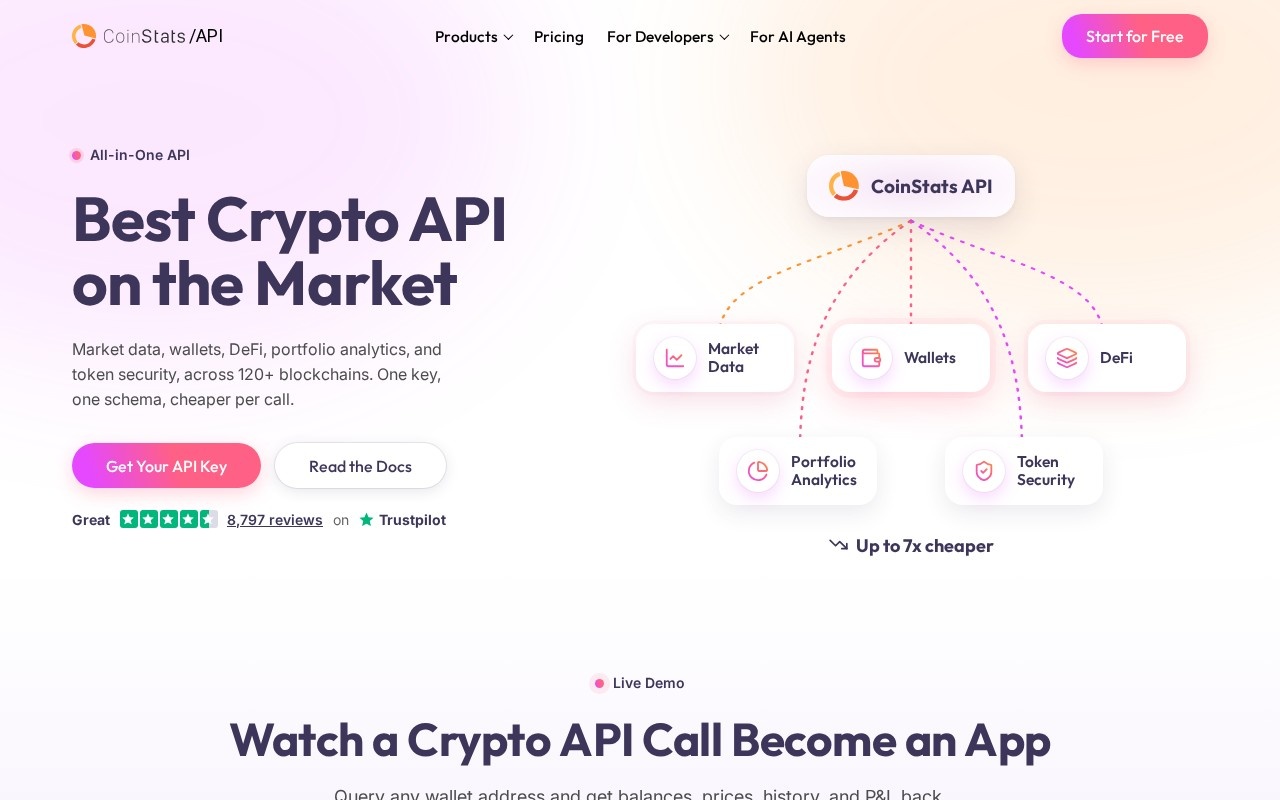
CoinStats API returns market, wallet, DeFi, portfolio, and token security data together. One wallet address gives you the whole picture. It powers a portfolio app with 1M+ monthly users.
- Market data for 100,000+ coins across 200+ exchanges.
- Wallet balances and history across 120+ blockchains.
- DeFi positions across 10,000+ protocols, auto-detected.
- Portfolio analytics with profit and loss.
- Token security scoring on every token.
- MCP Server for Claude, Cursor, and agents.
What to verify: read-only data layer, not a trade-execution or RPC endpoint.
Here is one practical example. Say an agent needs a wallet’s full state. With CoinStats Crypto API, one call returns balances, DeFi, and prices. You skip the separate price feed and token registry. For a wider view, read our best crypto API guide.
Here is that one call in practice:
# One wallet call, prices already attached
const res = await fetch(
  "https://openapi.coinstats.app/wallet/balance?address=0xd8dA...6045&connectionId=ethereum",
  { headers: { "X-API-KEY": "YOUR_API_KEY" } }
);
const tokens = await res.json();

# Response (trimmed)
[
  {
    "coinId": "ethereum",
    "symbol": "ETH",
    "amount": 4.208,
    "price": 3125.44
  }
]
One request returns the balance with its live price attached.
Every request carries an X-API-KEY header. One balance call costs 40 credits on the free tier.
“We built CoinStats API for one reason. Developers were stitching five services together to answer one question. Now they pass a wallet address and get the whole picture. Balances, DeFi, prices, and token risk. The teams winning today ship fast on clean data.”
Narek Gevorgyan, founder and CEO, CoinStats
Birdeye
Birdeye serves real-time onchain and DEX data across 14+ chains. Solana is its flagship. One call returns prices, trades, and token safety signals.
New token and pair discovery suits fast trading bots. WebSocket streams push live updates. It is read-only onchain data, not a centralized exchange feed.
- Real-time prices, OHLCV, and DEX trades.
- New token and new pair discovery.
- Token security and safety signals.
- Wallet data and WebSocket streaming.
- Official MCP server for Claude, Cursor, and VS Code.
What to verify: onchain and DEX data, not centralized exchange order books.
CoinDesk Data
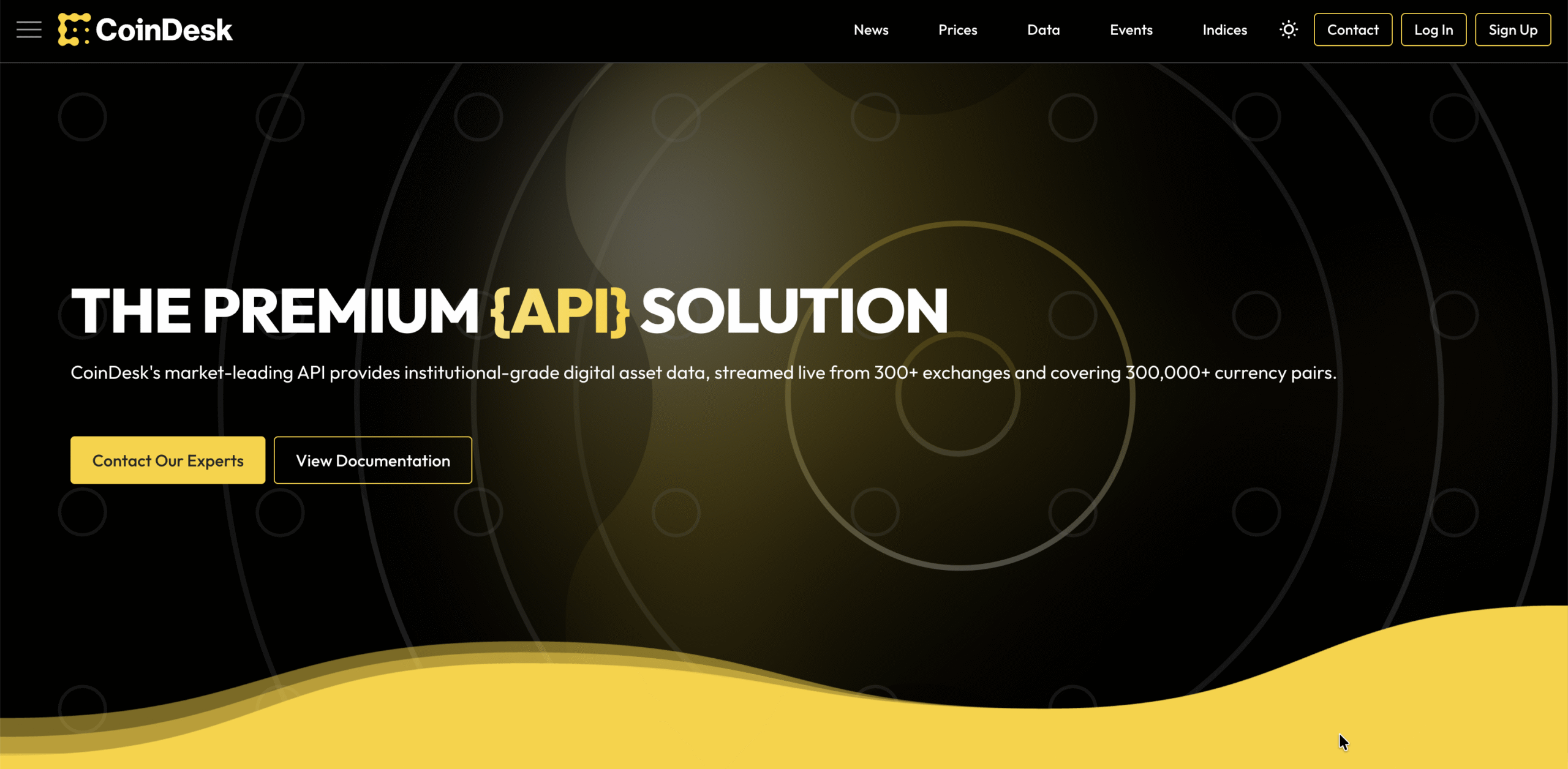
CoinDesk Data serves regulated indices, benchmark pricing, and derivatives feeds. It suits compliance-heavy trading desks. It now ships an MCP server for AI clients.
Its benchmark methodology is regulated and audited. That matters for funds and compliance teams. The tradeoff is sales-quoted pricing and no free tier.
- Benchmark and reference pricing for indices.
- Spot, derivatives, and order book data.
- Onchain and exchange flow metrics.
- MCP server through a Claude connector.
What to verify: free API tier ended in May 2026. Pricing is quote based.
The Graph Token API
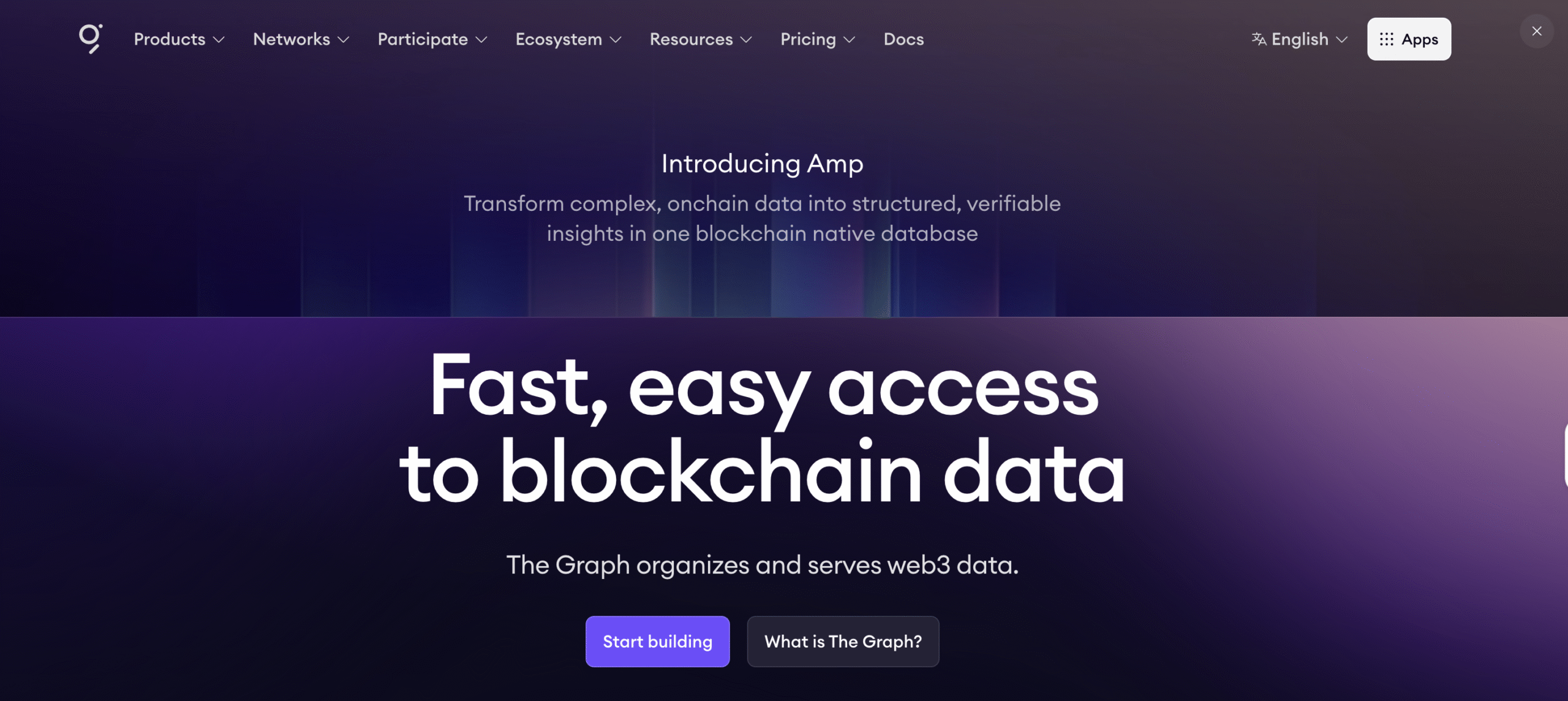
Token API from The Graph serves AI-ready token and market data. It covers DEX swaps, pools, and Hyperliquid perpetual markets. Two official MCP servers plug into agents.
It reads onchain data with low latency. Pricing is usage-based, so light apps stay cheap. It does not cover centralized exchange order books.
- OHLC price history and token metadata.
- DEX swaps, pools, and wallet balances.
- Hyperliquid perps and Polymarket markets.
- Subgraph MCP and Token API MCP servers.
What to verify: onchain and DEX focus. No centralized exchange order books.
Chainbase
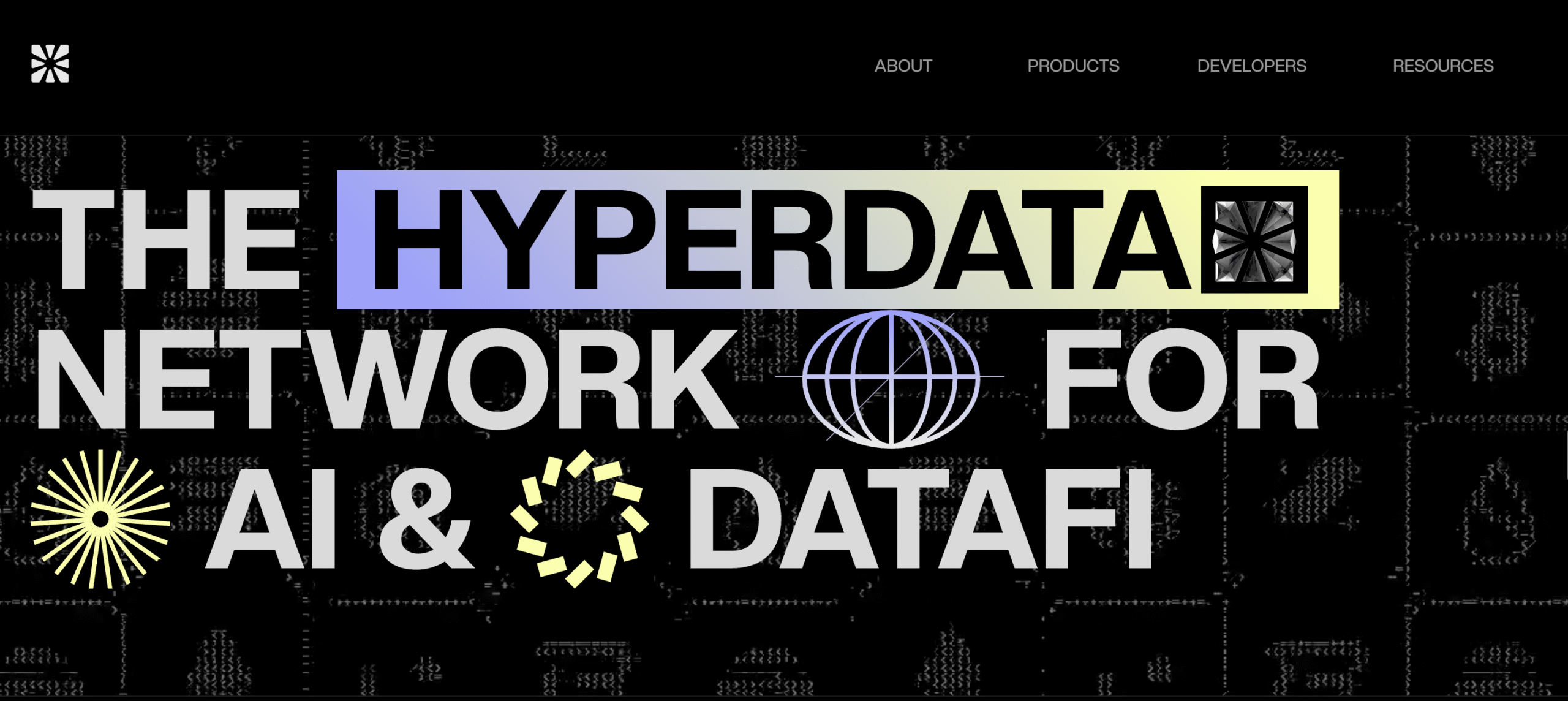
Chainbase indexes onchain data across 90+ chains. You query it with REST or SQL. It positions itself as a data network for AI agents.
SQL queries suit custom analytics and backfills. The free tier is generous for testing. Streaming stays REST-based, without a live WebSocket feed.
- Token prices, balances, and transfers.
- Onchain activity, holders, and NFT data.
- REST endpoints plus SQL queries.
- First-party MCP server and agent tooling.
What to verify: onchain and DEX data. No centralized exchange feeds.
GoldRush
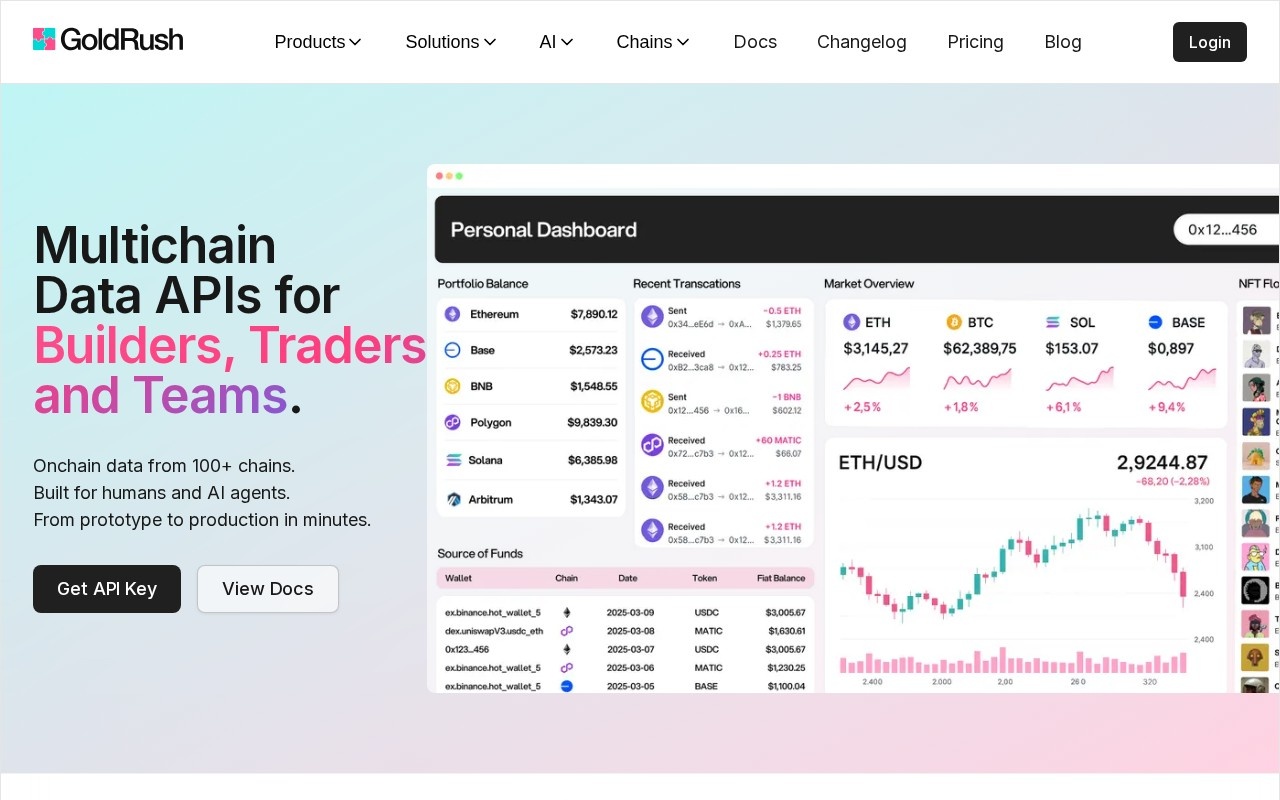
GoldRush is the data API from Covalent. It covers wallet balances, activity, and pricing across 100+ chains. Its MCP server exposes many tools to agents.
Entry pricing starts near ten dollars per month. Coverage spans wallet history and pricing across chains. It focuses on onchain data, not exchange feeds.
- Wallet balances and full activity history.
- OHLCV pricing and new DEX pairs.
- Token metadata and wallet transfers.
- MCP-native access for coding agents.
What to verify: Covalent rebranded to GoldRush. Check the current docs.
Nansen
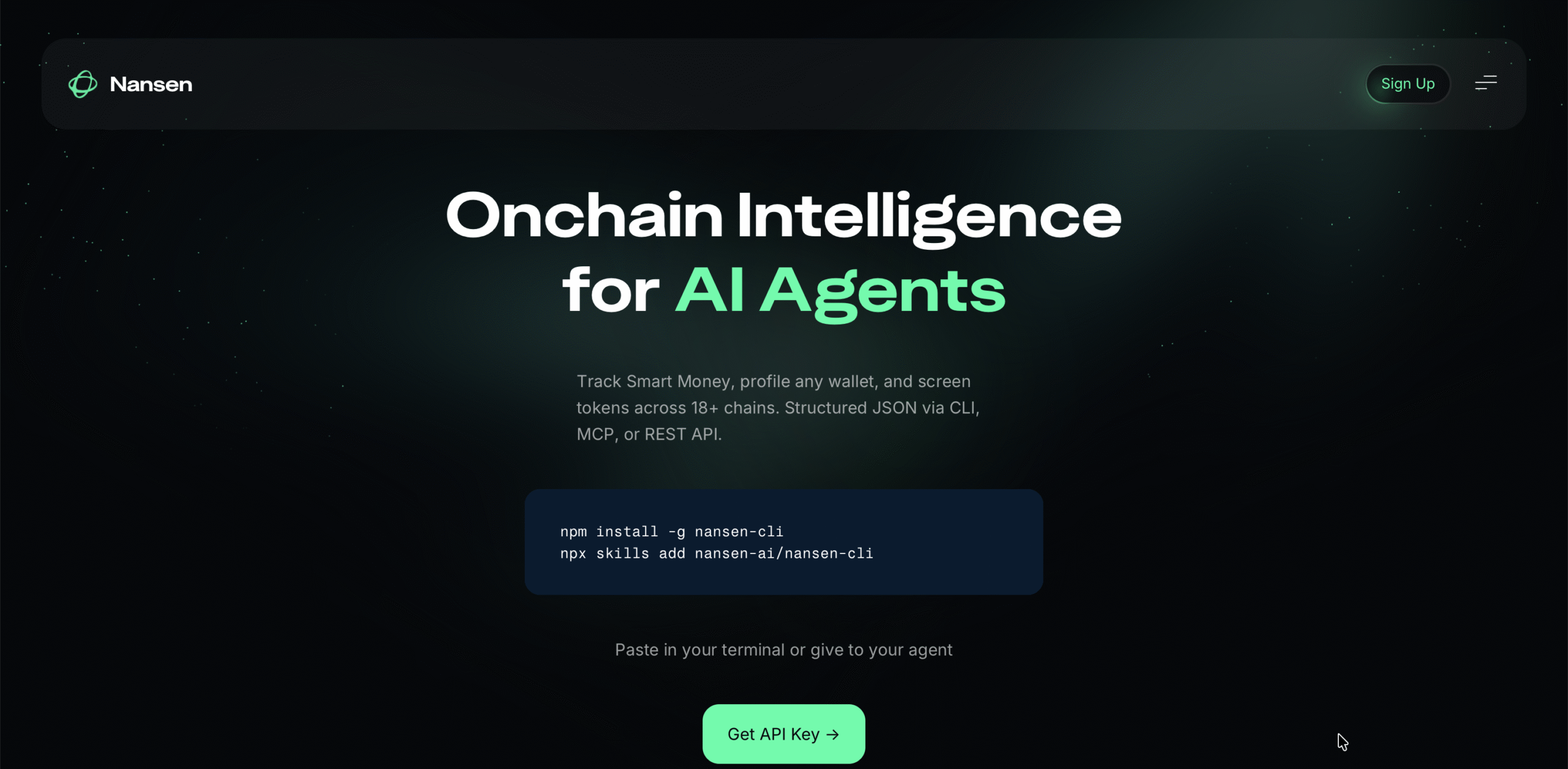
Nansen labels wallets and tracks smart money onchain. It covers DEX trades, wallet PnL, and token screening. Its MCP server feeds signals to AI agents.
Its edge is wallet labels, not raw price feeds. Signals suit alpha and research agents. Pair it with a market data API for full coverage.
- Smart money wallet labels and flows.
- DEX trades and token screening.
- Wallet profit and loss data.
- MCP server with one-click Claude setup.
What to verify: onchain intelligence, not a price or order book feed.
Top picks by category
Market, wallet, DeFi, portfolio, and token security in one call.
Pick this for the whole picture in one call.
Live DEX prices, trades, and token safety signals.
Pick this for onchain trading bots.
Regulated indices and derivatives feeds.
Pick this for compliance-grade pricing.
DEX trades, perps, and token data.
Pick this for onchain-native agents.
Smart money labels and wallet intelligence.
Pick this for alpha and signal agents.
Multichain wallet and price data from ten dollars.
Pick this for a low-cost start.
Comparison by use case
Trading bots and quant research
Top pick: Birdeye, for live onchain trading data.
Alternatives: CoinStats API, CoinDesk Data.
AI agents and MCP workflows
Top pick: CoinStats API, for one schema across data types.
Alternatives: Chainbase, GoldRush.
Derivatives and futures data
Top pick: CoinDesk Data, for funding and open interest.
Alternatives: The Graph Token API.
Onchain and DEX analytics
Top pick: The Graph Token API, for swaps and pools.
Alternatives: GoldRush, Chainbase.
Portfolio trackers and wallet apps
Top pick: CoinStats API. See our best crypto wallet APIs guide.
Alternatives: GoldRush.
Smart money and signal agents
Top pick: Nansen, for wallet labels and flows.
Alternatives: CoinStats API, Chainbase.
What you can build with these APIs
The right stack depends on what you ship. Here are four common builds and the data each one needs.
A trading bot
A bot needs fast prices and a clear read on liquidity. Birdeye streams real-time DEX prices and new pairs. CoinStats API adds market data and token risk across chains. The bot reads the feed, then sends orders through a separate exchange API. Keep the data layer and the execution layer apart. A read-only feed also keeps your keys safer.
A portfolio tracker
A tracker turns a wallet address into a clean dashboard. CoinStats API returns balances, DeFi positions, and prices in one call. You get profit and loss without a second service. For a deeper build, see our crypto wallet API guide.
An AI research agent
An agent answers questions in plain English. It calls an MCP server to read live data. CoinStats API and Nansen both expose MCP tools. The agent pulls balances, prices, and smart money signals, then reasons over them. No custom fetch logic required. Add token risk checks before it acts on a trade.
A tax or accounting tool
Tax tools need full transaction history across chains. CoinStats API returns parsed history for each wallet. GoldRush covers wallet activity on 100+ chains. You export clean records instead of raw logs.
Most real apps mix two or three of these. A tracker that adds trade signals, or an agent that also files taxes. One data layer keeps the schema consistent across all of them. That is where an all-in-one API earns its place.
Latency, history, and streaming
Coverage gets you started. Three deeper checks decide production fit.
First, latency and uptime. A trading bot feels every extra millisecond. Read each provider status page and test response times on your own chains.
Second, historical data. Backtests need years of clean prices. CoinDesk Data goes deep here. CoinStats API returns long price history through one crypto price API call.
Third, streaming. REST is fine for most agents. High-frequency bots often want WebSocket push instead of polling. Confirm the transport before you build.
Rate limits sit under all three. Free tiers cap requests per minute. Map your peak load against those limits early.
How to choose your crypto API
Start from the job, not the logo. A trading bot and a research agent need different feeds. Write down the exact data your app must return.
Then test the free tier. Send real requests for your users’ chains and assets. Read the actual response, not the homepage promise.
Check three things next: coverage, latency, and rate limits. Coverage means your users’ wallets and venues. Latency and limits decide if the API holds up in production.
Last, check AI readiness. If you build agents, confirm the MCP server works with your client. Most providers here ship one, so judge the data behind it.
Further reading
Representative of recurring r/AI_Agents threads on choosing a crypto data API.
Frequently asked questions about crypto APIs
What is a crypto API?
Is there a free crypto API?
What is the best crypto API for developers?
Do I need an API key to use a crypto API?
What is the best crypto API for trading?
What is the difference between a market data API and an exchange trading API?
Which crypto APIs support derivatives data?
How do trading bots get price data from an API?
What is the difference between REST and WebSocket for crypto prices?
What is the best crypto API for AI agents?
What is an MCP server for crypto data?
Can AI agents trade crypto through an API?
Do crypto data APIs work with Claude, Cursor, and other MCP clients?
Which MCP clients work with crypto data servers?
How much do crypto trading APIs cost?
How do I choose a crypto API for trading or AI agents?
Which crypto API has the best free tier for testing?
Tigran is the Head of Digital Marketing at CoinStats, working across crypto and consumer apps. His writing covers first-hand crypto experience and marketing case studies from that work. He has taken the stage at industry-leading conferences like MAU Vegas, Business of Apps Berlin, and App Promotion Summit London.
More from Tigran on the CoinStats blog · LinkedIn · X