
BeInCrypto 100 Institutional Awards Nomination: Moody’s Ratings for Best Digital Asset Ratings & Analytics Provider

0
0
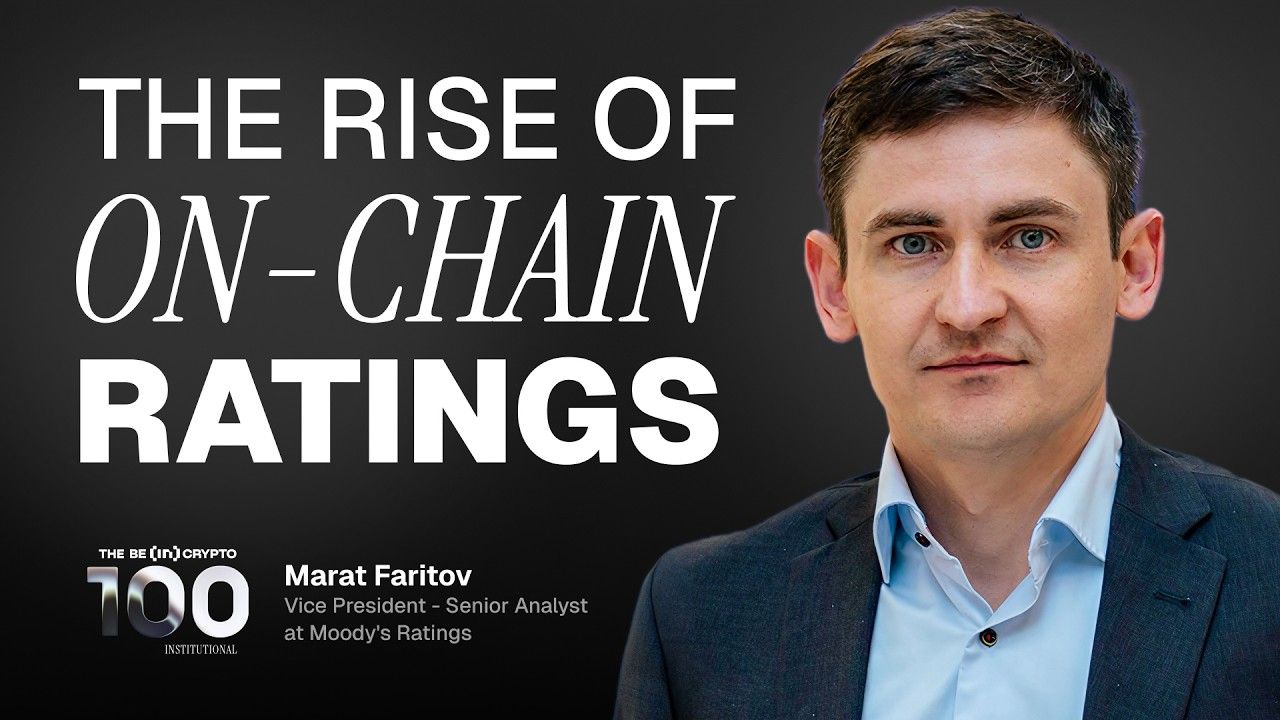
Tokenized real-world assets have crossed $16 billion in 2026. Tokenized US Treasuries alone account for roughly $9 billion. Major players like DTCC, JPMorgan, and BlackRock are actively building on these rails.
Yet behind the issuance and settlement layers sits a quieter system. Institutional capital still depends on independent credit analysis. That is where Moody’s Ratings operates.
On March 17, 2026, Moody’s Ratings became the first credit rating agency to publish its credit ratings directly on-chain.
The firm is now nominated for Best Digital Asset Ratings & Analytics Provider at the BeInCrypto Institutional 100 Awards 2026.
Credit Ratings Move On-Chain for the First Time
The nomination centers on the launch of the Token Integration Engine (TIE) on the Canton Network. The system allows Moody’s credit ratings to be distributed directly into blockchain-based financial workflows.
For the first time, a credit rating becomes machine-readable on-chain. Smart contracts and financial applications can query it in real time. This removes reliance on static reports or proprietary terminals.
Moody’s operates its own node on Canton. Participation is issuer-led, with ratings published under the same governance standards used off-chain. Access remains permissioned for institutional participants.
The network itself includes institutions such as Goldman Sachs, HSBC, BNP Paribas, and Franklin Templeton. It is used for tokenized assets, collateral management, and settlement.
| Founded | Employees | Revenue (FY25) | Ticker | NRSRO | Canton Network |
| 1909 | 16,000 | $7.72B | NYSE: MCO | Yes (SEC) | First CRA Node |
Data reflects Moody’s FY2025 filings and March 2026 disclosures.
Extending Credit Discipline to Stablecoins
Alongside TIE, Moody’s Ratings introduced a formal Stablecoin Rating Methodology. This is the first framework of its kind from a major credit rating agency.
The methodology evaluates reserve quality, market risk, operational design, and structural features. Stablecoins with similar structures can receive different ratings based on asset quality and risk exposure.
This extends traditional credit analysis into a new asset class. It mirrors the rigor applied to banks and money market funds.
The work builds on earlier experiments. In June 2025, Moody’s embedded a credit rating into a tokenized municipal bond on the Solana through a pilot with Alphaledger. That project showed ratings could be attached directly to tokenized securities.
Moody’s has also expanded its analytics layer. Its Digital Asset Monitor tracks risk across more than 25 stablecoins using AI-driven models. It assesses issuer risk, liquidity, and reserve transparency.
In parallel, a strategic alliance with Elliptic combines on-chain intelligence with Moody’s off-chain counterparty data. This creates a more integrated risk view across digital assets.
Together, these systems form a full stack. Credit ratings, risk analytics, and data distribution now operate across both traditional and blockchain environments.
The significance is structural. Credit ratings are no longer separate from financial infrastructure. They can now be embedded directly into how assets move and settle on-chain.
The BeInCrypto Institutional 100 Awards focus on firms building core infrastructure for digital finance. Moody’s nomination reflects its role in bringing institutional-grade credit analysis into blockchain-based markets.
0
0


 Manage all your crypto, NFT and DeFi from one place
Securely connect the portfolio you’re using to start.

0
0

0
0

0
0

0
0