
This New Proposal Has Traders Paying Attention — SOL Burn Rate Explosion?
0
0

A single governance signal from Solana co-founder Anatoly Yakovenko is quietly reshaping how serious analysts are thinking about SOL’s supply dynamics — at a moment when the price desperately needs a fundamental catalyst.
SolanaFloor reported that Toly has signalled support for SIMD-547, a tokenomics improvement proposal that would introduce a resource-based fee burn on higher-cost transactions.
The headline number is striking: estimated daily SOL burn would increase from 648 SOL per day to between 10,800 and 64,800 SOL.
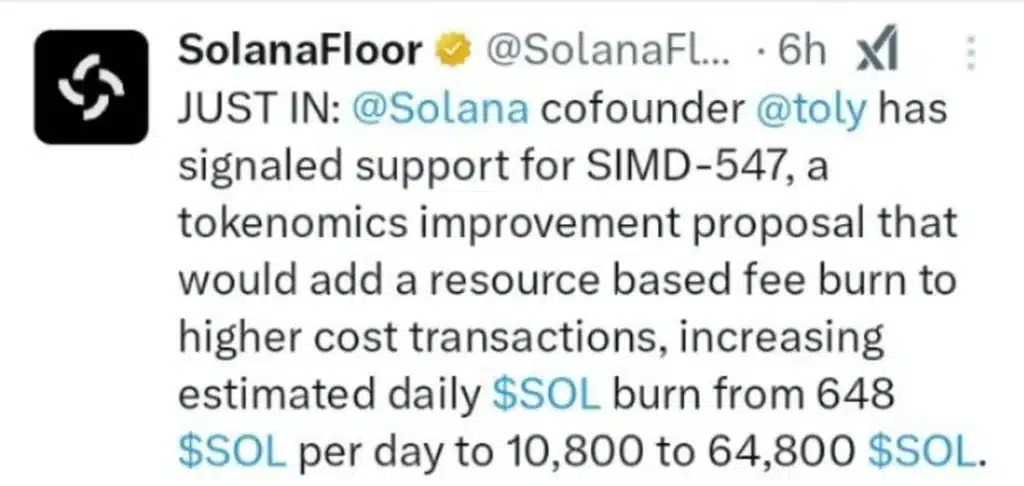
That is not an incremental adjustment — it is a structural transformation of Solana’s supply equation, and the market has not yet fully priced what that means.
What SIMD-547 Actually Does
Solana’s current fee structure burns a portion of base fees but leaves the majority of transaction revenue flowing to validators.
SIMD-547 proposes adding a resource-based burn component specifically targeting computationally expensive transactions — the kind generated by high-frequency DeFi activity, NFT minting bursts, and complex program interactions.
The mechanism is elegant in its logic: the more demand places stress on network resources, the more SOL gets permanently removed from circulation.
At the upper estimate of 64,800 SOL burned daily, that represents over 23 million SOL annually — a deflationary pressure that would meaningfully offset validator issuance and reshape SOL’s net supply trajectory.
Toly’s endorsement is not binding, but co-founder signal on a governance proposal of this magnitude carries significant weight in Solana’s validator community.
Ethereum’s fee burn narrative via EIP-1559 was one of the most durable price catalysts in crypto history. SIMD-547 is Solana asking whether the same story can run twice.
What the Chart Shows at This Moment
The TradingView SOL/USD weekly chart captured at 08:57 UTC on May 31, 2026 on Coinbase shows a protocol whose price has not yet caught up with its governance ambitions.
SOL closed the week at $82.72, down 2.88%, and is currently pinned inside the lower half of the Keltner Channel — between the lower band at $70.68 and the mid-line at $96.41, with the upper band at $122.15 representing the first meaningful recovery target.
The weekly RSI at 34.62 with the signal line at 37.28 is pressing toward oversold territory that has historically marked Solana’s most asymmetric entry points.
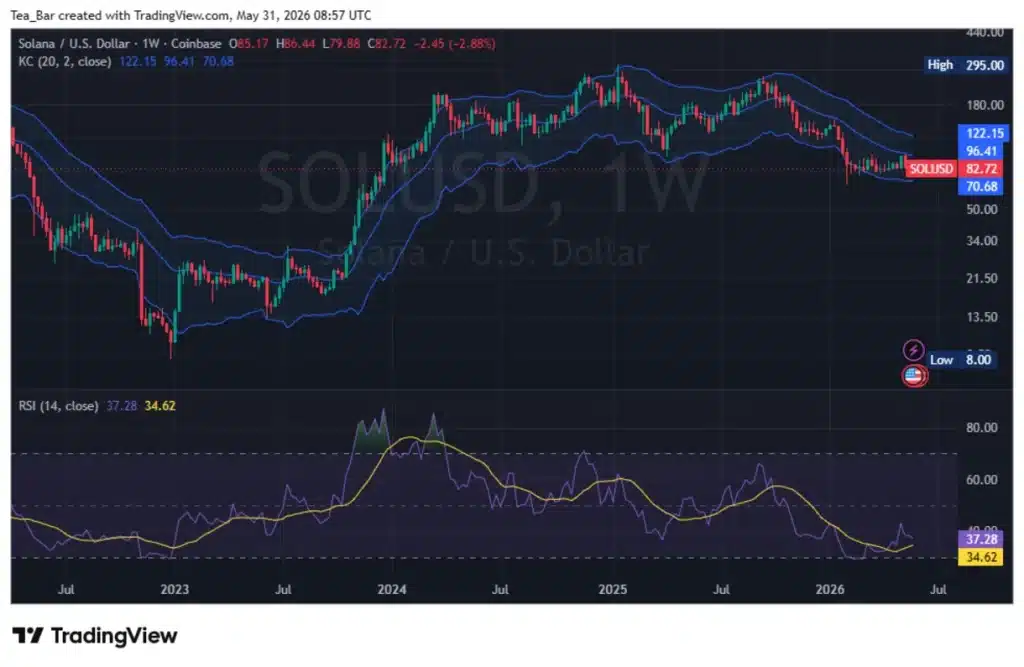
The cycle low of $8.00 visible on the far left of the chart provides the long-range context: every time SOL’s weekly RSI has approached the low-30s range, it has preceded recoveries measured in multiples, not percentages.
The Keltner Channel lower band at $70.68 is the structural floor the market is watching. Price has not tested it yet — but the distance between $82 and $70 is thin enough that it remains a live risk if macro conditions deteriorate further.
A hold above $80 into the weekly close, combined with a SIMD-547 governance vote gaining momentum, would be the combination that bulls need to construct a credible reversal narrative.
The Deflationary Inflection Point
Ethereum’s EIP-1559, introduced in 2021, demonstrated conclusively that fee burn mechanics do not just improve tokenomics on paper — they change how the market values the asset at a fundamental level.
The shift from inflationary to deflationary supply during periods of high network activity created a narrative that institutional analysts could model, and that retail participants could understand intuitively.
SIMD-547 offers Solana the same inflection point. At 64,800 SOL burned per day — the upper estimate during peak activity — the protocol’s supply dynamics flip from mildly inflationary to aggressively deflationary precisely when the network is most used.
That is the kind of self-reinforcing tokenomics that long-term holders build positions around.
SOL at $82, with a weekly RSI near oversold and a co-founder-endorsed burn proposal that could multiply daily supply destruction by 100 times — the gap between where the price is and where the fundamentals are pointing may be wider than it has been at any point this cycle.
Disclaimer:
This article is for informational purposes only and does not constitute financial, investment, or trading advice. The views expressed are based on publicly available data, market observations, and the author’s interpretation at the time of writing. Cryptocurrency markets are highly volatile and unpredictable, and past performance or current technical setups do not guarantee future results. Readers should conduct their own research and consult with a qualified financial advisor before making any investment decisions. TechGaged does not accept liability for any losses incurred based on the information presented.
The post This New Proposal Has Traders Paying Attention — SOL Burn Rate Explosion? appeared first on TechGaged.com.
0
0


 Manage all your crypto, NFT and DeFi from one place
Securely connect the portfolio you’re using to start.


0
0
