
FalconX Integrates Interstice to Connect Canton to Ethereum, Solana

0
0
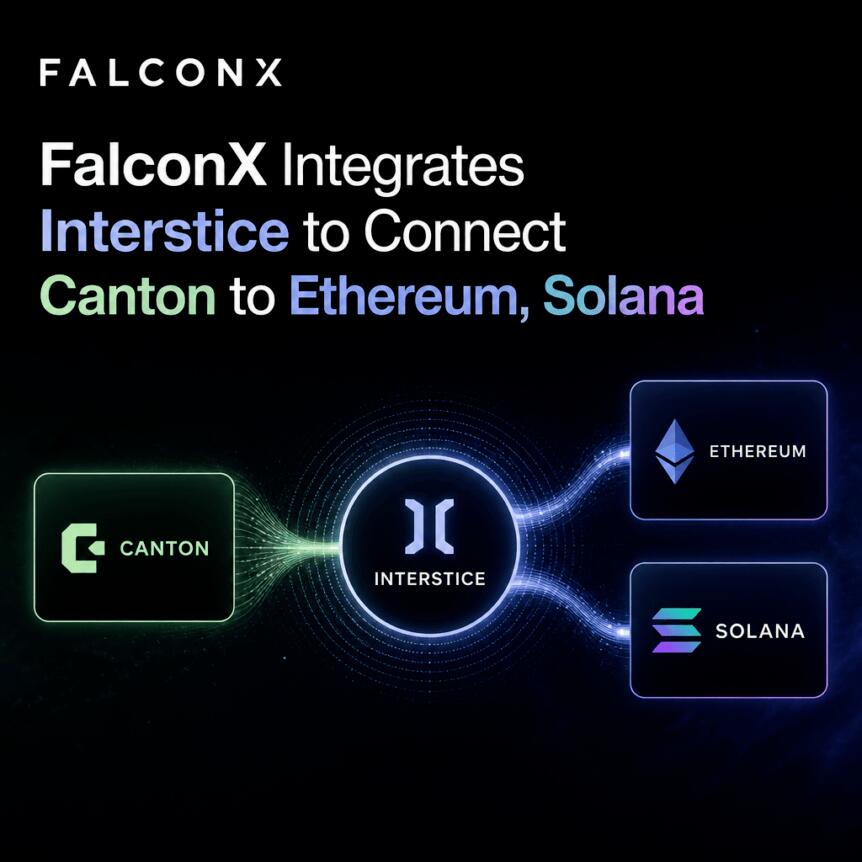
Interstice Digital has launched a non-custodial cross-chain swap engine intended to move tokenized assets between the Canton institutional blockchain and major public networks, including Ethereum and Solana, with support for Robinhood Chain. The company says the system is designed so Interstice does not take custody of users’ funds and does not submit transactions on their behalf.
Instead, the announcement highlights FalconX, a digital asset prime brokerage for institutional clients, as the liquidity provider behind the engine. Interstice frames the integration as a way to connect Canton’s institutional tokenization activity with on-chain liquidity and trading access on public blockchains.
Key takeaways
- Interstice’s cross-chain swap engine is described as non-custodial, with users retaining control rather than Interstice executing trades.
- FalconX is positioned as the liquidity layer supporting swaps between Canton and public networks such as Ethereum and Solana.
- Canton is built for regulated, institutional use, with privacy and permissioning controls aimed at compliant tokenized settlement.
- The launch does not specify which assets are supported initially or provide usage or transaction-volume figures.
A non-custodial route between Canton and public liquidity
According to Interstice’s Tuesday announcement, the swap engine is intended to enable asset transfers across four networks: Canton, Ethereum, Solana, and Robinhood Chain. The core promise is operational: swaps can be performed without Interstice taking custody of assets or acting as the direct transaction executor for users.
For institutions and tokenization platforms, that distinction matters because custody and execution control can shape risk management requirements, compliance reviews, and operational workflows. While the announcement confirms Interstice’s role is limited to providing the infrastructure, it does not disclose further implementation details such as the exact mechanism by which routing and execution occur or which asset types are immediately supported.
FalconX’s involvement is central to Interstice’s approach. The prime brokerage is described as providing liquidity for the engine, with the stated aim of giving users a path between tokenized assets on Canton and liquidity available on public chains. In practice, this kind of integration can reduce friction for moving exposure between an institutional settlement environment and the broader, liquid ecosystems of public blockchains—particularly where counterparties and market makers operate primarily outside permissioned networks.
Canton’s institutional positioning is expanding
Canton is a public blockchain built with institutional finance in mind, featuring privacy and permissioning controls for regulated transactions and tokenized assets. Interstice’s announcement connects the swap engine to this broader Canton narrative: bringing more access to tokenized assets and settlement while enabling interaction with the trading activity of public chains.
The ecosystem has already attracted traditional financial institutions. The article notes that Canton’s partners include major banks and market participants such as JPMorgan, Goldman Sachs, and BNP Paribas.
Interstice’s integration arrives alongside additional signals that institutional tokenization activity on Canton is accelerating. In July, electronic trading platform Tradeweb executed an onchain US Treasury trade on Canton, according to earlier coverage. The described transaction involved Franklin Templeton transferring a tokenized Treasury security to Virtu Financial in exchange for tokenized cash. Tradeweb said it was the first real-time purchase and sale of a tokenized US Treasury settled against USDCx—a USDC-backed stablecoin issued on Canton—with other participants including Societe Generale, Digital Asset, and Blockdaemon. Tradeweb’s role was execution and price discovery, while Canton synchronized settlement between the two tokenized assets in real time.
Additional deployments mentioned in the coverage include Societe Generale’s euro- and dollar-denominated stablecoins on Canton for tokenized collateral, repo financing, and institutional settlement. Separate reporting also indicates Visa has tested private stablecoin settlement on the network, and other efforts include a Japanese government bond collateral pilot involving Mizuho and Nomura, along with S&P Dow Jones Indices placing its iBoxx US Treasuries Index on Canton.
Why the swap engine matters for tokenized markets
Cross-chain capability is increasingly important to institutional tokenization because value often needs to move between different environments—permissioned settlement rails on one side and public-chain trading venues on the other. Interstice’s swap engine is designed specifically to address that gap by providing a “route” between Canton tokenized assets and liquidity on chains like Ethereum and Solana.
The announcement’s non-custodial framing also reflects a practical concern for regulated users: who controls assets during exchange. Even when cross-chain tools are technically capable, the operational control model can be a deal-breaker for institutions that must satisfy internal risk committees. By stating that Interstice does not hold custody and does not execute transactions on users’ behalf, the company is signaling a reduced intermediary role compared with custodial bridge designs.
Still, readers should note what remains missing from the public description. Interstice did not disclose which assets are supported at launch, and it did not provide transaction volume figures. Those details can heavily influence how quickly liquidity fragments or how the system behaves under real market conditions, especially if initial support is limited to a small set of tokenized instruments or stablecoins.
Another factor to watch is how liquidity provided through FalconX translates into effective pricing and routing across chains. While the announcement confirms FalconX is supplying liquidity, it does not specify whether the liquidity model is tied to specific market makers, whether swaps are routed through particular venues on public networks, or how spreads may vary depending on supported pairs.
What to watch next
The next checkpoints are likely to be practical rather than theoretical: which assets Interstice supports first on the engine, how users integrate it into existing Canton workflows, and whether the system expands institutional tokenization’s reach into public-chain liquidity without introducing new operational complexity. For now, the launch adds another infrastructure layer to Canton’s institutional ecosystem—but the market will want clarity on real-world usage and supported token coverage.
This article was originally published as FalconX Integrates Interstice to Connect Canton to Ethereum, Solana on Crypto Breaking News – your trusted source for crypto news, Bitcoin news, and blockchain updates.
0
0


 Manage all your crypto, NFT and DeFi from one place
Securely connect the portfolio you’re using to start.


0
0