
Memecoin Marketing Shift: From Online Hype to Real-World Risk
0
0
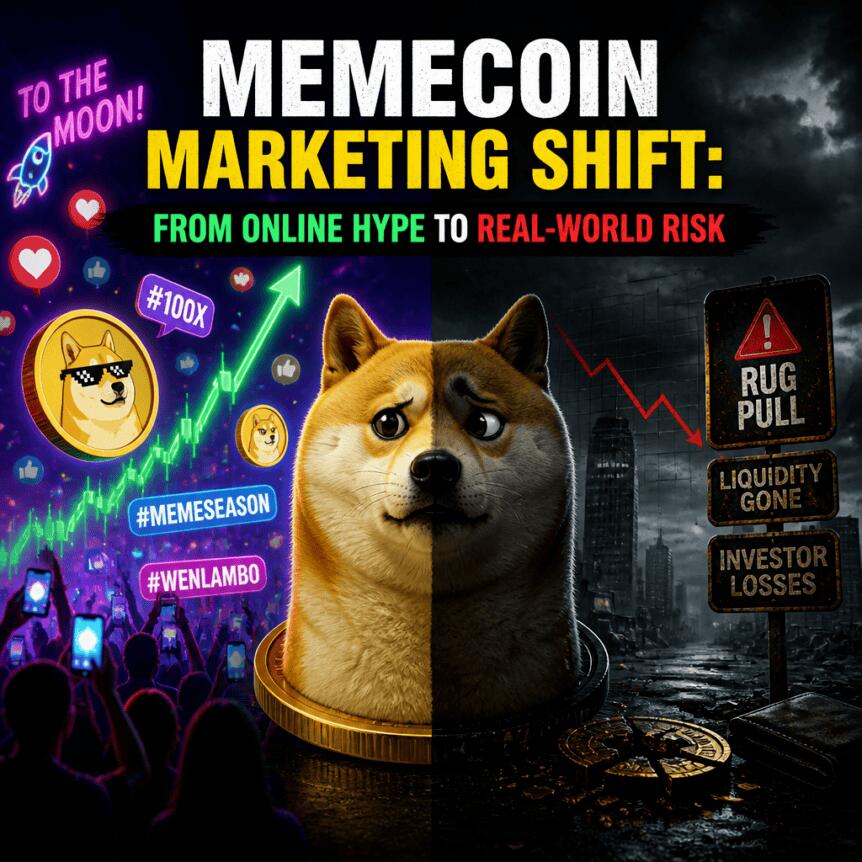
Memecoins were once largely confined to the internet: jokes turned into tokens, and trading played out on screens. But recent controversies tied to Solana’s Pump.fun suggest that memecoin promotion is increasingly reaching into real-world behavior—at times by rewarding people in crypto for promotional stunts.
The shift matters because it changes the incentives surrounding token launches and marketing. When attention becomes something participants can monetize directly, the line between entertainment, community engagement, and exploitation can blur—raising new ethical and regulatory questions for an industry already operating with uneven oversight.
Key takeaways
- Memecoin value is closely tied to visibility and social momentum, but Pump.fun-style bounty models intensify the competition for attention.
- Reports around creator bounties describe crypto rewards for attention-seeking behavior that can extend beyond online promotion.
- By lowering the barrier to token creation, platforms can move scarcity from “ability to launch” to “ability to stand out.”
- Supporters argue participation is voluntary, while critics warn that financial pressure and consent can be more complex than it appears.
- Regulators may struggle to classify bounty programs that combine promotion, compensation, and token-related incentives.
From meme culture to on-the-ground stunts
Memecoins have always been different from “serious” crypto narratives. Rather than relying on technical roadmaps or utility, they attract buyers through humor, absurdity, and a shared sense of internet culture. Traditionally, the biggest risk for participants was financial—speculators could lose money chasing hype without the memes themselves leaving the digital realm.
That boundary is increasingly being tested. Earlier coverage cited in Wired describes alleged Pump.fun controversies in which people reportedly accepted cryptocurrency payments for real-world actions such as shaving their heads, drinking large amounts of alcohol, and getting token names tattooed on their bodies. In some cases, promotion is not limited to content creation—it is framed as getting people to become “living advertisements.”
Whether these are best viewed as a new kind of community engagement or as a symptom of a more troubling attention economy remains contested, but the pattern itself is difficult to ignore. The more memecoin marketing resembles direct participation in high-risk public performances, the more it invites scrutiny beyond traders and into consumer protection, labor standards, and safety concerns.
Why attention remains the real “utility”
Memecoins do not require sophisticated technology to find an audience. Their market dynamics often come down to visibility: how many people are watching, sharing, and talking. As Wired notes in discussing memecoin culture and attention-driven markets, attention is treated like the scarce resource that feeds everything else—liquidity, trading activity, and renewed hype.
The attention cycle can be self-reinforcing. When a memecoin trends, it draws traders; when traders return, liquidity can improve; rising activity can generate more visibility; and that visibility can pull in still more market participants. The end result is that conversation becomes a primary driver of market survival.
This also helps explain why extreme promotion can become rational within the attention economy—even if it looks irrational from a distance. Online audiences move quickly, and what shocks viewers today may be forgotten tomorrow. To stay visible, creators often feel pressure to escalate, and audiences may amplify the spectacle by sharing screenshots and commentary rather than ignoring it.
Pump.fun’s launch model and the economics of standing out
One reason Pump.fun and similar systems caught on is that they make token creation faster and easier for nontechnical users. Earlier reporting described how such platforms turn launches into a near-instant process for many newcomers, lowering the initial barrier to participation.
But when token creation becomes cheap and fast, the bottleneck shifts. If almost anyone can launch a token, then differentiation depends less on technical effort and more on marketing reach. In attention-based markets, that often means competition for visibility becomes the central battleground—and promotion can become increasingly direct.
Wired’s earlier reporting on Pump.fun described how some platforms offered livestreaming features and faced criticism over promotional behavior used to attract investors and viewers. That reporting suggested a pattern in which competition led some creators to push boundaries to improve their odds of standing out. Eventually, livestreaming was suspended and later brought back with moderation measures, underscoring how platforms can respond once reputational or regulatory pressure rises.
Where creator incentives meet ethical risk
Supporters of crypto bounties often argue that participation is voluntary: people take part because they are paid, entertained, or both. The comparison to other entertainment industries is common—reality shows run stunts; influencers promote questionable products; athletes accept injury risks for income and visibility. Critics counter that the consent story can be more complicated when money and financial pressure are involved, especially if participants underestimate long-term consequences.
One widely shared example discussed in the source material involves a person in Tamil Nadu, India, who reportedly tattooed the ticker “$boutywork” on his forehead in an attempt to complete a bounty task. The episode highlights a core tension in attention-driven incentives: stunts designed to attract attention can turn into durable personal outcomes that outlast the moment that generated the token’s visibility.
Even when no permanent harm occurs, the incentive structure can still shape behavior. In markets where virality can function like currency, people may prioritize short-term rewards—financial gain, recognition, or both—over risks they might otherwise treat with more caution. The same dynamic can also keep controversial stunts in circulation: backlash and criticism can still generate engagement, which may encourage platforms and creators to chase bigger reactions.
Regulators face a hard classification problem
These developments raise complex questions for regulators because bounty programs don’t fit neatly into existing legal boxes. Depending on how tasks are structured, they can resemble marketing campaigns, promotional contests, work-like arrangements, high-risk reward systems, or forms of token-linked compensation that earlier laws were never designed to address.
Consumer protection authorities may ask whether participants understand the risks and potential consequences. Labor regulators may consider whether financial need and decision-making capacity should trigger stronger safeguards. Securities regulators, in turn, may be forced to examine whether token-based rewards change the legal character of promotion.
The source material emphasizes that answers will likely vary by jurisdiction. Without clearer standards, platforms may continue operating in a regulatory gray zone where enforcement is inconsistent and reputational consequences can outpace legal guidance.
For now, memecoin marketing’s direction remains uncertain. Investors and builders should watch for how platforms modify moderation rules, whether certain bounty categories are restricted, and whether communities begin rejecting exploitative tactics. The key question is whether the next escalation is met with clearer guardrails—or with a serious incident that forces more aggressive intervention.
This article was originally published as Memecoin Marketing Shift: From Online Hype to Real-World Risk on Crypto Breaking News – your trusted source for crypto news, Bitcoin news, and blockchain updates.
0
0


 Manage all your crypto, NFT and DeFi from one place
Securely connect the portfolio you’re using to start.

0
0

0
0

0
0

0
0