
Washington’s Crypto Tax Bill Targets the $2 Gas Fee Problem, and Delays the Harder Fights

0
0
BitcoinWorld

Washington’s Crypto Tax Bill Targets the $2 Gas Fee Problem, and Delays the Harder Fights
Key Takeaways
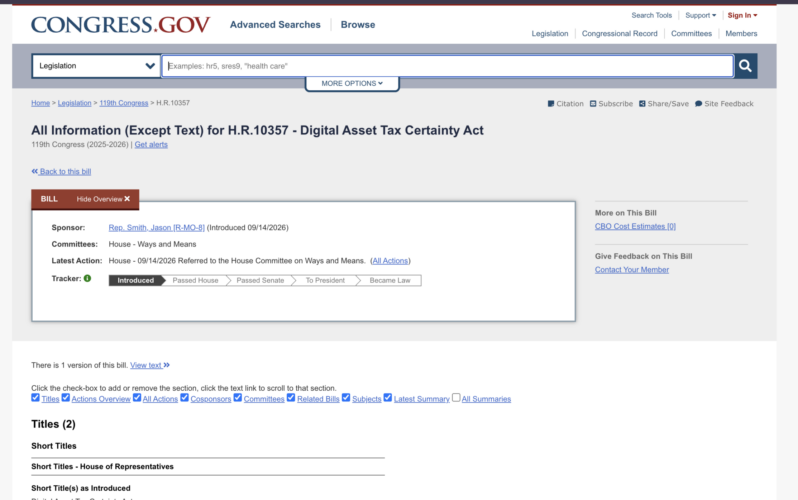
- The House Ways and Means Committee has released H.R. 10357, the 114-page Digital Asset Tax Certainty Act, and will mark it up on September 16.
- Blockchain network fees under $10 would no longer create a taxable event, but wallets with more than 5,000 transfers in the prior year would not get this relief.
- Closing the crypto wash-sale gap would raise revenue, while deferring tax on mining and staking rewards would cost it. The deferral is the most likely provision to be cut.
- The bill will probably not become law in 2026. Its real purpose is to set up the 2027 Congress.
Ask any American who has used Ethereum what makes crypto taxes painful, and many won’t mention their big trades. They’ll mention the small stuff. Under current rules, paying a network fee with a token counts as disposing of that token, so even a 40-cent gas payment can require a capital gain or loss calculation. For people who actually use crypto rather than just hold it, the paperwork can end up costing more than the transactions themselves.
House Ways and Means Chair Jason Smith’s new bill is the first serious attempt from Congress’s tax-writing committee to fix this.
Why it matters
The $10 fee exemption is small in dollar terms, but it removes a lot of friction. Swaps, bridges, and transfers all carry fees, so almost every active user benefits. The 5,000-transfer cutoff shows what lawmakers intend: they want to help ordinary users, not trading bots. High-frequency traders would stay under full reporting.
The exemption is also narrow. It appears to cover only on-chain network fees, not exchange trading fees or spreads. Crypto payments for everyday purchases still wouldn’t be tax-free. The bill doesn’t include the broad de minimis exemption for small purchases that the industry has long wanted.
Timeline
- June 8, 2026: Reps. Carey and Arrington introduce H.R. 9172, which would apply wash-sale rules to digital assets.
- June 9: Ways and Means hears testimony from Coinbase, Fidelity, Coin Center, and NYU’s Tax Law Center.
- September 13: Reports say Republicans are considering dropping the mining and staking deferral.
- September 14: The bill text is published. It draws on earlier bipartisan work by Reps. Horsford and Miller.
- September 15: The Senate holds its cloture vote on the CLARITY Act.
- September 16, 10 a.m. ET: Committee markup.
The trade-off inside the bill
The bill is structured as a revenue trade. Crypto traders can currently sell at a loss, buy the same asset back immediately, and still claim the deduction, which stock investors can’t do. Closing that gap is estimated to raise about $2.07 billion over a decade. Letting miners and stakers defer tax on newly created tokens until they sell them would cost about $2.96 billion.
That deferral is the provision to watch. Rep. Steven Horsford is the committee’s most outspoken Democratic supporter of crypto and a key swing vote. If Republicans remove the deferral or cap it at five years, they could lose his support. Either way, Wednesday’s vote will show whether crypto tax policy can remain bipartisan.
What comes next
The House goes on recess this week and won’t return until after the November election, so floor action this year is unlikely. Even so, a bill that has cleared committee gives the next Congress a starting point. The Treasury and IRS would then write the detailed rules. Watch whether the $10 threshold or the 5,000-transfer limit changes through amendments, since either would signal how generous the final law might be.
Conclusion
This bill won’t settle crypto taxation, but it changes the question from whether Congress will act to how the details will be written. The fee exemption helps everyday users. The wash-sale change brings crypto in line with stocks. The staking fight will show how much bipartisan support crypto actually has. The outcome of Wednesday’s markup will shape how 2027 begins.
This post Washington’s Crypto Tax Bill Targets the $2 Gas Fee Problem, and Delays the Harder Fights first appeared on BitcoinWorld.
0
0

 Manage all your crypto, NFT and DeFi from one place
Securely connect the portfolio you’re using to start.


