What Is a Blockchain API? How It Works & Best Tools [July, 2026]

Written by Tigran Mkrtchyan · Reviewed and fact-checked by Narek Gevorgyan · Published July 1, 2026 · Last updated September 4, 2026 · Pricing and limits verified September 2026
- What is a blockchain API?
- How does a blockchain API work?
- Blockchain API vs RPC vs your own node
- Types of blockchain APIs
- What data can you access?
- Common use cases
- Anatomy of a blockchain API call
- How to get a blockchain API and make your first call
- Blockchain API pricing models explained
- Security, authentication, and reliability
- How to choose the best blockchain API
- Common mistakes when choosing
- Blockchain APIs and AI: MCP and agents
- Best blockchain APIs in 2026
- Frequently asked questions
You want blockchain data in your app. Prices, balances, transactions, maybe DeFi positions.
So you spin up a node and connect to it. Then the trouble starts. Nodes were built to validate blocks, not to answer questions. Ask one for a wallet history and you get raw, encoded noise. I learned this the slow way.
A blockchain API fixes that. It sits between your app and the chain. It returns clean, ready data on request. No node to babysit, no decoding by hand.
I work on growth at CoinStats, so I have skin in this game. This guide still sticks to plain facts. What a blockchain API is and how it works. The types, the pricing, and how to choose one. You can build with CoinStats API or anything else after reading. The call is yours.
- A blockchain API is your access point to a chain’s data and actions.
- It abstracts nodes, indexing, and decoding so you just send requests.
- Main types: node RPC, indexed data APIs, query APIs, and streaming APIs.
- Most providers offer a free tier, then credit, usage, or tiered pricing.
- Judge an API on coverage, data depth, latency, docs, and AI readiness.
What is a blockchain API?
API stands for application programming interface. It is a contract between two programs. One side asks for something. The other side answers in a predictable format, usually JSON.
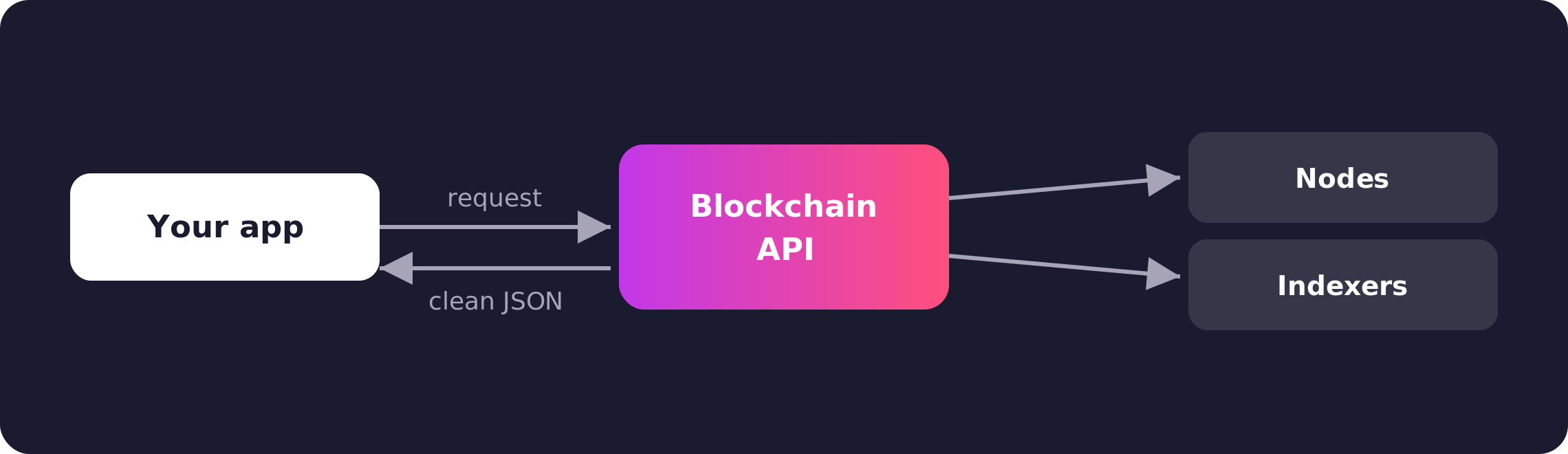
A blockchain API applies that contract to a chain. Behind the scenes it runs nodes, indexes blocks, decodes contracts, and normalizes the result. You never see that work. You send a request and get back structured data you can use.
Think of it as the access point to a chain’s ledger. The ledger is just a database of transactions and balances. The API is the clean window into it. For a broader primer on market data, see our best crypto API guide.
How does a blockchain API work?
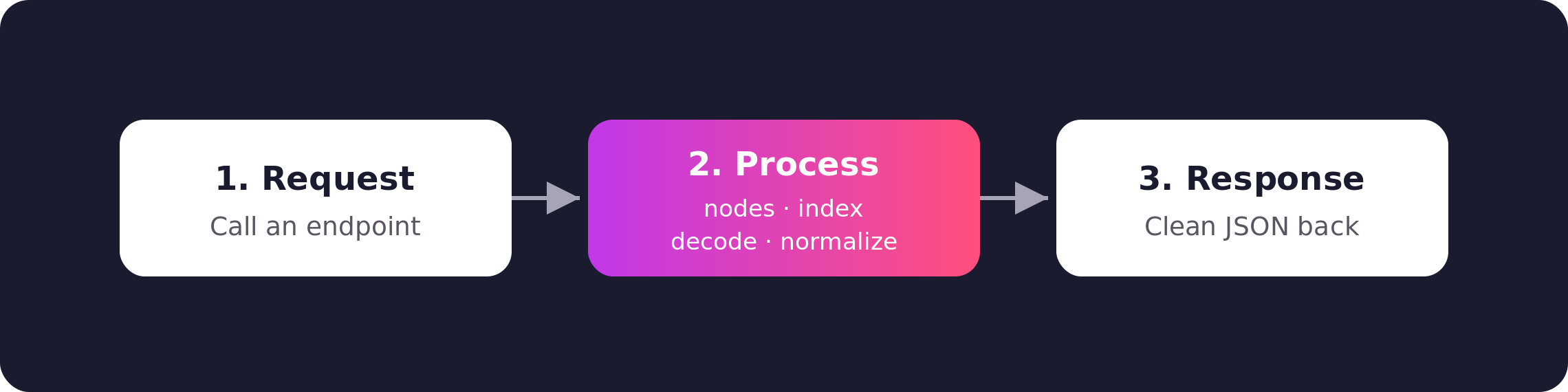
Every blockchain API call follows the same path. You send a request. The provider does the heavy lifting. You get a clean response. Here is each step.
1. The request
Your app sends an HTTP request to an endpoint. It includes a path, parameters, and an API key. For example, ask for the balance of a wallet address.
2. The processing
The provider routes your request to its infrastructure. Nodes hold the raw chain state. Indexers have already parsed blocks into searchable records. The provider decodes contract data and normalizes formats.
3. The response
You get back structured JSON. It is consistent across chains and easy to parse. No hex decoding, no block-by-block scanning, no schema guesswork on your side.
That middle step is the real value. Running your own indexers is slow to build and costly to keep alive. A good API hides all of it behind one endpoint.
Blockchain API vs RPC vs your own node
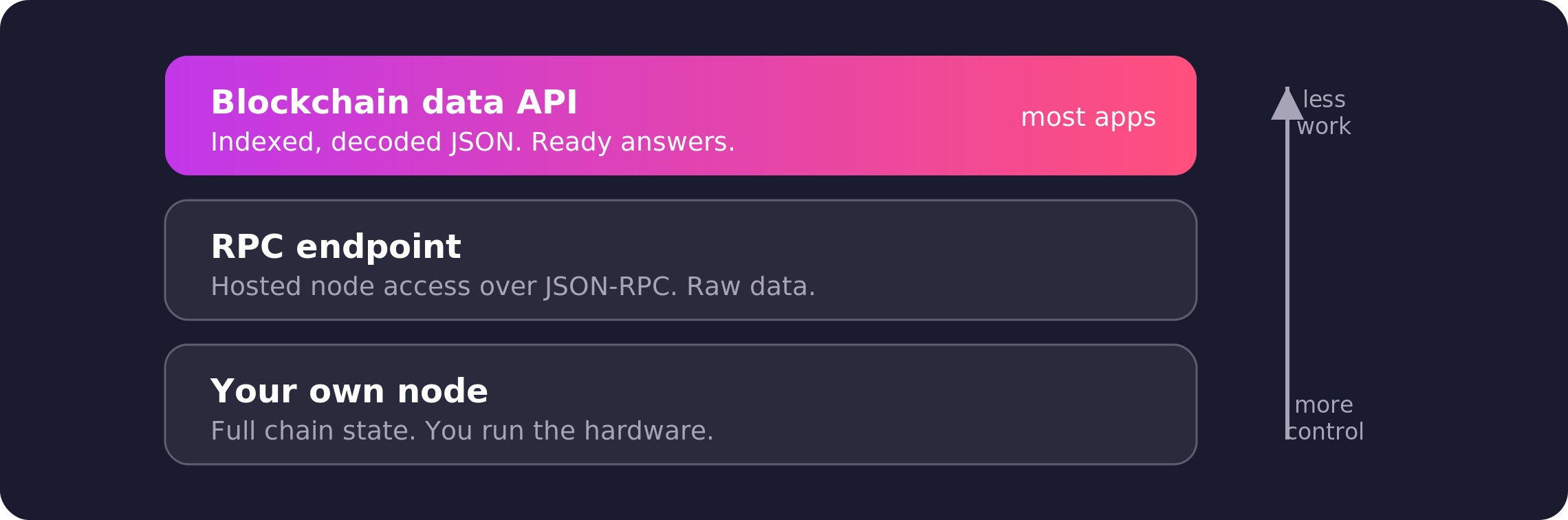
These three options sit at different levels of abstraction. An RPC endpoint talks to a node directly. A data API sits a layer above and returns ready answers. Running your own node means you own the whole stack.
| Option | What you get | Tradeoff |
|---|---|---|
| Your own node | Full control and raw access to chain state | You run, sync, and pay for the hardware |
| RPC endpoint | Hosted node access over JSON-RPC, no hardware | Raw, low-level data you still decode yourself |
| Blockchain data API | Indexed, decoded, ready answers over REST | You depend on the provider’s coverage |
RPC is the protocol nodes speak. JSON-RPC is the standard format for those calls. A data API often sits on top of RPC. It adds indexing, decoding, and search. If you need the RPC layer itself, we reviewed the best RPC node providers for 2026. Most teams want answers, not raw blocks. They reach for the data API first.
Types of blockchain APIs
People often ask about the four types of APIs. In blockchain, the useful split is by what each layer returns. Here are the four you will meet most.
Hosted node access over JSON-RPC. Read state, submit transactions, call contracts.
Pre-parsed records for balances, transfers, tokens, and prices. Clean JSON.
GraphQL or SQL-style access for filtering, sorting, and aggregation across history.
WebSockets, webhooks, or gRPC that push new blocks and transactions as they land.
Many providers bundle several of these. Use REST for balances, WebSockets for live prices, and a query layer for analytics. Pick the transport that fits each job.
What data can you access?
A blockchain API exposes both onchain records and market context. The exact menu depends on the provider. Most cover this core set.
Hashes, status, gas, timestamps, and full transaction history per address.
Native balances plus every token a wallet holds, with metadata.
Live and historical prices, market cap, and volume across coins.
Staking, lending, and liquidity positions resolved per wallet.
Decoded logs and events emitted by contracts you care about.
Token risk scores that flag honeypots, hidden fees, and blacklists.
The strongest data layers combine these. CoinStats Blockchain API returns prices, balances, transactions, DeFi, and token risk. That saves wiring up many separate sources.
Common use cases
Blockchain APIs power most of the crypto apps you already use. A few patterns show up again and again.
Show balances, history, and DeFi positions across many chains in one view.
Verify deposits, read balances, and credit accounts without running nodes.
Track protocol flows, yields, and token activity in real time.
Trace funds, screen addresses, and flag risky tokens before users transact.
Pull full transaction history to calculate gains and build reports.
Anatomy of a blockchain API call
Most REST blockchain APIs share the same request shape. Here is a neutral example for one wallet’s balance. The host below is a placeholder.
GET https://api.example.com/v1/wallets/0xAbC.../balance
Authorization: Bearer YOUR_API_KEY
Accept: application/json
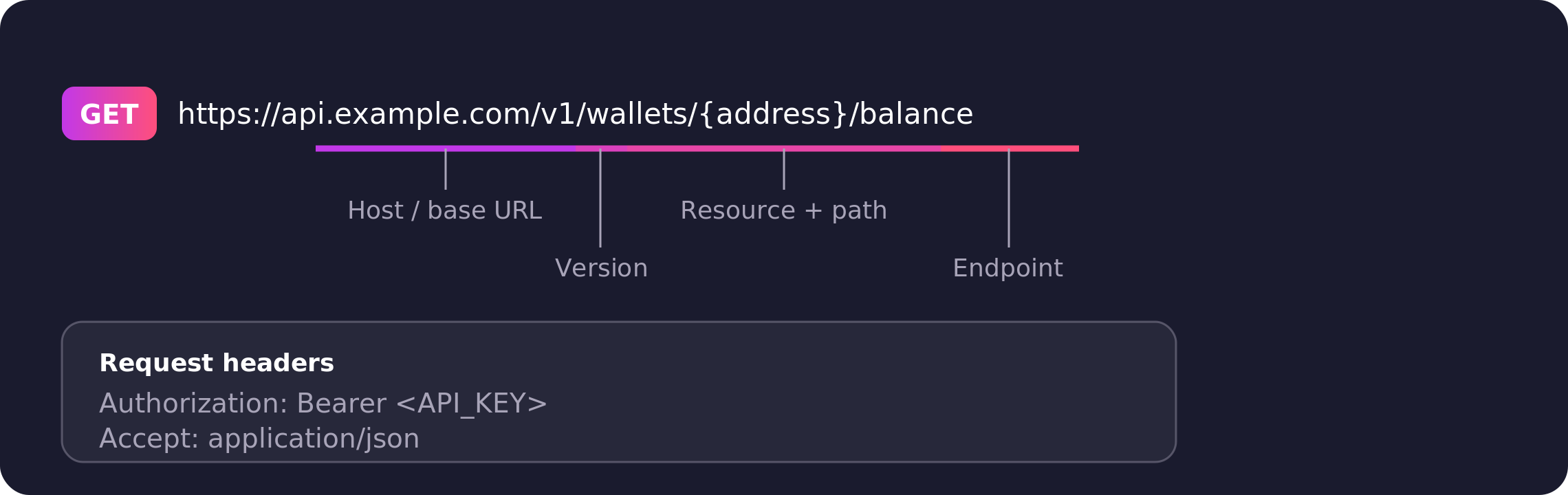
Break it into parts. The base URL points to the provider. The path picks the resource, here a wallet balance. Query parameters filter or page the result. Headers carry your key and the format you want back.
The response comes back as JSON. It lists the wallet’s tokens, amounts, and values in a fixed shape. You parse it once and reuse the structure for every wallet.
How to get a blockchain API and make your first call
Getting started looks the same across most providers. Five steps take you from zero to a live response.
Create an account on the provider’s developer portal. Most need no card for the free tier.
Generate a key in the dashboard. It identifies and authorizes your requests.
Find the endpoint you need. Check the path, parameters, and rate limits.
Send a request with your key in the header. Start with a simple read.
With CoinStats API, the free tier gives 20,000 credits a month. No card needed. Sign up at the developer portal, copy your key, then call an endpoint. A first read might look like this.
curl https://api.coinstats.app/v1/coins/bitcoin \
  -H "X-API-KEY: YOUR_API_KEY"
That returns Bitcoin’s current price and market data as JSON. Swap the path for wallet balances, transactions, or DeFi positions as you go. The same key works across endpoints.
Blockchain API pricing models explained
Pricing trips up a lot of teams. Most providers use one of four models. Knowing them helps you model cost before you commit.
A monthly quota at no cost. Great for testing and small apps. Watch the rate limits.
You pay per call or per fixed bundle of calls. Simple to reason about.
Each endpoint costs credits by weight. Heavy queries cost more than light ones.
Flat monthly tiers bundle a quota and a rate limit. Predictable bills.
We checked which APIs have a real free tier against official pricing pages.
Run the math for production load. Say you poll prices for 10 coins every 60 seconds. That is 10 times 60 times 24, or 14,400 calls a day. Model that against each tier before you pick.
Security, authentication, and reliability
A blockchain API key is a credential. Treat it like a password. Most read endpoints only need a key in the header. Write actions need more care.
- Keep keys server side. Never ship them in frontend or mobile code.
- Rotate keys on a schedule and after any suspected leak.
- Use scoped or read-only keys where the provider supports them.
- Respect rate limits and handle 429 responses with a retry and backoff.
Reliability matters as much as features. Check the provider’s uptime record and status page. Watch p95 latency on the endpoints you call most. A fast homepage means nothing if your real endpoint lags.
How to choose the best blockchain API
The right API depends on your use case. Test against these factors before you commit. Each one can break a project later.
Does it support every chain you need now and the next two you add?
Balances, history, DeFi, prices, and risk, or just raw RPC?
Real p95 latency and a public status history, not marketing claims.
Can you model your monthly bill from your real traffic?
Clear docs, examples for your stack, and honest rate limits.
Does it expose an MCP server for agents, not just REST?
Common mistakes when choosing
Most regrets trace back to a few avoidable errors. Watch for these before you sign anything.
- Picking on price alone without testing real latency.
- Assuming a chain is supported because the homepage shows its logo.
- Storing API keys in frontend code where anyone can read them.
- Skipping the rate-limit math for production traffic.
- Ignoring docs quality until you are deep in integration.
- Forgetting to plan for the next chains you will add.
Blockchain APIs and AI: MCP and agents
AI agents now need live onchain data too. The model context protocol, or MCP, is how they get it. MCP is a standard way to expose tools that an agent can call.
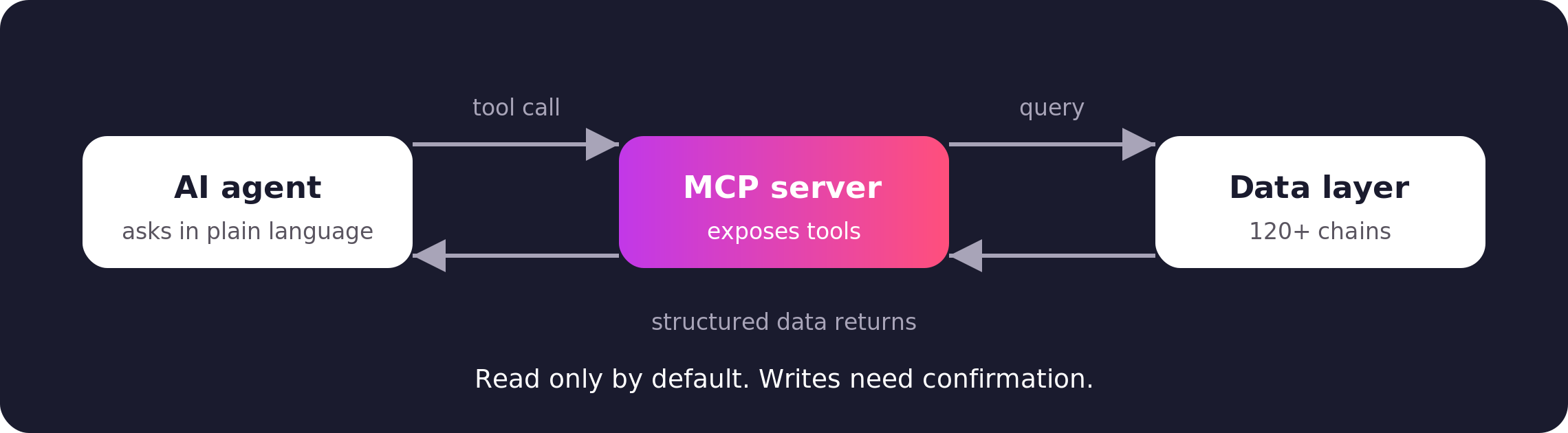
An MCP server lets an agent read prices, balances, and risk through tool calls. The agent asks in plain language. The server returns structured data. No custom glue code each time.
MCP is becoming a baseline feature, not a differentiator. CoinStats API exposes both REST and an MCP Server. Backends and AI agents call the same data layer. Most production MCP integrations stay read only by default. Write actions require explicit user confirmation.
Best blockchain APIs in 2026
Many providers serve this space. Your pick depends on the need: raw RPC, indexed data, or market context. If CoinStats API is on your shortlist, compare it against seven alternatives. Below is a fair snapshot, with CoinStats API first since we make it. For the full comparison, see our guide on how to choose a blockchain API. Pricing and limits verified September 2026.
| Provider | Best for | Chains | Free tier | Entry price |
|---|---|---|---|---|
| CoinStats API | Prices, wallet, DeFi, token risk | 120+ (74 EVM) | 20,000 credits/mo | $49/mo |
| The Graph | Custom indexing and subgraphs | 70+ | 100,000 queries/mo | Usage based |
| Covalent (GoldRush) | Cross-chain historical data | 100+ | 14-day trial, 25,000 credits | $10/mo |
| Tatum | Broad coverage plus RPC | 130+ | 100K lifetime credits | Dedicated from $99/mo |
| Ankr | High-volume RPC and nodes | 70+ | Public RPC plus freemium | Pay as you go |
CoinStats API
CoinStats Blockchain API gives apps and AI agents one endpoint set. It covers prices, wallet balances, transactions, DeFi positions, and token risk. It exposes both REST and an MCP Server. Backends and agents call the same data.
- 100,000+ coins and 200+ exchanges for prices and market data.
- 120+ blockchains, with 74 EVM chains queryable in one call.
- Per-wallet DeFi positions across 10,000+ protocols.
- Token Risks endpoint flags honeypots, hidden fees, and blacklists.
What to verify: confirm your endpoints sit on the free tier first.
“We built CoinStats API so one team can ship a full crypto app. No stitching together a dozen data sources and node providers.”
The Graph
The Graph is a decentralized protocol for indexing onchain data. You query subgraphs with GraphQL for custom datasets. A REST Token API adds balances and transfers.
What to verify: subgraphs need GraphQL skills, so budget learning time.
Covalent (GoldRush)
Covalent now operates as GoldRush. It returns historical onchain data across 100+ chains. One REST schema covers balances, transactions, and DEX trades.
What to verify: confirm support for your exact networks.
Tatum
Tatum combines blockchain data APIs with RPC nodes. It supports 130+ networks from one platform. You also get wallets, notifications, and fee tools.
What to verify: free credits are lifetime, not monthly, so plan usage.
Ankr
Ankr is node infrastructure for Web3 builders. It serves RPC across 70+ chains at scale. Advanced APIs add indexed data on select chains.
What to verify: no official MCP server yet, so check before relying on it.
Frequently asked questions about blockchain APIs
What is a blockchain API?
How does a blockchain API work?
What are the four types of APIs?
What is the difference between a blockchain API and an RPC node?
What blockchain API supports fast data retrieval?
Can I get wallet balances from a blockchain API?
Can I use a blockchain API with AI agents or MCP?
Is there a free blockchain API?
How much does a blockchain API cost?
Which blockchain API offers usage-based pricing?
How do I get a blockchain API key?
What is the best blockchain API for developers?
Which blockchain API offers the highest uptime?
How do I choose a blockchain API?
Tigran is the Head of Digital Marketing at CoinStats, working across crypto and consumer apps. His writing covers first-hand crypto experience and marketing case studies from that work. He has taken the stage at industry-leading conferences like MAU Vegas, Business of Apps Berlin, and App Promotion Summit London.
More from Tigran on the CoinStats blog · LinkedIn · X