Best Blockchain APIs in 2026: How to Choose the Right One

Written by Tigran Mkrtchyan · Reviewed and fact-checked by Narek Gevorgyan · Published June 30, 2026 · Last updated September 3, 2026 · Pricing and limits verified September 2026
Scroll r/ethdev for five minutes. You will find the same thread. Someone asks which blockchain API they should actually use. The replies read like group therapy. Surprise bills. Missing chains. Numbers that never match.
“I spend more time stitching APIs than shipping.”
I have read a lot of those threads. So here is the pattern underneath them. One provider gives you prices. Another gives you balances. A third handles DeFi. None of them agree. You glue them together and hope nothing breaks. Then one API changes, and your app goes down. That is the real cost of the wrong API.
So I did the homework these threads never finish. I researched every blockchain API I could find. Full disclosure. I help build CoinStats Crypto API.
Below are my five picks for 2026. CoinStats API is first. The facts below make the case, bias and all.
We make CoinStats API, so yes, we are biased. We know it. So this guide sticks to plain facts. Endpoints, coverage, and public pricing. The verdict is yours.
- Match the API to your use case, not the brand name.
- Data APIs return clean JSON. RPC nodes return raw chain calls.
- A real free tier lets you test before you commit.
- Most serious providers now ship an MCP server for AI agents.
- CoinStats API bundles market, wallet, DeFi, and risk in one.
What makes a good blockchain API
Blockchain APIs split into two broad types. RPC nodes give you raw access to a chain. You send low level calls and parse the results yourself. Data APIs do the indexing for you. They return clean JSON for balances, tokens, and prices.
Most apps want a data API. Some need both. New to this? Read our primer on what a crypto API is.
When you compare providers, weigh five things.
- Coverage. The chains, exchanges, and assets you need. Gaps here force extra integrations later.
- Data depth. Balances, DeFi, history, and token risk. Shallow data means more work on your side.
- Free tier. Real limits you can actually build on. A tiny tier only proves the login screen.
- AI readiness. An MCP server for agent access. Agents then read your data without glue code.
- Docs and limits. Clear pricing and honest rate limits. Surprises here turn into outages and bills.
- Reliability. Uptime, status pages, and real support. Data you cannot trust is worse than none.
One note on AI. MCP is becoming a baseline feature, not a differentiator. Most providers here ship one. The data underneath is what really differs.
Reliability deserves its own line. An API is part of your stack now. Check the status page and uptime history. Read how support handles outages. A cheap API that breaks at peak load is expensive.
Data API vs RPC node
This is the choice most teams get wrong first. So it is worth a closer look.
An RPC node is your direct line to a chain. You call low level methods and parse the raw result. It is precise and flexible for deep work. Picking that layer is its own decision. Our guide to RPC node providers compares uptime, chains, and free tiers. It is also a lot of plumbing. You handle pagination, decoding, retries, and reorgs yourself.
A data API sits one layer above. It indexes the chain and returns clean JSON. Balances arrive already priced. Transactions arrive already decoded. DeFi positions arrive already grouped by protocol. You ship features instead of parsers.
A quick example shows the gap. Say you want a token balance for one wallet. With RPC you call the contract and apply decimals. You repeat that for every token the wallet holds. With a data API you call one balances endpoint. You get every token, priced, in one response.
Here is the simple rule. Use a data API when you display information to users. Use RPC when you write transactions or need raw state. Many products use both. A wallet app reads balances from a data API. It then submits a swap through an RPC node.
Most providers in this guide are data APIs. Tatum and Ankr also give you RPC access. CoinStats API, The Graph, and Covalent (GoldRush) focus on indexed data.
One more point on cost and speed. RPC can be cheaper for raw reads at scale. A data API saves you build time and bugs. For most product teams, that trade is worth it. You are paying for clean data, not raw bytes.
The 5 best blockchain APIs at a glance
| Provider | Best for | Free tier | Entry price | AI (MCP) |
|---|---|---|---|---|
| CoinStats API | All-in-one wallet, market, DeFi, risk | 20,000 credits/mo | ~$49/mo | Yes, 20+ tools |
| The Graph | Custom indexing and subgraphs | 100,000 queries/mo | Usage based | Yes, Token API |
| Covalent (GoldRush) | Cross-chain historical data | 100,000 credits/mo | $10/mo | Yes, 27+ tools |
| Tatum | Broad coverage plus RPC | 100K lifetime credits | From $99/mo | Yes, 13 tools |
| Ankr | High-volume RPC and nodes | Public RPC plus freemium | Pay as you go | No official server |
Pricing and limits verified June 2026. Credit based plans vary by endpoint, so heavy calls cost more.
Feature by feature
Pricing is only half the picture. Here is how the five compare on capability. Use it to spot the gaps fast.
| Feature | CoinStats | The Graph | GoldRush | Tatum | Ankr |
|---|---|---|---|---|---|
| Market prices | Yes | Some | Some | Some | No |
| Wallet balances | Yes | Yes | Yes | Yes | Yes |
| DeFi positions | Yes | Yes | Some | Some | No |
| Historical data | Yes | Yes | Yes | Yes | Some |
| Raw RPC access | No | No | No | Yes | Yes |
| MCP server | Yes | Yes | Yes | Yes | No |
“Some” means partial or limited support. Verify against your exact chains and endpoints.
CoinStats API
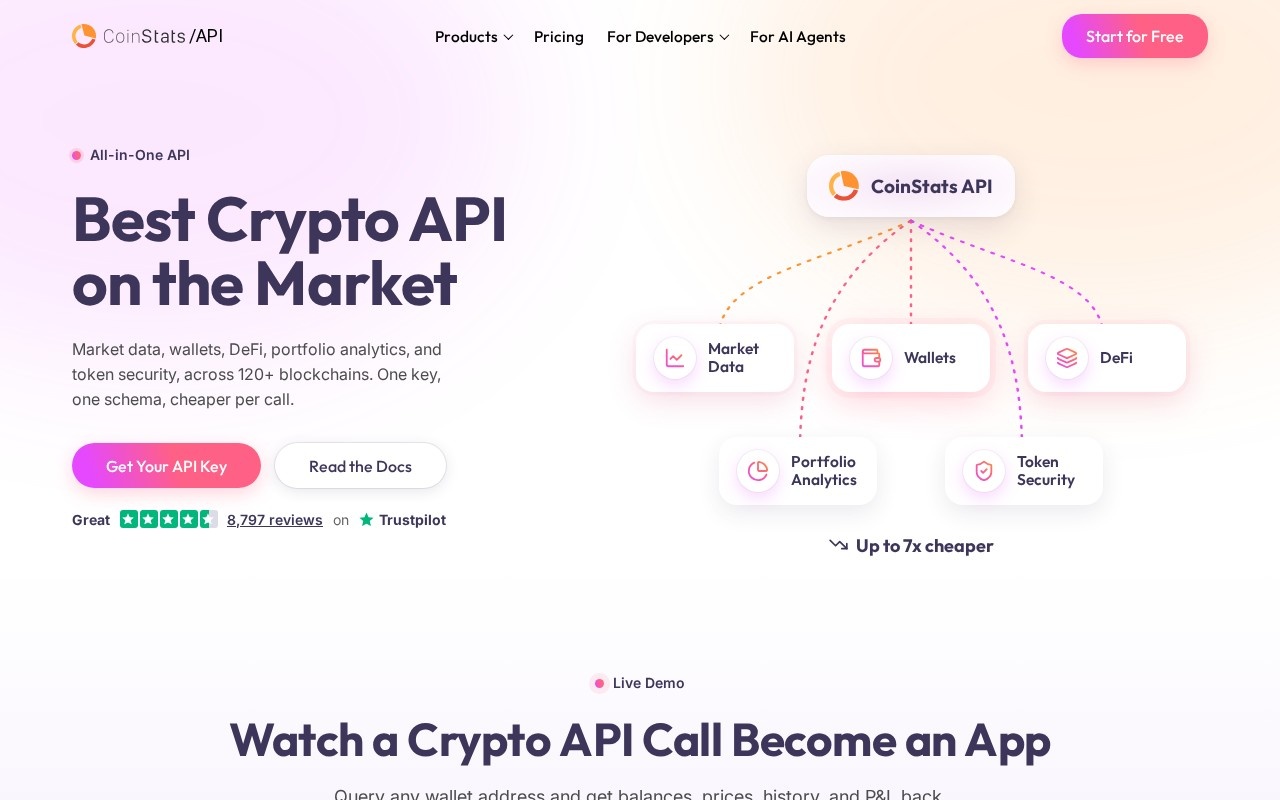
CoinStats API serves market, wallet, and DeFi data from one key. It runs on 120+ blockchains and 200+ exchanges. The same data powers the CoinStats app for 1M+ monthly users.
- Wallet balances and history across 120+ chains
- DeFi positions auto-detected across 10,000+ protocols
- Prices and charts for 100,000+ coins
- Token risk scoring to screen contracts
What to verify: Credit costs vary by endpoint. Map your call mix first.
CoinStats API exists because most crypto products outgrow a price feed. They need to show what a user actually holds. That means balances, history, DeFi, and risk together. CoinStats serves all of it from one schema. The same data runs the consumer app, so it is tested at scale.
The appeal is consolidation. One integration replaces a stack of vendors. That is usually cheaper than paying three providers. It is also less code to maintain. Fewer moving parts means fewer ways to break.
Pricing is credit based. The free tier gives 20,000 credits a month. Paid plans start near $49 a month. Light market calls cost one or two credits. Wallet and DeFi calls cost more, so size your plan to your mix.
Strengths. One key for market, wallet, DeFi, and risk. Broad chain coverage. Built in portfolio analytics. First class MCP support.
Watch-outs. Credit costs vary by endpoint. It is a data API, not an execution or RPC layer.
Say you want a portfolio view for any wallet. One call to CoinStats Crypto API returns balances, prices, and DeFi. You skip stitching a price vendor, an RPC node, and a parser. For a wider roundup, see our best crypto API guide.
Building on Ethereum? See our Ethereum API guide. Or start with CoinStats Ethereum API.
“Developers used to stitch five services together for one wallet view. That never made sense to us. Now one address returns balances, DeFi, and prices in a single call. Clean data is what lets teams ship fast. That is the API we wanted to build.”
Narek Gevorgyan, founder and CEO, CoinStats
The Graph
The Graph is a decentralized protocol for indexing blockchain data. You query subgraphs with GraphQL for custom datasets. A REST Token API adds balances, transfers, and prices.
- GraphQL subgraphs for custom indexed data
- Token API for balances, transfers, and holders
- MCP-ready Token API for AI agents
- Broad chain coverage across the network
What to verify: Subgraphs need GraphQL skills. Budget some learning time.
The Graph is the indexing layer many DeFi dashboards quietly run on. Subgraphs let you define the exact data you want. You then query it with GraphQL in a few lines. Major protocols like Uniswap and Aave already publish subgraphs.
Say you need every swap on a pool, over time. A subgraph returns just those fields, already indexed. You skip scanning blocks and decoding logs yourself. A newer Token API adds ready made balances and transfers over REST.
Pricing follows usage. You get 100,000 free queries a month to start. After that you pay per query as you scale.
Strengths. Precise GraphQL queries. A large library of community subgraphs. Decentralized, with no single point of failure.
Watch-outs. Subgraphs need GraphQL skills. Custom data means writing and deploying your own subgraph.
Covalent (GoldRush)
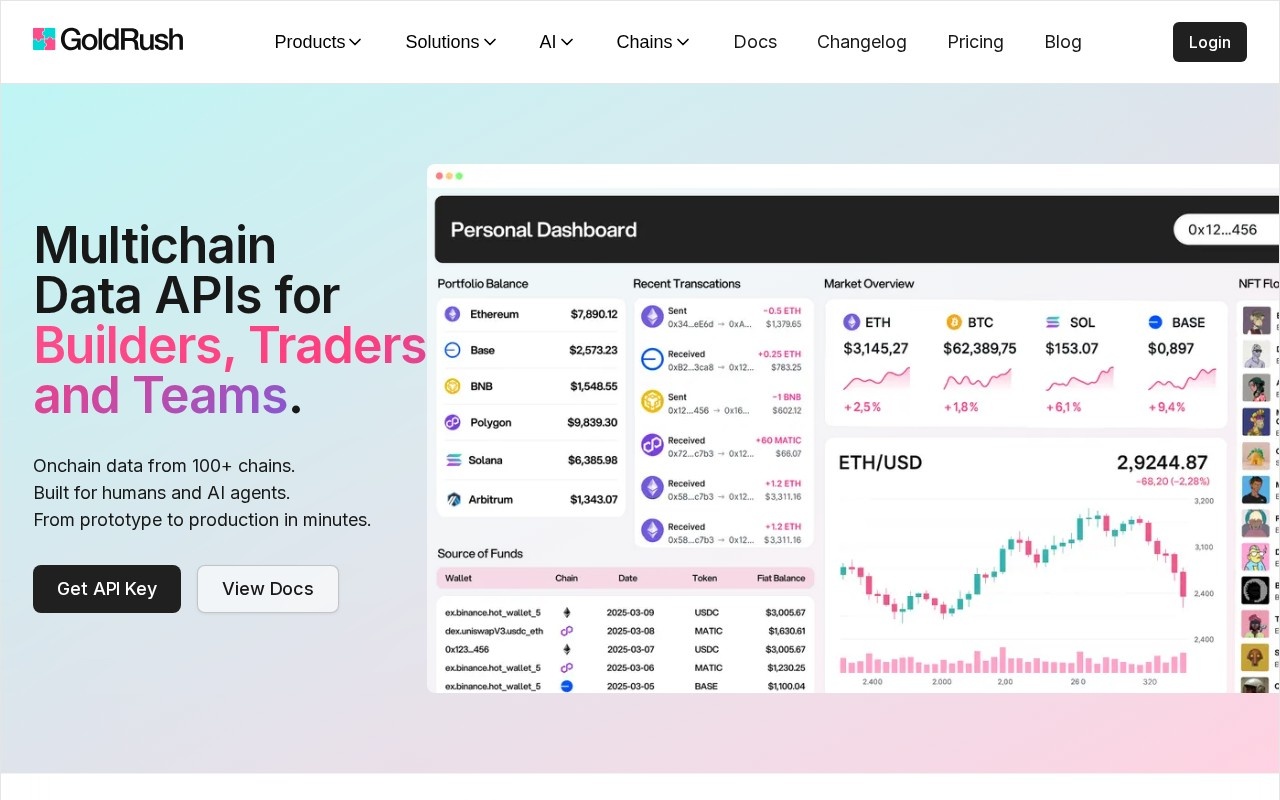
Covalent now operates as GoldRush. It returns historical onchain data across 100+ chains. One REST schema covers balances, transactions, and DEX trades.
- Token balances and transfers across 100+ chains
- Full historical onchain data by address
- DEX and price data in one schema
- GoldRush MCP server with 27+ tools
What to verify: Confirm support for your exact networks.
Covalent now goes by GoldRush. Its strength is breadth and history. One schema returns balances and transfers across 100+ chains. The historical depth suits analytics and backfills. Teams on smaller chains often find data here that others miss.
Imagine an analytics product across ten networks. With GoldRush the same call shape works on each one. You write one integration, not ten. That saves real engineering time on multichain pipelines.
Pricing is approachable. The free tier gives 100,000 credits a month. Paid plans start near $10 a month. A pay per request option also exists.
Strengths. Very broad chain coverage. Strong historical data. One consistent schema across chains.
Watch-outs. It can lag chain native APIs for real time use. Confirm depth on your exact networks.
Tatum
Tatum combines blockchain data APIs with RPC nodes. It supports 130+ networks from one platform. You also get wallets, notifications, and fee tools.
- Data API for balances, tokens, and transactions
- RPC node access across 130+ networks
- Real-time notifications for onchain events
- Official MCP server with 13 tools
What to verify: Free credits are lifetime, not monthly. Plan usage.
Tatum is the broad coverage option. It spans 130+ networks from one platform. You get data APIs and RPC nodes together. Extras include wallets, notifications, and fee tools. That helps when a project touches many chains at once.
Say a payments app needs ten chains and live alerts. Tatum can cover the data, the nodes, and the notifications. You lean on one vendor instead of several. That simplifies billing and support.
Pricing mixes free and paid tiers. The free plan includes 100,000 lifetime credits. Note that this pool is lifetime, not monthly. Dedicated throughput plans start near $99 a month.
Strengths. Very wide network support. Data and RPC in one place. An official MCP toolset.
Watch-outs. Free credits are lifetime, so they run out. Depth per chain varies, so test first.
Ankr
Ankr is node infrastructure for Web3 builders. It serves RPC across 70+ chains at scale. Advanced APIs add indexed data on select chains.
- RPC endpoints across 40+ public chains, free
- Advanced APIs for balances, tokens, and transactions
- Indexed queries across 19 mainnet chains
- 200M free API credits on the freemium tier
What to verify: No official MCP server yet. Check before you rely on it.
Ankr sits closer to infrastructure than data. Its RPC reaches 70+ chains at scale. Public endpoints are free and rate limited. Advanced APIs add indexed data on select chains. Teams pick Ankr when raw RPC throughput is the priority.
Think of a bot that reads state constantly. It needs fast, reliable RPC more than indexed feeds. Ankr is built for that kind of load. For clean balances and DeFi, pair it with a data API.
Pricing is mostly pay as you go. A public tier offers free, rate limited RPC. A freemium tier adds 200M credits a month for premium features.
Strengths. Strong RPC at scale. Wide chain list for nodes. A generous freemium credit pool.
Watch-outs. No official MCP server yet. Indexed data covers fewer chains than its RPC.
How blockchain API pricing works
Most blockchain APIs moved away from flat per call pricing. They use credits instead. Every plan includes a monthly credit pool. Each endpoint costs a set number of credits. Light calls cost little. Heavy calls cost more.
A price feed might cost one or two credits. A full wallet read can cost forty or more. A deep DeFi query can cost hundreds. So two apps on one plan can burn credits at very different rates.
This is why a raw price per call means little. What matters is your call mix. Map your real endpoints before you pick a plan. Then size the plan to that mix, with headroom.
Watch for two traps. First, lifetime credit pools that never refill, like the Tatum free tier. Second, multipliers on broad queries. Asking every chain at once can cost far more than naming a few. Specify the chains you need.
Free tiers also differ in spirit. Some give full data at a low limit. Others gate features behind paid plans. CoinStats API gives the same data on free and paid tiers. The only difference is a lower credit cap. Test the free tier the way you will actually use it.
One more cost note. Check the commercial terms, not just the price. Some free tiers block commercial use. CoinStats API allows commercial use on its free tier. Always read the license before you launch.
We listed the APIs with a genuine free tier, quotas and licenses included.
How we chose these five
We started from a simple goal. Help builders ship faster on clean data. So we focused on indexed data APIs, with infrastructure where it earns a place.
We screened every option three ways. First, is it alive and maintained in 2026? Some once popular APIs are now stale or shut down. Second, does it serve real, current data? We checked live docs and pricing pages. Third, does it ship an MCP server for AI agents?
We left out pure marketing claims and dead links. We also kept the list short on purpose. Five strong options beat twenty you have to filter. CoinStats API leads because it bundles the most layers behind one key. We said that up front, and we showed the facts.
We also weighed reliability and docs. An API with clear docs saves days of trial and error. We favored providers with status pages and active support. Where a provider fit a niche better, we said so. The goal is your best choice, not ours.
Top picks by category
Market, wallet, DeFi, and risk from one key.
Pick this if you display user holdings and value.
GraphQL subgraphs for bespoke datasets.
Pick this if you need custom indexed queries.
Deep history across 100+ chains.
Pick this for analytics and backfills.
Data plus RPC across 130+ networks.
Pick this if you need many chains at once.
Node infrastructure that scales.
Pick this for raw RPC throughput.
Comparison by use case
CoinStats API
It returns balances, prices, and DeFi together.
Alternatives: Covalent (GoldRush). See our best crypto wallet APIs.
The Graph
Subgraphs let you shape the exact dataset.
Alternatives: Covalent (GoldRush).
Covalent (GoldRush)
Deep onchain history across many chains.
Alternatives: The Graph.
Tatum
It reaches 130+ networks from one platform.
Alternatives: Ankr.
Ankr
It is built for raw RPC at scale.
Alternatives: Tatum.
CoinStats API
One schema across market, wallet, and DeFi.
Alternatives: The Graph, Covalent (GoldRush).
Common mistakes to avoid
A few errors show up again and again. Here are the ones worth dodging.
Picking by brand, not by fit. The biggest name is not always right. Match the API to the data you display. A price API will not show a user their holdings.
Skipping the free tier test. Homepages look great. Responses are what you ship. Send a real call and read the JSON before you commit.
Ignoring the call mix. A cheap looking plan can get expensive fast. Heavy wallet and DeFi calls burn credits quickly. Estimate your mix first.
Confusing RPC with data. Raw nodes do not return priced balances or DeFi positions. If you want clean output, use a data API.
Gluing too many providers. Every extra API adds keys, schemas, and failure points. Fewer providers means less to reconcile and maintain.
Forgetting rate limits. Free tiers cap requests per second. Plan for backoff and caching before launch, not after.
Trusting the homepage number. Coverage claims can be optimistic. A chain may be listed but thin. Test your exact networks and endpoints.
Building with no exit. Schemas differ across providers. Wrap each API behind your own interface. Then a future switch costs days, not weeks.
Over-optimizing too early. You do not need the perfect API on day one. Start with a free tier that fits. Switch later if your needs change.
How to choose your blockchain API
Start with your use case, not a brand. Write down the chains and data you actually need. Then test the free tier with a real call. Check coverage, latency, and rate limits under load.
Read the response, not the homepage logo. Confirm pricing on the official page before you commit. Run the same call across two providers and compare. The right API is the one that fits your data.
Sometimes one API will not cover everything. That is fine. A common pattern pairs a data API with an RPC provider. You read state from the data API. You write transactions through the node. Keep the two concerns in separate keys. A leak on one side then cannot touch the other.
One more habit saves real time. Run a small spike before you commit. Wire one screen end to end with the free tier. Measure latency, coverage, and credit burn on your own data. The right choice is usually obvious within an hour.
The bottom line is simple. There is no single best blockchain API. There is only the best fit for your product. Define your data needs, then let the choice follow.
Community and further reading
Representative of recurring r/ethdev threads on choosing a blockchain data API.
Longevity is a selection criterion now. Sim users learned that in August. Compare Dune Sim alternatives before committing.
Picking per chain? Start with our best Solana API guide.
Frequently asked questions about blockchain APIs
What is a blockchain API?
A blockchain API lets your app read chain data over HTTP. It returns prices, balances, transactions, and DeFi positions as JSON. You skip running your own nodes.
What is the difference between a blockchain API and an RPC?
An RPC gives raw, low level access to a node. A data API returns clean, indexed JSON. Most apps want the data API.
What is a data API versus a node provider?
A node provider serves raw RPC calls. A data API indexes the chain for you. See our RPC node provider comparison. It returns balances and prices ready to use.
What is the best blockchain API?
It depends on your use case. For all-in-one wallet and market data, CoinStats API fits well. For custom indexing, The Graph is a strong choice.
What is the best blockchain API for developers?
Developers value clean docs and a real free tier. CoinStats API and Covalent (GoldRush) both score well here. Test each before you commit.
How do I get wallet balances from a blockchain API?
Call a balances endpoint with a wallet address. CoinStats API returns priced balances across 120+ chains. The response is structured JSON.
Can I get DeFi data from a blockchain API?
Yes. CoinStats API auto-detects DeFi positions across 10,000+ protocols. Covalent (GoldRush) and The Graph also expose onchain DeFi data.
Which blockchain API is best for DeFi data?
CoinStats API detects DeFi positions across 10,000+ protocols. The Graph is strong for custom DeFi queries. Covalent (GoldRush) adds deep historical DeFi data. Pick by how much custom shaping you need.
Do blockchain APIs support multiple chains?
Yes. CoinStats API covers 120+ chains. Tatum reaches 130+ networks, and Covalent (GoldRush) covers 100+ chains.
Do blockchain APIs support Solana and Bitcoin?
Yes. CoinStats API covers Solana, Bitcoin, and EVM chains. Tatum and Covalent (GoldRush) also reach beyond EVM. Check each provider for your exact networks.
What is the best blockchain API for portfolio data?
CoinStats API is built for portfolio data. It returns balances, history, and profit and loss from one key. That suits trackers and tax tools.
Which blockchain API works with AI agents and MCP?
CoinStats API, The Graph, Covalent (GoldRush), and Tatum all ship MCP servers. MCP is now a baseline feature, not a differentiator.
Is there a free blockchain API?
Yes. CoinStats API has a free tier with 20,000 credits a month. The Graph, Tatum, and Ankr also offer free tiers. GoldRush offers a 14-day trial.
How much does a blockchain API cost?
Most use credit based plans. Free tiers start at zero. Paid plans here range from about $10 to $99 a month. Heavy usage costs more, so size to your call mix.
What is the best free blockchain API?
It depends on volume. CoinStats API gives 20,000 credits a month with full data. GoldRush gives a 14-day trial with 25,000 credits. The Graph gives 100,000 queries. Test each on your real calls.
How many requests do free blockchain APIs allow?
Limits vary by provider. CoinStats API allows 2 requests per second on the free tier. Always check the current pricing page.
How do I choose a blockchain API?
List the chains and data you need. Test the free tier with a real call. Then compare coverage, latency, and pricing.
Do I need both a data API and an RPC provider?
Often, yes. Use a data API to read and display information. Use RPC to submit transactions or read raw state. A data API alone is enough for read only products.
Can I use a blockchain API for a trading bot?
Yes, for the data side. CoinStats API serves prices and history for signals and backtests. A blockchain API does not place trades. Pair it with your exchange or RPC for execution.
Tigran is the Head of Digital Marketing at CoinStats, working across crypto and consumer apps. His writing covers first-hand crypto experience and marketing case studies from that work. He has taken the stage at industry-leading conferences like MAU Vegas, Business of Apps Berlin, and App Promotion Summit London.
More from Tigran on the CoinStats blog · LinkedIn · X