SimpleSwap Review 2026: Fees, Safety & How It Works

Tigran Mkrtchyan from CoinStats. Checked for accuracy on 12 August 2026.
SimpleSwap is a self-custodial multi-source swap aggregator. It handles the complexity of wallet-to-wallet crypto exchanges. You skip comparing rates across exchanges and building swap routes by hand. One entry point gives you aggregated liquidity from 20+ CEX and DEX providers. Funds move from a wallet you own to a wallet you own. The product has been on the market since 2018.
Wallet-to-wallet swapping spreads your crypto across chains and addresses. CoinStats crypto tracker pulls it back into one portfolio view. It covers 100,000+ coins across 120+ blockchains and 200+ exchanges.
Quick take
You want to swap crypto between your own wallets. You do not want an exchange account or a trading terminal. SimpleSwap does exactly that. The product launched in 2018. It has stayed online through every market cycle since.
What SimpleSwap actually is
SimpleSwap pulls liquidity from well-known CEX and DEX sources under the hood. In practice the flow is short. You pick a trading pair. You enter your receiving wallet address. You send the crypto. The converted asset lands in your wallet. Most crypto-to-crypto swaps need no account and no long-term balance.
The key distinction sits in the architecture. SimpleSwap runs no order book of its own. It keeps no user balances on hand. When you start a swap, the service receives your incoming transaction. It then routes the conversion across 20+ liquidity providers. Those span both CEX and DEX venues. The converted asset goes to the receiving address you specified. There is no platform account to fund. There is no balance to manage between swaps.
This is why the common SimpleSwap crypto exchange label misses the point. A traditional exchange asks you to keep an account. You then trade against other participants on an order book. SimpleSwap works more like a broker for one transaction. You provide the inputs. The converted result arrives in your wallet. Provider and route selection happen across aggregated liquidity.
That structure shapes everything else. It explains the simple interface and the breadth of supported assets. It explains the speed of execution. It also explains one more thing. Your funds never sit on a service you do not control.
Who should use SimpleSwap
You keep crypto in your own wallet. You want to convert assets without handing custody to anyone. Funds move wallet to wallet. You stay in control throughout.
You need a coin your usual venue does not list. Or you want to rebalance without opening another exchange account. Aggregated liquidity gives you one entry point.
Most crypto-to-crypto swaps need no account creation. You start a swap, it executes, and you move on. Nothing stays behind beyond the blockchain transaction.
Coverage spans Solana, Sui, Base, KAIA, Linea, and Ronin. That is 3.2M+ trading pairs from a single interface. No juggling five exchange accounts.
First-time crypto users. If crypto is new to you, the swap flow reads like a wallet transfer. It does not read like a trading terminal. You pick the pair and send the deposit. The converted asset then arrives in your wallet. Order-book mechanics and slippage parameters stay out of the path. There is nothing extra to learn before your first transaction. If something goes sideways, 24/7 live chat is one click away. Average response time is 4 minutes.
How to use SimpleSwap step by step
The whole flow takes about a minute of active work.
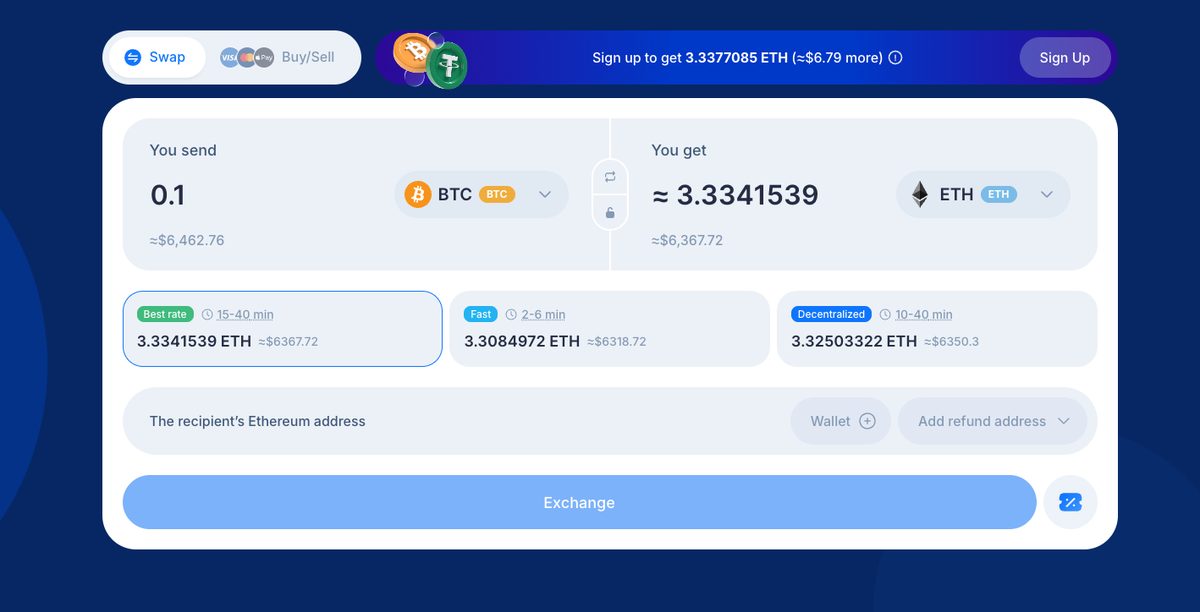
Choose your pair
Select the cryptocurrency you want to send. Then select the one you want to receive. SimpleSwap calculates an estimated conversion rate right away. That rate reflects real-time liquidity across its provider network. You see the expected output amount before committing.
Pick your rate type
Fixed rate locks the price for 20 minutes. You know exactly what you will receive. Your deposit just needs to arrive inside that window. Best for volatile conditions, or when certainty beats a marginally better deal.
Floating rate reflects real-time market pricing. The final amount is set at the moment of execution. Crypto prices move constantly, so the output may vary from the estimate.
Enter your wallet address
Provide the destination wallet address for the swapped asset. Some assets exist on multiple networks. USDT runs on TRX, BSC, ETH, and Solana, for example. Select the correct network before entering the address. Sending to the wrong network can lose your funds. SimpleSwap displays the required network during the swap flow. The final check is still on you.
Send your crypto
SimpleSwap generates a unique deposit address for this transaction. You send crypto from your own wallet to that address. That is the last action you need to take.
The platform handles the rest
Your transaction hits the blockchain. SimpleSwap waits for the required confirmations, which vary by network. Once confirmed, the swap routes through the optimal liquidity provider. That provider executes the conversion using available market liquidity. The converted asset then goes to the receiving wallet address you provided.
From your side it feels like a simple wallet transfer. Behind the scenes, SimpleSwap coordinates confirmations and routes the swap across aggregated liquidity.
Platform features in detail
2,800+ supported cryptocurrencies
SimpleSwap lists assets across major blockchain ecosystems. That runs from blue chips like Bitcoin and Ethereum to stablecoins. It also covers DeFi tokens, memecoins, and long-tail altcoins. The product added 450+ new assets in the past year alone. It followed momentum into Solana, Sui, Base, KAIA, Linea, and Ronin.
In practical terms you skip opening accounts on multiple exchanges. You reach those ecosystems through a single swap interface. Coverage runs from stablecoins like USD1 to trending tokens such as SHIB or PEPE. Where there is demand and liquidity, SimpleSwap routes it.
3.2 million+ trading pairs
Every combination of supported assets creates a potential trading pair. The aggregation engine handles cross-chain routing automatically. You do not pick a bridge or an intermediary token. The route is optimised for you.
No account needed for most crypto-to-crypto swaps
Standard crypto-to-crypto conversions skip the registration flow entirely. The product takes you from a selected pair to a confirmed transaction. There is no profile setup and no password to manage. Centralized exchanges require full onboarding before your first trade. This is a real difference.
Optional account creation unlocks the Loyalty Program. That includes fee discounts, USDT cashback, swap history, and price alerts.
Wallet-to-wallet architecture
Funds leave a wallet you own. They arrive at a wallet you own. Between those two points, SimpleSwap moves the transaction through its own infrastructure. That is how it sources aggregated liquidity. The relationship ends with that single transaction. There is no platform account to top up beforehand. There is no long-term balance to draw down after. This changes your risk profile compared to holding a position on an exchange.
SimpleSwap app, redesigned in 2026
The iOS and Android apps were rebuilt this year. They ship a cleaner interface and faster navigation. Completing a swap takes fewer taps. The redesign reflects how people actually use the product in 2026. That means quick conversions on the go, not long trading sessions at a desk.
Price alerts
Price alerts let you set notifications for specific cryptocurrencies. The market hits your target price and you get notified. You stop staring at charts. You wait for the alert and swap when conditions are right.
Loyalty Program: four tiers
SimpleSwap runs a four-tier Loyalty Program. Every tier carries a progressive fee discount on each swap. Higher tiers add USDT cashback. To join, create a Customer Account or log in with Google. You start at Bronze automatically.
Every swap counts toward your level permanently. There is no expiration window. Once you reach a tier, you keep it. Your volume can later drop below the threshold and the tier stays.
*Gold and Platinum members can switch reward modes once per month. The default mode pairs cashback with the standard fee discount. The enhanced mode drops cashback for a larger fee reduction.
Cashback is paid in USDT. Payout runs over TRX or BSC networks. Minimum withdrawal amount is 250 USDT. Gold and Platinum members also get a dedicated personal manager on Telegram. That manager is available 24/7 and handles requests within minutes.
Fiat on-ramp
Crypto should not be hard to buy. SimpleSwap offers fiat-to-crypto purchases through partner providers. Those include Mercuryo, Simplex, and Guardarian. You go from traditional currency to crypto without workarounds. Note that fiat purchases may trigger standard KYC verification. Payment processors require it.
What it costs: SimpleSwap fees explained
How SimpleSwap pricing works
SimpleSwap charges no separate, visible trading fee. Centralized exchanges do it differently. Here all costs are bundled into the conversion rate. You see that rate before confirming your swap. The quoted amount is the amount you receive. There are no hidden charges or surprise deductions afterward.
The rate you are quoted includes several components.
Liquidity spread. This is the gap between buy and sell prices from the underlying provider. It varies by asset pair and market depth. Major pairs like BTC/ETH and BTC/USDT carry tighter spreads. Exotic or low-liquidity pairs run wider. Typical range is 0.5% to 2%.
Service component. SimpleSwap’s margin is built into the rate. It covers product operations, infrastructure, support, and development.
Blockchain network fees. SimpleSwap does not charge these. They are the standard transaction fees the blockchain itself requires. They vary by network.
Routing costs. These come from executing the swap through partner exchanges or liquidity providers. They are included in the rate.
Fixed rate vs floating rate: the cost difference
Fixed rates carry a slightly wider spread than floating rates. That is the price of certainty. You are paying for a 20-minute price guarantee. It protects you from volatility during blockchain confirmation.
Floating rates can deliver a marginally better deal. That happens when the market moves in your favor. They can also move against you.
For most standard conversions the difference is small. The choice comes down to preference. Certainty or potential upside.
The bottom line on fees
SimpleSwap is optimized for convenience. It is not optimized for the lowest fee on every transaction. Say you run dozens of swaps daily. Say you compare spreads across five platforms hunting 0.05% edges. Centralized exchanges with explicit maker/taker fees may price tighter.
Now say you value self-custody, privacy, speed, and simplicity. You want one rate that includes everything, with no surprises. SimpleSwap’s bundled pricing model works exactly as advertised.
Support
In traditional finance, a delayed bank transfer is annoying. It is rarely catastrophic. In crypto, a stuck swap during a volatile market means real money. Support quality is not a nice-to-have here. It is infrastructure.
How support actually works
Live chat is available on the website and in the app. It is not a chatbot looping you through FAQ articles. These are human support agents who can look into your specific swap.
Order tracking gives you real-time visibility into every swap. Each transaction gets a unique order ID. The tracking page shows exactly where your swap stands. That runs from deposit confirmation to final delivery. Something gets delayed at any step and you see it immediately. Network congestion and liquidity routing both show up there.
Personal manager, for Gold and Platinum. This is where SimpleSwap diverges from the industry norm. At higher loyalty tiers you skip the ticket queue. A dedicated person knows your swap history and responds directly. Most platforms hide behind support forms and automated responses. This is a deliberately old-school choice that still works.
When things go wrong
Blockchain transactions can be unpredictable. Network congestion and confirmation delays stretch the timeline. Here is what SimpleSwap does differently.
Automatic resolution. Most support cases resolve automatically through internal systems. There is no ticket to file and no wait time on your side.
Fast human escalation. Some cases need human attention. The 4-minute average response time means you are not sitting in a queue. Your funds are not in limbo while the market moves.
Comparison with exchanges. Centralized exchange cases involving held funds can stretch for weeks. Compliance reviews can run longer. SimpleSwap’s resolution speed is a direct competitive advantage. That matters most for users with large swap volumes, where time equals money.
Security and self-custody
The core principle: your keys, your crypto
SimpleSwap is built on one architectural decision. There are no long-term user balances on the platform. This is not a marketing line. It is the structural difference from a centralized exchange.
On a traditional exchange you deposit crypto into the exchange’s wallet. The exchange controls those funds until you withdraw. That creates a single point of failure. The exchange gets hacked, goes insolvent, freezes withdrawals, or draws regulatory action. Your funds are at risk in every case. FTX, Celsius, Mt. Gox, and dozens of smaller platforms proved this is not theoretical.
SimpleSwap works differently. Your crypto leaves a wallet you own. It arrives at another wallet you own. The swap routes through SimpleSwap’s infrastructure in a single transaction. No ongoing platform account holds your funds. There is no exchange-style position to manage between swaps.
- Exchange custody risk. You keep no long-term balance on a platform you do not control. There is no exposure to platform insolvency.
- Counterparty risk. You are not trusting SimpleSwap to store your portfolio. Trust is limited to a single swap transaction.
- Account compromise risk. Most swaps require no account. The surface area for credential theft stays minimal.
What you are still responsible for
Self-custody means self-responsibility. SimpleSwap removes platform-side risks. You still handle the basics.
Wallet address accuracy. Always double-check the receiving wallet address. Blockchain transactions are irreversible. Send crypto to the wrong address and it is gone. SimpleSwap cannot reverse a confirmed blockchain transaction.
Network selection. Make sure you are sending on the correct blockchain network. Sending ERC-20 tokens to a BSC address can mean permanent loss. The reverse is equally true.
Wallet security. Your private keys, seed phrases, and wallet access are your responsibility. SimpleSwap never asks for your private keys.
Where identity verification applies
Most crypto-to-crypto swaps on SimpleSwap need no sign-up or document upload. The standard flow stays simple. Choose a pair. Enter the receiving wallet address. Send the deposit. Wait for the swapped asset to arrive.
KYC appears where identity confirmation is actually needed. Fiat purchases follow the requirements of payment partners. Those include Mercuryo, Simplex, MoonPay, Banxa, and Guardarian. Crypto-to-crypto swaps can also require verification. That happens when a specific transaction falls into a compliance scenario.
SimpleSwap also lets users verify their account in advance. The process takes a few minutes to submit at simpleswap.io/kyc. It confirms identity using an official document and a live face check.
Some users want a fuller account setup up front. It saves running into a case that needs identity data. For them this is the cleaner route. A verified account gives SimpleSwap and its provider network confirmed information from the start. That can open access to a broader liquidity provider pool and better rates. It supports more reliable processing. It reduces the need to collect basic identity details later. It also saves time if additional review comes up in the future.
When a swap needs review
SimpleSwap is built to keep wallet-to-wallet swaps simple. That means fewer steps and no long-term platform balance. Most crypto-to-crypto exchanges need no account at all. The goal is a clear, predictable experience. It should protect users without turning every swap into a full onboarding flow.
Most exchanges process automatically. In some situations additional review is required. Legal, regulatory, or compliance obligations drive that. Crypto funds may carry history from previous wallets, platforms, or counterparties. Transaction screening can surface information that needs more context. That can happen even when the current sender was not directly involved.
This is why a swap may be temporarily paused. A pause is not an accusation. It means the transaction context needs to be clarified.
In these cases SimpleSwap may ask about the source of funds. It may request documents that confirm the transaction context. This information meets legal and compliance obligations. It also helps the team understand the case correctly. Information requested more than once is not a delay tactic. It usually means the previous materials did not answer the compliance question clearly enough. Format, quality, or level of detail may have fallen short.
Some details cannot be discussed publicly. Sharing specific triggers, report sources, or risk logic could violate legal requirements. The same applies to affected parties and active-review details. AML/KYC, privacy, provider, regulator, and competent authority rules all apply. It could also make the screening process easier to bypass.
Third parties, regulators, or competent authorities may be involved. The timeline can then depend on their review. A firm ETA is not always possible. The case still moves through a defined process. That process clarifies the transaction and completes the exchange. It can also return the funds, or resolve the matter per procedure. Continue through the official support channel and provide the requested information there. That helps the review move quickest.
Integration into other platforms
SimpleSwap’s swap infrastructure reaches 6,000+ partner products. It gets there through SimpleSwap API. Those partners range from leading crypto wallets to enterprise-grade aggregators.
Key integrations include Exodus, which is NYSE-listed and powers self-custodial fixed-rate swaps. Tangem runs native swaps inside the cold wallet via Tangem Express. Private keys never leave the device there. Ellipal was the first co-branded hardware wallet integration and is 100% air-gapped. Cake Wallet is an open-source privacy wallet. Swaps have been a core feature there since 2022. Tonkeeper uses the swap engine for the leading TON ecosystem wallet.
The product runs on a self-custodial, wallet-to-wallet model. There is no deposit storage. Crypto moves directly from your wallet to your wallet. SimpleSwap scans liquidity across its provider network. It routes each swap through the optimal source. That delivers competitive rates without making you interact with multiple platforms.
Is SimpleSwap legit?
Yes, and that rests on record rather than reassurance. SimpleSwap Ltd has run the product since 2018. It has stayed online through every cycle since. The service has processed 20M+ swaps for 10M+ users with 99.9% uptime. The swap engine sits inside 6,000+ partner products. Those include Exodus, Ellipal, Cake Wallet, Tonkeeper, and Tangem. Each ran its own due diligence before integrating an outside service.
The legal documentation is public, not implied. Terms of Service, Privacy Policy, and Affiliate Terms all sit on the site. So does the Anti-Financial Crime and KYC Policy.
SimpleSwap Trustpilot reviews
What are users saying? Trustpilot is the most active page for simpleswap.io reviews. The company profile has been maintained since 2018. As of mid-2026 the service holds a 4.1 TrustScore with a Great label. That rests on 2,500+ reviews. Over the last 12 months, 80% of reviews left were five-star. The company replies to 100% of negative reviews, typically within a day. That is verified on the page. Reddit threads on the topic read much the same way.
Aggregators keep their own cards too. On Cryptoradar, simpleswap.io holds a 4.6 out of 5 user rating. The verification experience scores 4.7 there.