
Dragonfly’s Qureshi Urges Ending Zcash Dev Fund After 2028

0
0
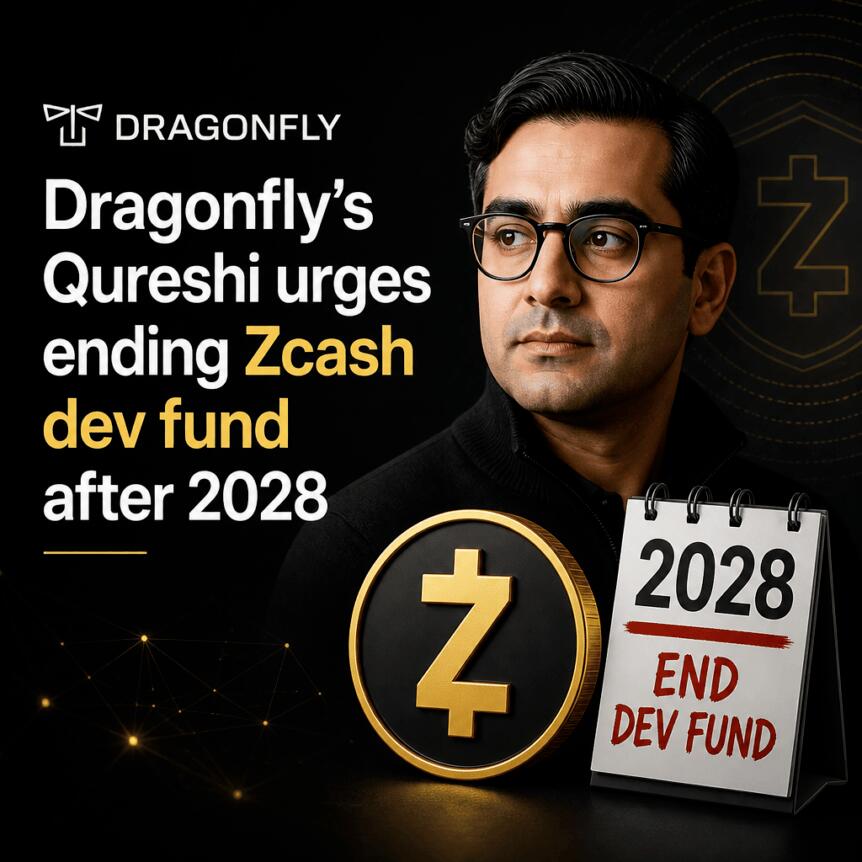
Dragonfly managing partner Haseeb Qureshi has urged the Zcash community to wind down the protocol’s ZEC development fund after it expires under current rules in 2028, arguing the fund has grown large enough to cover remaining work while also becoming increasingly vulnerable to “politicization” as its size nears $100 million.
The proposal lands amid a broader internal debate over how (and whether) the development fund should be controlled—an issue that has intensified as the ZEC token’s rally boosted the fund’s value. At press time, ZecStats reported the fund held 63,962 Zcash (ZEC) tokens, worth roughly $95 million.
Key takeaways
- Haseeb Qureshi argues the Zcash development fund should be treated as a final “dev fund,” ending when it expires in 2028.
- Based on ZecStats data, the fund’s balance is about $95 million and sits outside circulation until governance disburses it.
- Supporters say the fund is crucial for sustained development amid fast-evolving threats, including AI and quantum risks.
- The community is split not only on whether the fund should continue, but also on whether control should move toward token-holder voting.
- Critics including Maxime Desalle argue that ending the fund could eliminate governance disputes and potential security or dependency risks.
Why Qureshi wants the dev fund to end in 2028
Qureshi’s position, laid out in a Friday post on X, is focused on timing, size, and governance risk. He said the current development fund should be the last one, since it is already large enough to fund remaining Zcash work before the fund expires under existing rules in 2028.
In his view, however, the more the fund grows, the more it risks being drawn into political dynamics rather than purely technical decision-making. That concern is particularly salient as the fund approaches a value threshold of about $100 million, according to the ZecStats-reported balance.
For investors and builders, the core question is whether a large, semi-autonomous treasury mechanism improves continuity for development—or whether it creates governance friction that can slow priorities or erode long-term consensus.
How the Zcash development fund works
The ZEC development fund is designed as a protocol development allocation that accrues 0.1875 ZEC per block. Under the NU6 upgrade, that amount is described as representing 12% of the block subsidy. The fund’s holdings are kept outside normal token circulation, only becoming available when governance processes authorize disbursement.
Because it is built into the protocol’s block subsidy economics, the fund’s size is not simply a matter of community fundraising—it naturally expands with ongoing block production until its rules expire. That structural feature is part of why the current debate has intensified: a rising ZEC price increases the dollar value of locked assets without changing the number of tokens held.
A split on governance: token voting versus hybrid councils
Beyond the timing of any wind-down, Qureshi also challenged how the fund should be governed. He argued that control should not shift to “pure token holder voting,” while still supporting a partial approach in which token holders elect temporary councils.
Paradigm founder Matt Huang supported the broader idea of avoiding purely token-holder-driven control, arguing in a Wednesday post on X that pure token governance may introduce “unpredictability” and reduce long-term trust in Zcash as a monetary asset. Huang’s proposed alternative is a hybrid governance model that combines multiple forms of oversight rather than relying exclusively on token-weighted voting.
These arguments reflect a common tension in protocol treasuries: token-weighted systems can align governance with market incentives, but they may also be vulnerable to volatility-driven shifts in voting behavior. Hybrid systems, by contrast, aim to stabilize decision-making while still preserving a pathway for community influence.
Calls to eliminate the fund altogether
Not everyone agrees the fund should be preserved—even temporarily. Maxime Desalle, an investment analyst at Winklevoss Capital, suggested in a Thursday X post that the Zcash community should “completely get rid” of the development fund. He framed the elimination of the mechanism as a way to resolve governance disputes outright.
Desalle previously argued that the fund could hurt Zcash’s security and recreate the kinds of dependencies and bureaucracies that, in his view, many welfare-state systems face. While his critique focuses on governance structure, it also implies a more fundamental concern: that continuously accumulating value into a locked treasury can create incentives to capture decision-making rather than improve protocol resilience.
On the other side, Zcash founder Zooko Wilcox emphasized the historical role of development governance. In an earlier post on Sept. 1, he pointed to the Zcash Community Grants Committee as a major reason Zcash “has survived and grown to where it is today.” Later, on Sept. 14, Wilcox clarified that the committee accounts for only 40% of the development fund—an important detail for readers trying to map how much of the treasury is actually tied to grants versus other protocol-linked allocations.
What Zcash holders should watch next
The immediate uncertainty is whether Qureshi’s “final dev fund” framing will gain traction, and—separately—what governance model the community ultimately favors for any remaining disbursements before 2028. With the fund’s dollar value near $100 million based on ZecStats, governance decisions are likely to become more contentious, making the next proposals and voting outcomes crucial for anyone tracking Zcash’s long-term development runway.
This article was originally published as Dragonfly’s Qureshi Urges Ending Zcash Dev Fund After 2028 on Crypto Breaking News – your trusted source for crypto news, Bitcoin news, and blockchain updates.
0
0

 Управляйте всей своей криптовалютой, NFT и DeFi из одного места
Безопасно подключите используемый вами портфель для начала.


