
Top 5 Best Crypto Data APIs in 2026

Written by Tigran Mkrtchyan · Reviewed and fact-checked by Narek Gevorgyan · Published May 14, 2026 · Last updated September 4, 2026
Crypto runs nonstop. So does the data that powers every app on top of it. Developers, analysts, and product teams all depend on the same thing. They need a reliable source of crypto data, served fast, at the right price.
If wallet balances and DeFi positions are the data you need, see our roundup of the crypto wallet APIs built for that job. Teams shopping the DeFi layer specifically should also check our best DeFi APIs guide.
The market has dozens of providers. Most cover one slice well and the rest poorly. That makes picking the right API harder than it should be.
This guide compares the five best crypto data APIs in 2026. We look at coverage, data freshness, pricing, and the jobs each one actually fits. By the end, you’ll know which API matches your use case.
For a wider lineup that includes wallet-tracking and DeFi-focused tools, see our best crypto API guide.
Need a wider field? See seven more data API alternatives compared.
For Ethereum specifically, you may want a dedicated Ethereum data API.
What Is a Crypto Data API?
A crypto data API is the pipe that delivers crypto data to your app. Prices, volumes, wallet balances, onchain activity, research notes. Anything you’d otherwise scrape from a dozen sources.
One request goes out. The provider pulls from exchanges, chains, and DeFi protocols and returns one JSON response.
Most providers fall into one of two buckets.
Most teams need both. That’s where the choice gets interesting.
A market data API alone covers price displays and simple charts. Then you add a wallet input. Or a DeFi yield breakdown. Or an AI agent that reads onchain activity.
At that point you’ve moved past market data. You need an API that resolves wallet addresses to balances. You need it to surface protocol positions. You need it to feed context to your models.
Pure market data APIs hit a wall there. Pure onchain APIs hit the wall on the other side. The best crypto data API for most products is the one that crosses both.

Delivery shape matters too. Most providers ship REST endpoints. Some add WebSocket streams for live data. A few now expose an MCP Server.
That last one is new and worth flagging. MCP turns a data API into a tool any LLM can call directly. If you’re building anything with AI agents, providers that support MCP save you weeks of glue code.
Polling, streaming, and MCP tool calls. Same data, three different rhythms.
Latency is the other axis. Portfolio trackers run fine with 30 to 60 second refresh. Trading systems need sub-second WebSocket streams. Most apps live in between.
Match the cadence to the job. Paying for tick-level data you don’t use is wasted budget. It’s one of the most common overspends on a crypto API bill.

Want the longer list? See API alternatives compared on pricing.
How to Choose the Right Crypto Data API
There’s no universal best. The right pick depends on coverage needs, latency, budget, and what your app actually does. Six factors matter most.
One factor often gets skipped. AI agent and LLM integration.
As assistants move from chat into action, your data layer needs new protocols. That means MCP Servers, structured tool schemas, and reasoning-friendly endpoints. Every provider in the list is heading there. The depth of support varies.
A quick word on pricing models. Some providers charge per call. Others charge per credit, with each endpoint consuming a different amount. A third group flat-rates by tier and lets you call as much as you want.
Per-credit is the most flexible. It also makes forecasting harder. Always read the docs before committing. Hidden multipliers on bulk endpoints can quietly turn a $99 plan into $999 in usage.
On a tight budget? Start with the free crypto data APIs we verified.

The Top 5 Crypto Data APIs in 2026
We picked these five based on coverage breadth, data quality, transparent pricing, and developer experience. Order reflects fit for the broadest range of crypto use cases, not raw scale.
We left out two categories on purpose. Trading APIs from exchanges like Binance and Coinbase are excluded because they only serve their own venue. Pure onchain RPC providers are out for the same reason. If raw node access is what you’re after, see our guide to the best blockchain APIs.
They answer one low-level question rather than aggregating data for product use. The five here all aggregate. All sell access through tiers. All serve developers building apps for end users.
CoinStats API covers the broadest functional surface among the providers in this list. Most crypto APIs answer one question. CoinStats answers five. What’s the price? What’s in this wallet? What positions does the wallet hold across DeFi? What’s the portfolio value over time? Is this token safe to interact with?
CoinStats unifies multiple layers of crypto intelligence into a single API platform. In formula terms:
Developers often describe CoinStats API as CoinGecko or CoinMarketCap with extra layers. Market data coverage matches. Wallets, DeFi, portfolio analytics, and token security stack on top. Pricing runs four to six times cheaper at the entry tier.
Coverage runs across 100,000+ coins, 200+ exchanges including Binance, Coinbase, and Hyperliquid, and 120+ blockchains. Wallet endpoints support Ethereum and other EVM chains, Solana, and Bitcoin via xpub, ypub, and zpub.
DeFi resolution covers 10,000+ protocols at the per-wallet level. That means staking, lending, LP positions, and yield are detected automatically from any wallet address. Not surfaced as protocol-wide TVL.
Coinstats also ships an MCP Server. All three major crypto data providers now have MCP Servers. Only CoinStats exposes wallet, DeFi, and portfolio data through it.
That’s the layer LLMs and AI agents need. Without it, an agent can describe a user’s holdings. With it, the agent can act on them.
The product behind the API runs at scale. 1M monthly users sit on top of these endpoints across web, mobile, and the wider CoinStats app. That informs the surface in practical ways.
Wallet ingestion handles the messy reality of multi-chain users. DeFi resolution covers the long tail of newer protocols, not just the top 20. Portfolio aggregation collapses balances from CEXs, wallets, and DeFi positions into one number. That’s how a real user wants to see it.
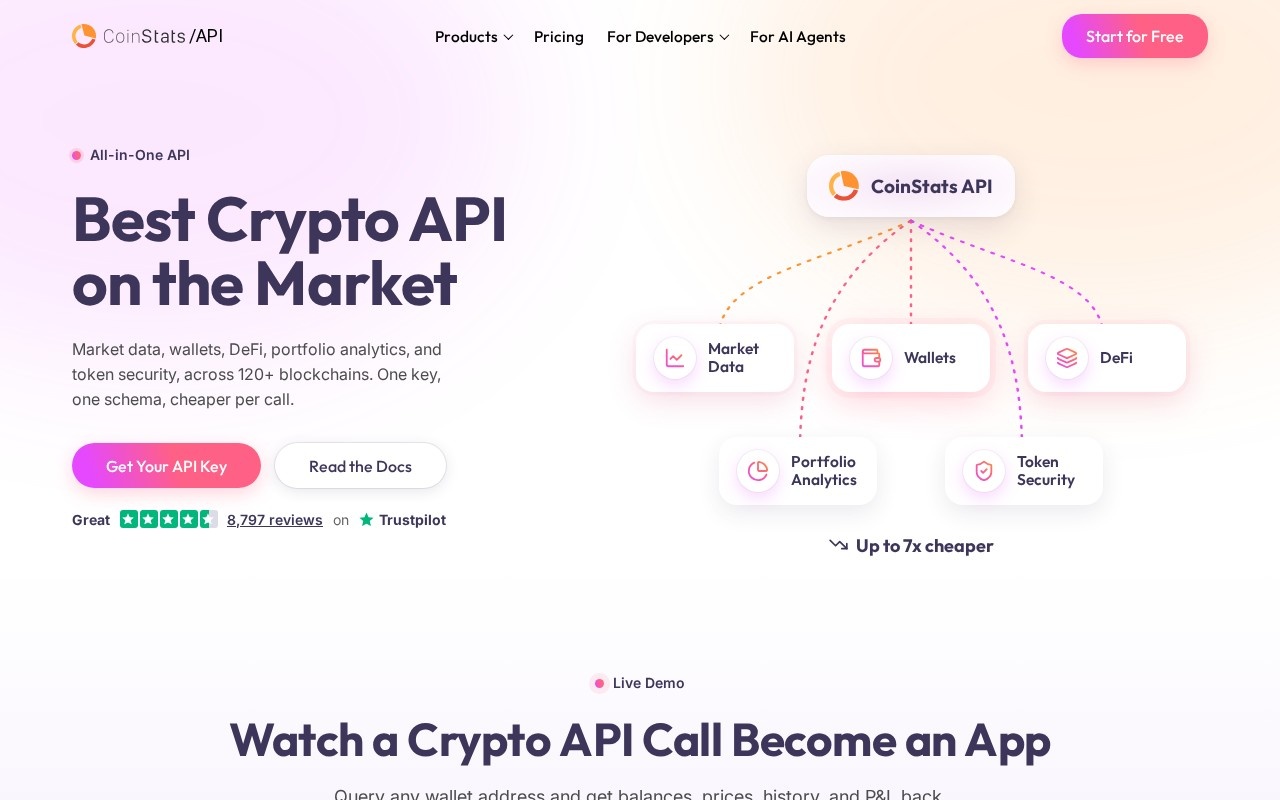
Common builds on top of CoinStats API include portfolio trackers and wallet dashboards. DeFi analytics tools and AI agents that answer questions about a user’s positions. Tax tools that need balances across chains. Wallet apps that run security checks before swaps. Anything that takes a wallet address and needs to return more than just a balance.
Key features
- 100,000+ coins, 200+ exchanges, 120+ blockchains
- Wallet endpoints for Ethereum, EVM chains, Solana, and Bitcoin xpub/ypub/zpub
- Per-wallet DeFi position detection across 10,000+ protocols
- Portfolio analytics: P&L, charts, unified value across exchanges and wallets
- Token security data for risk checks before swaps and listings
- MCP Server with full wallet, DeFi, and portfolio coverage
- REST API with credit-based pricing and a free tier
- All-in-one API: market + wallet + DeFi + portfolio + token security
- Only API resolving DeFi protocols to per-wallet positions
- MCP Server built for AI agent and LLM integration
- Four to six times cheaper than major competitors at the entry tier
- No derivatives or order book depth endpoints
- No deep research reports or token unlock schedules
CoinPaprika API sits between basic market data and lightweight fundamentals. Standard endpoints cover prices, tickers, and exchanges. The interesting layer is on top.
Team rosters, social media activity across X and other platforms, and a calendar of project events. Useful for apps that want to surface sentiment or upcoming catalysts beside the price chart.
Coverage is solid for top assets. It thins quickly past the largest 2,000 coins on the free tier. The paid tiers open up the full universe.
WebSocket support is reserved for enterprise. Real-time trading apps aren’t the fit here. Read-side dashboards and research surfaces work well.
Key features
- 10,000+ coins, 500,000+ DEX tokens, 350+ exchanges
- 10 exchange-specific endpoints with rankings, fiats, and volume stats
- Social and team data for sentiment workflows
- Events and project calendar endpoints
- Free tier with 20,000 calls per month
- Unique team and social data endpoints
- Decent free tier for testing
- Clear REST documentation
- Free plan limited to top 2,000 coins
- Refresh intervals of 1 to 3 minutes
- WebSocket access gated to enterprise
- No wallet, DeFi, or portfolio endpoints
Massive (formerly Polygon.io) treats crypto as one asset class among equities and forex. That matters for fintech teams who don’t want to maintain three vendors. One SDK, one auth pattern, one bill.
The trade-off is crypto coverage. Massive supports a smaller universe of coins and excludes Binance.
For pure crypto products this is restrictive. For multi-asset platforms it isn’t. Brokerages and retail trading apps that already serve equities get a clean win.
Massive’s unified shape becomes the main reason to pick it. The team also publishes solid WebSocket implementations and consistent SDKs across languages.
Key features
- 500+ crypto coins from Coinbase, Kraken, Bitstamp, Bitfinex
- Unified endpoints for stocks, forex, and crypto
- WebSocket streams for tick-level CEX data
- Minute and second-level aggregates
- Free tier for testing, paid plans from $49 per month
- Stocks, forex, and crypto in one integration
- Affordable tick-level CEX data
- Predictable flat pricing
- Only 500+ crypto coins
- No Binance data since 2021
- No DEX, wallet, or DeFi coverage
- Commercial use needs the $999/month plan
Glassnode does one thing very well. Onchain analytics.
The API exposes thousands of metrics derived from raw chain data. Address activity, miner flows, exchange deposits and withdrawals, supply dynamics, profit and loss cohorts.
Proprietary clustering groups addresses into entities. Internal shuffling doesn’t pollute the signal. Strong for research, less so as a general-purpose data layer.
Pricing skews institutional. The lower tiers cover dashboard access with limited metrics. Full API access generally requires upper-tier subscriptions, and bespoke data delivery is enterprise only.
For funds, quant desks, and serious analytics platforms the cost matches the depth. For a consumer crypto app, Glassnode is overkill and you’d want a different layer for prices.
Key features
- 7,500+ onchain metrics across 1,200+ assets
- 900+ endpoints organized into 23 categories
- Entity-adjusted activity metrics
- Spot, futures, and options coverage for 300+ assets
- Delivery via REST API, Snowflake, and an Excel add-in
- Deepest onchain metrics catalog in the industry
- Entity adjustment filters out internal noise
- Point-in-time data for clean backtesting
- API access requires upper-tier plans
- Narrow focus on BTC, ETH, and selected majors for top-tier metrics
- No wallet-level portfolio endpoints for end users
- Pricing trends institutional
Messari is the research layer of crypto data. The API covers prices and basic metrics but the value sits in the metadata.
Asset profiles, governance, fundraising rounds, token unlock schedules, news aggregation, and access to Messari’s own research output. Pair it with a market data API for full coverage.
The Pro and Enterprise tiers also bundle Messari AI features and alerts. That makes the platform useful as an intelligence dashboard, not just a feed.
Free tier exists for testing, but the full surface lives behind enterprise contracts with pricing on request.
Key features
- 40,000+ assets with real-time and historical prices
- Onchain metrics across 200+ DeFi protocols
- Token unlock schedules and fundraising data
- News from 500+ sources
- Bulk API for historical exports in CSV or JSONL
- Strong asset profiles and qualitative metadata
- Token unlocks and fundraising data in one place
- Bulk historical exports for research workflows
- API pricing is opaque outside the free tier
- Full features sit behind enterprise plans
- Not built for live trading or wallet integration
Comparing the Top 5 Crypto Data APIs
| Provider | Coverage | Strength | Wallet & DeFi | MCP Server | Pricing |
|---|---|---|---|---|---|
| CoinStats | 100K+ coins, 200+ exchanges, 120+ chains | All-around fit | Yes, 10K+ protocols | Yes, full surface | Free tier, credit-based |
| CoinPaprika | 10K+ coins, 350+ exchanges | Social & event data | No | No | Free, paid from $99/mo |
| Massive | 500+ crypto coins, equities & forex | Multi-asset platforms | No | No | Free, paid from $49/mo |
| Glassnode | 1,200+ assets, 7.5K+ metrics | Onchain analytics | No | No | Free, API on upper tiers |
| Messari | 40K+ assets, 200+ DeFi protocols | Research & intelligence | Limited | No | Free tier, enterprise custom |

CoinStats API stands out as the only entry covering the full surface. Market data, wallet data, DeFi positions, portfolio analytics, and AI-agent integration through a single MCP Server.
The other four are stronger in narrow lanes. Most need pairing with something else to cover what real products require.
Which API Should You Pick?
Match your use case to the provider that fits. The short version is below.
The longer version is that most products start with one provider and grow into a second. Worry less about picking the perfect fit on day one. Focus on the API that supports your near-term roadmap without getting in the way.

A few teams will end up combining two providers. That’s fine.
Two pairings work cleanest. CoinStats plus Glassnode for product plus research. CoinStats plus Massive for crypto-aware fintech apps.
Frequently Asked Questions About Crypto Data APIs
Quick answers to the questions developers ask most about crypto data APIs.
What is a crypto data API?
Which crypto data API is the best?
What is a crypto data API used for?
Where can I get crypto prices as an API?
Do I need an API key?
How fresh is the data?
Which crypto data API works with AI agents and MCP?
Does Polygon.io support crypto data?
Is there a free crypto data API?
How much does a crypto data API cost?
Per call, per credit, or flat tier: what is the difference?
Which crypto API is best for fintech apps with stocks and forex?
Which crypto data API has the lowest latency?
Can I combine two crypto data APIs?
How do I choose a crypto data API?
Conclusion
The best crypto data API in 2026 depends on what you build. Pure market data has many credible options. Wallet, DeFi, and AI-agent integration narrows the field fast.
For most teams shipping crypto products this year, CoinStats API is the cleanest pick. It delivers the widest functional surface in one integration.
Prices, wallets, DeFi positions, and portfolio analytics arrive through one REST API. The MCP Server adds an AI-agent layer on top.
Specialists still matter. Glassnode owns onchain analytics. Messari owns research and intelligence. Massive owns the multi-asset story. CoinPaprika owns the social and event layer.
The five together cover almost everything a crypto app needs. The trick is starting with the right one. Add the next when the use case demands it.
Tigran is the Head of Digital Marketing at CoinStats, working across crypto and consumer apps. His writing covers first-hand crypto experience and marketing case studies from that work. He has taken the stage at industry-leading conferences like MAU Vegas, Business of Apps Berlin, and App Promotion Summit London.
More from Tigran on the CoinStats blog · LinkedIn · X