
7 Best Solana APIs for Developers in 2026 (Free + Paid)

Written by Tigran Mkrtchyan · Reviewed and fact-checked by Narek Gevorgyan · Published June 1, 2026 · Last updated September 3, 2026 · Pricing and limits verified September 2026
Solana moves fast. Block times sit near 400 milliseconds. Token launches, swaps, and DeFi positions all settle in under a second. Solana now ranks among the most active chains in crypto. This guide ranks the best Solana APIs of 2026, free and paid.
Solana activity expanded fast in 2025. Memecoin trading hit records. Jupiter routed billions in swaps. AI trading agents made Solana their home chain. Mobile wallets grew. New DeFi primitives launched almost weekly.
Developers feel that growth as pressure. More users want more data. Apps need to read tokens, NFTs, DeFi positions, and trade history at speed. Wallet trackers, portfolio dashboards, and AI agents all hit the same wall.
That wall is data. Solana data is harder to work with than Ethereum data. The account model differs from EVM. Each wallet has separate Associated Token Accounts for every SPL token it holds. DeFi protocols store positions in custom account layouts. Transaction parsing requires program-specific knowledge.
Most multichain APIs treat Solana as an afterthought. They miss SPL tokens. They flatten the account model. Some skip DeFi positions entirely. Others return raw RPC responses with no parsing.
Developers and AI agents need APIs built for Solana, not bolted on. The best Solana APIs for developers vary by the job. Some serve raw RPC for low-latency reads. Others deliver structured wallet data. A few specialize in DEX routing or NFT indexing.
Pick the wrong category and you spend weeks gluing endpoints together. Pick the right one and you ship in days.
The AI agent boom adds another layer of demand. LLMs and trading agents need clean, predictable schemas. They also need real-time data without sitting in front of a JSON-RPC firehose. MCP Servers solve this. They expose API data through clean, LLM-friendly schemas.
Below are the top 7 Solana APIs for developers and AI agents in 2026. Some cover wallet and DeFi data. Some power swap routing. Some serve raw RPC at scale. Each leads in a specific lane.
We rank them by builder usefulness, not by marketing reach. The comparison table below lines them up side by side. A picker under it re-ranks all seven by priority.
Looking for a broader picture first? Read our Best Crypto Wallet APIs for Developers in 2026 before narrowing to Solana.
- Best overall: CoinStats Solana API. Wallet, DeFi, portfolio, prices, and history in one key.
- Best real-time streams: Hello Moon. Geyser events with wallet labels attached.
- Best swap routing: Jupiter. Free quotes and swap execution.
- Best token market data: Birdeye. Prices, OHLCV, and DEX trades in seconds.
- Best indexing: Shyft. GraphQL, decoded transactions, generous free RPC.
- Best raw RPC: Syndica. Ankr adds 20+ chains under one vendor.
- MCP support is now baseline. The data underneath decides the winner.
- Most production apps combine two or more providers.
Building agents? See more API alternatives with MCP support.
Building on Ethereum instead? See the best Ethereum APIs.
What Is a Solana API?
A Solana API is a service. It lets your app read or write Solana blockchain data without running a validator.
You skip running a node. You skip parsing raw transactions. You make HTTP calls and get JSON back.
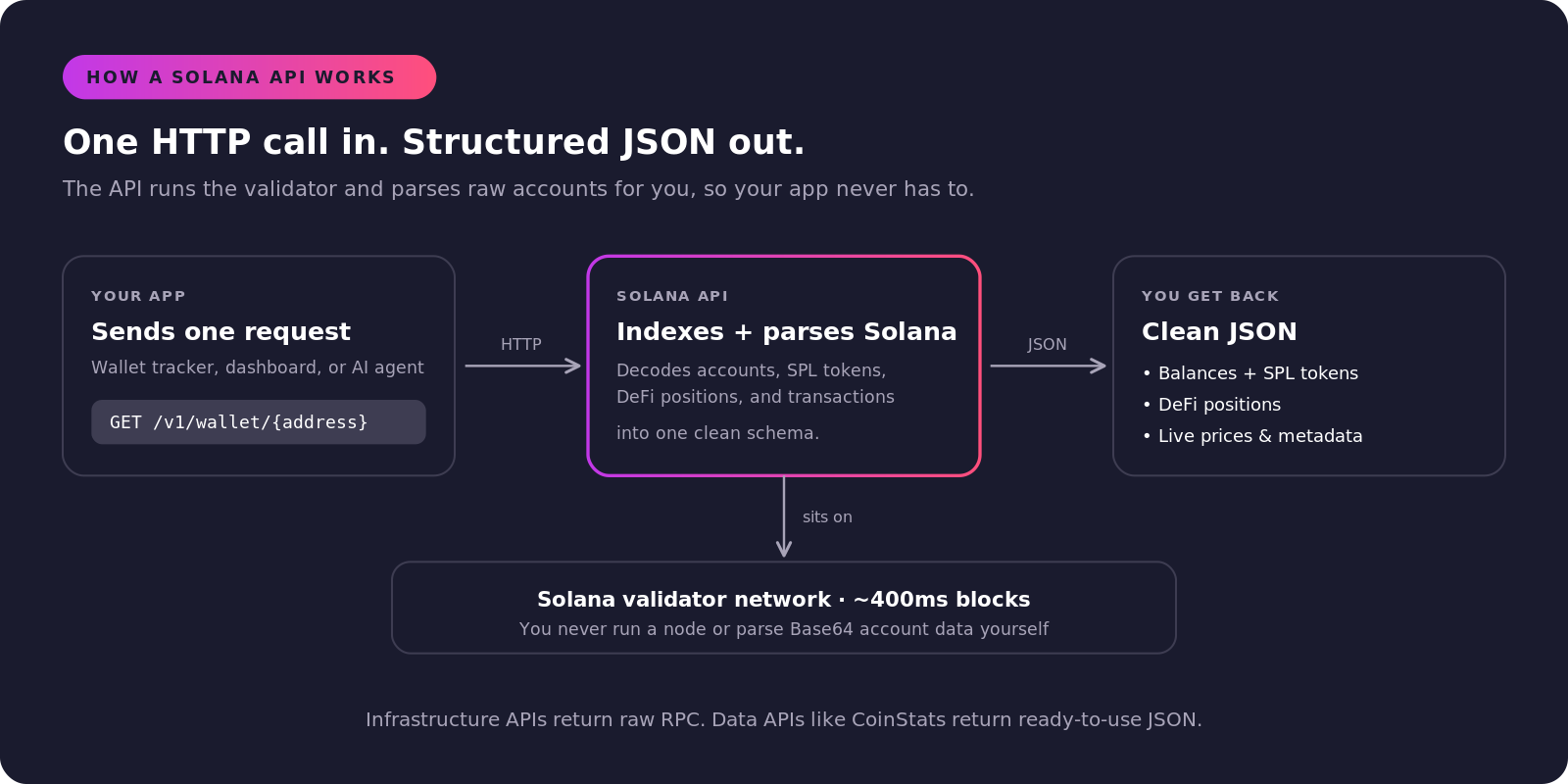
Most Solana APIs fall into two buckets. Some give you raw infrastructure. Others give you structured data.
Infrastructure APIs (like RPC) let you submit transactions and query accounts directly. Our RPC node provider guide covers Solana support across five providers. Data APIs (like CoinStats) deliver pre-processed wallet balances, DeFi positions, prices, and transaction history.
New to this category? Read our beginner’s guide to crypto APIs for the fundamentals before picking a provider.
Building with agents? See crypto API alternatives with MCP support.
How to Choose a Solana API
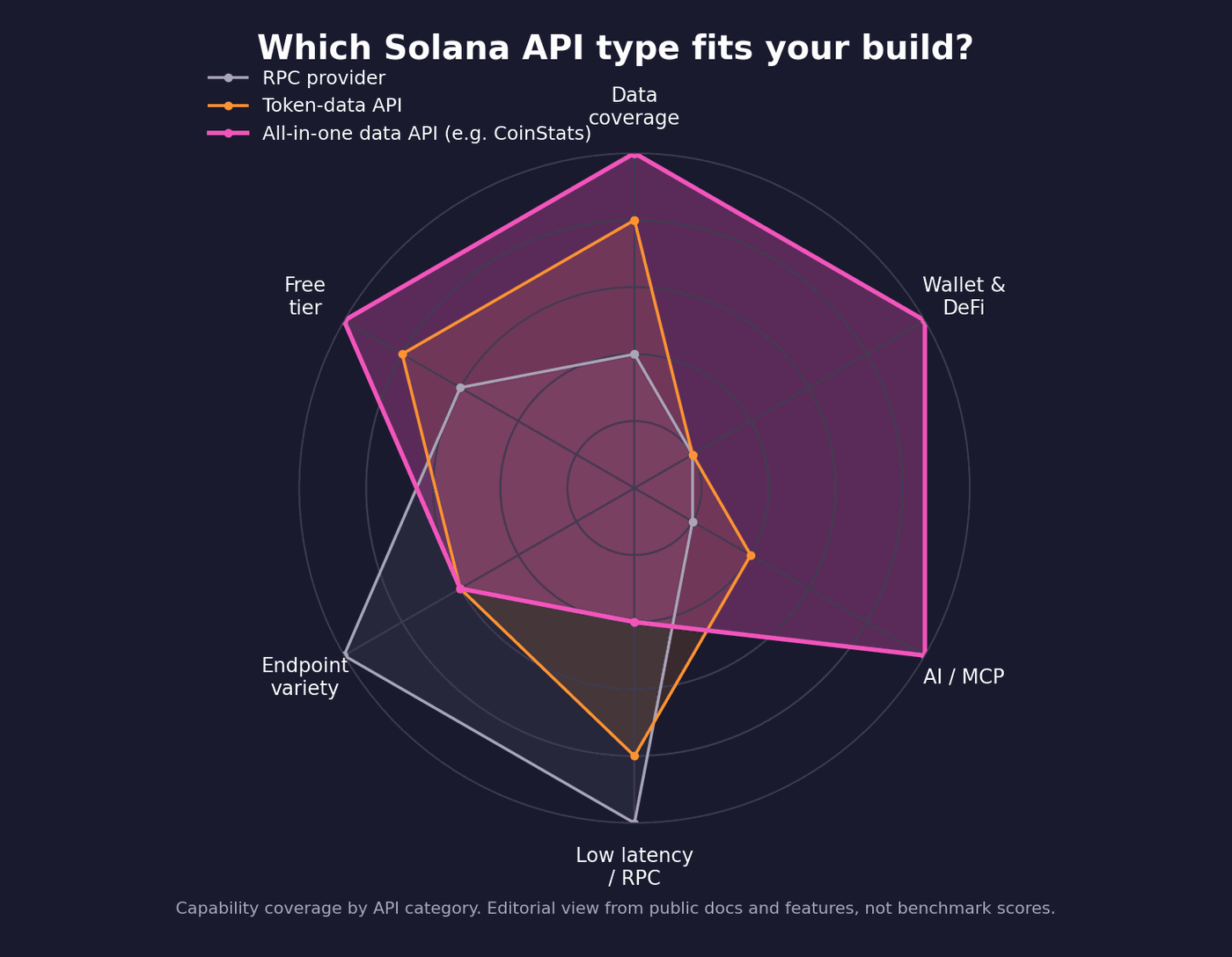
Six factors matter when picking a Solana API. Match them to your build. The same criteria apply when you weigh the best blockchain APIs across other chains.
How We Picked These 7 APIs
We started with more than 20 Solana data and RPC providers. Dead and stale products went first. A missing pricing page or years-old docs cost points.
Every number in this guide comes from an official source. We re-verified pricing, free tiers, and rate limits in August 2026. MCP claims were checked against official docs, not marketing pages.
- Data depth. Balances, DeFi positions, decoded transactions, prices.
- Free tier value. Published limits you can actually prototype on.
- Pricing transparency. Public prices beat quote forms.
- Latency and streams. How fast data moves at production load.
- AI-agent readiness. A working MCP Server and clean schemas.
- Docs and limits. Clear references, honest rate limits.
CoinStats API is our product. The bias box above says so. The rankings still follow the published numbers. Where a rival wins a lane, we say it.
The 7 Best Solana APIs for Developers and AI Agents in 2026
The table lines them up side by side. Provider deep dives follow below.
Swipe the table sideways to compare →
| Provider | Best for | Free tier | Entry price | AI (MCP) |
|---|---|---|---|---|
| CoinStats Solana API | All-in-one wallet, DeFi, and market data | 20,000 credits/mo, 2 req/s | $49/mo | ✅ |
| Hello Moon | Real-time streams and analytics | Free key, limits not published | Not publicly listed | — |
| Jupiter | DEX swap routing | Free, 1 req/s | $25/mo | Docs only |
| Birdeye | Token market data | 30,000 CU/mo, 1 req/s | $39/mo | ✅ |
| Shyft | Indexing and decoded data | Unlimited credits, 1 req/s API | $49/mo legacy tier | — |
| Syndica | High-performance RPC | 10M calls/mo, 100 req/s | $199/mo | — |
| Ankr | Multi-chain RPC | ~1,800 req/min public | PAYG from $10 | — |
Pricing and limits verified August 2026 against official pricing pages.
Tap any priority below. All 7 APIs re-rank instantly.
Pick a priority to re-rank all 7. Verified August 2026.
CoinStats Solana API
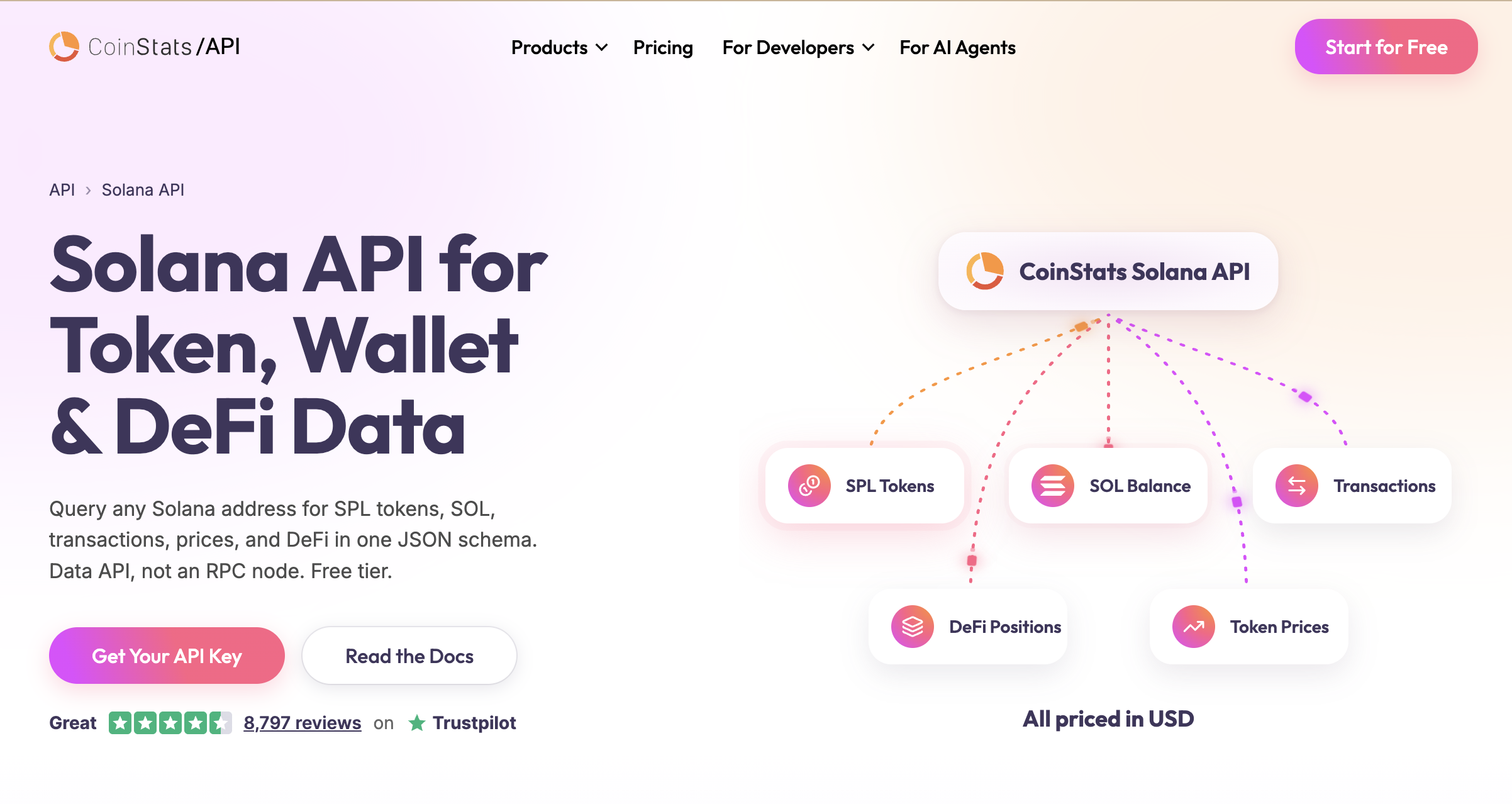
CoinStats Solana API is an all-in-one crypto API. Developers and AI agents get one endpoint for everything onchain. Wallet balances. SPL token positions. DeFi positions across thousands of protocols. Full transaction history. Token prices and metadata.
CoinStats is the only API that resolves DeFi protocols to per-wallet positions on Solana. Most providers stop at token balances. CoinStats keeps going. It detects staking, lending, liquidity, and yield positions across 10,000+ DeFi protocols.
CoinStats Solana API works as a complete solana wallet tracker api. Plug in an address. You get tokens, DeFi exposure, and history in one call. No parsing accounts, no merging endpoints.
The MCP Server matters most for AI agents. LLMs connect via Model Context Protocol. They call wallet, DeFi, and price data through clean schemas. No prompt engineering. No JSON gymnastics.
Pricing is credit-based. The free tier covers prototyping. Paid tiers scale to production. CoinStats serves 1M monthly users and indexes 100,000+ coins across 120+ blockchains.
Key features:
- Wallet balances and SPL token holdings via the solana token positions api
- Per-wallet DeFi positions via the solana wallet defi positions api across 10,000+ protocols
- Full solana wallet transaction history api with pagination and filters
- Real-time token prices, OHLCV, and market metadata
- MCP Server for AI agents and LLM-based apps
- REST endpoints, credit-based pricing, free tier available
- Broadest data coverage on Solana
- Only API exposing per-wallet DeFi positions
- MCP Server for AI agents and LLMs
- Free tier for prototyping
- Single API for wallet, market, and portfolio data
- Not a low-latency RPC provider
- No raw transaction submission
CoinStats Solana API pricing
Free tier: 20,000 credits a month at 2 requests per second. No card required, commercial use included. Starter is $49 a month for 1M credits at 30 requests per second. That is roughly $0.05 per 1,000 credits.
“Developers used to stitch five services together for one wallet view. On Solana that pain doubles. Now one address returns balances, DeFi, and history in one call. The teams winning right now ship fast on clean data.”
Narek Gevorgyan, founder and CEO, CoinStats
Hello Moon
Hello Moon is a Solana-first developer platform. It processes millions of onchain events daily through a Geyser plus Kafka pipeline. The result is real-time streaming that most data APIs can’t match.
The NFT and DeFi analytics are deep. Hello Moon detects wash trading. It labels wallet entities. It surfaces influencer and whale activity across Solana DEXs.
The platform also runs Solana RPC endpoints and a transaction landing service. So you get analytics, streaming, and infra from one provider. Coverage extends to Sei and Movement too.
Free API access is unusually easy. Sign in with a Solana wallet, sign a message, get your key.
Key features:
- Real-time onchain event streaming via Geyser and Kafka
- NFT analytics with wash trading detection
- Wallet entity labels and behavior tracking
- DeFi event monitoring across Solana protocols
- Solana RPC endpoints and transaction landing service
- Webhooks for custom onchain triggers
- Real-time streaming via Geyser
- Strong onchain analytics and entity labeling
- Bundles data, RPC, and tx landing in one platform
- Free API access with wallet signature
- No DeFi position resolution per wallet
- Smaller brand than infra incumbents
Hello Moon pricing
API keys are free. Sign in with a Solana wallet and sign a message. Rate limits are not published. A public pricing page no longer exists. Budget for a sales conversation at scale.
Jupiter
Jupiter routes swaps across most Solana DEXs. It finds the best price across pools and AMMs. Then it executes the trade in one transaction.
Jupiter API serves the action layer, not the data layer. You don’t read state. You execute trades. That’s the lane.
Two APIs do most of the work. Quote API returns the best price for a token pair. Swap API builds and submits the transaction. Limit orders and DCA APIs round out the suite.
AI trading agents lean on Jupiter heavily. Routing across 30+ Solana DEXs in one call beats integrating each venue directly.
Key features:
- Aggregated swap routing across 30+ Solana DEXs
- Quote API for live token pair pricing
- Swap API for one-call execution
- Limit order and DCA APIs
- Slippage controls and route customization
- Open-source SDKs in multiple languages
- Best swap execution on Solana
- Free to use with no platform fees
- Wide DEX coverage in one call
- Well-maintained open-source SDKs
- Action API only, no wallet or portfolio reads
- No DeFi position or NFT data
Jupiter pricing
Free tier allows 1 request per second with no monthly cap. Developer is $25 a month for 25M credits at 10 requests per second. Overage runs $1 per 1M credits.
Birdeye
Birdeye built its reputation on Solana token data. Real-time prices. OHLCV candles. DEX trade flow. Memecoin trackers and trading dashboards lean on it heavily.
The solana token api coverage runs deep. Token metadata, supply, holder counts, and security flags all sit behind one REST endpoint. New token listings show up fast.
Birdeye now supports multiple chains. Solana coverage remains the deepest. EVM chains are growing but newer.
Pricing tiers scale from free to enterprise. The free tier supports light prototyping. Production apps usually move to paid plans.
Key features:
- Official MCP Server for AI agents at dev-mcp.birdeye.so
- Real-time token prices and OHLCV across Solana DEXs
- Token metadata, supply, and holder counts
- DEX trade flow and pool activity
- Trader analytics and PnL tracking
- Security signals on new token listings
- Multi-chain support with Solana as primary focus
- Deep Solana token and DEX data
- Fast new-listing detection
- Well-known in the trader community
- Free tier available
- No wallet portfolio or DeFi position data
- Rate limits tighten quickly on free tier
Birdeye pricing
Standard is free with 30,000 compute units a month at 1 request per second. Lite is $39 a month at 15 requests per second. Published CU allowances differ between the pricing page and docs. Confirm your tier limits before committing.
Shyft
Shyft is a Solana developer infrastructure platform. The flagship product is a GraphQL API over indexed Solana data. You query accounts, programs, NFTs, and transactions through flexible schemas.
NFT support runs deep. Metadata, royalties, collections, mint history, and transfers all sit behind a single endpoint. NFT-heavy dApps lean on Shyft because the alternative is parsing Metaplex accounts by hand.
Transaction parsing is the other strong lane. A raw solana transaction history api response is dense. Shyft decodes program calls into structured JSON.
RPC endpoints, webhooks, and Mainnet plus Devnet support round out the platform. Free and paid tiers available.
Key features:
- GraphQL API over indexed Solana data
- NFT metadata, collections, and transfer history
- Transaction parsing with decoded program calls
- Account and program state queries
- RPC endpoints on Mainnet and Devnet
- Webhooks for onchain events
- Strong NFT and indexing depth
- GraphQL flexibility for custom queries
- Solana-native focus
- Decoded transaction parsing saves work
- No portfolio or DeFi position resolution
- Narrower audience outside NFT and indexing builds
Shyft pricing
The free plan has unlimited credits at 10 RPC requests per second. API calls cap at 1 request per second. A legacy Hack tier costs $49 a month. Current plans with gRPC start at $199 a month.
Syndica
Syndica is a Solana-only RPC provider. The focus is performance. Bare-metal nodes, geographic distribution, and tuned indexing keep latency low.
ChainStream is the differentiator. It delivers real-time Solana data over WebSocket and gRPC. MEV searchers and trading firms use it for slot-by-slot updates.
JSON-RPC, gRPC, and Geyser subscriptions all run on the same infra. Dedicated nodes are available for teams that need isolated capacity.
This is pure infrastructure. No portfolio data. No DeFi positions. Just fast reads and reliable writes to Solana.
Key features:
- High-performance Solana JSON-RPC and gRPC
- ChainStream real-time WebSocket data
- Geyser subscriptions for slot-level events
- Dedicated node options
- Mainnet and Devnet support
- Tiered pricing with free entry tier
- Low latency on heavy workloads
- Real-time streaming via ChainStream
- Dedicated node options for scale
- Solana-only focus aids performance tuning
- RPC only, no wallet or DeFi data layer
- Pricing climbs fast at high request volume
Syndica pricing
The free tier is 10M RPC calls a month at 100 requests per second. Scale is $199 a month for 200M requests. Extra transfer bills at $0.10 per GB.
Ankr
Ankr runs a decentralized RPC network across 20+ chains. Solana sits alongside Ethereum, Polygon, BSC, and the rest. Teams operating on many chains get one vendor relationship.
The Solana RPC quality is solid. Latency is competitive on the premium tier. The free tier handles light prototyping.
Ankr also runs a Solana validator and offers staking APIs. So liquid staking integrations are first-class.
Ankr is the breadth pick on this list. Solana-specific depth is not the angle. Multi-chain coverage is.
Key features:
- Solana RPC with JSON-RPC and WebSocket
- RPC across 20+ blockchain networks
- Premium and pay-as-you-go tiers
- Decentralized node distribution
- Liquid staking APIs
- Free tier for prototyping
- Single vendor across many chains
- Decentralized node network
- Established brand and reliability
- Liquid staking APIs included
- Solana-specific depth is lower than native providers
- No wallet portfolio or DeFi position layer
Ankr pricing
Public endpoints allow about 1,800 requests a minute at no cost. Freemium adds 200M API credits a month. Paid usage is pay as you go from a $10 deposit. Credits price at $0.10 per 1M.
Top Picks by Category
Five lanes, five winners. Category labels match the jobs builders hire these APIs for.
Wallet, DeFi, portfolio, prices, and history behind one key.
Pick it when one integration must cover the whole data layer.
Geyser plus Kafka event streams with wallet labels.
Pick it for live dashboards and event-driven agents.
Aggregated routing across Solana DEXs, free at 1 req/s.
Pick it when your app trades, not just reads.
Prices, OHLCV, and DEX trades with fast new-token pickup.
Pick it for screeners and memecoin tooling.
10M free calls a month at up to 100 req/s.
Pick it when latency and raw reads dominate.
Solana plus 20+ chains, pay as you go from $10.
Pick it when one vendor must cover many chains.
Which Solana API Should You Pick?
Match your build to a primary use case. Then pair providers if one API can’t cover everything.
Solana wallet tracker app
AI trading agent
Real-time analytics
Swap router or trading bot
Memecoin or token data app
NFT marketplace or mint
Low-latency RPC at scale
Multi-chain RPC needs
What Solana Developers Are Reading
Roundups and build logs from the community. Useful second opinions before you commit.
Representative of recurring r/solana threads on choosing a Solana data API.
Conclusion
Solana developer needs are diverse. No single API covers every job well. The right pick depends on what you’re building.
CoinStats Solana API covers the broadest surface area. Wallet balances, SPL token positions, and DeFi positions across 10,000+ protocols. Transaction history, prices, and an MCP Server for AI agents. One API, one auth, one schema.
Specialists win in their lanes. Jupiter for swaps. Birdeye for token data. Shyft for NFTs and indexing. Hello Moon for real-time streams. Syndica and Ankr for raw RPC.
Most production builds mix two or three providers. A wallet app might pair CoinStats for portfolio data with Syndica for low-latency reads. An AI trading agent might combine CoinStats MCP with Jupiter swaps.
Building cross-chain? Read our Best Multichain Crypto Portfolio APIs guide to extend beyond Solana.
Frequently Asked Questions about Solana APIs
Quick answers to common questions about Solana APIs, pricing, and AI agent access.
What is a Solana API?
A Solana API lets your app read Solana data over HTTP. It replaces running and parsing your own validator. Data APIs return parsed balances, tokens, DeFi positions, and prices. RPC providers expose the raw chain interface.
Does Solana have an official API?
Solana ships the JSON-RPC interface that validators expose. Public endpoints exist but are rate-limited and not for production. Most teams use a commercial RPC or data provider on top.
What’s the difference between an RPC provider and a data API?
RPC providers expose Solana’s raw JSON-RPC interface. They return unprocessed account state and transaction data.
Data APIs sit several layers above. They return structured tokens, normalized DEX trades, and pre-enriched balances.
Most production stacks use both. An RPC provider handles execution and raw chain state. A data API handles portfolio, market, and analytics layers.
How much does a Solana API cost?
Free tiers cover prototyping on every provider here. Entry paid plans run $25 to $199 a month. Jupiter starts at $25, Birdeye at $39, CoinStats at $49. Raw RPC at scale costs more. Syndica’s paid plan starts at $199.
Is there a free Solana API?
Yes. Every provider in this guide has a free tier or free access. CoinStats includes 20,000 credits a month with commercial use. Syndica includes 10M RPC calls a month. Jupiter is free at 1 request per second.
Are free tiers enough to launch a production app?
For prototyping and low-volume apps, often yes. Production trading systems, screeners, and active portfolio products usually outgrow free tiers fast.
Paid plans add throughput, granularity, and SLA guarantees. Production workloads need these. Run the planned query pattern through the free tier for a few days first. That tells you whether the upgrade is needed.
What is the best Solana API in 2026?
For most builds, CoinStats Solana API. It bundles wallet, DeFi, portfolio, prices, and history behind one key. Specialists win narrower jobs. Jupiter for swaps, Birdeye for token data, Syndica for raw RPC.
Which Solana API is best for AI agents in 2026?
CoinStats Solana API is the strongest fit for agent builds. Its MCP Server exposes live wallet, DeFi, portfolio, and price tools. Claude Code, Cursor, and VS Code connect out of the box.
Birdeye also ships an official MCP Server for token market data. Jupiter’s MCP serves docs and schemas, not live data. The other providers here need custom tool wrappers.
MCP support is now baseline. Compare the data behind the tools.
What is the best Solana RPC?
Syndica leads on published free volume and performance tooling. Ankr covers Solana alongside 20+ chains on pay-as-you-go pricing. Shyft bundles RPC with indexing. Pick by latency needs and region.
Can I use the same API for Solana and other chains?
Yes. CoinStats Solana API extends across 120+ blockchains through one schema. The same code reads Solana, Ethereum, EVM chains, and Bitcoin.
Ankr covers Solana RPC alongside 20+ networks. Birdeye supports Solana plus a few other chains, with the deepest data on Solana. Jupiter, Shyft, Hello Moon, and Syndica are Solana-native.
Do Solana APIs support transaction submission?
Only RPC providers do directly. Syndica, Ankr, Hello Moon, and Shyft support transaction submission. All four run Solana RPC endpoints.
Data-focused APIs are read-only. CoinStats Solana API and Birdeye return onchain data but do not broadcast transactions. Jupiter supports swap execution flows. The underlying transaction still goes through an RPC provider.
How do I read DeFi positions on a Solana wallet?
Most APIs return only token balances. Only CoinStats Solana API resolves per-wallet DeFi positions on Solana.
It detects staking, lending, liquidity, and yield positions across 10,000+ protocols. The response includes USD value and protocol metadata.
Other providers leave that work to you. You query each protocol’s accounts and parse them by hand.
How fast do new tokens appear in Solana APIs?
Cadence varies by provider. Solana-native aggregators like Birdeye pick up new tokens within seconds of pool creation. CoinStats Solana API adds new tokens through both onchain detection and exchange feeds.
Hello Moon streams new token events in real time via Geyser. RPC providers like Syndica and Ankr surface raw state immediately. Parsing and enriching it is your job.
Tigran is the Head of Digital Marketing at CoinStats, working across crypto and consumer apps. His writing covers first-hand crypto experience and marketing case studies from that work. He has taken the stage at industry-leading conferences like MAU Vegas, Business of Apps Berlin, and App Promotion Summit London.
More from Tigran on the CoinStats blog · LinkedIn · X